Advertisement
)


At a Glance
- Concept: A financial bet between two parties on whether a specific borrower will fail to repay their loans.
- Why it matters: It secures trillions of dollars in global debt, but because it operates outside traditional insurance regulations, unchecked CDS exposure caused the 2008 financial crisis.
- Who uses it: Hedge funds, institutional asset managers, and massive investment banks seeking to hedge risk or speculate on economic failure.
- Biggest takeaway: You do not have to actually own the underlying bond to buy a credit default swap on it, allowing Wall Street to place massive, unbacked bets on the collapse of financial assets.
In Simple Words
Imagine you lend $100,000 to a friend to start a business. You trust your friend, but you are worried the business might fail and you will lose your money.
To protect yourself, you go to a wealthy investor. You offer to pay them $2,000 every year. In exchange, the investor promises that if your friend ever goes bankrupt and cannot repay the loan, the investor will step in and give you your $100,000 back.
You have just created a Credit Default Swap. You “swapped” the risk of default away from yourself and onto the wealthy investor. You pay a steady premium, and they take on the risk.
In the global economy, banks use this exact mechanism to protect themselves when they lend billions of dollars to corporations or entire countries. However, unlike regular insurance, you can buy this protection even if you never lent the money in the first place. This is equivalent to buying fire insurance on your neighbor’s house; if it burns down, you get rich.
Why This Matters
The global economy runs on debt. Corporations issue bonds to build factories, and governments issue bonds to build highways. Without a mechanism to manage the risk of these bonds failing, banks would be too terrified to lend money, and economic growth would halt.
Credit default swaps solve this by making risk tradable. The CDS market is massive. As of 2026, the overall global over-the-counter (OTC) derivatives market handles trillions of dollars in exposure, with initial margin requirements crossing $1.6 trillion.
However, because a CDS is technically a private “swap” contract rather than a legal “insurance” policy, it bypassed heavy government insurance regulations for decades. Traditional insurance companies are legally required to hold massive amounts of cash in reserve to ensure they can pay out claims. Before 2008, the Wall Street banks selling CDS protection did not hold enough cash in reserve.
When the underlying assets (subprime mortgages) began to fail, the sellers of CDS protection (like AIG) suddenly owed billions of dollars they did not have. The failure of these invisible contracts triggered a systemic chain reaction that nearly destroyed the global banking system. Today, tracking the CDS market is the most accurate way macroeconomists monitor exactly which companies and countries Wall Street believes are about to default.
HOW CREDIT DEFAULT SWAPS WORK
A credit default swap is not a physical asset. It is a highly complex legal agreement engineered to transfer risk synthetically.
Here is the exact mechanism of a standard CDS transaction.
1. The Fundamental Problem
A bank holds $100 million in corporate bonds from an airline. The bank earns a 5% interest rate, but if the airline goes bankrupt, the bank loses the entire $100 million principal. The bank needs a way to guarantee its principal without selling the bond.
2. The ISDA Master Agreement
The bank approaches a hedge fund willing to take on the risk. Before trading, both parties sign an ISDA Master Agreement. Created by the International Swaps and Derivatives Association (ISDA), this standardized legal contract dictates exactly how disputes will be settled and how collateral must be posted. It is the legal foundation of the entire global derivatives market.
3. The Core Mechanism: Premiums and Protection
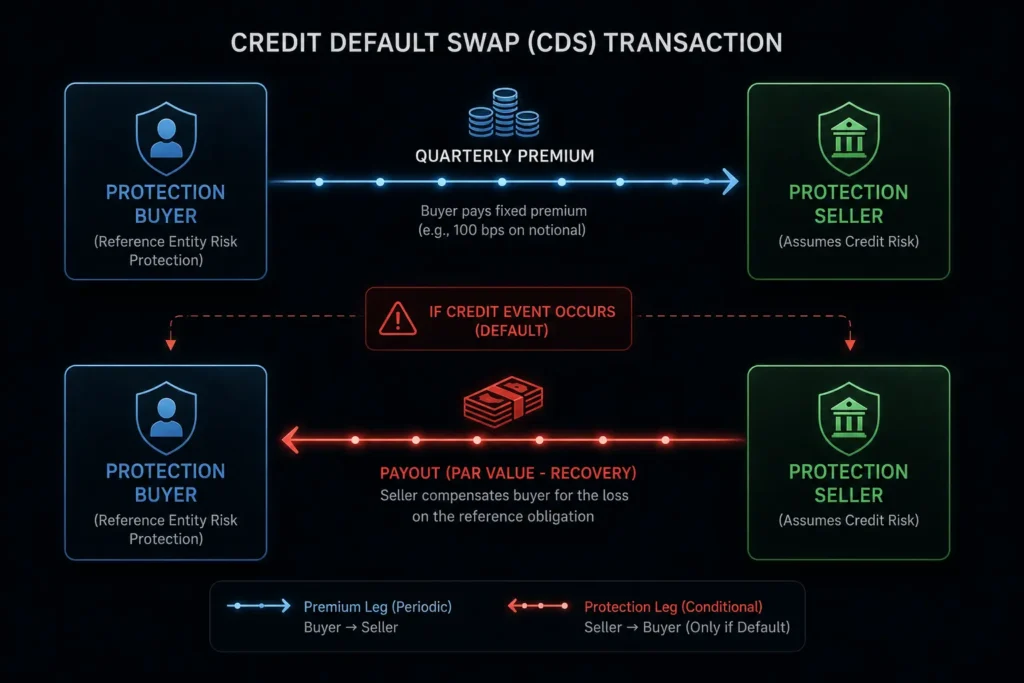
The bank (the “Protection Buyer”) agrees to pay the hedge fund (the “Protection Seller”) a quarterly premium—for example, 2% of the $100 million principal ($2 million a year). In exchange, the hedge fund promises to cover the losses if the airline suffers a “Credit Event.” As long as the airline survives, the hedge fund simply collects the $2 million every year as pure profit.
4. The Credit Event
A payout is only triggered if a legally defined Credit Event occurs. This is not simply a late payment. The ISDA Determinations Committee—a group of major global banks—must vote to officially declare an event. Standard events include formal bankruptcy, a failure to pay interest, or a forced debt restructuring where the borrower forces lenders to accept a lower payback amount.
5. Settlement (Physical vs. Cash)
If a Credit Event is declared, the contract settles.
- Physical Settlement: The Protection Buyer hands the worthless airline bonds over to the Protection Seller, and the Seller hands over the full $100 million in cash.
- Cash Settlement (Modern Standard): Because many buyers do not actually own the underlying bonds (Naked CDS), an auction determines the post-default value of the bond. If the market decides the bankrupt bond is now worth 20 cents on the dollar, the Protection Seller simply pays the Protection Buyer the 80-cent difference in cash.
Real-World Applications
Credit default swaps are actively traded every day to manage exposure to global volatility.
Sovereign Debt Protection: When global investors purchase government bonds from emerging market nations with volatile economies, they simultaneously purchase Sovereign CDS contracts. If the nation suffers an economic collapse and defaults on its national debt, the investors are compensated by the hedge funds that sold the protection.
Synthetic CDOs: Wall Street investment banks bundle thousands of CDS contracts together into a single mega-product called a Synthetic Collateralized Debt Obligation. Instead of bundling actual bonds, they bundle the bets on those bonds. This allows investors to gain exposure to massive sectors of the corporate debt market without the bank having to physically source and purchase the underlying bonds.
Naked Speculation: A hedge fund analyst believes a major commercial real estate developer is secretly insolvent and will collapse within a year. The hedge fund buys millions of dollars in CDS protection against the developer, even though the fund does not own any of the developer’s actual real estate debt. When the developer goes bankrupt, the hedge fund cashes out the massive CDS payout.
Economic & Strategic Impact
The pricing of a credit default swap is the purest indicator of global financial stress.
The cost of a CDS is measured in “basis points.” If the cost to insure a company’s debt spikes from 50 basis points to 500 basis points, the broader financial market instantly knows that institutional insiders believe a bankruptcy is imminent. This pricing data frequently acts as an early warning system, predicting corporate failures months before stock prices collapse.
For global regulators, the CDS market represents the ultimate contagion risk. Because OTC derivatives are interconnected, the failure of one massive Protection Seller can bankrupt dozens of innocent Protection Buyers.
To mitigate this, post-2008 financial regulations (like the Dodd-Frank Act in the US and EMIR in the EU) forced a massive structural change. Today, most standardized CDS contracts must be cleared through Central Counterparties (CCPs). The CCP acts as a neutral middleman, sitting between the buyer and the seller, requiring both to post daily cash collateral. This ensures that if the seller goes bankrupt, the clearinghouse can still pay the buyer, stopping the domino effect of systemic collapse.
Advantages
Absolute Risk Mitigation
It allows commercial banks to aggressively lend capital to corporations to build infrastructure, knowing their massive principal loans are perfectly insured against catastrophic bankruptcy.
Capital Relief
Banks are legally required by central regulators to hold cash in reserve against risky loans. By purchasing a CDS to eliminate the risk of the loan, the bank is legally allowed to free up that trapped capital and lend it to other businesses, stimulating the economy.
Deep Market Liquidity
Because investors can trade CDS contracts without having to physically locate and purchase illiquid corporate bonds, the derivative market remains highly fluid and responsive to breaking economic news.
Limitations
Extreme Counterparty Risk
The insurance is only as reliable as the entity selling it. If you buy billions in protection from a bank that goes bankrupt during a systemic crisis, your CDS contract instantly becomes a worthless piece of paper.
Regulatory Complexity
Navigating the legal definitions of a “default” is incredibly complex. If a corporation successfully negotiates a minor debt extension with its creditors, the ISDA Determinations Committee may vote that it does not legally qualify as a “Restructuring Credit Event,” leaving CDS buyers with no payout.
Procyclical Panic
When the CDS price for a company spikes, it signals distress. Other banks see this spike and refuse to lend the company new money. The lack of new money forces the company into actual bankruptcy. The derivative market can create a self-fulfilling prophecy of corporate destruction.
Common Misconceptions
Misconception: A CDS is legally a standard insurance policy.
Reality: A CDS is a derivative swap contract. Traditional insurance requires you to have an “insurable interest” (you must own the car to buy car insurance). A CDS allows you to buy protection on debt you have absolutely no connection to.
Misconception: The government decides when a credit event occurs.
Reality: The government has no say in CDS payouts. The decision is made entirely by the ISDA Determinations Committee, which consists of 15 major global banks and investment firms voting on whether a legal trigger was met.
Misconception: All CDS contracts exploded and vanished after the 2008 crisis.
Reality: The market restructured, but it did not vanish. It transitioned to central clearinghouses and mandatory margin collateral. As of 2026, the global CDS market remains highly active, expanding due to rising global corporate debt levels.
What Most People Miss
The danger of a “Naked CDS” completely alters the scale of financial disasters.
In a normal market, if a corporation issues $1 billion in bonds and goes bankrupt, the absolute maximum loss to the financial system is $1 billion.
However, because anyone can buy and sell a Naked CDS on that specific corporation, Wall Street can easily write $20 billion worth of CDS contracts based on that $1 billion of physical debt.
When the company defaults, the underlying $1 billion bond failure triggers $20 billion in mandatory payouts across the derivative ecosystem. The financial engineering mathematically magnifies a localized corporate failure into a massive systemic shockwave.
Comparison Table
| Feature | Corporate Bond | Credit Default Swap (Covered) | Naked Credit Default Swap |
| Purpose | To lend money to a company and earn interest. | To insure an owned bond against the risk of default. | To speculate that a company will go bankrupt. |
| Do You Own the Debt? | Yes. | Yes. | No. |
| Cash Flow | You receive interest payments. | You pay a quarterly premium. | You pay a quarterly premium. |
| If Company Survives | You get your principal back. | You lose the premiums paid. | You lose the premiums paid. |
| If Company Defaults | You lose your principal investment. | You receive a massive cash payout covering your lost bond. | You receive a massive cash payout (pure profit). |
| Systemic Risk Level | Low (losses are contained to the bond size). | Moderate. | Extremely High (artificial magnification of losses). |
Case Study
Situation: In the mid-2000s, global banks issued billions of dollars in Mortgage-Backed Securities (MBS) filled with high-risk subprime housing loans.
Challenge: Investors recognized that the housing market was unstable. They wanted to short the market (bet against it), but directly shorting physical houses or highly illiquid mortgage bonds was logistically difficult.
Solution: Investors turned to Credit Default Swaps. Hedge fund managers, most famously Michael Burry and John Paulson, went to Wall Street banks and purchased billions of dollars in Naked CDS contracts. They paid a relatively small premium to insure subprime mortgage bonds they did not even own. A massive insurance company, AIG, confidently sold them this protection, assuming the housing market would never crash simultaneously across the country.
Outcome: In 2008, the underlying subprime mortgages failed. AIG was contractually obligated to pay out tens of billions of dollars on the CDS contracts they had sold. Because AIG did not have the cash in reserve, the U.S. government was forced to bail out AIG with $180 billion of taxpayer money to prevent the buyers of those CDS contracts from collapsing in a domino effect.
Lessons Learned: Selling uncollateralized derivative insurance on correlated assets is economically lethal. The crisis proved that OTC derivative markets required mandatory, central clearing and strict daily cash margin requirements to survive systemic shocks.
Future Outlook
Next 12–24 Months
Corporate debt defaults are expected to rise as legacy debt matures and requires refinancing at higher global interest rates. The ISDA Determinations Committee will face increasingly complex legal battles over “Restructuring Credit Events,” particularly as distressed companies use aggressive lock-up agreements and consent solicitations to avoid formal bankruptcy declarations.
Next 3–5 Years
The total size of the CDS market is projected to expand significantly, tracking toward an estimated $14 to $15 billion in market capitalization by the early 2030s. The vast majority of standard Single-Name and Index CDS trading will migrate entirely to electronic execution platforms and central clearinghouses, drastically reducing the opacity of bilateral (bank-to-bank) trades.
Next 10 Years
Blockchain technology and smart contracts will begin to replace the legacy ISDA Master Agreement architecture. Future Credit Default Swaps will be coded as decentralized digital contracts. An “Oracle” network will monitor a corporation’s public debt. If a missed payment is detected, the smart contract will execute automatically, instantly transferring digital cash collateral to the protection buyer without requiring a physical committee vote.
Most Likely Scenario
The CDS market will remain an irreplaceable tool for global capital allocation. While heavy regulations have successfully mitigated the reckless, uncollateralized speculation that caused 2008, the sheer volume of synthetic debt means that a synchronized, multi-national sovereign debt crisis would still severely stress the liquidity limits of modern central clearinghouses.
Key Takeaways
- A Credit Default Swap allows an investor to pay a premium to transfer the risk of a debt default to a third party.
- Unlike traditional insurance, investors can buy “Naked” CDS contracts to bet against companies without actually owning their underlying debt.
- Payouts are triggered by highly specific legal “Credit Events,” requiring a formal vote by the ISDA Determinations Committee.
- The 2008 financial crisis was triggered when sellers of CDS protection failed to hold enough capital to cover massive, correlated subprime mortgage defaults.
- Modern regulations force most CDS trades through central clearinghouses (CCPs) that require daily cash margin to prevent counterparty contagion.
- A spike in the cost of a company’s CDS premium is a highly accurate, real-time warning signal of impending corporate bankruptcy.
- The market relies entirely on the standardized legal architecture of the ISDA Master Agreement.
Glossary
Central Counterparty (CCP): A financial clearinghouse that sits between a buyer and a seller, guaranteeing the trade and requiring both parties to post cash collateral to prevent default contagion.
Credit Event: A legally defined trigger, such as bankruptcy or failure to pay, that obligates the seller of a CDS to pay the buyer.
ISDA (International Swaps and Derivatives Association): The global trade organization that creates the standardized legal definitions and Master Agreements governing the derivatives market.
ISDA Determinations Committee: A panel of major financial institutions that officially votes to determine whether a specific corporate action legally constitutes a Credit Event.
Naked CDS: Purchasing credit protection on a bond or asset that you do not actually own, used purely for speculation rather than hedging.
Over-The-Counter (OTC): Financial trades executed directly between two parties without the supervision of a public stock exchange.
Par Value: The full face value of a bond that is owed to the lender upon maturity.
Synthetic CDO: A highly complex financial product created by bundling together multiple Credit Default Swaps, allowing investors to gain exposure to the risk of bonds without physically holding them.
Frequently Asked Questions
Does a CDS guarantee I won’t lose money?
It only guarantees you won’t lose money to the underlying bond defaulting. However, if the hedge fund that sold you the CDS goes bankrupt, you lose your protection. This is known as counterparty risk.
Why is a Naked CDS legal?
Financial markets allow Naked CDS trading because it provides massive liquidity. Allowing speculators to trade risk makes it much easier and cheaper for the people who actually own the bonds to find someone willing to sell them insurance.
How is a Credit Event officially decided?
It is not automatic. An investor must submit a request to the ISDA Determinations Committee. The committee evaluates the public evidence and votes on whether the corporation’s actions met the exact legal definition of a default or restructuring.
What does it mean to “Cash Settle” a CDS?
In the past, the buyer had to physically hand the defaulted bond to the seller to get paid. Because Naked CDS buyers don’t own the bond, they can’t do this. Cash settlement solves this by running an auction to determine the bond’s remaining value, and the seller simply pays the buyer the difference in cash.
Can you buy a CDS on a country?
Yes. Sovereign CDS contracts are heavily traded. If a country defaults on its government bonds, the protection sellers must pay out the buyers.
Why did AIG collapse in 2008?
AIG Financial Products sold billions of dollars in CDS protection on subprime mortgage bonds. They treated it like regular insurance, assuming a total nationwide housing crash was statistically impossible. When it happened, they did not have the cash required by the ISDA contracts to cover the losses.
What is an Index CDS?
Instead of buying protection on a single company (Single-Name CDS), you can buy an Index CDS. This is a single contract that provides protection against a large basket of companies all at once, widely used to hedge against a broad economic recession.
Do everyday retail investors buy Credit Default Swaps?
No. The OTC derivatives market is strictly limited to institutional investors, hedge funds, and major commercial banks due to the massive capital requirements and extreme mathematical complexity.
Sources
- ISDA: Key Trends in the Size and Composition of OTC Derivatives Markets
- Precedence Research: Credit Default Swap (CDS) Market Size to Hit USD 14.51 Billion by 2035
- Fortune Business Insights: Credit Default Swap Market Size and Forecast
- Jones Day Insights: Important Guidance on Restructuring Credit Event Triggers Under ISDA Definitions