Advertisement
)

AT A GLANCE
- Concept: The Order Book Problem: Public exchanges broadcast every pending trade, allowing fast algorithms to see large orders before they execute.
- Concept: Informational Leakage: When a mutual fund attempts to sell a million shares on a public exchange, the market panics and the price collapses immediately.
- Concept: Midpoint Matching: Dark pools quietly pair buyers and sellers exactly at the mathematical midpoint of the current public bid-ask spread.
- Concept: Pre-Trade Opacity: The network completely hides the size and price of the order from the public until after the transaction has fully cleared.
HOW IT WORKS
When a retail investor buys ten shares of a company, they route the order to a lit exchange like the New York Stock Exchange or NASDAQ. Lit exchanges operate on a public limit order book. Every single bid (buy price) and ask (sell price) is broadcast globally in real-time. This transparency guarantees fair pricing for small trades, but it mathematically destroys large ones.
If a state pension fund needs to liquidate three million shares of a tech stock, they cannot simply dump the order onto the public book. High-Frequency Trading (HFT) algorithms constantly scan the lit exchanges for massive imbalances. The millisecond the HFT algorithm detects the pension fund’s massive sell order, the algorithm instantly cancels its own buy orders and aggressively shorts the stock. The pension fund suffers severe “market impact” or “informational leakage”—their own massive size artificially drives the price down against them before they can even finish selling.
Dark pool crossing networks were engineered to solve this exact mechanical vulnerability. Operated by major broker-dealers like Goldman Sachs (Sigma X) or independent consortiums, a dark pool is simply a private server rack running a matching engine. It operates with strict pre-trade opacity. When the pension fund submits its order to sell three million shares, the dark pool does not broadcast the order to the public. The order sits silently on a hidden server.
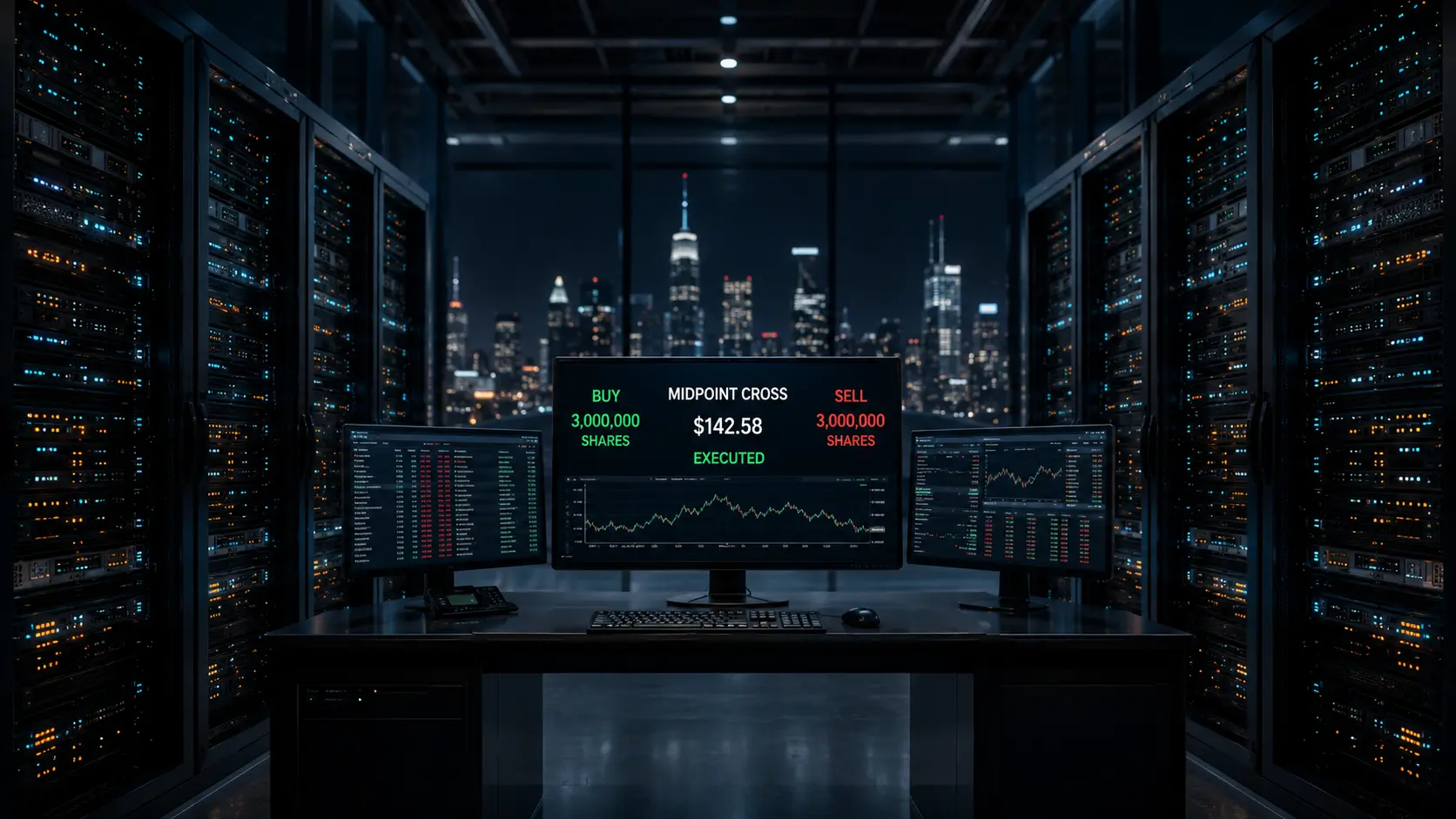
The crossing network algorithm constantly monitors the National Best Bid and Offer (NBBO) broadcast by the lit exchanges. If another institutional investor submits a hidden order to buy three million shares of the same stock into the dark pool, the algorithm executes a “cross.” It matches the two institutional whales instantly and silently.
To guarantee fairness without public price discovery, the crossing network typically executes the trade at the exact midpoint of the lit exchange’s current bid-ask spread. Neither the buyer nor the seller pays the spread premium, both institutions secure massive volume execution, and the broader public market remains completely unaware of the transaction until it is reported to the consolidated tape after the fact.
WHY IT MATTERS NOW
Dark pools execute over forty percent of all daily equity volume in the United States. They are not a fringe element of the capital markets; they are the primary plumbing for institutional portfolio rebalancing.
The necessity of dark pools highlights a severe structural reality: the public stock market is heavily fragmented and dominated by hyper-fast algorithmic arbitrage. A modern public exchange is no longer a physical floor of human brokers; it is a microwave-linked network of servers executing trades in microseconds. In this environment, speed is the only measurable advantage. Institutional money managers—who invest on five-year horizons, not five-millisecond horizons—are fundamentally outmatched on lit exchanges.
Dark pools level the playing field by neutralizing the speed advantage. Because the order book is completely blind, HFT firms cannot front-run the institutional block trades. This allows massive mutual funds and sovereign wealth funds to cleanly rotate billions of dollars of capital between sectors—moving from tech to energy, for example—without triggering violent, algorithmic flash crashes on the public tape.
The economics of this execution are massive. For a $100 billion pension fund, shaving just three cents off the execution price of a block trade via a dark pool midpoint cross saves millions of dollars in slippage. These savings compound over decades, directly funding the retirement accounts of ordinary teachers and municipal workers who possess zero knowledge of the underlying market microstructure.
WHAT MOST PEOPLE MISS
Mainstream financial media frames dark pools as unregulated, nefarious black markets where corporate insiders manipulate stock prices. They entirely miss the reality that dark pools are heavily regulated by the Securities and Exchange Commission (SEC) and the Financial Industry Regulatory Authority (FINRA), and are expressly designed to protect retail-backed pension money from predatory algorithms.
However, the primary risk is not insider trading; it is toxic flow. Because broker-dealers run their own internal dark pools, they often route aggressive HFT order flow into the pool to interact with the slow institutional orders. This creates “pinging.” An HFT algorithm will send out hundreds of tiny, 100-share orders into a dark pool, explicitly trying to bump into a hidden institutional whale. Once the tiny order executes, the HFT firm knows the whale is there, allowing them to race back to the lit exchange and front-run the remaining volume, perfectly defeating the dark pool’s entire purpose.
THE TRAJECTORY
Next 12–36 Months: Regulators will enforce stricter “Trade-At” rules, forcing dark pools to guarantee significant price improvement over the lit exchanges to justify taking volume away from the public order book. This will slowly shrink the market share of smaller, less efficient broker-dealer crossing networks.
Next Five Years: Dark pools will integrate homomorphic encryption and zero-knowledge proofs directly into the matching engine. This cryptographic architecture will allow two competing institutional funds to mathematically prove they have matching block orders without ever exposing the exact ticker symbol or volume to the dark pool operator, permanently eliminating the risk of internal broker front-running.
Next Ten Years: The strict boundary between lit exchanges and dark pools will dissolve. Major public exchanges will adopt continuous, randomized batch-auction mechanisms, holding all orders in a blind queue for one full second before matching them simultaneously. This will physically neutralize the microsecond speed advantage of HFT, rendering standalone dark pools obsolete for standard equity execution.
What Could Go Wrong: If a major dark pool operator suffers a catastrophic software failure that accidentally broadcasts its entire hidden order book to the public tape for even a few seconds, HFT algorithms will ruthlessly exploit the exposed institutional positions. This would trigger a massive, localized liquidity crisis as funds violently cancel their orders, completely freezing institutional capital rotation.
Most Likely Outcome: Dark pool crossing networks will remain the mandatory execution venue for massive institutional block trades. However, to combat the continuous threat of algorithmic pinging, they will evolve from simple blind matching engines into highly exclusive, cryptographically secured liquidity venues accessible only to vetted, long-term capital allocators.
KEY TERMS
- Dark Pool: A private financial exchange or hub that allows investors to trade equities without revealing their order size or price to the public market before execution.
- Block Trade: A massive transaction involving a large number of equities or bonds being traded at an arranged price between two parties, typically exceeding 10,000 shares.
- Limit Order Book: The digital, publicly visible list of all active buy and sell orders on a lit exchange, displaying exactly how many shares are available at each specific price.
- Informational Leakage: The unintended signaling of a large impending trade to the broader market, which causes other market participants to alter their pricing dynamically before the trade completes.
- Front-Running: The predatory practice where a high-frequency trading firm detects a large incoming institutional order and races to buy the stock first, only to sell it back to the institution at a higher price milliseconds later.
SOURCES
- Securities and Exchange Commission (SEC) — Concept Release on Equity Market Structure and Dark Liquidity
- Financial Industry Regulatory Authority (FINRA) — Dark Pool Trading Volume and Alternative Trading System (ATS) Reporting
- Journal of Financial Economics — The Microstructure of Crossing Networks and Institutional Execution Costs
- CFA Institute — Dark Pools, Internalization, and Equity Market Quality