Advertisement
)

An artificial intelligence data center is not just a computer; it is an industrial-scale space heater. The fundamental laws of thermodynamics dictate that virtually 100% of the electricity pumped into a server rack is ultimately converted into heat. For the past twenty years, the cloud computing industry treated this heat as garbage. Hyperscalers spent billions of dollars on massive air conditioning units, chillers, and evaporative cooling towers simply to blow this thermal energy into the atmosphere, often consuming millions of gallons of drinking water in the process. From a thermodynamic perspective, the modern internet is an engine of staggering waste.
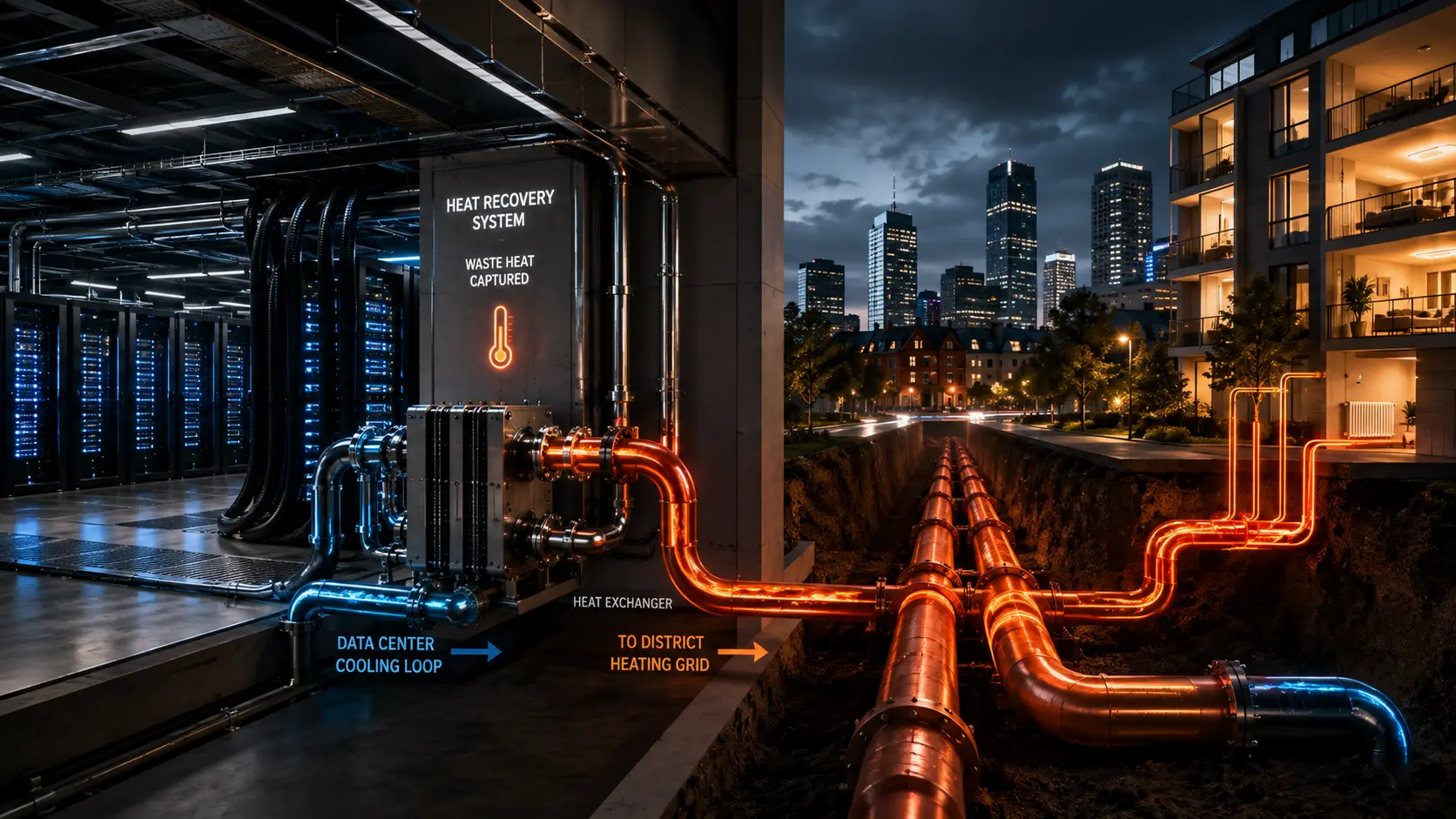
Why should you care right now? Because European regulators and grid operators have officially declared an end to this waste. As AI models scale, their power demands are threatening to destabilize national energy grids. To justify their massive electrical footprint, tech giants are being forced to close the loop. By connecting their server racks directly to municipal underground water pipes, hyperscalers are capturing their 140°F (60°C) waste heat and pumping it into the radiators of surrounding urban homes and hospitals. This architectural pivot is turning data centers from massive energy drains into synthetic geothermal power plants, fundamentally rewriting the economics of digital infrastructure.
What is Data Center District Heating?
Data center district heating is the infrastructural process of capturing the thermal exhaust generated by computer servers and transferring it into a municipal underground water grid. Instead of venting waste heat into the atmosphere, the thermal energy is repurposed to heat residential and commercial buildings, radically improving overall energy efficiency.
At a Glance
- Concept: Taking the boiling hot water that cools down AI supercomputers and piping it into a city’s underground heating network to warm thousands of homes.
- Why it matters: AI data centers consume gigawatts of electricity. By recycling the resulting heat, a city can shut down its fossil-fueled boiler plants, offsetting the massive carbon footprint of the data center.
- Who uses it: Hyperscalers (Meta, Amazon, Google, Microsoft), colocation providers (Equinix, Digital Realty), and European municipalities (Stockholm Exergi, Fjernvarme Fyn).
- Biggest takeaway: The new EU Energy Efficiency Directive legally mandates that large data centers must attempt to recover their waste heat, effectively forcing Silicon Valley to become local utility providers in Europe.
In Simple Words
If you have ever played a high-end video game on a desktop computer, you know that the room quickly gets hot. The computer chips draw electricity, perform math, and radiate heat.
Now, imagine building a warehouse with 100,000 of the world’s most powerful computers running artificial intelligence equations 24/7. The heat generated is enough to literally melt the building. The old way to solve this was to install giant air conditioners on the roof and blow the hot air into the sky.
District Heating Integration stops throwing the heat away. Instead of blowing air, the data center pumps cold water over the computer chips. The chips heat the water up to a scalding temperature. The data center then pumps this hot water through a pipe that connects to the city’s underground heating network. The hot water flows into people’s apartments, warms up their radiators during the winter, cools down, and flows back to the data center to repeat the cycle. The AI essentially acts as the furnace for the entire neighborhood.
Why This Matters
For Data Center Developers, Urban Planners, and Utility Executives, thermal integration is the new passport to securing building permits.
In major tech hubs like Frankfurt, Dublin, and Amsterdam, local governments are imposing strict moratoriums on new data center construction. The electrical grids are simply tapped out. However, if a developer can prove that their data center operates symbiotically—supplying baseload heat to a city and allowing the local municipality to shut down a coal or natural gas-fired heating plant—the political friction vanishes. Heat recovery transforms the data center from a parasitic burden on the local community into critical civic infrastructure, unlocking expedited permitting and heavy ESG (Environmental, Social, and Governance) tax incentives.
The Shift to Liquid Cooling and Heat Recovery
The true catalyst for this transition is the impending shift to Liquid Cooling.
As long as data centers used cold air to cool their servers, district heating was difficult. Air cooling produces low-grade waste heat (around 30°C / 86°F). To use this in a city grid, the utility has to use massive, energy-hungry industrial heat pumps to “lift” the temperature up to the 80°C required for household radiators.
The AI revolution is changing this. Massive GPUs (like NVIDIA’s Blackwell architecture) run so hot that air cooling no longer works. The industry is pivoting to Direct-to-Chip (D2C) liquid cooling. Liquid cooling captures heat much more efficiently, outputting high-grade hot water at 55°C to 65°C. This perfectly aligns with the operating temperatures of modern, 4th-generation district heating grids, allowing the heat to be transferred effortlessly without massive parasitic energy penalties.
How Data Center Waste Heat Recovery Works
Bridging the ultra-sterile environment of a server farm with the gritty reality of municipal plumbing requires pristine thermodynamic engineering. Here is the first-principles breakdown of the architecture.
1. The Fundamental Problem: Thermal Limits of Silicon
Computer processors must remain below a strict thermal limit (typically around 85°C) to prevent logic errors and physical melting. Removing the heat generated by electrical resistance is the primary operational bottleneck of hyperscale computing.
2. The Insufficiency of Atmospheric Venting
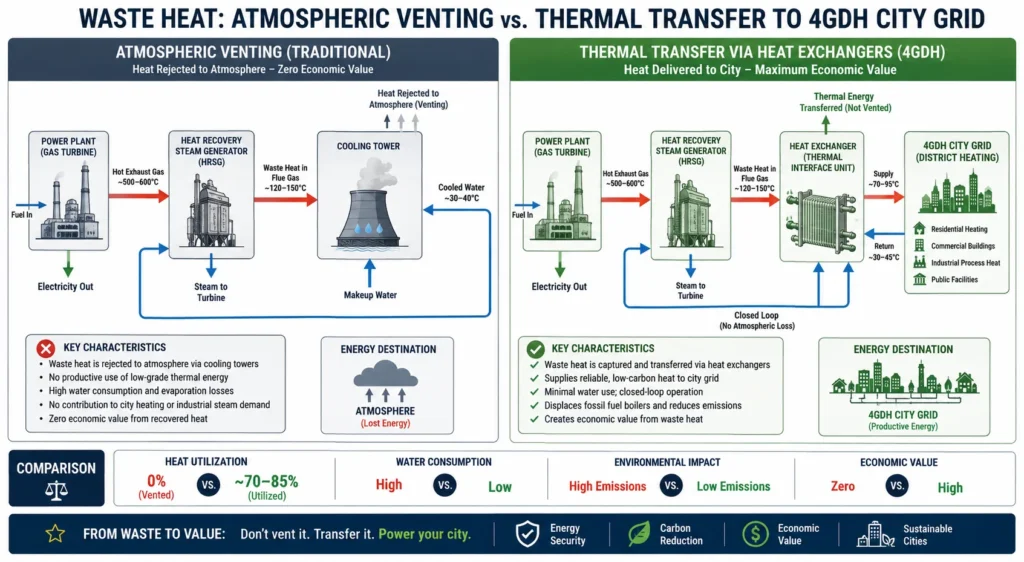
Historically, Computer Room Air Handlers (CRAHs) expelled this heat into the atmosphere using cooling towers. This squanders 100% of the thermal energy and frequently evaporates millions of gallons of potable water daily, drawing intense environmental backlash in drought-prone regions.
3. The Core Mechanism: The Liquid-to-Liquid Heat Exchanger
In a district heating setup, the data center operates a closed “primary loop” of ultra-pure, deionized water that cools the servers. This hot water is pumped into a titanium plate-and-frame heat exchanger.
Simultaneously, the city’s district heating utility pumps its “secondary loop” water into the other side of the exchanger. The two waters never touch—they are separated by thin metal plates—but the thermal energy transfers flawlessly from the hot server water into the city water.
4. Technical Depth: Heat Pumps and the Temperature Lift
Because older city grids require water at 80°C or 90°C to push through miles of uninsulated legacy pipes, the heat exchanger alone is sometimes insufficient. Engineers install an industrial heat pump between the data center and the city grid. The heat pump acts like a reverse refrigerator, using a compressor and a refrigerant cycle to absorb the 40°C data center heat and “lift” it to the 80°C required by the city, dumping it into the municipal grid.
5. Real-World Consequences: The Power Usage Effectiveness (PUE) Paradox
By exporting heat, a data center alters its efficiency metrics. While running a heat pump might technically increase the data center’s gross electrical intake, the net energy benefit to society is massive. Regulators introduced the Energy Reuse Factor (ERF) to reward facilities that export heat, permanently shifting the industry’s focus from simply cooling servers cheaply to maximizing the total thermodynamic utility of the site.
Global Examples of Data Center District Heating
The integration of tech and municipal utilities is already operating at scale across Northern Europe.
Meta’s Odense Data Center (Denmark): Meta operates a massive hyperscale facility in Odense, Denmark, perfectly engineered for heat recovery. The facility directs its server exhaust through a massive heat pump facility operated by the local utility company, Fjernvarme Fyn. The recovered heat is sufficient to warm up to 11,000 local homes. Crucially, the system allowed the municipality to permanently decommission a major coal-fired power plant, directly linking Facebook likes and Instagram reels to the decarbonization of Danish winters.
Stockholm Data Parks (Sweden): The city of Stockholm, in partnership with utility provider Stockholm Exergi, actively invites hyperscalers to build within city limits specifically to harvest their heat. The initiative created a “heat market,” where data centers act as thermal suppliers, selling their excess heat directly to the utility grid. By paying data centers for their thermal exhaust, Stockholm Exergi essentially subsidizes the data center’s cooling costs, creating a massive financial incentive for tech companies to relocate to Sweden.
Amazon Web Services in Tallaght (Ireland): In a bid to ease tensions with the highly constrained Irish electrical grid, AWS integrated its Tallaght data center into South Dublin’s District Heating Scheme. The system captures waste heat to warm local civic buildings, a university campus, and residential apartments. This project serves as the blueprint for how U.S. hyperscalers plan to negotiate their social license to operate in increasingly hostile European regulatory environments.
Economic & Strategic Impact
The core friction in scaling district heating is the Thermal Off-Take Agreement.
For a data center developer, selling heat sounds lucrative, but it is deeply complicated. A data center must run 24/7/365, meaning it generates massive amounts of heat in the middle of July when the city does not need it. Conversely, if the data center suffers an outage in January, thousands of homes freeze.
To bridge this, hyperscalers and utilities sign rigorous Thermal Off-Take Agreements. These contracts define who pays for the multimillion-dollar heat exchangers and heat pumps, and who guarantees the backup heat supply (usually the utility via massive electric boilers or thermal storage tanks). The economics only work when the utility is willing to pay a high enough price per Megawatt-hour of heat to justify the data center’s upfront capital expenditure (CapEx) in specialized plumbing.
Advantages
- Massive Decarbonization: Capturing waste heat allows cities to shut down legacy coal, oil, and natural gas-fired district heating boilers, drastically cutting regional carbon emissions.
- Regulatory Compliance: Meets the strict mandates of the EU Energy Efficiency Directive (EED), accelerating building permits and reducing the risk of governmental construction moratoriums.
- New Revenue Streams: Data centers transition from paying to cool their servers to getting paid for their thermal exhaust, improving the long-term operational economics (OpEx) of the facility.
- Water Conservation: By routing heat into a closed-loop municipal water grid, data centers bypass the need for evaporative cooling towers, saving millions of gallons of potable water annually.
Limitations
- Geographic Dependency: District heating requires an existing underground pipe network. While ubiquitous in Europe, these networks are virtually non-existent in the sprawling suburbs of the United States, rendering the technology useless in major U.S. data center hubs like Northern Virginia.
- Temperature Mismatch: Traditional air-cooled data centers output air that is too cool (30°C) to inject straight into a city grid. The necessary heat pumps require massive amounts of parasitic electricity to boost the temperature, cutting into the overall efficiency gains.
- Seasonal Heat Rejection: Cities only need heating in the winter. During the summer, the data center must still reject its heat, meaning developers must still build expensive backup cooling towers (CapEx redundancy) to handle the summer load.
Common Misconceptions
Misconception: The water from the city grid flows directly over the computer chips.
Reality: The systems are physically segregated. The pristine, deionized water cooling the $40,000 AI chips never mixes with the gritty, treated water of the municipal grid. They pass each other inside a titanium heat exchanger, sharing only temperature, never fluid.
Misconception: Data centers generate enough heat to warm entire major cities.
Reality: While the heat is massive, it is geographically constrained. Hot water loses temperature the further it travels underground. A data center can only effectively heat the immediate surrounding neighborhoods or districts; it cannot transport heat fifty miles across a state.
Misconception: Waste heat recovery is a brand-new idea.
Reality: Heavy industries (like steel mills and chemical plants) have shared waste heat with cities for decades. The novelty is treating a pristine, digital computer warehouse exactly like a heavy-industrial factory.
What Most People Miss
The disruptive capability of 4th Generation District Heating (4GDH).
Most analysts assume data centers must always install expensive heat pumps to boost their temperature to the 80°C required by legacy city grids. What they miss is the evolution of the cities themselves.
Urban planners are currently rolling out 4th Generation District Heating grids. These modern, highly insulated networks are designed to operate at ultra-low temperatures (around 50°C to 60°C). Because AI servers using direct-to-chip liquid cooling naturally output water at exactly 60°C, the two technologies are perfectly converging. In a 4GDH city, the data center can pipe its cooling water directly into the heat exchanger and straight to the homes, completely eliminating the multi-million-dollar industrial heat pump and achieving perfect, frictionless thermodynamic symbiosis.
Comparison Table
| Feature | Legacy Atmospheric Venting | District Heating (Air-Cooled DC) | District Heating (Liquid-Cooled DC) |
| Waste Heat Fate | Blown into the sky | Captured via heat pumps | Transferred via heat exchangers |
| Coolant Exit Temp | ~30°C – 35°C (Air) | ~30°C – 35°C (Air) | ~50°C – 65°C+ (Liquid) |
| Parasitic Power Demand | High (Chillers/Fans) | Very High (Requires massive heat pumps) | Low (Direct transfer to 4GDH grids) |
| Water Consumption | Very High (Evaporative) | Low | Near Zero (Closed loop) |
| Regulatory Standing | Facing Moratoriums | Compliant (EED Mandate) | Highly Incentivized |
Case Study
Situation: The European Union aggressively updated its Energy Efficiency Directive (EED), mandating that all data centers over 1 MW of power demand must conduct a cost-benefit analysis for waste heat recovery. For hyperscalers expanding in the Nordics, traditional air-cooling designs were facing intense regulatory friction from municipalities attempting to decarbonize their winter heating grids.
Challenge: Design a hyperscale facility capable of exporting its thermal energy economically to the municipal grid, without risking the uptime or security of the core cloud infrastructure.
Solution (The Stockholm Exergi Partnership): A major colocation provider established a flagship facility in Stockholm Data Parks. Rather than fighting the mandate, they collaborated directly with Stockholm Exergi, the local utility. The facility was designed from the ground up with a dedicated thermal off-take substation. The utility installed large-scale heat pumps directly adjacent to the data center’s primary cooling loop.
Outcome: The facility successfully began exporting over 5 Megawatts of thermal energy continuously into the Stockholm municipal grid. Stockholm Exergi paid the data center for the heat, creating a new revenue stream that significantly offset the facility’s cooling costs. The project provided enough heat for roughly 10,000 modern apartments and was instrumental in helping the city phase out its last remaining coal-fired cogeneration plant.
Lessons Learned: The Stockholm deployment validated that data centers are viable thermal utilities. It proved to global hyperscalers that aligning data center architecture with municipal energy policy is not a regulatory burden, but a strategic asset that secures long-term operational viability in energy-constrained global markets.
Future Outlook
Next 12–24 Months
The era of Mandatory European Compliance. Throughout 2026 and 2027, the rollout of the EU EED will force total compliance across the continent. Every new data center blueprint submitted in Germany, France, and the Nordics will feature mandatory liquid-to-liquid heat exchangers. Colocation providers will aggressively market their “Energy Reuse Factor” (ERF) to ESG-conscious enterprise clients, proving that hosting their servers actively contributes to urban decarbonization rather than climate destruction.
Next 3–5 Years
The scaling of Micro-Data Center Heating Boilers. As hyperscale facilities move to the fringes of power grids, startups like Qarnot and Heata are decentralizing the model. Over the next five years, we will see the mass deployment of “compute boilers”—small racks of 10 to 50 AI servers installed directly in the basements of large apartment buildings or public swimming pools. These edge computing nodes will execute batch processing for tech companies while providing 100% of the building’s hot water locally, entirely bypassing the need for massive underground district piping.
Next 10 Years
The U.S. Thermal Infrastructure Retrofit. By the mid-2030s, the energy demands of Artificial General Intelligence (AGI) will push the U.S. electrical grid to the breaking point. Facing massive public backlash for wasting heat while grid prices soar, U.S. tech giants will form joint ventures with infrastructure funds to build micro-district heating grids from scratch. Hyperscalers will fund the laying of underground pipes in new, massive planned communities (like those surrounding the tech hubs of Texas and Ohio), essentially building company-towns where the rent is subsidized by the thermal exhaust of the world’s most powerful AI supercomputers.
Most Likely Scenario
Data Center District Heating will permanently transition the cloud computing industry from a solitary digital sector into a foundational pillar of physical public utilities. As the physics of AI demand a shift to hot, liquid cooling, the marriage between the tech industry and municipal heating networks will become inescapable, finalizing the thermodynamic loop of the 21st-century digital economy.
Key Takeaways
- Data center district heating captures the massive waste heat generated by computer servers and pumps it into a city’s underground water grid to heat local homes.
- Traditionally, data centers blew this heat into the sky using massive air conditioners, wasting immense electricity and water.
- The European Union has mandated (via the Energy Efficiency Directive) that large data centers must attempt to recycle their heat, forcing tech companies to act as local utility providers.
- The transition from air cooling to liquid cooling for AI chips outputs water at 60°C. This perfectly matches modern city heating grids, making the transfer of heat incredibly efficient.
- If a city’s grid is older and needs 80°C water, the data center must use massive “industrial heat pumps” to artificially boost the temperature, which consumes extra electricity.
- While highly successful in Europe (e.g., Sweden, Denmark), the technology struggles in the U.S. because most American cities do not have underground district heating pipes.
Glossary
4th Generation District Heating (4GDH): Modern, highly insulated municipal underground pipe networks designed to operate at lower temperatures (50°C – 60°C), making them perfect for direct integration with liquid-cooled data centers.
Direct-to-Chip (D2C) Liquid Cooling: A method where cold liquid is pumped directly over the computer processor. It absorbs heat much better than air, outputting high-grade hot water perfect for district heating.
Energy Efficiency Directive (EED): An EU regulatory framework that legally mandates large data centers to conduct cost-benefit analyses on capturing and exporting their waste heat to nearby communities.
Heat Exchanger: A mechanical device (usually layered titanium plates) that allows heat to transfer from the data center’s clean water loop into the city’s dirty water loop without the two fluids ever mixing.
Industrial Heat Pump: A massive machine that acts like a reverse refrigerator. It absorbs low-temperature heat from the data center and uses electricity/compressors to boost it to a much higher temperature for the city grid.
Power Usage Effectiveness (PUE): The classic metric for data center efficiency (total facility power divided by IT equipment power). It is being supplemented by the Energy Reuse Factor (ERF) to reward facilities that export their heat.
Sources
European Commission: Energy Efficiency Directive (EED) – Data Centres
Danfoss: Data center heat recovery: A hidden potential
Stockholm Data Parks: Data Center Heat Recovery in Stockholm
Data Center Dynamics: Meta Odense data center heat recovery project
Uptime Institute: The reality of data center district heating