Advertisement
)


In 2027, a shipping container full of regular-fit sports joggers manufactured for a global brand like Zara or H&M could arrive at the Port of Rotterdam and be legally blocked from entering Europe—not because of a tariff, but because of a missing barcode. For the last twenty years, global supply chains have operated in the dark. A fashion brand might know the name of the Tier 1 factory that sewed the fabric, but they are often completely blind to the Tier 3 farm that actually grew the cotton or the dye house that dumped toxic chemicals into a local river. When consumers asked for eco-friendly products, corporations responded with “greenwashing”—slapping unverified, vague sustainability claims on their websites.
Why should you care right now? Because the European Union has officially weaponized customs enforcement to kill greenwashing. Under the new Ecodesign for Sustainable Products Regulation (ESPR), maintaining access to the European market requires absolute, mathematical transparency. Every piece of clothing, battery, and electronic device must soon carry a “Digital Product Passport” (DPP). By scanning a QR code on a clothing tag, a customs agent (or a consumer) will instantly access a decentralized database showing the exact carbon footprint, water usage, and geographic origin of every single component in that item. This law is transforming supply chain opacity from a competitive advantage into a critical legal liability, forcing a multi-billion-dollar digital overhaul of global trade.
What is a Digital Product Passport (DPP)?
A Digital Product Passport (DPP) is a legally mandated, machine-readable data record tied to a physical product via a unique identifier (like a QR code or NFC tag). Enforced by the EU’s Ecodesign for Sustainable Products Regulation (ESPR), it tracks the product’s origin, material composition, environmental footprint, and recyclability across its entire supply chain lifecycle.
At a Glance
- Concept: A digital “Carfax report” for everyday physical goods, proving their history and chemical makeup from the raw material farm all the way to the retail shelf.
- Why it matters: If a company cannot cryptographically prove exactly how and where a product was made, it will be banned from being sold in the European Union.
- Who uses it: Global apparel brands (Zara, H&M, Ralph Lauren, Lacoste), consumer electronics giants (Apple, Samsung), and EV battery manufacturers.
- Biggest takeaway: The EU is not building a massive centralized government database to hold this information. They are forcing the private sector to build a decentralized, interoperable network where data is securely passed from supplier to brand to consumer.
In Simple Words
Imagine you buy a knit sweater from a brand like Gant or Ralph Lauren.
Today, you look at the physical tag, and it says “100% Cotton. Made in Vietnam.” That is the limit of the information you, or the government, possess.
Under the Digital Product Passport mandate, that physical tag must include a permanent QR code. When you scan it with your phone, it opens a digital ledger that tells a complete story:
- “This cotton was grown on Farm X in India, using 400 liters of water.”
- “It was dyed at Facility Y in Bangladesh, generating 2kg of CO₂.”
- “It was sewn at Factory Z in Vietnam.”
- “It contains zero restricted toxic chemicals.”
- “When you are done with it, bring it to Recycler A, because the yarn is 100% recyclable.”
The government isn’t just asking brands to provide this story—they are demanding cryptographic proof. If the story is missing, the sweater is illegal to sell.
Why This Matters
For Supply Chain Executives, Trade Lawyers, and ESG Auditors, the DPP mandate represents the transition from Voluntary ESG to Strict Liability Trade Law.
Historically, sustainability reports were marketing documents produced by the PR department. If a brand made a false claim, the worst outcome was a bad news cycle. The ESPR fundamentally changes the legal architecture of sustainability. By tying the environmental data directly to the physical product via a unique identifier, the DPP becomes a mandatory customs document. Failing to provide accurate, deep-tier supply chain data is no longer a marketing faux pas; it is a direct violation of European market access laws, resulting in immediate product impoundment and catastrophic revenue loss.
The Circular Economy and the ESPR Framework
The global economy operates on a “Take-Make-Dispose” linear model. The EU’s ultimate goal is a Circular Economy—where materials are endlessly recycled and reused.
However, recyclers cannot recycle a product if they don’t know what chemicals or alloys are inside it. The DPP solves this blind spot. By creating a standardized, machine-readable data layer that travels with the physical product until the end of its life, recyclers can scan a dead laptop or a torn pair of sports joggers and instantly know exactly how to safely disassemble it and extract the raw materials. The DPP is the foundational software required to run a hardware-based circular economy.
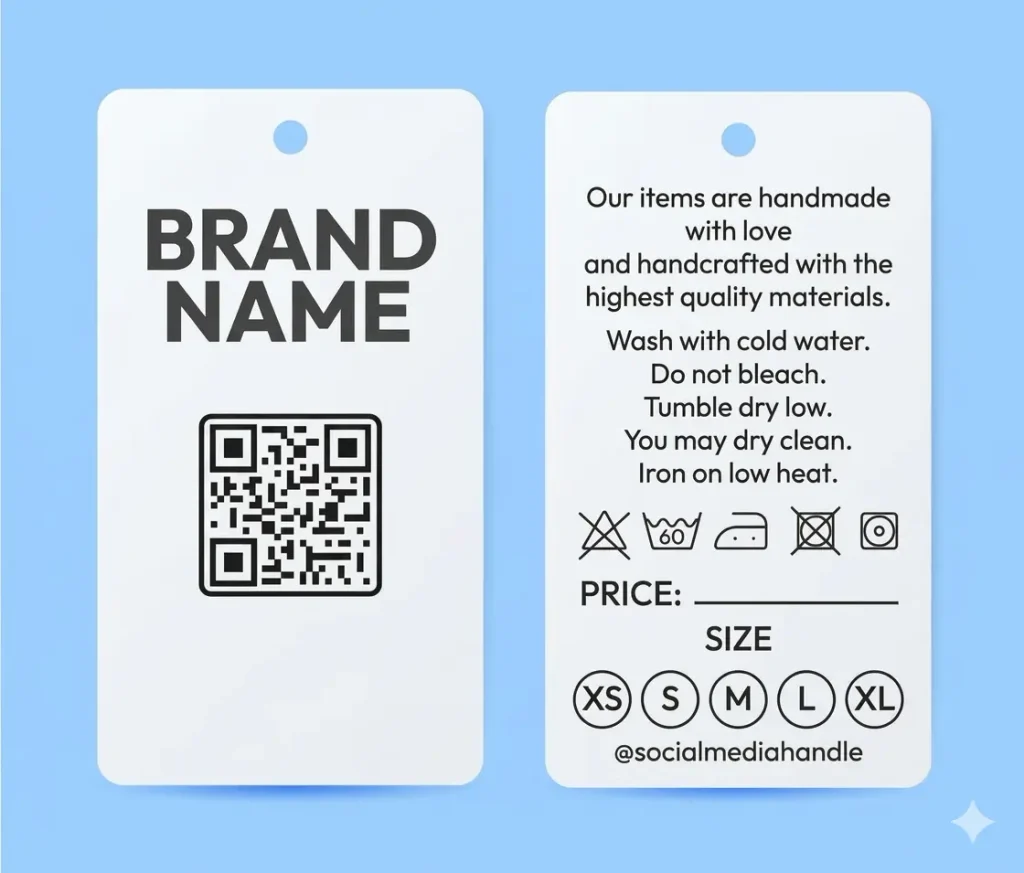
How Digital Product Passports (DPP) Track Supply Chains
Enforcing a digital tracking mandate across a fragmented, multi-lingual global supply chain requires strict data architecture. Here is the first-principles breakdown of the system.
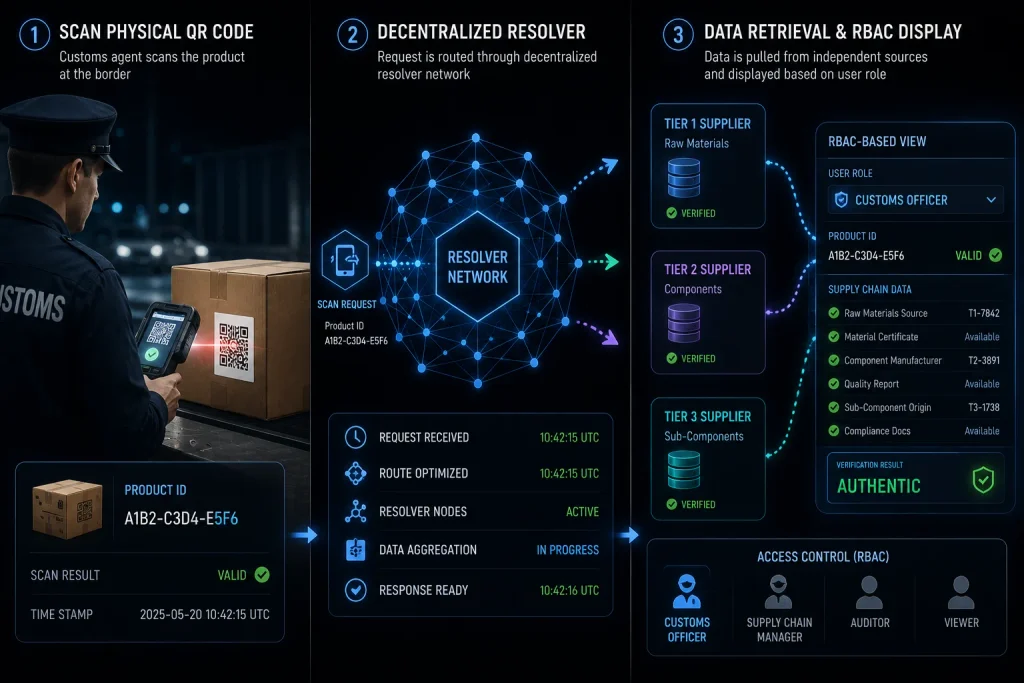
1. The Fundamental Problem: Tier-3 Obfuscation
Most global brands only have contracts with their “Tier 1” suppliers (the factory that does the final assembly). They have zero visibility into Tier 2 (the fabric mill) or Tier 3 (the raw material farm). Because data is trapped in isolated, incompatible ERP systems across different countries, tracing the exact chain of custody of a single batch of material is mathematically impossible.
2. The Core Mechanism: Decentralized Identifiers
The EU ESPR does not require companies to upload their proprietary supply chain data to a central government server (which would be a massive corporate espionage risk). Instead, it relies on a decentralized schema.
Every product is assigned a Unique Product Identifier (UPI). This identifier acts as a digital key.
3. Technical Depth: The Data Carrier and Resolver
The physical product receives a “Data Carrier” (a QR code, RFID, or NFC tag). When a customs agent scans the tag, the request goes to a “Resolver”—a routing system (similar to how a URL works on the internet). The Resolver automatically pings the decentralized, private databases of the brand and its suppliers, fetching the required data and displaying it instantly on the agent’s device.
4. Technical Depth: Granular Role-Based Access
Not everyone sees the same data. The DPP enforces strict Role-Based Access Control (RBAC).
- The Consumer scans the tag and sees recycling instructions and carbon footprint metrics.
- The Recycler scans the tag and sees a hidden schematic for safely dismantling the battery or dissolving the textile dye.
- The Customs Authority scans the tag and sees the highly classified names and addresses of the Tier 3 raw material suppliers to ensure no forced labor was used.
5. Real-World Consequences: The Data Mesh Integration
To comply, a massive brand like Lacoste or Zara cannot wait until 2027 to act. They must instantly force their thousands of independent suppliers in Asia to adopt interoperable data standards (like GS1 EPCIS). If a Tier 3 supplier cannot digitally verify their water usage and push that data up the chain, the brand must fire them and find a supplier who can. The DPP is forcing a brutal, rapid digitalization of the entire developing world’s manufacturing base.
DPP Rollout: EV Batteries, Textiles, and Electronics
The DPP is rolling out in targeted product categories, focusing first on high-impact environmental sectors.
Industrial and EV Batteries (The Vanguard): The Battery Passport is the very first mandatory DPP, going into effect earlier than other sectors. Because electric vehicle (EV) batteries contain critical, toxic, and highly valuable minerals (lithium, cobalt, nickel), the EU mandates that every large battery possess a digital passport. This passport tracks the exact chemical composition, the cycle-life health of the battery, and ensures that the cobalt was not mined using forced labor. When an EV is scrapped, the recycler uses the DPP to perfectly extract and resell the lithium, establishing localized European mineral security.
Apparel and Textiles: The fast fashion industry is the second massive target. Europe is suffocating under millions of tons of discarded, unrecyclable clothing. By enforcing the DPP on textiles, brands are legally forced to declare the exact blend of synthetic fibers (e.g., polyester vs. elastane) in a pair of sports joggers. Because mixed plastics are nearly impossible to recycle chemically, the sheer transparency of the DPP forces designers to utilize monomaterials (100% cotton or 100% recycled polyester) from the very beginning of the design phase to avoid public and regulatory backlash.
Consumer Electronics: Devices like smartphones, tablets, and laptops are actively being integrated into the ESPR framework. For electronics, the DPP heavily emphasizes the “Right to Repair.” The passport must include digital links to spare parts catalogs, repair manuals, and a “repairability score.” This legally terminates the era of planned obsolescence, forcing tech giants to design hardware that independent repair shops can easily fix.
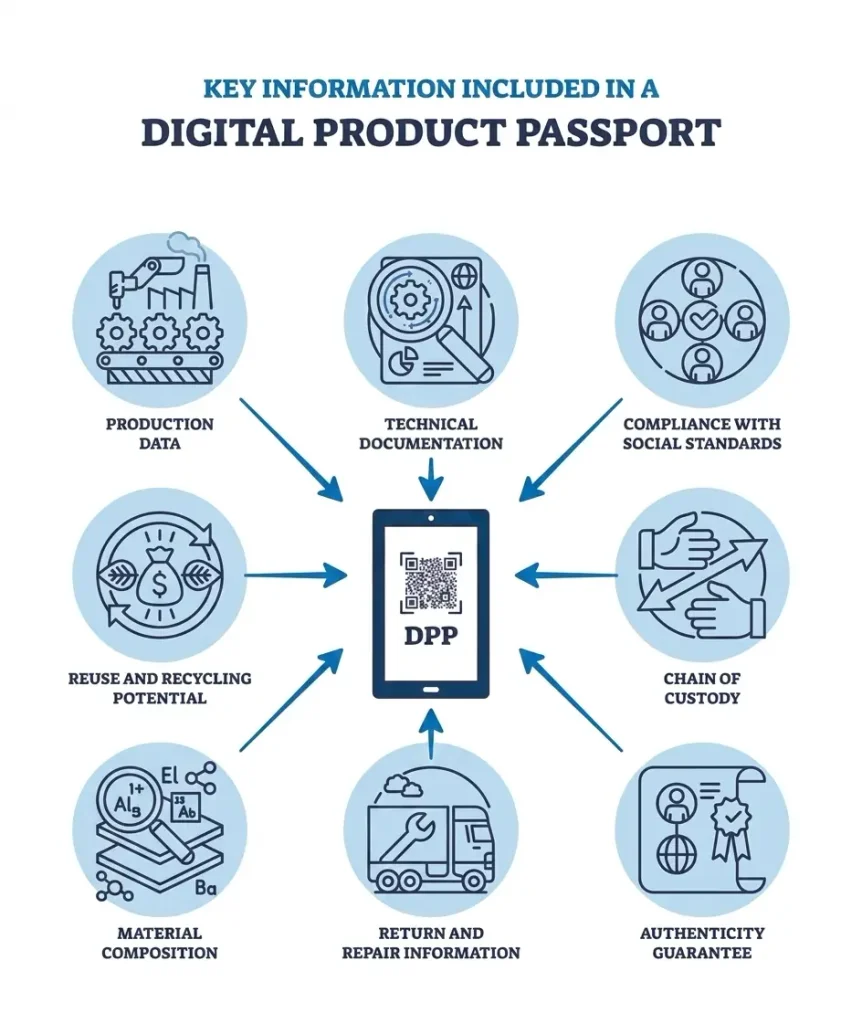
Economic & Strategic Impact
The core strategic consequence of the DPP is the Eradication of the Compliance Arbitrage.
For decades, brands optimized their profit margins by engaging in “compliance arbitrage”—shifting manufacturing to countries with the weakest environmental and labor laws, and then obscuring that fact from Western consumers through complex shell companies and intermediaries.
The Digital Product Passport permanently destroys this arbitrage. Because the EU demands continuous, machine-readable proof of the entire lifecycle, brands can no longer hide behind their intermediaries. If a brand wants to sell to the 450 million wealthy consumers in the European Single Market, they are financially forced to consolidate their supply chains, dropping cheap, non-compliant suppliers in favor of slightly more expensive, heavily digitized, mathematically auditable partners.
Advantages
- Eradicates Greenwashing: Replaces vague marketing buzzwords (“Eco-Friendly”) with standardized, legally enforceable, and scientifically measured carbon and water footprint metrics.
- Enables the Circular Economy: Provides recyclers with the exact chemical blueprints of physical products, turning mountains of toxic landfill waste into highly valuable, recoverable commodity streams.
- Protects Authentic Brands: Counterfeit luxury goods cannot replicate the cryptographically secure, decentralized ledger tracking of a true DPP, providing an absolute digital shield against intellectual property theft for premium brands.
- Supply Chain Resilience: Forces brands to actually map their deep-tier suppliers, inadvertently providing them with the data required to predict and avoid geopolitical supply chain shocks before they happen.
Limitations
- The Small Business (SME) Crush: Implementing a cryptographically secure, interoperable data tracking system is incredibly expensive. While a multi-billion-dollar brand can afford the IT overhaul, a small, 50-person fabric mill in Vietnam cannot. The mandate risks bankrupting the developing world’s SME manufacturing base.
- Data Security and Espionage: Supply chain data is the most closely guarded secret of any manufacturing empire. Despite role-based access controls, forcing companies to link their internal supplier networks to public-facing resolvers creates a massive, unprecedented attack surface for corporate espionage.
- Scope 3 Data Accuracy: Accurately measuring the carbon footprint of a specific farm or dye house (Scope 3 emissions) is notoriously difficult. Suppliers may simply “guess” or use generic industry averages, polluting the DPP database with inaccurate math that defeats the purpose of the regulation.
Common Misconceptions
Misconception: The DPP is a European database where companies upload their files.
Reality: The EU is not building a centralized database. The EU is merely dictating the language and rules. The data remains hosted on private, decentralized corporate servers; the DPP acts as a digital bridge to fetch that data only when scanned.
Misconception: Only European companies have to comply.
Reality: The ESPR applies to any product placed on the European market, regardless of where the company is headquartered. If an American tech company or a Chinese fast-fashion brand wants to sell a product in Paris or Berlin, they must attach a DPP.
Misconception: The DPP is just a digital PDF manual.
Reality: It is a dynamic, machine-readable ledger. It must utilize interoperable global standards (like GS1) so that automated software, customs scanners, and robotic recycling machines can read and process the data instantly without human intervention.
What Most People Miss
The disruptive intelligence value of Secondary Market Monetization.
When brands look at the DPP, they see a massive compliance tax. What they miss is the greatest customer-retention mechanism ever invented.
Because the DPP is permanently tied to the physical product, the brand remains connected to the item long after the initial sale. If a consumer sells a luxury jacket on a secondary market app (like Vinted or Depop), the new buyer will scan the DPP QR code to verify its authenticity. The original brand can use this scan to instantly offer the new, second-hand buyer repair services, personalized styling advice, or a discount on matching accessories. The DPP transforms physical products into permanent, interactive digital marketing channels.
Comparison Table
| Feature | Legacy ESG Reporting | Digital Product Passport (DPP) |
| Data Format | Static PDF / Annual Report | Machine-readable, dynamic digital ledger |
| Granularity | Corporate-wide averages | Product-specific / Batch-specific metrics |
| Legal Enforcement | Voluntary / Low penalty | Strict Liability (Customs block at EU border) |
| Supply Chain Depth | Tier 1 (Final Assembly) | Tier 3/4 (Raw Material Origin) |
| End-of-Life Utility | None | Provides exact dismantling/recycling blueprints |
Case Study
Situation: The European Commission identified the textile sector as one of the highest-polluting and least transparent industries globally. Billions of garments were entering the EU annually with falsified or legally insufficient origin documentation, making it impossible to enforce carbon reduction targets or circular recycling initiatives.
Challenge: Create an interoperable digital tracking system that could trace the lifecycle of a garment from a raw cotton farm in India, through a spinning mill, to a European retail store, without forcing thousands of independent, competing companies to surrender their proprietary data to a central authority.
Solution (The CIRPASS Pilot Project): Funded by the European Commission, the CIRPASS (Collaborative Initiative for a Standards-based Digital Product Passport) consortium launched a massive pilot program. They brought together standards bodies (like GS1), tech companies, and major textile brands to define the exact data architecture of the textile DPP. They established a decentralized schema utilizing unique identifiers (GTINs) and EPCIS standard event-tracking.
Outcome: The pilot successfully demonstrated that a consumer could scan a QR code on a garment and pull data securely from multiple disparate databases in real-time. It validated the Role-Based Access Control (RBAC) model—proving a consumer could see the carbon footprint, while only the recycling facility could access the chemical dye composition, and only the brand could see the actual factory names.
Lessons Learned: The CIRPASS initiative proved that the technological hurdles of the DPP are entirely solvable using existing, open-source global data standards. It sent a definitive warning to the global supply chain: the infrastructure for the ESPR mandate is already built, tested, and operational. Brands relying on supply chain opacity have officially run out of time.
Future Outlook
Next 12–24 Months
The era of Battery and Textile Implementation. As the ESPR deadlines for EV batteries and textiles crystallize (2026/2027), we will witness a frantic, multi-billion-dollar software scramble. Major global brands will aggressively audit their deep-tier suppliers, executing massive purges of any supplier incapable of integrating into decentralized data schemas. Supply chain traceability software platforms (like TrusTrace and Everledger) will experience explosive venture capital growth as brands desperately try to map their networks before the customs window closes.
Next 3–5 Years
The scaling of Global Contagion (The Brussels Effect). The European Union is the ultimate regulatory superpower. Once the DPP is established for the EU, global companies will not run two separate, highly complex supply chains (one for Europe and one for America). They will standardize the DPP across their entire global operations. Shortly thereafter, jurisdictions like California, Japan, and the UK will simply copy and paste the ESPR legislation into their own domestic laws, establishing the Digital Product Passport as the default operating system for all international trade.
Next 10 Years
The Automated Circular Customs Border. By the mid-2030s, the concept of a physical customs inspection will be obsolete. As a cargo ship leaves a port in Asia, the millions of Digital Product Passports inside the containers will broadcast their cryptographic ledgers directly to European customs servers in real-time. Artificial Intelligence will instantly audit the carbon footprint, water usage, and labor compliance of the entire cargo load while the ship is still in transit. Non-compliant products will be legally flagged and automatically rejected before the ship even reaches European waters, creating a frictionless, zero-carbon global trade membrane.
Most Likely Scenario
The Digital Product Passport is not an environmental suggestion; it is the most aggressive modernization of global trade law in the 21st century. By demanding atomic-level accountability for every physical atom imported into its borders, the EU is legally forcing the analog manufacturing world into the digital age. Brands that master the data mesh will unlock hyper-efficient, resilient supply chains. Brands that ignore the mandate will find themselves permanently locked out of the world’s most lucrative consumer market.
Key Takeaways
- To combat greenwashing, the EU is enforcing the Ecodesign for Sustainable Products Regulation (ESPR), which mandates a “Digital Product Passport” (DPP) for physical goods.
- The DPP requires products like electronics and textiles to carry a QR code or NFC tag that links to a digital ledger detailing the product’s origin, carbon footprint, and recyclability.
- If a pair of sports joggers or a laptop arrives at European customs without a compliant, verifiable DPP, it will be legally blocked from entering the continent.
- The EU is not building a centralized database. The system relies on decentralized data sharing, forcing brands to digitally connect with their deepest “Tier 3” raw material suppliers.
- The passport has “Role-Based Access.” A consumer sees recycling instructions, but a customs agent sees the highly classified names of the overseas factories to ensure no forced labor was used.
- This mandate destroys “compliance arbitrage”—brands can no longer hide dirty, polluting manufacturing practices behind opaque, untraceable supply chain intermediaries.
Glossary
Circular Economy: An economic system aimed at eliminating waste and the continual use of resources. The DPP enables this by giving recyclers the exact instructions needed to safely tear down and reuse old products.
Digital Product Passport (DPP): A machine-readable digital record tied to a physical product, providing comprehensive data on its origin, materials, environmental impact, and end-of-life disposal.
Ecodesign for Sustainable Products Regulation (ESPR): The overarching European Union law that establishes the strict environmental requirements and mandates the use of the DPP for goods sold in the EU.
Greenwashing: The deceptive corporate practice of marketing a product as environmentally friendly without providing any actual, verifiable scientific data to back up the claim.
Role-Based Access Control (RBAC): A security system within the DPP that ensures different people scanning the exact same QR code see different information based on their legal clearance (Consumer vs. Recycler vs. Government Agent).
Scope 3 Emissions: The carbon footprint generated not by the brand itself, but by its independent suppliers (like a cotton farm or a third-party shipping company). Tracking this is the hardest part of the DPP.
Sources
European Commission: Ecodesign for Sustainable Products Regulation (ESPR)
World Economic Forum (WEF): How Digital Product Passports will transform global supply chains
GS1: Global Standards for the Digital Product Passport
CIRPASS: Collaborative Initiative for a Standards-based Digital Product Passport
Vogue Business / Sourcing Journal: What the EU’s Digital Product Passport Means for Fashion