Advertisement
)


For forty years, institutional investors played a simple game: they gave money to Private Equity firms (the General Partners, or GPs), the GPs used that money to buy and sell companies, and the investors took a cut of the profits. This model works, but it is notoriously volatile. Your returns depend entirely on whether a specific portfolio of companies succeeds or fails in a constantly shifting macroeconomic environment. Wall Street, however, detests volatility. The ultimate financial alchemy is converting unpredictable risk into a perpetual, mathematical yield.
Why should you care right now? Because the smartest money on Wall Street has stopped investing in the funds and started buying the firms. In a massive, multi-billion-dollar structural shift, firms like Blue Owl and Goldman Sachs are buying 20% ownership stakes in the General Partners themselves. This strategy, known as GP Stakes investing, allows institutions to legally tap into the guaranteed, massive management fees generated by Private Equity firms regardless of how their underlying investments perform. By effectively securitizing the operational cash flow of the world’s most lucrative asset managers, GP Stakes have created a new, hyper-resilient asset class that fundamentally re-engineers the capital structure of private markets.
What is GP Stakes Investing?
GP Stakes investing is an alternative asset class where an investor purchases a minority, non-controlling equity stake (typically 10% to 25%) in a private capital management firm (the General Partner). It allows the investor to capture a pro-rata share of the firm’s highly predictable management fees and variable carried interest, transforming private equity economics into a perpetual yield vehicle.
At a Glance
- Concept: Instead of giving a Private Equity firm money to invest in a startup, you buy 20% of the Private Equity firm itself, earning a cut of every fee they charge.
- Why it matters: Private Equity management fees are contractual and guaranteed. GP Stakes turn these guaranteed fees into a massive, stable dividend check for institutional investors.
- Who uses it: Mega-managers like Blue Owl, Petershill (Goldman Sachs), Hunter Point Capital, and Blackstone, who buy stakes in mid-to-large-tier alternative asset managers.
- Biggest takeaway: The GP gets hundreds of millions of dollars in permanent cash without giving up voting control. They use this cash to launch new funds, buy competitors, or pay out retiring founders, fueling the rapid consolidation of the private markets.
In Simple Words
Imagine a casino.
A traditional Limited Partner (LP) is like a gambler. They walk into the casino, place bets on different tables (investing in specific companies), and hope they win. Sometimes they make massive profits; sometimes they lose everything.
A General Partner (GP) is the casino owner. They make money on the “house edge”—charging fees to the gamblers just for the privilege of playing at the tables, regardless of who wins or loses.
GP Stakes Investing is realizing that being the gambler is stressful, but owning the casino is incredibly lucrative. Instead of placing bets at the table, you buy 20% of the casino’s actual business. Every time the casino charges an entrance fee, you get a cut. You are no longer betting on individual companies; you are securitizing the house edge.
Why This Matters
For Institutional LPs, Private Equity Partners, and M&A Analysts, GP Stakes represent the Monetization of Franchise Value.
Historically, the value of a Private Equity firm was locked up in illiquid carried interest (performance fees) that could take a decade to realize. If a founding partner wanted to retire, extracting the value of the firm they built was an agonizingly complex accounting nightmare. GP Stakes introduce immediate, permanent liquidity. By establishing standardized valuation multiples (often ranging from 10x to 15x Management Fee Related Earnings), GP Stakes provide a clear, mathematical off-ramp for founders, while injecting permanent balance sheet capital that allows the firm to aggressively scale and launch new products without returning to external capital markets.
The Rise of the Mega-Firm and GP Capital Needs
The private capital market is undergoing extreme consolidation. Institutional LPs are tired of managing 100 different relationships; they want to give their money to a handful of “mega-firms” that offer everything: private equity, private credit, real estate, and infrastructure.
To survive, a mid-sized Private Equity firm must transform into a diversified mega-firm. But launching a new private credit division or buying a real estate firm requires massive amounts of cash. Traditional bank loans are too restrictive. GP Stakes provide the ultimate solution: hundreds of millions in permanent, non-voting growth capital that aligns perfectly with the firm’s long-term expansion strategy.
How GP Stakes Investing Securitizes Fee Streams
Extracting yield from a private partnership without triggering regulatory or operational chaos requires precise financial engineering. Here is the first-principles breakdown of the architecture.
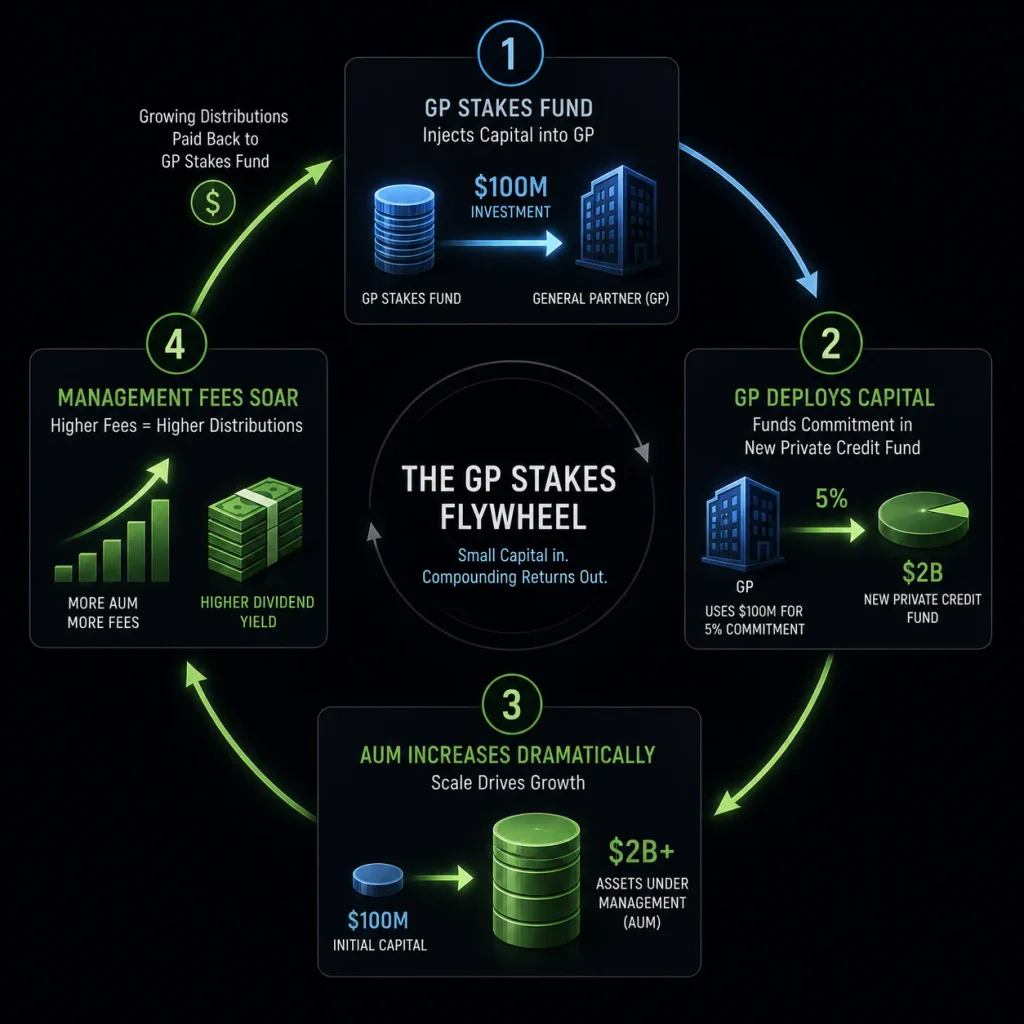
1. The Fundamental Problem: The GP Commitment
When a Private Equity firm (the GP) launches a new $1 billion fund, their investors (LPs) demand that the GP put “skin in the game.” LPs typically require the GP to invest 1% to 5% of their own money ($10M to $50M) alongside the LPs. As a GP successfully grows and launches multiple multi-billion-dollar funds simultaneously, they physically run out of personal cash to meet these mandatory commitments.
2. The Core Mechanism: The Minority Acquisition
A GP Stakes fund approaches the Private Equity firm. The fund offers a massive upfront cash payment in exchange for a minority, non-controlling equity stake (usually 10% to 25%) in the management company itself. Crucially, the GP Stakes fund takes no board seats and demands zero voting rights regarding day-to-day investment decisions, leaving the original founders in complete control.
3. Technical Depth: Securitizing the Revenue Streams
Once the stake is acquired, the GP Stakes fund is entitled to a pro-rata share of the firm’s economics. This is split into two distinct streams:
- Fee-Related Earnings (FRE): The management fees charged on assets under management (AUM). Because LPs sign 10-year lock-up agreements, this revenue is contractually guaranteed, immune to market crashes, and highly predictable. This forms the “bond-like” dividend yield of the GP Stake.
- Performance-Related Earnings (PRE): The Carried Interest (the 20% cut of the profits when a company is successfully sold). This is volatile and equity-like, providing massive upside during bull markets.
4. Technical Depth: The Capital Deployment
The GP takes the massive upfront cash payment and deploys it strategically. They use it to fund their mandatory 5% GP commitments for their next three funds, hire elite portfolio managers to launch a new private credit division, or buy a smaller boutique firm to expand their geographic footprint. The capital acts as high-octane fuel for AUM growth.
5. Real-World Consequences: The Flywheel Effect
Because the GP used the capital to launch new funds and grow AUM, their Management Fees instantly increase. Because the GP Stakes fund owns 20% of the firm, their dividend yield instantly increases. The structure creates a perfect alignment of incentives, locking the GP and the Stakes investor into a perpetual, compounding growth flywheel.
Major Players: Blue Owl, Petershill, and Founder Exits
GP Stakes investing has transitioned from a niche experiment into a dominant force driving alternative asset management.
Blue Owl Capital (The Architect): Blue Owl (which merged with Dyal Capital) essentially invented the modern GP Stakes market. They have acquired stakes in titans like Vista Equity Partners, Silver Lake, and Thoma Bravo. Instead of acting as a traditional buyout firm that plans to sell the stake in five years, Blue Owl operates as a permanent capital vehicle. They buy the stake to hold it forever, passing the massive, aggregated management fee dividends directly through to their own institutional investors as a high-yielding, low-risk alternative to bonds.
Goldman Sachs Petershill: Operating out of Goldman’s asset management division, Petershill targets mid-market and boutique GPs. They utilize Goldman’s massive global distribution network to provide “value-add” services to the GPs they buy into. By plugging a boutique real estate firm into Goldman’s global fundraising machine, Petershill artificially accelerates the AUM growth of the GP, instantly boosting the value of their own minority stake.
Founder Succession and IPO Alternatives: When the founders of a $5 billion private equity firm reach retirement age, they face a crisis: they cannot easily sell the firm to a competitor without triggering mass panic among their LPs. Historically, the only option was a grueling public IPO. GP Stakes provide a quiet, private alternative. The founders sell 20% of the firm to a GP Stakes fund, cash out a significant portion of their net worth into their personal bank accounts, and hand the remaining operational control smoothly to the next generation of partners.
Economic & Strategic Impact
The core strategic vulnerability of GP Stakes is the Illiquidity and the Secondary Exit Market.
If you buy a company, you eventually sell it. But GP Stakes are designed as perpetual, minority, non-controlling hold assets. You cannot force the GP to sell the firm, and you cannot force them to go public.
If a GP Stakes fund eventually does need to return capital to its own investors, how do they exit? The industry is aggressively trying to build a secondary market for GP Stakes. We are seeing the rise of “Continuation Vehicles” and GP-led secondaries, where a new GP Stakes fund buys the stake from the old GP Stakes fund. However, this market is still in its infancy. If a macroeconomic crisis hits and liquidity dries up, GP Stakes funds may find themselves permanently trapped in these minority positions with absolutely zero mathematical path to exit.
Advantages
- Bond-Like Resilience: Because Management Fees are legally contracted on 10-year lockups, the cash flow is completely insulated from short-term market crashes, providing a highly defensive yield.
- Asset-Light Leverage: A GP Stakes investor captures the economic upside of billions of dollars of deployed capital without actually having to manage the underlying assets, employees, or portfolio companies.
- Diversification: A GP Stakes fund might own 20% of 15 different Private Equity firms across tech, healthcare, and real estate. This provides massive, cross-sector macroeconomic diversification inside a single investment vehicle.
- Complete Founder Alignment: By structuring the deal as non-voting equity, the GP Stakes fund avoids hostile board takeovers, ensuring the original founders remain fiercely motivated to grow the firm.
Limitations
- Permanent Illiquidity: There is no established, highly liquid public market for 15% stakes in private partnerships. Unwinding the position requires a complex, bespoke secondary transaction.
- The “Double Fee” Layer: Institutional investors putting money into a GP Stakes fund are paying management fees to the Stakes fund, which is in turn capturing management fees from the underlying GP. This “fee-on-fee” structure creates a heavy drag on net returns.
- Adverse Selection: The absolute best, most successful Private Equity firms on Earth (like KKR or Apollo) do not need to sell GP Stakes; they generate enough cash internally. There is a risk that GP Stakes funds are only acquiring stakes in “tier two” managers who are desperate for growth capital.
Common Misconceptions
Misconception: The GP Stakes fund tells the Private Equity firm what companies to buy.
Reality: GP Stakes funds are strictly passive, non-voting investors. They intentionally wall themselves off from the daily investment decisions to avoid legal liability and conflicts of interest.
Misconception: They are buying the companies inside the Private Equity fund.
Reality: They do not own the portfolio companies. They own the management company (the office, the brand, the right to charge fees).
Misconception: This is only for failing Private Equity firms that need a bailout.
Reality: The vast majority of GP Stakes deals target highly successful, rapidly growing firms. The capital is used offensively (to launch new strategies or buy competitors) rather than defensively.
What Most People Miss
The disruptive intelligence value of Cross-Selling and Ecosystem Synergies.
When a mega-fund like Blackstone or Blue Owl buys a stake in a smaller GP, they aren’t just buying cash flow; they are buying a captive audience.
If Blue Owl owns 20% of a mid-market private equity firm, and that private equity firm needs to borrow $500 million to execute a leveraged buyout, where do they go for the loan? They go straight to Blue Owl’s Private Credit division. The GP Stake acts as a massive, structural pipeline to feed high-yield deals back into the buyer’s other business verticals. The GP Stakes ecosystem creates a closed-loop, self-feeding financial cartel that locks out independent commercial banks.
Comparison Table
| Feature | Traditional LP Investment | GP Stakes Investing |
| Asset Owned | Shares in a specific, temporary Fund | Equity in the permanent Management Firm |
| Primary Return Source | Capital gains from selling companies | Management Fees (FRE) and aggregated Carry |
| Volatility / Risk | High (Equity-like risk) | Low to Moderate (Bond-like yield) |
| Duration | 7 to 10 Years | Perpetual / Permanent Hold |
| Influence | Limited Partner Advisory Committee | Passive, Non-Voting |
Case Study
Situation: Dyal Capital (now part of Blue Owl) recognized that institutional investors like massive state pension funds were desperate for high-yield, low-volatility assets. Standard private equity was too volatile, and public bonds yielded practically nothing. Concurrently, highly successful mid-market private equity firms were hitting an AUM ceiling because their partners lacked the personal cash to fund the mandatory 5% GP commitments required to launch larger funds.
Challenge: Create a financial vehicle that could extract the stable, bond-like management fees from these private equity firms and package them into a perpetual dividend product for pension funds, while providing the GPs with the permanent capital they needed to scale.
Solution (The Permanent Capital Vehicle): Dyal Capital launched specialized GP Stakes funds. They approached elite managers (like Vista Equity Partners) and purchased minority stakes. They structured the acquisitions not as temporary buyouts, but as permanent capital investments. Dyal aggregated the management fee streams from dozens of these top-tier firms.
Outcome: Dyal effectively securitized the operational cash flows of the private markets. The massive, diversified stream of management fees provided their institutional LPs with a highly stable, double-digit dividend yield that easily outperformed traditional fixed income. For the GPs, the influx of hundreds of millions of dollars allowed them to effortlessly fund their GP commitments and launch new, multi-billion-dollar credit and real estate funds.
Lessons Learned: The strategy validated that the true, un-leveraged value in alternative assets is not in the portfolio companies, but in the franchise value of the management firm itself. By isolating and monetizing the Fee-Related Earnings (FRE), the industry proved that private equity could be mathematically derisked for conservative institutional capital.
Future Outlook
Next 12–24 Months
The era of Down-Market and Specialist Proliferation. The mega-cap GPs (the top 100 firms globally) have already been heavily saturated by Blue Owl, Petershill, and Blackstone. In the immediate future, new, specialized GP Stakes funds will aggressively target the “middle market”—venture capital firms, specialized infrastructure funds, and niche private credit managers with $1B to $5B in AUM. This will push the securitization model deep into the specialized layers of the global economy.
Next 3–5 Years
The scaling of The GP-Led Secondary Exit. As the original 2015-era GP Stakes funds approach the end of their 10-year lifespans, they face a massive liquidity crisis. How do you sell a perpetual hold asset? The industry will invent the “GP-Stakes Secondary.” We will see massive, structured continuation vehicles where sovereign wealth funds or secondary specialists (like Lexington Partners) buy entire portfolios of GP Stakes from the original buyers. Establishing this secondary liquidity pathway is the absolute prerequisite for the asset class to survive the decade.
Next 10 Years
The Public Market Convergence and Tokenization. By the mid-2030s, the opacity of GP Stakes will face technological disruption. Using blockchain infrastructure (such as the Canton Network), massive asset managers will tokenize their minority GP Stakes. A 20% stake in an elite private equity firm will be fractionalized into millions of tradable digital tokens. This will finally allow retail investors and standard mutual funds to legally buy the underlying management fee yields of Wall Street’s most exclusive casinos, fully integrating the shadow banking system into public liquidity.
Most Likely Scenario
GP Stakes investing permanently alters the DNA of private capital. By injecting permanent, non-voting balance sheet capital into the ecosystem, it fuels the rapid, monopolistic consolidation of the industry. The future belongs to multi-strategy “mega-managers.” GP Stakes ensure that the most successful firms never run out of the capital required to absorb their smaller competitors, establishing an impenetrable oligopoly at the pinnacle of global finance.
Key Takeaways
- Traditional investors give money to Private Equity firms to buy companies. GP Stakes investors buy a piece of the Private Equity firm itself.
- The primary goal is to capture a slice of the firm’s “Management Fees.” Because these fees are legally guaranteed for 10 years, it turns risky private equity into a safe, predictable dividend.
- Private Equity founders sell these 20% stakes to get massive amounts of upfront cash without giving up voting control of their company.
- Founders use this cash to launch new funds, buy competing firms, or gracefully retire and pass the firm to the next generation.
- Firms like Blue Owl and Goldman Sachs dominate this space, operating as massive aggregators that collect management fees from dozens of different Private Equity firms simultaneously.
- The biggest risk is illiquidity. Because you own a minority stake in a private partnership, you cannot easily force a sale or exit the investment if the market crashes.
Glossary
Assets Under Management (AUM): The total amount of money a Private Equity firm controls. The more AUM a firm has, the more management fees they generate.
Carried Interest (PRE): The performance fee. Typically, the Private Equity firm keeps 20% of the profits when they successfully sell a company. It is highly lucrative but volatile.
Fee-Related Earnings (FRE): The highly stable, guaranteed revenue a firm makes simply by charging a 1% to 2% management fee on their AUM, regardless of whether their investments make or lose money.
General Partner (GP): The Private Equity firm itself (the people making the investment decisions and charging the fees).
GP Commitment: The rule that forces the partners of a Private Equity firm to invest their own personal money (usually 1% to 5%) alongside their investors when launching a new fund.
Limited Partner (LP): The institutional investors (pension funds, endowments) that provide the actual money for the Private Equity firm to invest.
Sources
PitchBook: The Evolution and Expansion of GP Stakes Investing
Bain & Company: Global Private Equity Report – The Rise of GP Stakes
Blue Owl Capital: Understanding the GP Capital Solutions Market
Institutional Investor: Monetizing the Management Company: The Economics of GP Stakes
Goldman Sachs Asset Management: Petershill and the Maturation of Private Capital Franchises