Advertisement
)
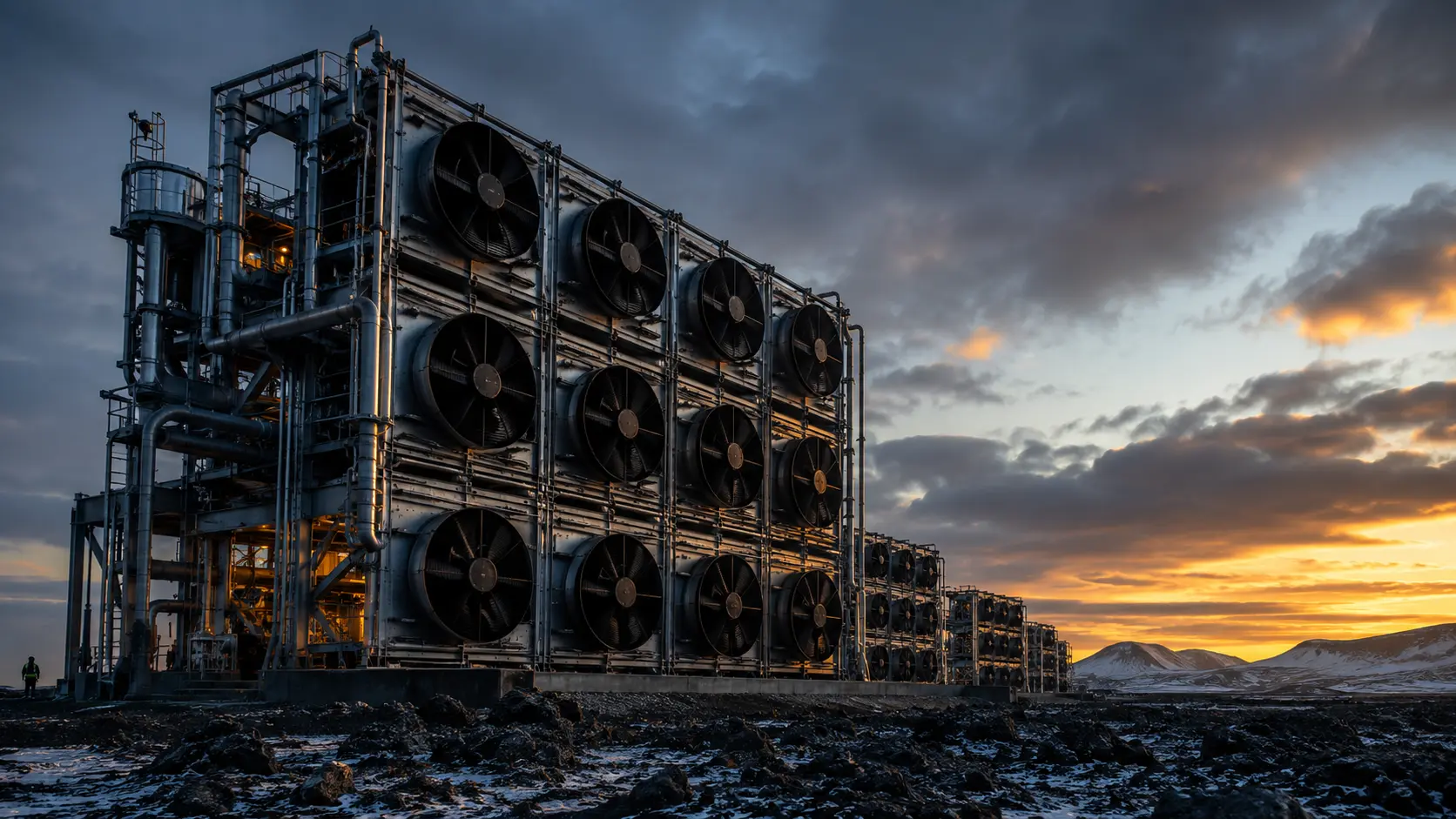

At a Glance
- Concept: Engineering massive industrial facilities to chemically extract historical CO2 emissions directly from the open atmosphere.
- Why it matters: Even if the global economy instantly stops emitting greenhouse gases today, the legacy carbon already in the atmosphere guarantees catastrophic warming. To reverse climate change, humanity must physically remove billions of tons of CO2 from the sky.
- Who uses it: Tech hyperscalers (Microsoft, Amazon) purchasing carbon removal credits, energy giants pivoting to carbon management (Occidental Petroleum), and pure-play DAC engineering firms (Climeworks, Carbon Engineering, Heirloom).
- Biggest takeaway: DAC is not constrained by engineering; it is constrained by the laws of physics. Because CO2 makes up only 0.04% of the atmosphere, gathering it requires moving astronomical volumes of air and applying massive amounts of thermal energy to separate the chemical bonds, making the Levelized Cost of Removal (LCOR) the ultimate hurdle.
In Simple Words
Imagine a massive Olympic swimming pool. Someone drops a single teaspoon of dark blue ink into the water and stirs it until the ink is completely invisible. Your job is to extract that specific teaspoon of ink and put it back into a bottle.
This is the challenge of Direct Air Capture (DAC). Carbon dioxide (the ink) makes up a tiny fraction of the atmosphere (the pool).
To get it out, you cannot just use a coffee filter. Instead, DAC companies build giant walls of fans that pull the air over a specialized chemical “sponge.” This sponge ignores oxygen and nitrogen but acts like a magnet for carbon dioxide. Once the sponge is completely saturated with CO2, it is moved into a sealed chamber and baked with intense heat. The heat forces the sponge to release the CO2 as a pure gas, which is captured and pumped deep underground where it turns to stone. The clean sponge is then cooled down and sent back to the fans to absorb more ink.
Why This Matters
The voluntary carbon market has suffered a massive crisis of trust due to fraudulent “avoided deforestation” credits. Corporations making “Net Zero” pledges are desperate for carbon offsets that provide absolute, undeniable mathematical proof of removal.
DAC provides exactly that. Unlike planting trees—which take decades to grow and can burn down in a wildfire tomorrow—DAC physically measures and weighs the carbon before permanently injecting it into deep geologic saline aquifers. It is the gold standard of permanence.
However, the cost is staggering. The global DAC market is projected to surge toward $22 billion by 2035, but current unit economics are brutal. While a ton of carbon on the legacy offset market might cost $10, a ton of carbon removed via DAC currently costs between $600 and $1,000 on the spot market. For DAC to become a viable climate solution, engineers must radically optimize the chemical kinetics to crush the Levelized Cost of Removal (LCOR) down to the industry target of $100 per ton.
The Big Picture
The difficulty of DAC is governed by the Second Law of Thermodynamics and the Sherwood Plot.
The Sherwood Plot is an empirical rule in chemical engineering stating that the cost of extracting a target material rises exponentially as its concentration decreases.
When you attach a “point-source” carbon scrubber to the smokestack of a coal power plant, the CO2 concentration is roughly 10% to 15% (100,000 to 150,000 parts per million). It is relatively easy and cheap to capture. In the open atmosphere, CO2 concentration is roughly 420 parts per million (0.04%). Because it is so highly diluted, the thermodynamic “minimum work of separation” is vastly higher. You must process nearly 3,000 tons of ambient air just to extract one single ton of CO2.
HOW DIRECT AIR CAPTURE WORKS
Extracting trace gases from the atmosphere requires navigating complex trade-offs between air velocity, chemical binding affinity, and thermal desorption. Here is the first-principles breakdown.
1. The Fundamental Problem: Entropy and Dilution
The atmosphere naturally wants gases to mix evenly (entropy). Reversing this process to isolate pure CO2 requires forcing a chemical reaction. You must introduce a material that binds with CO2 strongly enough to pull it out of the fast-moving air, but weakly enough that you can easily break the bond later to collect the CO2 without using an impossible amount of energy.
2. The Insufficiency of Biological Carbon Removal
Historically, we relied on trees and oceans to absorb CO2. However, biological removal is extraordinarily slow and requires massive land footprints. To remove 1 gigaton of CO2 using forests requires a landmass the size of Texas. Furthermore, biological storage is temporary; when a tree dies and rots, the CO2 returns to the sky. We need an industrial process with a tiny physical footprint that guarantees permanence.
3. The Core Mechanism: The Air Contactor and Desorption
All DAC systems operate on a two-step cycle:
- Step 1 (The Air Contactor): Massive industrial fans pull ambient air over a high-surface-area structure coated with a sorbent (solid) or solvent (liquid). The CO2 chemically binds to this material.
- Step 2 (Desorption/Regeneration): Once saturated, the material is isolated in a sealed chamber. Thermal energy (heat) and sometimes a vacuum are applied to break the chemical bond. The CO2 is released as a high-purity gas, and the regenerated material is cycled back to the fans.
4. Technical Depth: Liquid Solvents vs. Solid Sorbents
The industry is split into two competing chemical architectures:
- Liquid-DAC (L-DAC): Used by Carbon Engineering (1PointFive). It sprays a liquid potassium hydroxide (KOH) solution that reacts with CO2 to form potassium carbonate. This is fed into a pellet reactor with calcium hydroxide to create calcium carbonate pellets. These pellets must be roasted in a “calciner” at extremely high temperatures—roughly 900°C—to release the CO2.
- Solid-DAC (S-DAC): Used by Climeworks. It uses porous solid filters chemically functionalized with amines. Amines act as chemical hooks for CO2. Because the amine-CO2 bond is weaker than the calcium carbonate bond, S-DAC only requires roughly 100°C of heat (often supplied by a vacuum and low-grade steam) to release the CO2.
5. Real-World Consequences: The Thermal Penalty
The difference in desorption temperatures dictates the factory’s location and energy economics. Because L-DAC requires 900°C, it is incredibly difficult to power with electricity. It typically requires burning natural gas (with its own internal carbon capture system attached) to generate the extreme heat. Because S-DAC only requires 100°C, it can be entirely powered by waste heat from industrial plants or clean geothermal energy (which is why Climeworks builds its flagship facilities in Iceland).
Real-World Applications
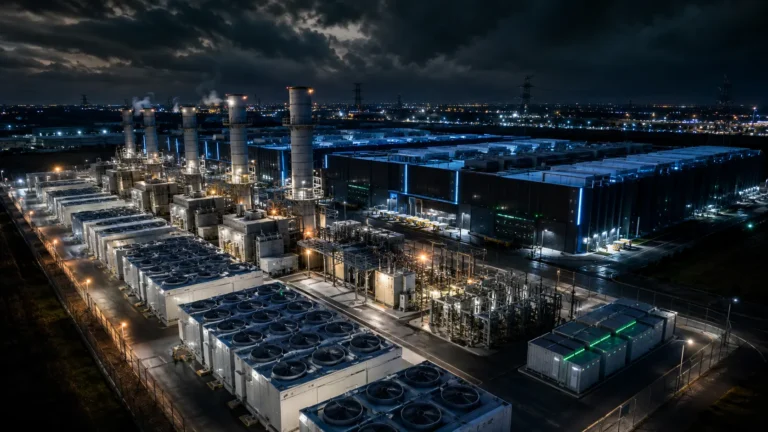
As of 2026, the DAC industry has moved from pilot testing into the construction of multi-hundred-million-dollar commercial mega-facilities.
Project STRATOS (Texas): Developed by 1PointFive (a subsidiary of Occidental Petroleum) using Carbon Engineering’s L-DAC technology. Expected to be the world’s largest DAC plant, STRATOS is engineered to capture 500,000 tons of CO2 annually. The captured carbon is compressed and injected into deep saline aquifers in the Permian Basin for permanent geological storage.
Climeworks Mammoth (Iceland): Switched on in May 2024, Mammoth represents the commercial scale-up of Solid-DAC technology. Designed for a nameplate capacity of 36,000 tonnes of CO2 per year, the facility uses Iceland’s abundant, cheap geothermal energy to power the fans and supply the 100°C heat required for the desorption process. The CO2 is then mixed with water and injected into basalt rock formations via their partner, Carbfix, where it mineralizes into stone within two years.
Limestone-Based DAC (Heirloom): A third emerging pathway leverages natural minerals. Heirloom (operating in California and Louisiana) uses calcium oxide (limestone). By supercharging the natural carbon-absorbing properties of crushed limestone, they capture CO2 and then use an electric kiln to extract the gas. This avoids complex engineered amines or liquid chemicals, offering a potentially lower-cost pathway heavily backed by Microsoft’s climate fund.
Economic & Strategic Impact
The financial viability of Direct Air Capture is entirely dependent on the Levelized Cost of Removal (LCOR).
LCOR calculates the total lifecycle cost of building the plant (CapEx), maintaining it, and powering it (OpEx), divided by the total tons of CO2 it successfully removes over its lifetime.
Currently, LCOR is the existential threat to the industry. Spot purchases for DAC credits hover between $600 and $1,000 per ton. At $1,000 per ton, removing 1 gigaton of CO2 (a fraction of what is required annually by 2050) would cost $1 trillion.
The U.S. Department of Energy established the “Carbon Negative Shot” to drive this cost below $100 per net metric ton. Achieving this requires mass manufacturing the air contactors (modularization), extending the lifespan of the chemical sorbents (which currently degrade after a few thousand thermal cycles), and securing ultra-cheap, zero-carbon electricity to eliminate the parasitic energy load.
Advantages
- Geographic Flexibility: Unlike point-source capture (which must be built on top of a steel or cement factory), DAC plants can be built anywhere. They are optimally placed directly over ideal geologic storage sites (like saline aquifers or basalt formations) with access to stranded renewable energy.
- Permanent and Verifiable: Once injected underground, the carbon is locked away for millennia. The amount is metered and mathematically undeniable, solving the monitoring, reporting, and verification (MRV) crisis plaguing nature-based offsets.
- Minimal Land Footprint: DAC facilities remove vastly more CO2 per square acre than the densest forests on Earth, freeing up arable land for global agriculture.
Limitations
- Astronomical Energy Demands: DAC is exceptionally power-hungry. If a DAC plant is powered by a grid that still burns coal or standard natural gas, the emissions generated to power the fans and heaters will exceed the amount of CO2 the plant captures.
- Sorbent Degradation: The extreme temperature cycling (heating up to release CO2 and cooling down to capture more) physically destroys the chemical sorbents over time. Replacing these chemicals adds massive operational costs.
- Water Intensity: Many L-DAC systems lose significant amounts of water to evaporation as millions of tons of dry air blow through the liquid contactors, creating resource conflicts in arid regions like Texas or the Middle East.
Common Misconceptions
Misconception: DAC is basically a giant air filter.
Reality: A filter traps physical particles (like dust or smoke). CO2 is a gas, completely mixed with oxygen and nitrogen at a molecular level. DAC is not a filter; it is an active, continuous chemical processing plant that fundamentally alters molecular bonds.
Misconception: DAC gives fossil fuel companies an excuse to keep polluting.
Reality: While critics argue DAC poses a “moral hazard” by distracting from immediate emissions reductions, the IPCC mathematics are absolute: even if we hit zero emissions tomorrow, we still have to remove billions of tons of legacy CO2 to stabilize the climate. We need aggressive reduction and aggressive removal.
Misconception: DAC plants produce fresh oxygen.
Reality: DAC simply removes CO2 and lets the rest of the air pass through. It does not output pure oxygen like a tree performing photosynthesis; it just strips out the carbon.
What Most People Miss
The hidden danger of the Parasitic Energy Load.
When a DAC company claims they are capturing 500,000 tons of CO2, you must ask: What is the net removal?
If an L-DAC facility uses a natural gas plant to heat its 900°C calciner, that gas plant produces massive CO2 emissions. The DAC facility must first capture the emissions from its own power source before it can start capturing “legacy” CO2 from the ambient air. If the system is inefficient, a massive percentage of the plant’s capability is wasted simply cleaning up its own operational exhaust, drastically inflating the true Levelized Cost of Removal for the end buyer.
Comparison Table
| Feature | Solid-DAC (S-DAC) | Liquid-DAC (L-DAC) | Nature-Based Removal (Reforestation) |
| Capture Medium | Solid amine-functionalized filters | Liquid alkali solvent (KOH) | Biological photosynthesis |
| Desorption Temperature | ~100°C (Low-grade heat / Steam) | ~900°C (High-grade calcination) | N/A |
| Energy Source | Geothermal, Waste Heat, Renewables | Natural Gas (with internal capture) | Solar (Sunlight) |
| Land Footprint | Extremely Low | Low | Extremely High |
| Permanence | Millennia (Geologic storage) | Millennia (Geologic storage) | Decades (High reversal risk) |
| Current Market Phase | Modular commercial scale-up | Mega-facility construction | Mature, but facing severe trust crises |
Case Study
Situation: In the mid-2020s, tech hyperscalers like Microsoft, Shopify, and Stripe recognized that their aggressive “carbon negative” pledges were mathematically impossible to achieve using traditional nature-based offsets due to massive supply quality issues and reversal risks.
Challenge: They required permanent, verifiable carbon removal, but the DAC market was entirely nascent. Projects were unable to secure the massive bank loans required for construction without guaranteed future revenue streams, creating a classic chicken-and-egg financing trap.
Solution (The Corporate Offtake Agreement): The tech giants acted as market-makers. Microsoft signed unprecedented, multi-year advance market commitments. They committed to purchasing hundreds of thousands of tons of future CO2 removal from projects like 1PointFive’s STRATOS and Heirloom’s limestone facilities, at prices estimated between $200 and $300 per ton.
Outcome: These legally binding offtake agreements allowed DAC developers to walk into traditional banks and secure the billion-dollar project financing required to pour concrete. By accepting the “green premium” and paying inflated early-adopter prices, corporate capital directly subsidized the technological learning curve, accelerating the scale-up of the global DAC industry by roughly a decade.
Lessons Learned: In deep-tech climate infrastructure, voluntary corporate capital can successfully bridge the “valley of death” between pilot projects and commercial mega-facilities. However, for DAC to transition from a luxury corporate PR purchase to a globally scaled climate utility, the underlying physics and thermodynamics of the capture process must continue to optimize until LCOR drops below the critical $100 threshold.
Future Outlook
Next 12–24 Months
The industry will eagerly monitor the operational data from the first wave of mega-facilities (Mammoth and the initial phases of STRATOS). The critical metrics to watch are sorbent degradation rates and net-energy consumption. If these plants consume more energy per ton than their engineering models predicted, the path to a sub-$200 LCOR will be severely delayed, potentially stranding early capital investments.
Next 3–5 Years
The emergence of Electro-Swing Adsorption (ESA) and advanced membrane technology. To escape the brutal thermal penalty of heating and cooling massive chemical vats, researchers are developing next-generation electrochemical DAC. These systems use electricity to alter the charge of specialized electrodes, binding and releasing CO2 without requiring any heat. If these technologies successfully transition from the lab to commercial pilots, they could definitively solve the parasitic energy load problem.
Next 10 Years
The battle for the $100/ton threshold. By 2035, the DAC market will experience a brutal consolidation. Technologies that cannot push their LCOR below USD 150/ton will go bankrupt, unable to compete with cheaper biomass-carbon-removal (BiCRS) or enhanced rock weathering. The survivors will likely be highly modular S-DAC units mass-produced on automotive-style assembly lines, shipped globally, and plugged directly into stranded, off-grid solar and wind farms in remote desert regions.
Most Likely Scenario
Direct Air Capture will succeed, but it will never be cheap enough to justify continued fossil fuel emissions. It will establish itself as a highly specialized, expensive utility sector designed explicitly to neutralize the final 5% to 10% of “hard-to-abate” sectors (like aviation and heavy industry) and slowly draw down historical atmospheric debt. The physics of entropy guarantee that DAC will always remain the most difficult and expensive climate solution, but unfortunately, it is the one we can no longer live without.
Key Takeaways
- Direct Air Capture (DAC) chemically extracts CO2 from ambient air, separating a gas that represents only 0.04% of the atmosphere.
- Because CO2 is so highly diluted, the laws of thermodynamics dictate that DAC requires massive amounts of energy to move air and break chemical bonds.
- Liquid-DAC (L-DAC) systems use potassium hydroxide and require extreme heat (~900°C) to release the captured carbon, often relying on natural gas.
- Solid-DAC (S-DAC) systems use amine-functionalized solid filters and require significantly less heat (~100°C), allowing them to run on geothermal or waste heat.
- The primary metric for success is the Levelized Cost of Removal (LCOR). The industry must drive costs from current spot prices of $600–$1,000/ton down to $100/ton.
- DAC provides absolute, mathematically verifiable permanence (by storing CO2 in deep geologic formations), making it the preferred premium offset for risk-averse corporate buyers.
Glossary
Amine-functionalized Sorbent: A solid material engineered with chemical compounds (amines) that have a strong natural affinity to bind with carbon dioxide molecules.
Calcination: An extremely high-temperature industrial process (often ~900°C) used in L-DAC to break down calcium carbonate pellets and release pure CO2.
Levelized Cost of Removal (LCOR): The total lifecycle cost of building, operating, and powering a DAC plant, divided by the total net tons of CO2 it permanently removes from the atmosphere.
Parasitic Energy Load: The amount of energy a system consumes simply to run its own operations, which subtracts from the overall efficiency and net-benefit of the facility.
Point-Source Capture: Capturing CO2 directly at the source of emission (like a factory smokestack) where the concentration is extremely high, making it much easier and cheaper than DAC.
Sherwood Plot: A chemical engineering rule demonstrating that the cost of separating a target material increases exponentially as its concentration in the mixture decreases.
Frequently Asked Questions
Why don’t we just plant more trees?
Trees are essential, but they are not permanent. When a tree burns in a forest fire or dies and rots, all the carbon it absorbed goes straight back into the atmosphere. Additionally, there is physically not enough arable land on Earth to plant the number of trees required to reverse historical emissions without starving the global food supply.
What happens to the CO2 after it is captured?
The most permanent solution is geologic storage. The CO2 is pumped thousands of feet underground into saline aquifers or basalt rock formations. Under extreme pressure, the CO2 reacts with the rock and mineralizes, literally turning into solid stone over a few years, trapping it forever.
Is DAC the same as Carbon Capture and Storage (CCS)?
No. Traditional CCS captures carbon directly from a polluting smokestack before it enters the atmosphere. DAC captures “legacy” carbon that is already floating around in the open ambient air.
If it takes so much energy, doesn’t it cause more pollution?
This is the greatest risk. A DAC plant must be powered by zero-carbon energy (solar, wind, nuclear, geothermal) or heavily abated energy. If a DAC plant is plugged into a coal-powered energy grid, the math reverses, and the plant becomes a net emitter of CO2.
Who pays for this?
Currently, the market is subsidized by government grants (like the U.S. DAC Hubs program) and massive corporations (Microsoft, Amazon, Stripe) who voluntarily purchase the credits at premium prices to meet their ESG and Net-Zero corporate commitments.
Sources
- Market Research Future: Direct Air Capture Market Size, Share, Trends, Forecast 2035 (May 2026)
- Regreener: The 5 Best Direct Air Capture Carbon Credit Projects of 2026 (March 2026)
- Fortune Business Insights: Direct Air Capture Market Size & Share | Forecast Report 2034 (July 2026)
- Carbon180: Direct Air Capture – Pathways, Challenges, and Economics
- Office of Scientific and Technical Information (OSTI): Direct Air Capture Case Studies: Sorbent System (Revision 1)