Advertisement
)

The global economy is racing to adopt hydrogen as the ultimate zero-carbon fuel for heavy industry, shipping, and aviation. However, this transition harbors a dirty secret: currently, 95% of the world’s hydrogen is produced by boiling natural gas in a process that vents nearly a billion tons of carbon dioxide (CO₂) into the atmosphere every year. The proposed “green” alternative—using massive arrays of solar panels to split water—requires such staggering amounts of electricity and fresh water that scaling it globally could take decades. The energy transition is effectively trapped between cheap but polluting chemistry, and clean but prohibitively expensive physics.
Why should you care right now? Because industrial engineers have found a loophole in fossil fuel chemistry. By utilizing extreme heat in the absence of oxygen, a process known as Direct Methane Pyrolysis splits natural gas perfectly in half. Instead of burning the gas and creating invisible, atmospheric CO₂ this reaction extracts the pure, clean hydrogen and turns the remaining carbon pollution into a physical, valuable black powder. This architecture—classified as “Turquoise Hydrogen”—allows energy companies to monetize the world’s massive natural gas reserves without triggering a climate catastrophe, completely eliminating the need for multi-billion-dollar carbon capture pipelines.
What is Direct Methane Pyrolysis (Turquoise Hydrogen)?
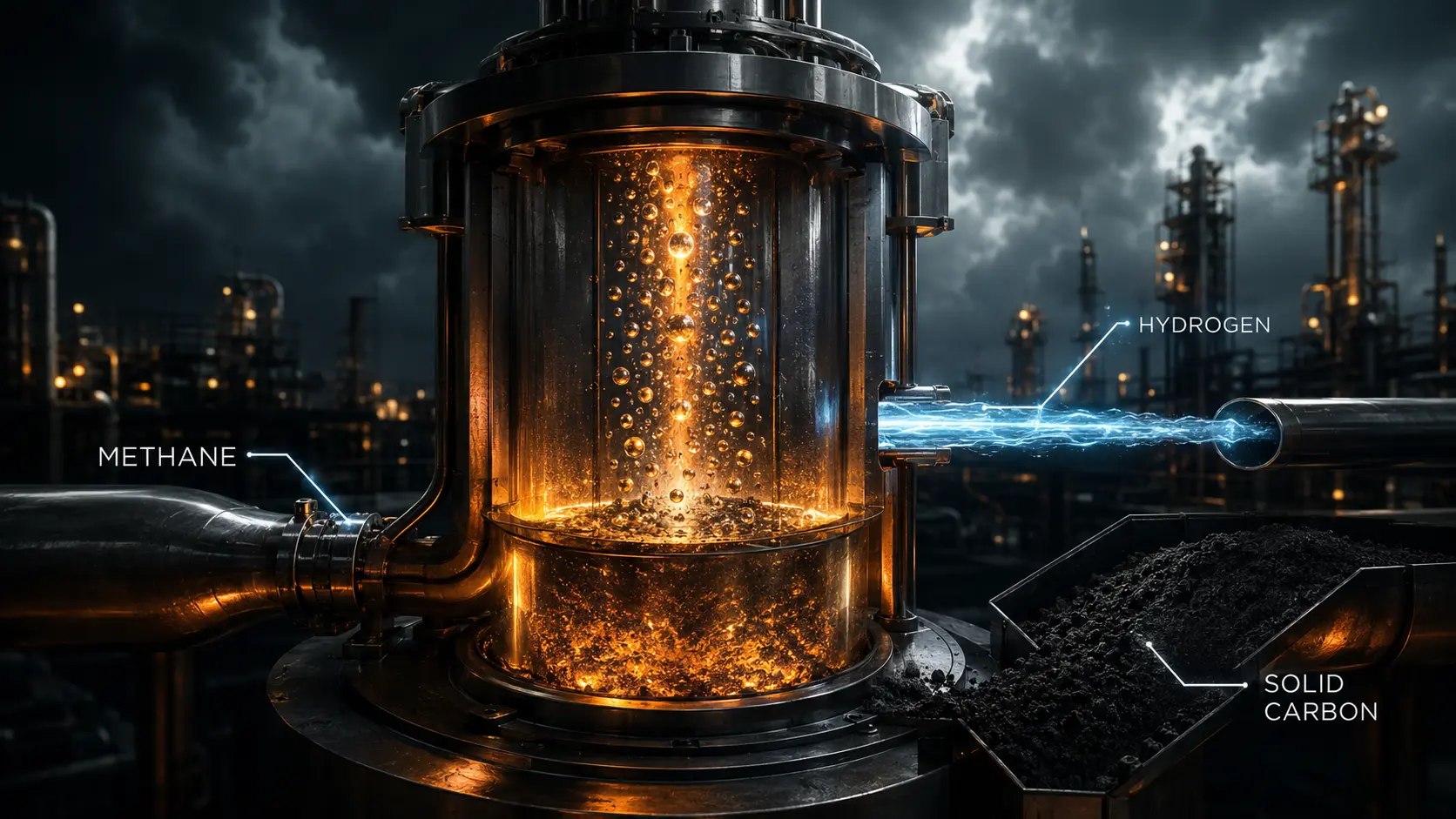
Direct Methane Pyrolysis (Turquoise Hydrogen) is a thermochemical process that uses extreme heat in the absence of oxygen to split natural gas (CH₄) into pure hydrogen gas (H₂) and solid carbon. Because the carbon is captured as a physical solid rather than a greenhouse gas, it enables zero-emission hydrogen production without requiring complex carbon capture and storage (CCS) infrastructure.
At a Glance
- Concept: Baking natural gas until it shatters, separating the clean hydrogen fuel from the polluting carbon, and capturing the carbon as a solid black dust.
- Why it matters: It produces hydrogen with the low emissions of “Green” hydrogen but uses a fraction of the electricity, allowing the fossil fuel industry to decarbonize its core product today.
- Who uses it: Cutting-edge energy startups (Monolith Materials, C-Zero, Hazer Group), petrochemical giants, and industrial tire manufacturers buying the carbon byproduct.
- Biggest takeaway: Traditional “Blue” hydrogen plants must spend billions building pipelines to pump CO₂ gas underground. Turquoise pyrolysis plants skip this entirely by sweeping up solid carbon powder and selling it for a profit.
In Simple Words
Imagine you have a piece of wood.
If you burn the wood in a campfire (like a traditional natural gas power plant), it mixes with the oxygen in the air, releases heat, and creates a massive cloud of toxic smoke (CO₂). The wood disappears into the atmosphere.
If you put that same piece of wood into a sealed steel box with zero oxygen and bake it at 1,000°C (Pyrolysis), it cannot catch fire. Instead, the intense heat breaks the wood down. The useful, flammable gases vent out the top to be used as clean fuel, and what is left sitting at the bottom of the box is a solid lump of pure, black charcoal. You get the energy, but the “smoke” is trapped as a solid physical object you can hold in your hand.
Why This Matters
For Energy Investors, Industrial Engineers, and Commodity Traders, Methane Pyrolysis represents the ultimate Evasion of CCS CapEx.
The current plan to decarbonize the natural gas industry relies on “Blue Hydrogen”—using traditional steam reforming but capturing the CO₂ gas before it escapes. Carbon Capture and Storage (CCS) is an infrastructural nightmare. It requires building massive compressor stations, securing permits for hundreds of miles of high-pressure pipelines, and finding federally approved Class VI underground geological vaults to permanently bury the gas. A pyrolysis plant physically bypasses this entire multi-billion-dollar supply chain. It outputs solid carbon that can be shoveled into standard shipping containers and put on a commercial freight train. It transforms carbon management from an expensive waste disposal problem into a lucrative commodities trading desk.
The Hydrogen Color Spectrum: Grey, Blue, Green, and Turquoise
To understand the energy transition, you must understand the “Hydrogen Color Spectrum”:
- Grey Hydrogen: Made from natural gas. Vents CO₂. (Cheap, dirty, the current standard).
- Blue Hydrogen: Made from natural gas. Captures and buries the CO₂. (Expensive, requires massive pipeline infrastructure).
- Green Hydrogen: Made from water using renewable electricity. (Zero emissions, but requires astronomical amounts of power and fresh water).
- Turquoise Hydrogen (Pyrolysis): Made from natural gas. Outputs solid carbon. (The hybrid: Zero emissions, uses 1/7th the electricity of Green hydrogen, and requires zero CO₂ pipelines).
How Direct Methane Pyrolysis Works
Splitting a methane molecule without creating a carbon dioxide molecule requires an anoxic (oxygen-free), endothermic environment. Here is the first-principles breakdown of the architecture.
1. The Fundamental Problem: SMR and Oxygen
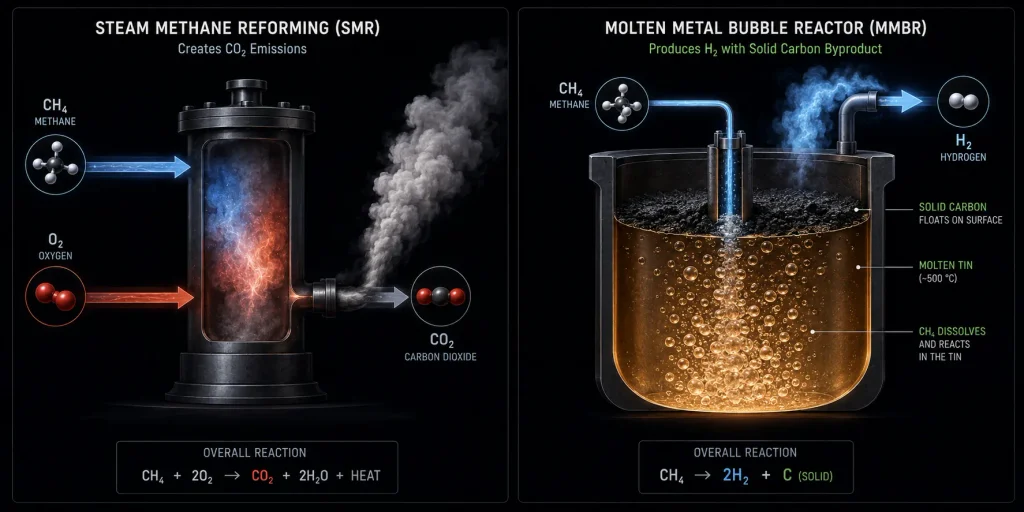
In traditional Steam Methane Reforming (SMR), natural gas (CH₄) is mixed with superheated water/steam (H₂O). The oxygen in the water strips the carbon away, forming carbon monoxide (CO) and eventually carbon dioxide (CO₂), releasing the hydrogen. The inclusion of oxygen makes CO₂ an unavoidable mathematical certainty.
2. The Core Mechanism: Thermal Cracking
Methane Pyrolysis removes oxygen and water from the equation entirely. Methane gas (CH₄) is pumped into an ultra-high-temperature reactor (typically between 800°C and 1,200°C) completely devoid of air.
Under this extreme thermal stress, the strong covalent bonds holding the methane molecule together shatter. The reaction is elegantly simple:
CH₄ + heat → C (solid) + 2H₂ (gas)
3. Technical Depth: The Clogging Dilemma
The chemistry is easy; the physical engineering is incredibly difficult. If you pump methane into a hot, empty steel tube, the carbon turns solid instantly and coats the inside walls of the tube. Within hours, the tube completely clogs with solid carbon blockages (coking), shutting down the factory.
4. Bypassing the Clog: Molten Metal Bubble Column Reactors
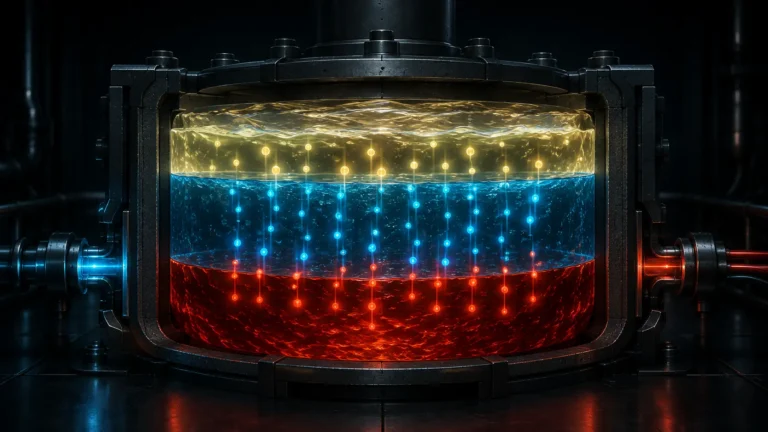
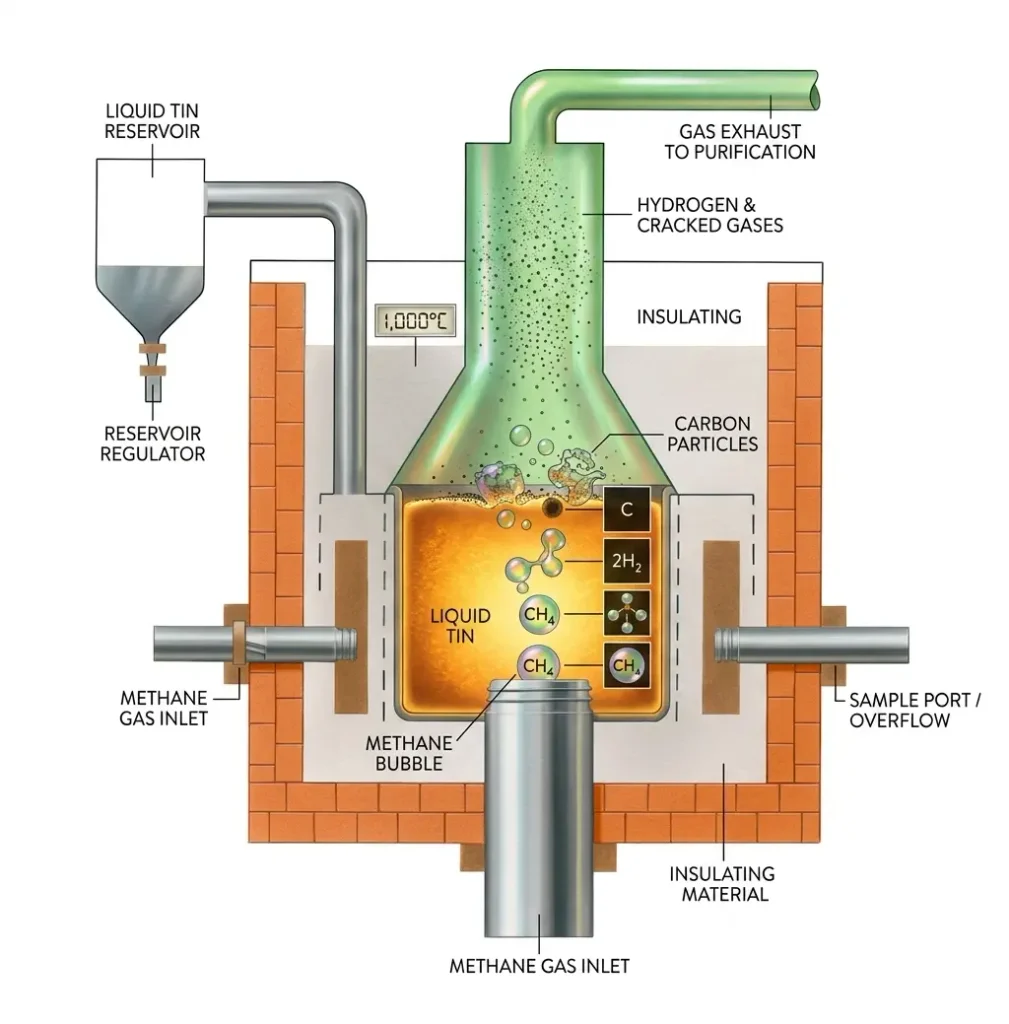
To solve this, advanced engineers utilize Molten Metal Bubble Reactors. Instead of an empty tube, the reactor is filled with a pool of liquid metal (like molten tin or bismuth alloy) kept at 1,000°C.
Methane gas is injected at the very bottom of the pool. As the methane bubbles rise through the scorching liquid metal, they crack. The liquid metal transfers heat into the gas bubble flawlessly, but because the walls of the “tube” are actually moving liquid metal, the solid carbon has nothing to stick to.
5. Real-World Consequences: Skimming the Carbon
When the bubble reaches the surface of the molten metal pool, it bursts. The pure hydrogen gas floats up into a collection pipe. The solid carbon dust, which is lighter than the liquid metal, floats on the surface of the pool like a microscopic layer of black foam. Mechanical scrapers continuously sweep the surface, pulling the dry, solid carbon powder out of the reactor without ever interrupting the continuous flow of the plant.
Commercializing Turquoise Hydrogen: Tires and Green Steel
Turquoise hydrogen is rapidly exiting the R&D phase, driven by the intense commercial demand for its physical carbon byproduct.
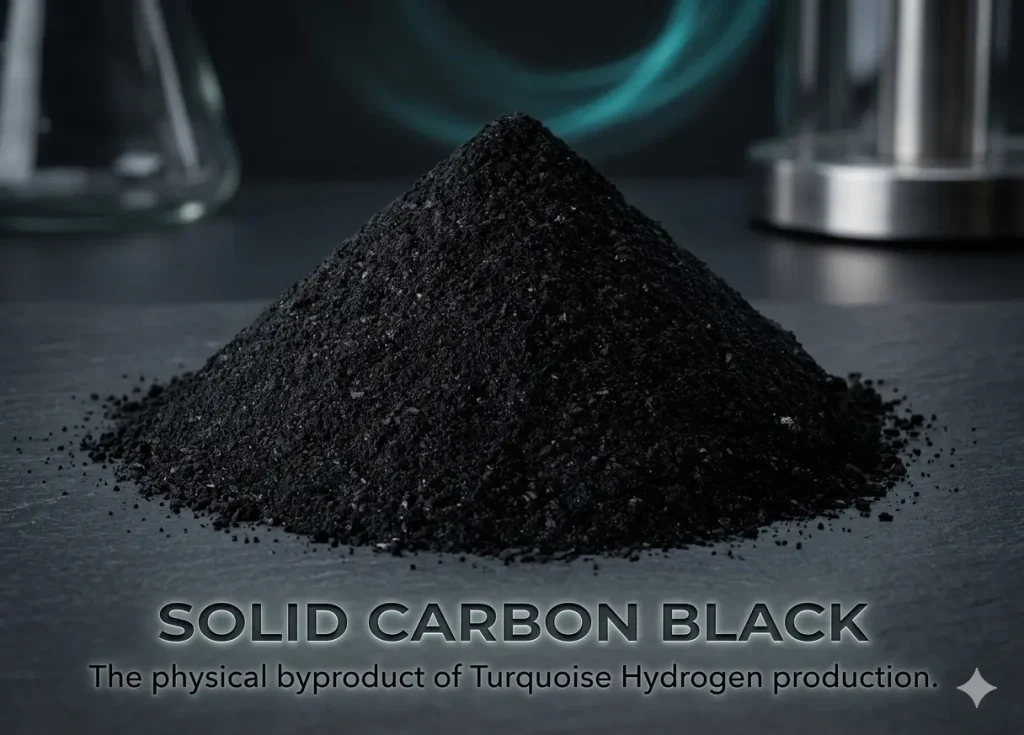
Tire and Rubber Manufacturing: The solid carbon produced by pyrolysis is primarily “Carbon Black.” The global tire industry requires millions of tons of carbon black annually to reinforce rubber and give tires their black color and durability. Currently, industrial carbon black is made by burning heavy petroleum oil, a highly polluting process. Pyrolysis plants can sell their high-purity carbon black directly to companies like Michelin and Goodyear, allowing automakers to aggressively decarbonize the supply chain of their vehicle tires.
Soil Amendment and Agriculture: If the pyrolysis process is tuned differently, it produces a lower-grade carbon known as “biochar” or agricultural carbon. When tilled into farming soil, this solid carbon dramatically improves water retention, harbors beneficial microbes, and acts as a permanent, millennium-long carbon sink, generating massive quantities of verifiable, high-quality carbon removal credits in the voluntary carbon markets.
Decarbonizing Heavy Metallurgy (Green Steel): Steelmaking relies heavily on coal (coke) to act as a reducing agent to strip oxygen away from iron ore. By placing a turquoise hydrogen facility next to a steel mill, the mill can use the pure hydrogen gas to power a Direct Reduced Iron (DRI) furnace, while utilizing the solid carbon byproduct as a clean, low-emission additive to achieve the precise carbon content required for advanced steel alloys, fully internalizing the zero-carbon loop.
Economic & Strategic Impact
The core strategic value of Methane Pyrolysis is its Energy Input Arbitrage.
Green hydrogen (water electrolysis) is universally hailed as the future, but it is bound by harsh thermodynamics. Splitting H₂O requires an immense 50 to 55 kWh of electricity per kilogram of hydrogen.
Methane Pyrolysis relies on the fact that the Carbon-Hydrogen bonds in natural gas are significantly weaker than the Hydrogen-Oxygen bonds in water. Splitting methane requires only about 7 to 10 kWh of electricity per kilogram of hydrogen (to heat the reactor). Because it requires only 1/7th the electrical energy, a Turquoise Hydrogen plant can produce massive, industrial-scale volumes of clean fuel using only a modest, localized solar or wind farm, entirely bypassing the need to grid-lock gigawatts of renewable energy that plague Green Hydrogen mega-projects.
Advantages
- Zero Gaseous Emissions: Because oxygen is excluded from the reactor, it is chemically impossible for the plant to emit CO₂, achieving the clean profile of Green Hydrogen.
- Infrastructure Evasion: Solid carbon can be stored in a warehouse, loaded into a dump truck, and sold globally. It completely bypasses the brutal regulatory permitting, CapEx, and geographic constraints of building pressurized CO₂ pipelines for Blue Hydrogen.
- Low Energy Demand: Consumes a fraction of the renewable electricity required for water electrolysis.
- Dual-Revenue Stream: The plant sells two distinct commodities: premium zero-carbon hydrogen fuel, and industrial-grade carbon black. In many operating models, the sale of the carbon covers the entire operating cost of the facility, making the hydrogen effectively free to produce.
Limitations
- Natural Gas Dependency: Turquoise hydrogen still relies on drilling, extracting, and transporting natural gas. If the upstream natural gas supply chain suffers from “fugitive methane leaks” (methane escaping from pipes into the atmosphere), the climate benefits of the pyrolysis plant are severely degraded, as methane is a hyper-potent greenhouse gas.
- The Carbon Market Saturation Risk: The global market for carbon black is roughly 15 million tons per year. If the entire global hydrogen market switches to pyrolysis, it would output hundreds of millions of tons of solid carbon annually. This would instantly flood and crash the carbon black commodity market, turning a valuable byproduct into worthless landfill waste.
- High-Temperature Metallurgy: Maintaining a commercial-scale reactor at 1,000°C continuously induces severe thermal stress, metal fatigue, and corrosion on the reactor walls, requiring highly advanced, expensive superalloys to prevent catastrophic structural failure.
Common Misconceptions
Misconception: The carbon is burned to make the heat.
Reality: The heat used to run the pyrolysis reactor is usually provided by clean electricity (electric plasma torches or resistive heating) or by burning a small fraction of the generated hydrogen. The carbon from the methane is never burned; it is exclusively preserved as a solid.
Misconception: Turquoise hydrogen is worse than Green hydrogen.
Reality: Assuming the electricity used to heat the reactor comes from renewable sources, and the upstream methane pipes don’t leak, Turquoise hydrogen has an identical “Scope 1” zero-emission profile to Green hydrogen, but achieves it vastly cheaper and faster.
Misconception: It only works with fossil fuels.
Reality: Pyrolysis works on any methane molecule. If a facility captures biogas (methane emitted from rotting cow manure or landfills) and runs it through pyrolysis, the process actually becomes Carbon Negative. It permanently pulls carbon out of the active biological cycle and locks it into solid powder.
What Most People Miss
The disruptive capability of Microwave and Plasma Pyrolysis.
Most analysis focuses on heating a giant steel tube or a vat of liquid metal (Thermal Pyrolysis). What most miss is the aggressive pivot toward electromagnetic chemistry.
Companies are developing reactors that do not heat the walls of the tube at all. Instead, they blast the flowing methane gas with high-power microwaves or cold plasma arcs. These electromagnetic waves target the specific resonant frequency of the Carbon-Hydrogen bond, vibrating the molecule until it shatters instantly. Because the heat is generated inside the gas molecule rather than transferring through the wall of a furnace, the reactor achieves near-instantaneous startup times, drastically improves thermal efficiency, and completely prevents solid carbon from fusing to the cool reactor walls.
Comparison Table
| Feature | Grey Hydrogen (Unabated SMR) | Blue Hydrogen (SMR + CCS) | Green Hydrogen (Electrolysis) | Turquoise Hydrogen (Pyrolysis) |
| Feedstock | Natural Gas + Water | Natural Gas + Water | Water | Natural Gas |
| Energy Input | Moderate | High | Massive (~50 kWh/kg) | Low (~7 kWh/kg) |
| CO₂ Emissions | Massive (Vented) | Low (Captured gas) | Zero | Zero |
| Byproduct State | Atmospheric Gas | Pressurized Gas | Oxygen Gas | Solid Carbon Powder |
| Infrastructure | Standard Pipes | Massive CO₂ Pipelines | Massive Water Supply | Dry Bulk Shipping |
Case Study
Situation: The industrial carbon black market is notoriously dirty. Manufacturing the fine black powder required for vehicle tires involves burning heavy “slurry oil,” which emits catastrophic levels of CO₂, NOₓ, and SOₓ Concurrently, the world desperately needed cheap, clean hydrogen.
Challenge: Prove that thermal methane pyrolysis could be scaled from a laboratory experiment into a commercially viable, continuous-flow heavy industrial plant capable of satisfying the stringent quality controls of global tire manufacturers, while producing zero-carbon hydrogen.
Solution (Monolith Materials): Monolith Materials, headquartered in Nebraska, engineered an advanced plasma pyrolysis architecture. By utilizing 100% renewable wind and solar electricity to power intense plasma torches, they heated flowing natural gas to extreme temperatures in an anoxic environment.
Outcome: Monolith successfully commissioned the Olive Creek facility—the first commercial-scale methane pyrolysis plant in the world. The facility continuously outputs high-purity turquoise hydrogen (which is converted into clean anhydrous ammonia for agricultural fertilizer) and premium-grade carbon black. In late 2021, Monolith secured a $1 billion conditional loan guarantee from the U.S. Department of Energy (DOE) and signed massive off-take agreements to supply decarbonized carbon black directly to Goodyear and Michelin.
Lessons Learned: The Monolith deployment validated that the transition to clean hydrogen does not have to be a pure cost-center. By successfully commercializing the solid carbon byproduct, they proved that Turquoise Hydrogen possesses the strongest, most immediate unit economics in the energy transition, capable of decarbonizing two massive, separate global supply chains (agriculture and automotive) from a single facility.
Future Outlook
Next 12–24 Months
The era of Pilot Scale Liquid Metal and Plasma Validation. Through 2026 and 2027, the market will witness the deployment of advanced reactor prototypes moving beyond the initial plasma torch designs. Companies like C-Zero and Hazer Group will aggressively scale their molten-metal and fluid-bed reactor technologies in field tests. The critical metric for success will be proving that these continuous-flow reactors can run for months without clogging, establishing the mechanical reliability required to attract Tier-1 utility capital.
Next 3–5 Years
The scaling of Biogas Carbon-Negative Arbitrage. As corporate ESG mandates tighten, corporations will desperately seek verifiable carbon removal credits. Pyrolysis companies will pivot their feedstock from fossil-fuel natural gas to Renewable Natural Gas (RNG) captured from dairy farms and landfills. By splitting biogas and burying the solid carbon byproduct in concrete or soil, these facilities will become highly lucrative, legally verifiable “Carbon Negative” engines, earning massive premiums from tech giants willing to pay top dollar to offset their historical emissions.
Next 10 Years
The Distributed Industrial Hub Architecture. By the mid-2030s, the dream of a massive, continent-spanning hydrogen pipeline network will largely be abandoned due to crippling infrastructure costs. Instead, Turquoise Hydrogen will win the market through distributed generation. Compact pyrolysis reactors will be built directly on-site at major steel mills, chemical plants, and fueling stations. Because they only require a standard natural gas hookup and a modest electrical connection, they will produce zero-emission hydrogen exactly where it is consumed, eliminating the need to transport highly volatile hydrogen gas altogether.
Most Likely Scenario
Direct Methane Pyrolysis is the necessary pragmatic bridge of the energy transition. Green hydrogen remains mathematically constrained by the sheer lack of available renewable grid capacity. By leveraging the existing, multi-trillion-dollar global natural gas pipeline network, but fundamentally altering the combustion physics at the very end of the pipe, Turquoise Hydrogen offers the fastest, most economically viable path to deploy millions of tons of zero-carbon fuel this decade.
Key Takeaways
- Standard hydrogen production boils natural gas and vents massive amounts of CO₂ pollution into the atmosphere.
- Direct Methane Pyrolysis (Turquoise Hydrogen) uses extreme heat without oxygen to shatter the natural gas molecule, separating it into clean hydrogen gas and solid carbon powder.
- Because no oxygen is present in the reactor, it is chemically impossible for the plant to create or emit carbon dioxide (CO₂).
- Traditional “Blue” hydrogen requires spending billions of dollars on pipelines to pump CO₂ gas underground. Turquoise hydrogen completely bypasses this by sweeping up the solid carbon and selling it for profit.
- The solid carbon byproduct (Carbon Black) is highly valuable and is sold to tire manufacturers, plastics companies, and the agricultural sector.
- Pyrolysis requires only roughly 1/7th of the electrical energy needed to make “Green” hydrogen from water, making it vastly easier to scale on today’s power grid.
Glossary
Carbon Black: A fine, pure black carbon powder. It is a highly valuable industrial commodity used primarily to strengthen the rubber in vehicle tires.
Endothermic Reaction: A chemical reaction that requires a massive input of heat to occur. Splitting methane into carbon and hydrogen is highly endothermic.
Green Hydrogen: Hydrogen produced by splitting water (H₂O) using massive amounts of renewable electricity (electrolysis).
Molten Metal Bubble Reactor: An advanced pyrolysis reactor that pumps methane gas through a 1,000°C pool of liquid tin or bismuth. The bubbles shatter, and the solid carbon floats to the top, preventing the machine from clogging.
Steam Methane Reforming (SMR): The legacy, highly polluting method of making hydrogen by mixing natural gas with hot steam, resulting in massive CO₂ emissions.
Turquoise Hydrogen: The industry color-code for hydrogen produced via methane pyrolysis, characterized by zero gaseous emissions and a solid carbon byproduct.
Sources
Monolith Materials: Plasma Pyrolysis and the Commercialization of Turquoise Hydrogen
C-Zero: Decarbonizing Natural Gas via Molten-Metal Methane Pyrolysis
U.S. Department of Energy (DOE): Advanced Pathways for Clean Hydrogen Production
Hazer Group: The Hazer Process: Methane Pyrolysis for Graphite and Hydrogen
International Energy Agency (IEA): The Future of Hydrogen and Methane Cracking Technologies