Advertisement
)
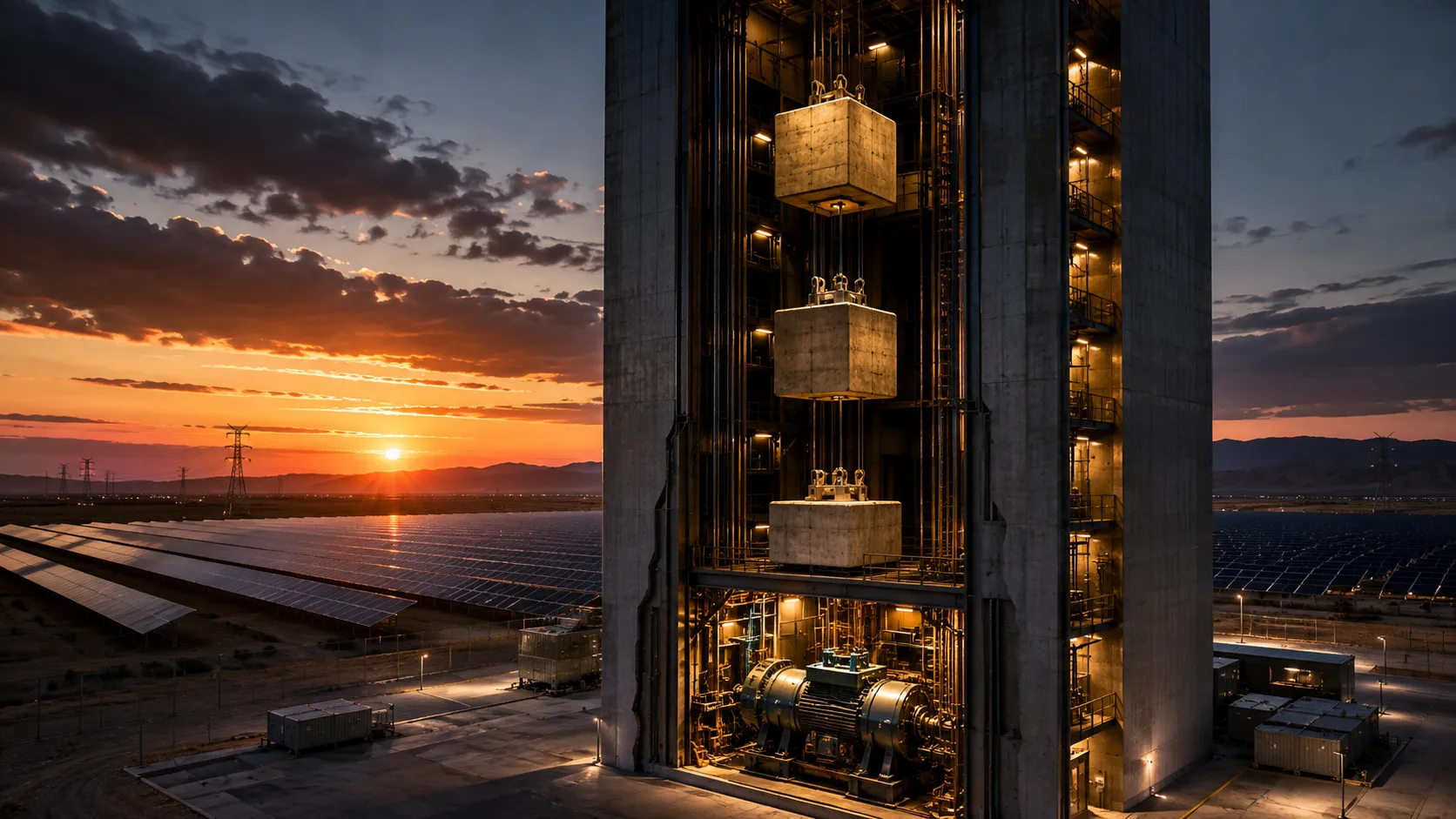

When the sun sets on a massive solar farm, the electrical grid loses gigawatts of power in a matter of minutes. To keep the lights on through the night, utilities must dump that excess daytime solar power into a battery. For the past decade, the default answer has been massive fields of lithium-ion cells. But lithium has a fatal thermodynamic flaw: it degrades. Every time a chemical battery charges and discharges, its internal structure physically fractures, ensuring the multi-billion-dollar asset will be dead in a decade.
Why should you care right now? Because mechanical engineers are abandoning chemistry and returning to high school physics to build a battery that never dies. By harnessing the brutal, inescapable force of gravity, startups are using excess solar power to hoist thousands of tons of concrete blocks high into the air, or dragging massive steel weights up abandoned mine shafts. When the grid needs power, they simply drop the weights. As the blocks fall, they spin massive generators, perfectly releasing the stored energy. This mechanical grid buffering requires zero rare-earth metals, poses zero fire risk, and offers a permanent, zero-degradation energy vault capable of stabilizing the global power grid for a century.
What is a Gravity Energy Storage System (GESS)?
A Gravity Energy Storage System (GESS) is a mechanical battery that stores excess electricity as potential energy. It uses surplus power to physically lift massive weights—such as concrete blocks or compressed earth—against gravity. When energy demand peaks, the weights are lowered, spinning motorized generators through regenerative braking to dispatch electricity back to the grid.
At a Glance
- Concept: A giant mechanical battery. It lifts heavy blocks when electricity is cheap and drops them to spin generators when electricity is expensive.
- Why it matters: Chemical batteries degrade over time and pose extreme fire risks. A gravity battery is made of concrete and steel—it will not degrade, crack, or catch fire, offering infinite cycle life.
- Who uses it: Utility companies, grid operators, and massive industrial parks partnering with startups like Energy Vault and Gravitricity.
- Biggest takeaway: It does not require specific topography. While pumped hydro requires two mountains and a river, GESS can be built on a perfectly flat desert or dropped straight down into an abandoned coal mine shaft.
In Simple Words
Think of an old-school grandfather clock. To make the clock tick, you pull a heavy brass weight to the top of a chain. As gravity slowly pulls that weight downward, the chain spins the internal gears, powering the clock for days.
A Gravity Energy Storage System (GESS) is just a grandfather clock scaled up to the size of a skyscraper.
During the day, when solar panels generate too much electricity, the system uses that extra juice to run a motorized winch, pulling a 30-ton block of concrete to the top of a tower. The energy is now “stored” in the height of the block. At night, when the city needs power, the system releases the brake. As the 30-ton block falls back to the ground, it pulls the cable, spinning the motor backward. The motor acts as a generator, turning the mechanical falling motion directly back into electricity for the grid.
Why This Matters
For Utility Planners, Energy Engineers, and ESG Investors, GESS solves the Long-Duration Energy Storage (LDES) Capital Trap.
The energy transition requires shifting massive amounts of power not just for two hours, but for 12, 24, or 48 hours to survive multi-day storm fronts where wind and solar drop to zero. Lithium-ion batteries scale terribly for LDES; doubling your storage duration means buying twice as many expensive chemical cells.
With GESS, separating power (the size of the motor) from capacity (the amount of heavy blocks) changes the financial math. To double the storage capacity of a gravity battery, you do not need to buy more expensive lithium or cobalt. You simply manufacture more cheap concrete blocks or dig a slightly deeper hole. This decouples capital expenditure (CapEx) from storage duration, making GESS one of the only economically viable pathways to multi-day grid buffering.
The Need for GESS vs. Pumped Storage Hydropower
The gold standard for grid storage has always been Pumped Storage Hydropower (PSH)—pumping water up a mountain and letting it flow back down through a turbine. PSH accounts for over 90% of the world’s current grid storage.
However, we have run out of mountains. Building PSH requires incredibly specific geographical topography, massive environmental disruption, and up to a decade of regulatory permitting to flood a valley. GESS democratizes mechanical storage. It is the geographic unbinding of pumped hydro. A towering GESS facility can be built on flat land right next to a solar farm, or perfectly hidden underground by repurposing the millions of abandoned vertical mine shafts scattered across former industrial heartlands.
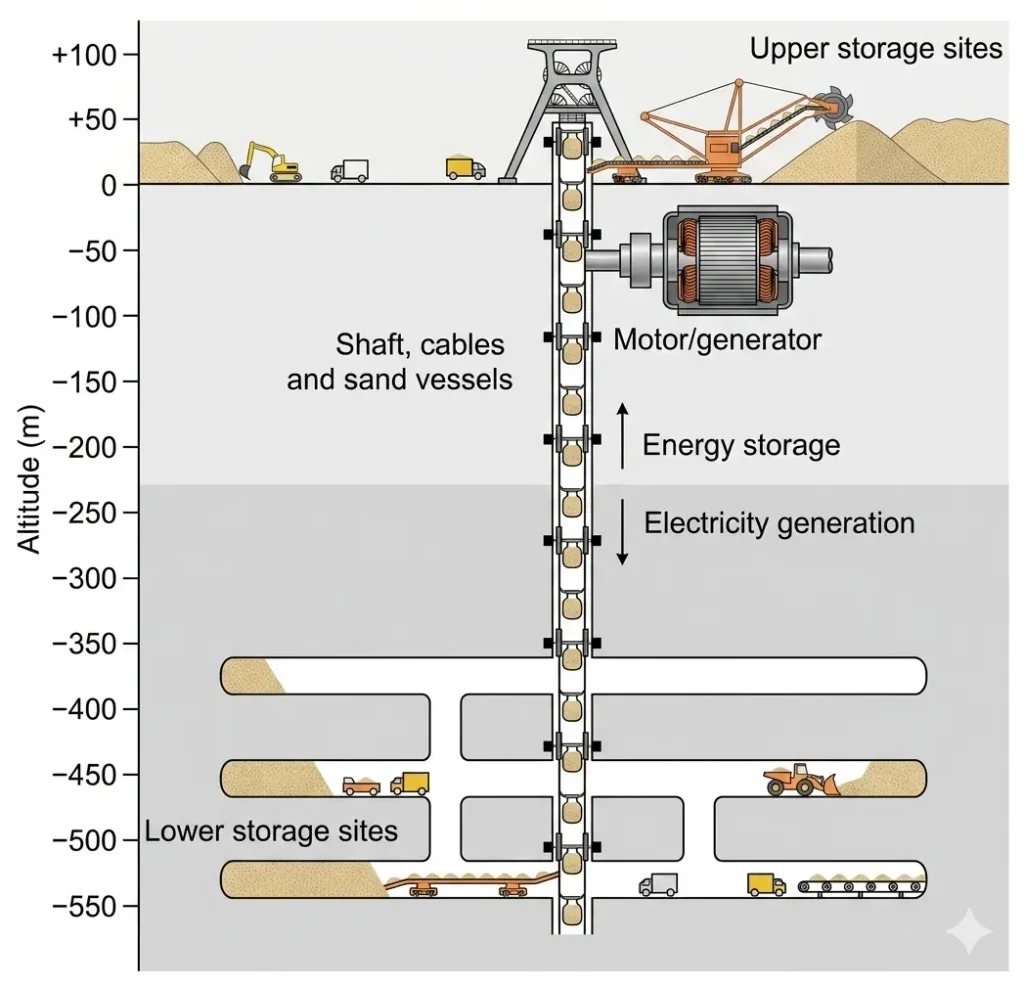
How GESS Works: Potential Energy and Regenerative Braking
Extracting highly regulated, pure, 60-hertz electrical power from a falling block of dirt requires absolute mastery over mechanical engineering and power electronics. Here is the first-principles breakdown of the architecture.
1. The Fundamental Problem: Chemical Entropy
Storing energy in a chemical battery relies on forcing ions into microscopic physical structures (like a graphite anode). This creates physical stress, swelling, and chemical entropy. Over thousands of cycles, the physical structure breaks down, and the battery dies. Mechanical storage avoids chemistry entirely, but historically required water and mountains.
2. The Core Mechanism: Potential Energy Thermodynamics
The entire system operates on the fundamental physics equation for potential energy:
E = mgh
Where energy (E) equals mass (m) multiplied by gravity (g) and height (h). Because gravity is a constant, to store more energy, you must either increase the weight of the blocks (mass) or lift them higher (height). There are no chemical reactions, no electrolytes, and no thermal runaway risks.
3. Technical Depth: Variable-Frequency Drives (VFD)
You cannot just drop a 30-ton block; it would accelerate wildly, snap the cable, and destroy the generator. The system utilizes heavy-duty Variable-Frequency Drives (VFDs) and permanent magnet synchronous motors.
When the grid has excess power, the VFD operates the machine as a motor, drawing power to reel the block upward. When dispatching power, the VFD uses regenerative braking. It precisely controls the descent of the block down to the millimeter per second. By providing exact electromagnetic resistance against the falling weight, the motor spins perfectly in reverse, outputting a smooth, continuous electrical current.
4. Technical Depth: The Orchestration Algorithm
A single block falling only provides a few seconds of power. A commercial GESS (like the Energy Vault EVx) features thousands of blocks and dozens of separate elevator shafts operating simultaneously. A centralized AI orchestration software dictates the choreography. As one block approaches the bottom of its shaft, the software automatically begins dropping a second block in a different shaft. The overlapping power generation guarantees a perfectly flat, uninterrupted electrical output to the local substation.
5. Real-World Consequences: Sunk Cost Recovery
By targeting abandoned deep-shaft coal and gold mines (such as those pioneered by Gravitricity in Europe), utilities leverage a massive economic loophole. The most expensive part of a gravity battery is achieving the drop height (h). By utilizing a 1,000-meter-deep mine shaft that was dug 50 years ago, the utility claims millions of dollars in previously “sunk” capital expenditure, turning a decaying industrial liability into a hyper-profitable grid asset.
Energy Storage Lifecycle Simulator
Mechanical Gravity (GESS) vs. Chemical Lithium-Ion Degradation
0 Cycles
0 (Brand New)
10,000 (End of Life)
Retained Total Capacity
100.0%
Zero mechanical degradation
Round-Trip Efficiency (RTE)
95.0%
High initial chemical efficiency
Commercial GESS Deployments: Energy Vault and Gravitricity
GESS is graduating from computer simulations to physical, megawatt-scale deployments across the globe.
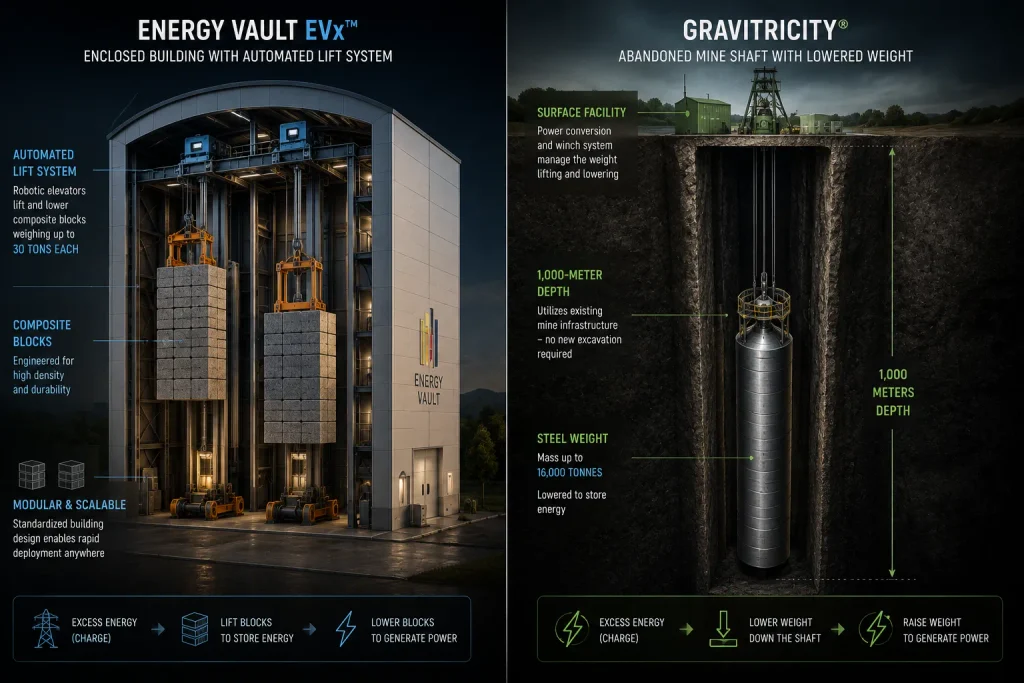
Energy Vault (EVx Architecture): Energy Vault originally prototyped a massive, multi-arm crane that stacked blocks in an open-air tower. Recognizing that heavy winds act as a severe destabilizing force on suspended swinging blocks, they pivoted to the “EVx” architecture. The EVx is a massive, modular, enclosed building that resembles a concrete parking garage. Inside the enclosed structure, automated elevators lift and drop thousands of 30-ton blocks made of compressed local dirt and waste ash. In 2023 and 2024, Energy Vault commissioned its first multi-megawatt, commercial-scale facilities in China, definitively proving the orchestration of solid-mass gravity storage.
Gravitricity and Mine Shaft Repurposing: Based in the UK, Gravitricity is actively targeting the thousands of abandoned mine shafts across Europe and South Africa. Their architecture drops massive, heavily concentrated steel weights (up to 12,000 tons) down shafts that can exceed a kilometer in depth. Because the shaft is completely protected from weather and environmental interference, the winches can operate with absolute precision. This method provides the extreme h (height) variable of the mgh equation without requiring a single building permit for a skyline-obstructing tower.
Advanced Rail Energy Storage (ARES): An alternative to vertical lifting is inclined lifting. ARES utilizes heavy, mass-loaded train cars placed on a steep mountain railway track. During excess solar production, electric motors drive the heavy train cars up the mountain. When power is needed, the cars roll backward down the hill, using their electric traction motors as regenerative brakes to generate power. It is functionally pumped hydro without the need for water, requiring only a steep grade and standard railway track.
Economic & Strategic Impact
The core strategic advantage of GESS is Supply Chain Sovereignty and Earth-Abundant Materials.
The global lithium-ion supply chain is an extreme geopolitical vulnerability, requiring lithium from Australia or South America, cobalt from the DRC, and mid-stream chemical refining dominated entirely by China. If a trade war erupts, a Western nation cannot build chemical batteries.
GESS entirely severs this dependency. The “battery” is made of locally poured concrete, compressed dirt, recycled coal ash, and standard steel cables. The motors are standard industrial VFDs available from global suppliers like Siemens or ABB. A GESS facility can be sourced, manufactured, and constructed using 100% domestic, earth-abundant materials, perfectly insulating national energy grids from international commodity shocks and rare-earth mineral embargoes.
Advantages
- Zero Capacity Degradation: Concrete blocks do not lose their mass. A 30-ton block dropped on Day 1 generates the exact same amount of energy as a 30-ton block dropped on Day 10,000.
- Decoupled Scaling Economics: Increasing the storage duration is as cheap as casting more dirt blocks, making it highly competitive for 12-to-24-hour Long Duration Energy Storage (LDES).
- Intrinsic Safety: Contains zero flammable electrolytes or volatile chemicals. It cannot suffer from thermal runaway, allowing it to be safely co-located next to critical urban infrastructure or data centers.
- Synthetic Inertia: Because the system physically spins heavy mechanical rotors to generate power, it naturally provides rotational inertia to the grid, helping to stabilize alternating current (AC) frequencies against the volatility of wind and solar.
Limitations
- Low Volumetric Energy Density: Chemical batteries pack massive energy into a tiny box. Gravity is a relatively weak force. Storing the equivalent energy of a small lithium-ion shipping container requires lifting thousands of tons of concrete hundreds of feet into the air, necessitating a sprawling, massive physical footprint.
- Mechanical Fatigue: While the “capacity” (the block) never degrades, the moving parts do. Heavy steel cables fray, pulleys wear out, and elevator rails warp under the constant friction of 30-ton loads, requiring rigorous, ongoing mechanical maintenance and lubrication schedules.
- Lower Round-Trip Efficiency (RTE): Lithium-ion batteries can return over 90% of the energy put into them. GESS typically achieves a round-trip efficiency of 80% to 85% due to frictional losses in the cables, gears, and VFD heat dissipation, meaning you “waste” more energy operating the system.
Common Misconceptions
Misconception: Gravity batteries generate free energy (perpetual motion).
Reality: They are strictly storage devices. You must use electricity from the grid to run the motor and lift the block. Because of friction, you will always get slightly less energy out of the falling block than you put in to lift it.
Misconception: If the cable snaps, the block will crash and destroy the facility.
Reality: Commercial GESS architectures use redundant, multi-cable industrial hoist systems identical to those used in mine elevators and skyscrapers. They feature passive, mechanical fail-safe braking systems that instantly lock the block to the guide rails if tension is lost.
Misconception: The blocks will swing in the wind and hit the tower.
Reality: While early open-air crane prototypes struggled with wind sheer and pendulum effects, all modern, commercial-scale GESS deployments (like EVx) are entirely enclosed in heavy modular buildings, completely shielding the mechanics from atmospheric interference.
What Most People Miss
The disruptive intelligence value of Ultra-Fast Response Times (Ancillary Services).
When analysts think of a falling concrete block, they assume it takes minutes to spool up and generate power. In reality, gravity acts instantly.
Because the heavy blocks are suspended in a state of continuous tension on the cables, releasing the electromagnetic brake on the VFD allows the block to begin accelerating and generating power in less than a second. This allows a GESS to compete in highly lucrative “Ancillary Services” markets—such as rapid frequency regulation. If a sudden surge hits the local grid, the gravity battery can instantly absorb or dispatch millisecond-perfect bursts of power, generating massive revenue streams for the utility entirely separate from its primary storage duties.
Comparison Table
| Feature | Lithium-Ion (LFP) | Pumped Hydro (PSH) | Gravity Energy Storage (GESS) |
| Energy Storage Medium | Chemical lattice | Water (mgh) | Concrete / Steel Blocks (mgh) |
| Capacity Degradation | High (Dies in 10-15 years) | Zero | Zero |
| Geographic Constraint | None (Place anywhere) | Extreme (Needs mountains/water) | Low (Flat land or mine shafts) |
| Supply Chain Risk | Extreme (Lithium, Cobalt) | Low (Earth, water, steel) | Low (Concrete, dirt, steel) |
| Round-Trip Efficiency | ~90%+ | ~80% | ~80% – 85% |
Case Study
Situation: As global power grids aggressively phased out coal baseload plants in favor of intermittent solar and wind, the demand for Long-Duration Energy Storage (LDES) skyrocketed. Traditional lithium-ion was deemed too expensive for 12-hour storage and too exposed to supply chain shocks. Utilities needed a mechanical alternative to pumped hydro, but lacked the necessary mountainous topography.
Challenge: Engineer a grid-scale mechanical battery that operates on the reliable physics of pumped hydro, but utilizes solid mass instead of water, allowing it to be deployed on flat topography using cheap, earth-abundant materials.
Solution (The Energy Vault EVx Architecture): Energy Vault commercialized the EVx system, abandoning their earlier open-air crane design for a fully enclosed, modular, elevator-based building. They designed the mobile masses to be cast from hyper-local, cheap materials—specifically soil and toxic coal ash from nearby retiring coal plants—completely eliminating the need to import steel or lithium.
Outcome: In late 2023, Energy Vault connected its first 25 MW / 100 MWh EVx system to the grid in Rudong, China. The facility operates dozens of synchronized elevator shafts lifting 24-ton blocks. The deployment proved that orchestrated, solid-mass lifting could perfectly replicate the smooth, reliable power curves of traditional pumped hydro while being built on entirely flat ground.
Lessons Learned: The Rudong deployment validated the transition from chemical reliance to mechanical ingenuity. It proved that the true value of an energy storage asset is not its raw volumetric energy density, but its lack of degradation. By decoupling capacity scaling from rare-earth supply chains, GESS confirmed its viability as a permanent, multi-decade cornerstone of the zero-carbon grid.
Future Outlook
Next 12–24 Months
The era of Commercial Scale Validation. Over the next two years, the immediate focus will be the operational auditing of the first multi-megawatt GESS deployments in China and the US. Utility operators will rigorously monitor the Round-Trip Efficiency (RTE) to verify it maintains the projected 80% mark, and aggressively audit the mechanical wear-and-tear on the VFDs and steel cables. If the operational maintenance costs remain low, GESS will be rapidly certified as a “bankable” asset class by major infrastructure financiers.
Next 3–5 Years
The scaling of Mine Shaft Rehabilitation (Brownfield Transitions). As global coal and deep-vein mineral mines reach the end of their economic lives, nations are left with massive, toxic liabilities. GESS operators like Gravitricity will partner with massive mining conglomerates (like BHP or Rio Tinto) to instantly convert these dying mines into gravity batteries. This will preserve local union jobs (transitioning miners into mechanical hoist operators) while immediately hooking gigawatt-scale, zero-degradation mechanical batteries directly into the high-voltage transmission lines already built for the old mine.
Next 10 Years
The Hyper-Local Materials Arbitrage. By the mid-2030s, GESS facilities will serve a dual purpose: energy storage and waste remediation. To make the 30-ton blocks as cheap as possible, GESS companies will forge contracts with municipalities to cast their blocks out of unrecyclable urban waste, fiberglass wind turbine blades, and toxic industrial slag. The GESS facility will act as a permanent tomb for the region’s industrial garbage, locking it safely inside concrete blocks that simultaneously stabilize the renewable energy grid for a century.
Most Likely Scenario
Gravity Energy Storage Systems will not replace lithium-ion in the short-duration (2 to 4 hour) market, where chemical density remains king. However, as the grid demands 12, 24, and 48-hour storage to survive deep winter storms, the financial penalty of lithium degradation will become mathematically unbearable. By returning to the foundational, indestructible physics of mgh, GESS will establish itself as the heavy, permanent baseload anchor of the global renewable transition, proving that the best battery doesn’t require a chemistry lab—just a heavy rock and a very tall building.
Key Takeaways
- Lithium-ion batteries break down and lose capacity over time. A Gravity Energy Storage System (GESS) uses solid concrete blocks that never lose mass, meaning the battery never degrades.
- GESS works like a giant grandfather clock. It uses excess daytime solar power to winch 30-ton blocks of concrete high into the air.
- At night, it drops the blocks. As they fall, they pull the cables, spinning the electric motors backward to generate clean, instant electricity for the grid.
- Because the blocks are made from cheap local dirt, coal ash, or waste, GESS is completely immune to the volatile, expensive supply chains of lithium and cobalt.
- Unlike Pumped Hydro (which needs a mountain and a river), a GESS facility can be built on a flat desert or dropped straight down into an abandoned coal mine shaft.
- While it lasts forever and poses zero fire risk, a GESS takes up a massive physical footprint and requires constant mechanical maintenance on its steel cables and pulleys.
Glossary
Ancillary Services: Rapid, micro-adjustments made to the power grid to keep the electrical frequency stable. Because a suspended gravity block can be dropped instantly, GESS can provide these highly lucrative stabilization services in milliseconds.
Capacity Degradation: The process where a chemical battery (like lithium) loses its ability to hold a charge over thousands of uses. GESS blocks have zero capacity degradation.
Long-Duration Energy Storage (LDES): Technologies designed to store electricity for 10, 12, or 24+ hours, filling the massive gaps when the sun isn’t shining and the wind isn’t blowing for days at a time.
Potential Energy (E = mgh): The energy stored in an object because of its height. The math is Mass times Gravity times Height. To store more energy in a GESS, you just make the block heavier or lift it higher.
Regenerative Braking: Using an electric motor to slow down a falling object (like a concrete block). Instead of losing that braking energy as heat, the motor turns the kinetic energy back into electricity.
Variable-Frequency Drive (VFD): The heavy-duty industrial computer and power electronics system that precisely controls the speed of the electric motors lifting and dropping the blocks.
Sources
Energy Vault: EVx Solid Mass Gravity Energy Storage Architecture
Gravitricity: Underground Gravity Energy Storage in Repurposed Mine Shafts
Advanced Rail Energy Storage (ARES): Gravity-Driven Railway Energy Storage
IEEE Spectrum: The Quest for a Gravity Battery
U.S. Department of Energy (DOE): Long-Duration Energy Storage Earthshot