Advertisement
)
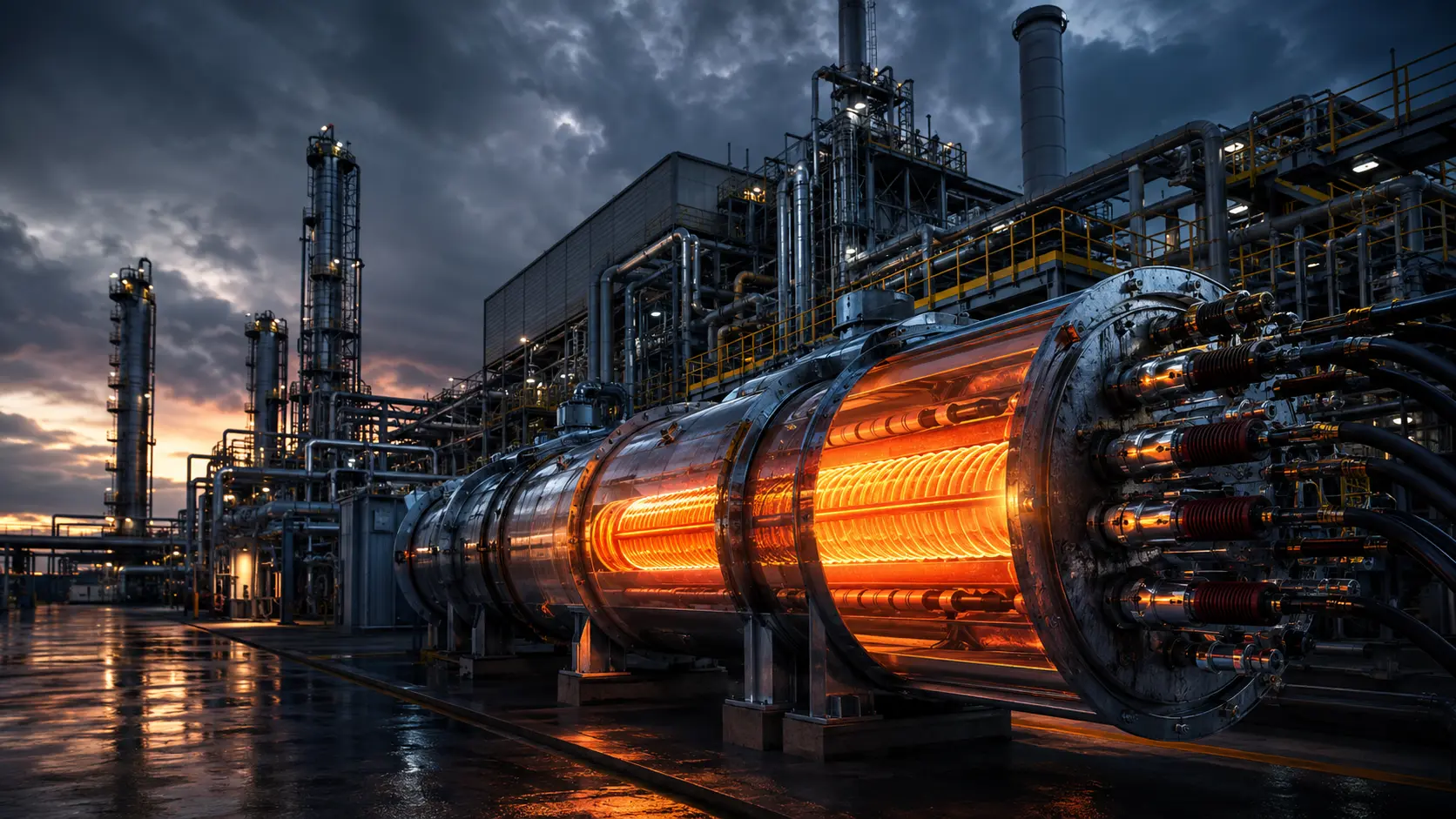

Look around the room you are in right now. The casing of your computer, the insulation on your wiring, the dashboard of your car, and the packaging of your medicine all begin their lives as a single chemical: ethylene. To produce the millions of tons of ethylene required by modern civilization, the petrochemical industry relies on “steam cracking”—a brutal, brute-force process that involves baking hydrocarbons inside massive industrial furnaces until the molecules physically shatter. To reach the required 850°C (1,560°F), these furnaces burn unimaginable volumes of natural gas. Because of this extreme heat requirement, steam cracking is the single most energy-intensive, carbon-heavy process in the entire chemical industry, venting hundreds of millions of tons of CO₂ globally every year.
Why should you care right now? Because the chemical industry is attempting the largest engineering retrofit in its history. Instead of burning gas to create heat, a coalition of the world’s largest chemical companies has successfully figured out how to plug these massive factories directly into the electrical grid. By replacing fossil-fuel combustion with giant electrical resistors, “Electric Steam Cracking” can reach 850°C using pure wind and solar power. This breakthrough threatens to eliminate 90% of the emissions from plastic manufacturing, fundamentally unlinking the future of modern materials from the burning of fossil fuels.
What is Electric Steam Cracking?
Electric steam cracking is an advanced petrochemical manufacturing process that replaces traditional fossil-fuel burners with electric heating elements. By utilizing renewable electricity and Joule heating to reach the 850°C required to break down hydrocarbons into base chemicals like ethylene, the process can eliminate up to 90% of the furnace’s direct carbon emissions.
At a Glance
- Concept: Unplugging a chemical factory from a natural gas pipeline and plugging it into a wind turbine to generate extreme industrial heat.
- Why it matters: Plastics aren’t going away. If we cannot figure out how to make ethylene without burning natural gas, decarbonizing the global economy is mathematically impossible.
- Who uses it: Global chemical monopolies (BASF, SABIC, Dow, Shell) and specialized industrial engineering firms (Linde).
- Biggest takeaway: This technology solves the manufacturing emissions of plastic (Scope 1), making the factory clean. However, it does not solve the end-of-life plastic waste problem in the oceans.
In Simple Words
Think about how you boil water in your kitchen.
For decades, we used Gas Stoves. You ignite natural gas to create a physical flame. The flame heats the pot, and the water boils. This works, but it releases carbon emissions and waste heat directly into your kitchen.
Now, think about an Electric Kettle. You plug it into the wall. Electricity runs through a metal coil inside the kettle. Because the metal resists the electricity, it gets incredibly hot very fast, boiling the water with zero flame and zero localized emissions.
Electric Steam Cracking is simply building an electric kettle the size of an office building. Instead of boiling water to make tea, the chemical industry is “boiling” petroleum gas at 850°C to shatter the molecules and make the building blocks of plastic. By switching from giant gas stoves to giant electric kettles, the factory stops emitting CO₂ entirely.
Why This Matters
For Industrial Engineers, ESG Investors, and Commodity Analysts, electric cracking solves the “Hard-to-Abate” Sector Paradox.
The global economy cannot run exclusively on steel and wood; modern medicine, agriculture, and lightweight electric vehicles require high-performance polymers. Historically, ESG investors shunned the petrochemical sector because there was no technological pathway to produce plastics without massive carbon emissions. The successful demonstration of E-Cracking proves that “green chemistry” is no longer an oxymoron. It provides a viable, scalable CapEx deployment strategy for chemical giants to hit their 2050 Net-Zero targets, fundamentally de-risking their long-term institutional valuations from future carbon taxes.
Decarbonizing Industrial Heat with E-Cracking
There are three ways to decarbonize industrial heat.
- Burn clean Hydrogen (expensive to transport).
- Capture the CO₂ from burning natural gas (expensive to bury).
- Electrify the heat directly.
Electrification is the most elegant solution because it bypasses fluid logistics. You do not need pipelines for hydrogen or CO₂; you only need high-voltage transmission wires. By moving the complexity of decarbonization away from the chemical plant and onto the electrical grid, E-Cracking allows chemical engineers to focus purely on optimizing molecular yields rather than managing toxic gas exhaust.
How Electric Steam Cracking Works: Joule Heating
Achieving a perfectly uniform 850°C across miles of high-pressure chemical piping using electricity requires extreme metallurgical precision. Here is the first-principles breakdown of the architecture.
1. The Fundamental Problem: Endothermic Shattering
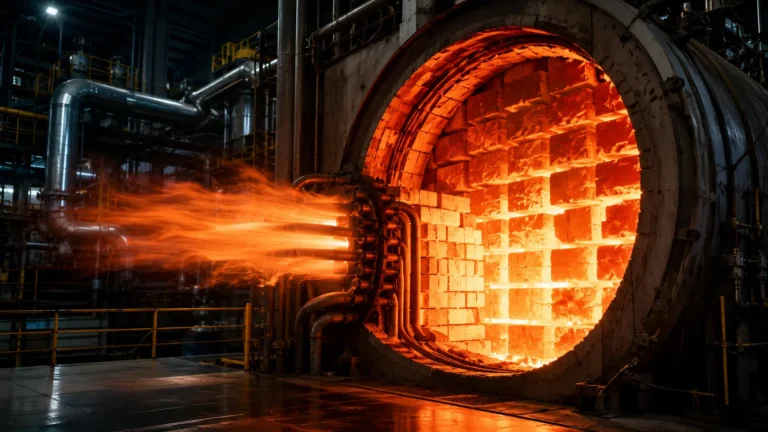
Hydrocarbons (like naphtha) are incredibly stable molecules. To break them apart (cracking), you must apply massive amounts of heat. Because the chemical reaction absorbs heat (endothermic), the furnace must continuously blast energy at the pipes carrying the gas just to keep the temperature from dropping. Traditionally, hundreds of natural gas flames constantly lick the outside of the reactor tubes.
2. The Core Mechanism: Joule Heating
Electric steam cracking replaces the flames with the principle of “Joule Heating” (or resistive heating). When you force a massive electrical current through a material that resists the flow of electricity, the electrical kinetic energy is converted directly into thermal energy (heat). This is the exact same physics used in a toaster, scaled up by a factor of ten thousand.
3. Technical Depth: Indirect vs. Direct Heating
There are two primary architectures being developed to apply this heat:
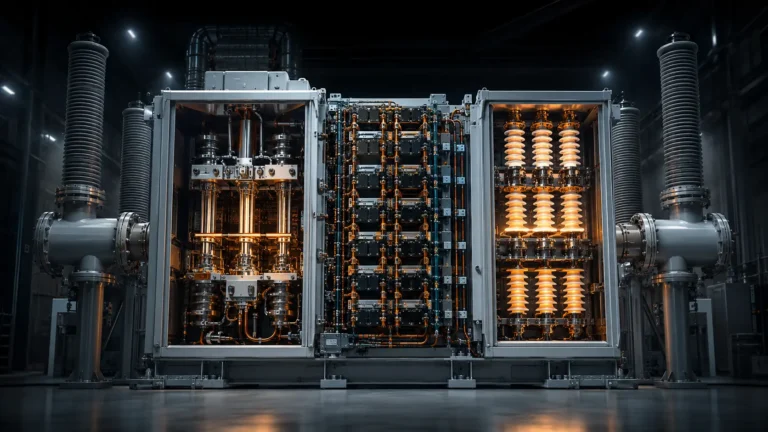
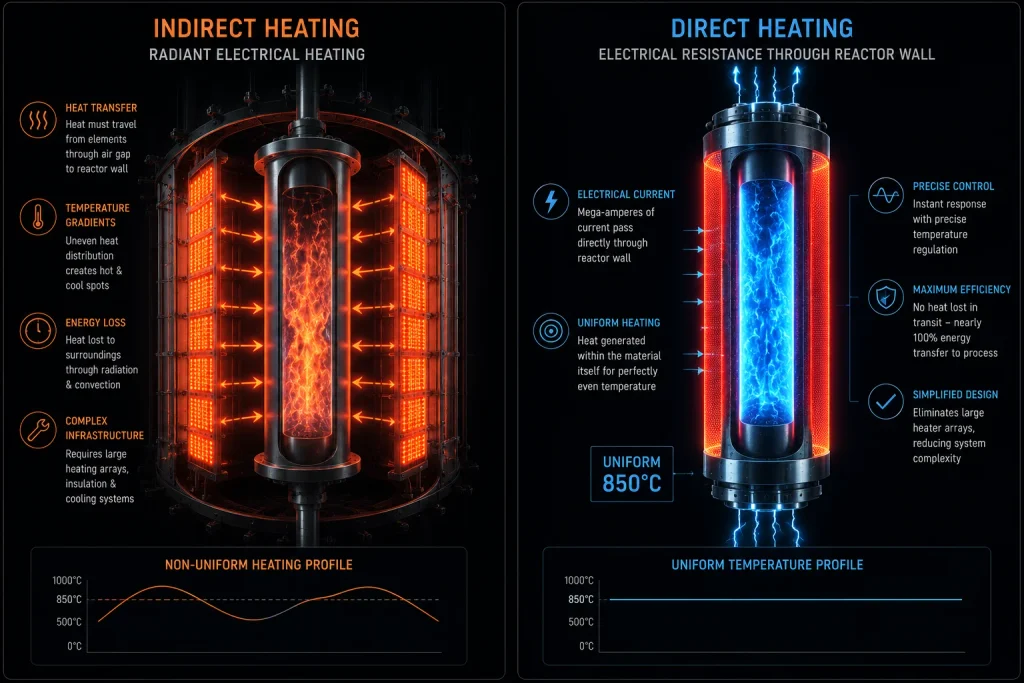
- Indirect Heating: Massive electrical heating elements are placed next to the reactor tubes inside the furnace. The elements get blazing hot and radiate heat onto the tubes, mimicking how the old gas flames worked.
- Direct Heating (The Breakthrough): The reactor tube itself becomes the heating element. An immense electrical current is passed directly through the metal alloy of the pipe carrying the naphtha. As the pipe resists the electricity, the walls of the pipe heat up to 850°C, transferring the heat instantly and uniformly to the gas flowing inside it.
4. Technical Depth: Metallurgical Survival
The primary hurdle of Direct Heating is metallurgy. Passing mega-amperes of electricity through a metal pipe while the inside of the pipe is subjected to highly corrosive, 850°C high-pressure hydrocarbon gas causes extreme physical stress. The alloy must not melt, warp, or crack under decades of continuous thermal cycling. Engineers rely on advanced, proprietary nickel-chromium superalloys designed specifically to balance electrical resistance with extreme structural integrity.
5. Real-World Consequences: Scope 1 Eradication
By completely sealing the furnace and eliminating the combustion of natural gas, the exhaust smokestack of the chemical plant is effectively removed. Assuming the electricity comes from a clean source (wind, solar, nuclear), the direct carbon footprint (Scope 1 emissions) of the ethylene production process drops by 90%.
Commercial E-Furnace Deployments: BASF and Dow
Electric steam cracking has officially exited the laboratory and is currently operational at heavy industrial scales.
The BASF, SABIC, and Linde Demonstration Plant: In mid-2024, these three chemical and engineering titans inaugurated the world’s first large-scale electrically heated steam cracking furnace. Located at BASF’s massive Verbund site in Ludwigshafen, Germany, the plant integrates seamlessly into an existing commercial production line. It processes roughly 4 tons of hydrocarbon feedstock per hour, consuming 6 megawatts of renewable electricity. By proving the technology operates flawlessly in a real-world, continuous-flow environment, the consortium validated the engineering blueprint for global retrofitting.
Dow and Shell’s E-Cracker Consortium: Concurrently in the Netherlands and Texas, Dow and Shell have invested heavily in their own E-Cracker R&D programs. They are specifically focusing on retrofitting existing, legacy furnaces. Rather than tearing down a $5 billion chemical plant, they are engineering drop-in electrical resistor modules that can physically replace the old gas burners inside the existing steel footprint, drastically lowering the initial capital expenditure required for a company to transition.
Dynamic Grid Load Balancing: Chemical plants run 24/7, making them the ultimate baseload consumers. However, wind and solar power fluctuate. E-Furnaces offer a profound secondary application: dynamic load balancing. Because electrical heating can be turned up or down in milliseconds (unlike a massive gas fire, which takes hours to safely adjust), an E-Cracker can act as a shock absorber for the local power grid. When the wind blows hard and electricity is practically free, the plant runs the E-Furnace at maximum capacity.
Economic & Strategic Impact
The core strategic vulnerability of E-Cracking is the Spark Spread Reality.
The “Spark Spread” is the economic difference between the price of natural gas and the price of electricity.
In regions like Europe, where natural gas is heavily taxed or imported at a premium, the math to switch to renewable electricity is compelling. However, in regions like the U.S. Gulf Coast or the Middle East, natural gas is pumped out of the ground at prices so low it is essentially free.
Even if an E-Furnace is technologically perfect, a U.S. chemical plant operator will not switch to electricity if it costs three times more than burning cheap Texas gas. The widespread commercial adoption of E-Cracking relies less on the brilliance of the engineering, and entirely on governments enacting aggressive carbon pricing (Carbon Taxes) to artificially penalize the use of cheap fossil fuels.
Advantages
- 90% Reduction in Scope 1 Emissions: When powered by renewables, it effectively eliminates the direct carbon footprint of the most polluting sector of the chemical industry.
- Precision Temperature Control: Electrical resistance can be modulated instantaneously and perfectly, allowing for a more uniform temperature across the reactor tube, which can actually increase the yield of high-value chemicals compared to the uneven hot-spots caused by gas flames.
- Reduced Localized Pollution: Eliminating combustion removes not just CO₂, but also toxic NOₓ (Nitrogen Oxides) and SOₓ (Sulfur Oxides), drastically improving the air quality for the communities living near the industrial plant.
- Grid Synergy: Fast response times allow the plant to ramp down consumption during grid emergencies, earning the chemical company millions in “Demand Response” payments from the utility operator.
Limitations
- Astronomical Electricity Demand: A full-scale, commercial ethylene cracker powered entirely by electricity would require hundreds of megawatts of continuous power—the equivalent of an entire dedicated nuclear reactor or a massive offshore wind farm just for one factory building.
- Metallurgical Fatigue: The direct heating method runs massive electrical currents through pipes that are simultaneously holding highly pressurized, 850°C hydrocarbon gas. The thermal and electrical stress over a 20-year lifespan risks metal fatigue, cracking, and catastrophic highly-flammable gas leaks.
- No Solution for Scope 3 Emissions: While E-cracking makes the manufacturing of plastic clean, the final product is still plastic. If that plastic ends up in a landfill or the ocean, the environmental crisis persists. It solves the climate problem, but ignores the waste problem.
Common Misconceptions
Misconception: E-Cracking creates “Biodegradable” or “Green” plastic.
Reality: The output of an E-Cracker is exactly the same standard ethylene used today. It makes the exact same indestructible plastic water bottle. The only thing that changes is that the smoke from the factory is eliminated.
Misconception: The electricity goes directly into the gas to break it apart.
Reality: The electricity never touches the gas. The electricity is only used to heat the metal pipe. The heat from the metal pipe is what breaks the gas apart.
Misconception: We will replace all chemical plants tomorrow.
Reality: Chemical crackers are billion-dollar assets designed to run for 40 years. Companies will not tear down a perfectly functional 5-year-old gas cracker. The transition will be agonizingly slow, waiting for legacy plants to naturally reach the end of their operational lifespans before being replaced by E-Furnaces.
What Most People Miss
The disruptive capability of Hybrid Furnace Architecture.
Analysts often view the transition as a binary choice: either 100% Gas or 100% Electric. What they miss is the pragmatic, intermediate step of the Hybrid Furnace.
Companies like Linde are designing furnaces that contain both gas burners and electrical heating elements in the exact same box. Why? To play the commodity markets in real-time. If it is high noon and solar power is cheap, the plant runs on electricity. If a winter storm hits and electricity prices spike, a computer instantly shuts off the electricity and ignites the gas burners. This hybrid approach guarantees the factory never shuts down and always utilizes the absolute cheapest energy source available at any given millisecond.
Comparison Table
| Feature | Traditional Steam Cracker | Electric Steam Cracker (E-Furnace) |
| Heat Source | Natural Gas Combustion | Joule Heating (Electricity) |
| Operating Temperature | ~850°C | ~850°C |
| Scope 1 CO₂ Emissions | Massive | Near Zero (with renewables) |
| Temperature Control | Moderate (Uneven flame hot-spots) | Absolute Precision |
| Primary Economic Hurdle | Carbon Taxes / Regulation | The “Spark Spread” (Price of electricity) |
| Grid Interaction | None | Dynamic Load Balancing / Demand Response |
Case Study
Situation: The global chemical industry faced an existential threat from tightening environmental regulations. Steam cracking of naphtha into olefins represents roughly 70% of the industry’s total greenhouse gas emissions. For companies like BASF and SABIC, achieving their publicly stated Net-Zero by 2050 goals was mathematically impossible without fundamentally reinventing the furnace.
Challenge: Prove that electrical resistive heating (Joule heating) could scale from a laboratory curiosity into a continuous-flow, heavy industrial environment capable of maintaining a stable 850°C without melting the reactor tubes or interrupting chemical yields.
Solution (The Ludwigshafen E-Furnace): In 2021, BASF, SABIC, and Linde secured funding from the German Federal Ministry for Economic Affairs and Climate Action. They engineered two distinct heating concepts in parallel: direct heating (passing current through the process tubes) and indirect heating (radiant elements around the tubes). In 2024, they completed construction of a multi-megawatt demonstration plant at BASF’s flagship site.
Outcome: The demonstration plant successfully integrated into the existing chemical pipeline. It achieved the exact high-temperature cracking yields of a traditional fossil-fuel furnace, but did so silently and without an exhaust smokestack. The project proved that the advanced high-temperature alloys could withstand the electrical and thermal loads simultaneously, clearing the primary technical risk off the board for future mega-scale deployments.
Lessons Learned: The Ludwigshafen project validated that industrial decarbonization is no longer a chemistry problem; it is purely an infrastructure and policy problem. The technology works flawlessly. The only barrier left is securing access to gigawatts of cheap, 24/7 renewable electricity to power it.
Future Outlook
Next 12–24 Months
The era of Hybrid Retrofit Pilots. Over the next two years, we will see the major petrochemical giants (Dow, ExxonMobil, Chevron Phillips) announce pilot retrofits of their existing, aging crackers. They will not build new plants; they will install hybrid electrical units into current factories to test the local grid reliability. These pilots will be heavily subsidized by federal grants (like the U.S. Inflation Reduction Act or the EU Innovation Fund) to offset the high capital costs of the untested metallurgy.
Next 3–5 Years
The scaling of Behind-the-Meter Renewable PPA Integration. As E-Crackers require massive, constant power, chemical companies will stop relying on the public utility grid. Instead, they will sign massive, dedicated Power Purchase Agreements (PPAs) directly with offshore wind farms or next-generation Small Modular Nuclear Reactors (SMRs) built immediately adjacent to the chemical plant. This “behind-the-meter” strategy guarantees the factory has cheap, 100% clean power without paying the public utility transmission fees.
Next 10 Years
The Carbon Border Tax Enforcement. By the mid-2030s, jurisdictions like the European Union will fully enforce the Carbon Border Adjustment Mechanism (CBAM). If a U.S. or Chinese company tries to export plastic to Europe that was made in a dirty, gas-burning cracker, Europe will slap a massive carbon tax on it at the border. This geopolitical tariff will instantly destroy the economic advantage of cheap natural gas. Global chemical companies will be financially forced to transition their entire fleets to Electric Steam Cracking simply to retain access to Western consumer markets.
Most Likely Scenario
Electric Steam Cracking is the inevitable, definitive solution to heavy chemical emissions. The physics are sound, and the demonstration plants are running. However, the transition will be geographically fractured. Europe, driven by high gas prices and strict carbon laws, will electrify rapidly. The United States and the Middle East, addicted to practically free natural gas, will delay the transition as long as politically possible, adopting E-Crackers only when global carbon tariffs mathematically force their hand.
Key Takeaways
- To make the building blocks of plastic, the chemical industry bakes oil and gas at 850°C. Doing this requires burning massive amounts of natural gas, releasing millions of tons of CO₂.
- Electric Steam Cracking (E-Cracking) solves this by replacing the gas fire with electricity. It works exactly like a giant toaster or electric kettle, eliminating 90% of the carbon emissions.
- The breakthrough involves “Direct Heating”—running massive electrical currents directly through the metal pipes carrying the chemicals, causing the pipe itself to glow red-hot.
- BASF, SABIC, and Linde have successfully built and turned on the world’s first industrial-scale E-Cracker in Germany, proving the technology works outside of a laboratory.
- Because electric heaters can be turned on and off instantly, chemical plants can act as “shock absorbers” for the power grid, running at maximum capacity when wind and solar power are cheap and abundant.
- The biggest hurdle is cost. In places where natural gas is dirt-cheap, chemical companies will not spend billions to switch to electricity unless governments force them to with carbon taxes.
Glossary
Demand Response: A program where power companies pay massive factories to temporarily turn off their machines when the power grid is struggling to prevent blackouts.
Endothermic Reaction: A chemical reaction that requires a constant supply of intense heat to occur. (Cracking molecules apart is highly endothermic).
Joule Heating (Resistive Heating): The process of generating heat by forcing an electrical current through a material that resists the flow of electricity (like the glowing wires in a toaster).
Olefins (Ethylene / Propylene): The foundational chemical building blocks produced by steam cracking, used to manufacture almost all commercial plastics, rubbers, and solvents.
Scope 1 Emissions: The direct greenhouse gases emitted by a factory (e.g., the smoke coming out of the factory’s own chimney).
Spark Spread: The financial difference between the cost of natural gas and the cost of electricity. A critical metric that determines whether a factory will burn gas or plug into the grid.
Sources
BASF Corporate: BASF, SABIC and Linde inaugurate the world’s first demonstration plant for large-scale electrically heated steam cracking furnaces
SABIC Technical Review: Electrification of Steam Crackers for a Net-Zero Future
Dow Chemicals: Dow and Shell advance electric cracking technology to decarbonize petrochemical production
International Energy Agency (IEA): The Future of Petrochemicals
Chemical & Engineering News (C&EN): Can the chemical industry electrify its way to zero emissions?