Advertisement
)

AT A GLANCE
- Concept: Offshore Ledgers: Eurodollars are US dollars created and held entirely outside Federal Reserve jurisdiction.
- Concept: Collateral Scarcity: Foreign banks secure overnight dollar loans exclusively using pristine sovereign US Treasury debt.
- Concept: Time Value Distortion: Inversion occurs when panicking banks hoard cash and demand massive short-term liquidity premiums.
- Concept: The Shadow Run: An inverted curve mathematically signals that institutions fundamentally distrust counterparty balance sheets.
HOW A EURODOLLAR YIELD CURVE INVERSION WORKS
The global economy operates on a dual-dollar system. The domestic dollar exists within the United States, strictly monitored and regulated by the Federal Reserve. The Eurodollar is a completely separate entity. It is a US dollar-denominated liability generated on the balance sheet of a commercial bank located outside the United States.
A Eurodollar is not physical cash. It is pure ledger money. When a bank in London issues a dollar-denominated loan to a corporation in Tokyo, the bank creates that Eurodollar out of thin air simply by updating its digital ledger. This system constitutes the largest pool of liquidity on Earth, operating entirely in the shadows of international finance.
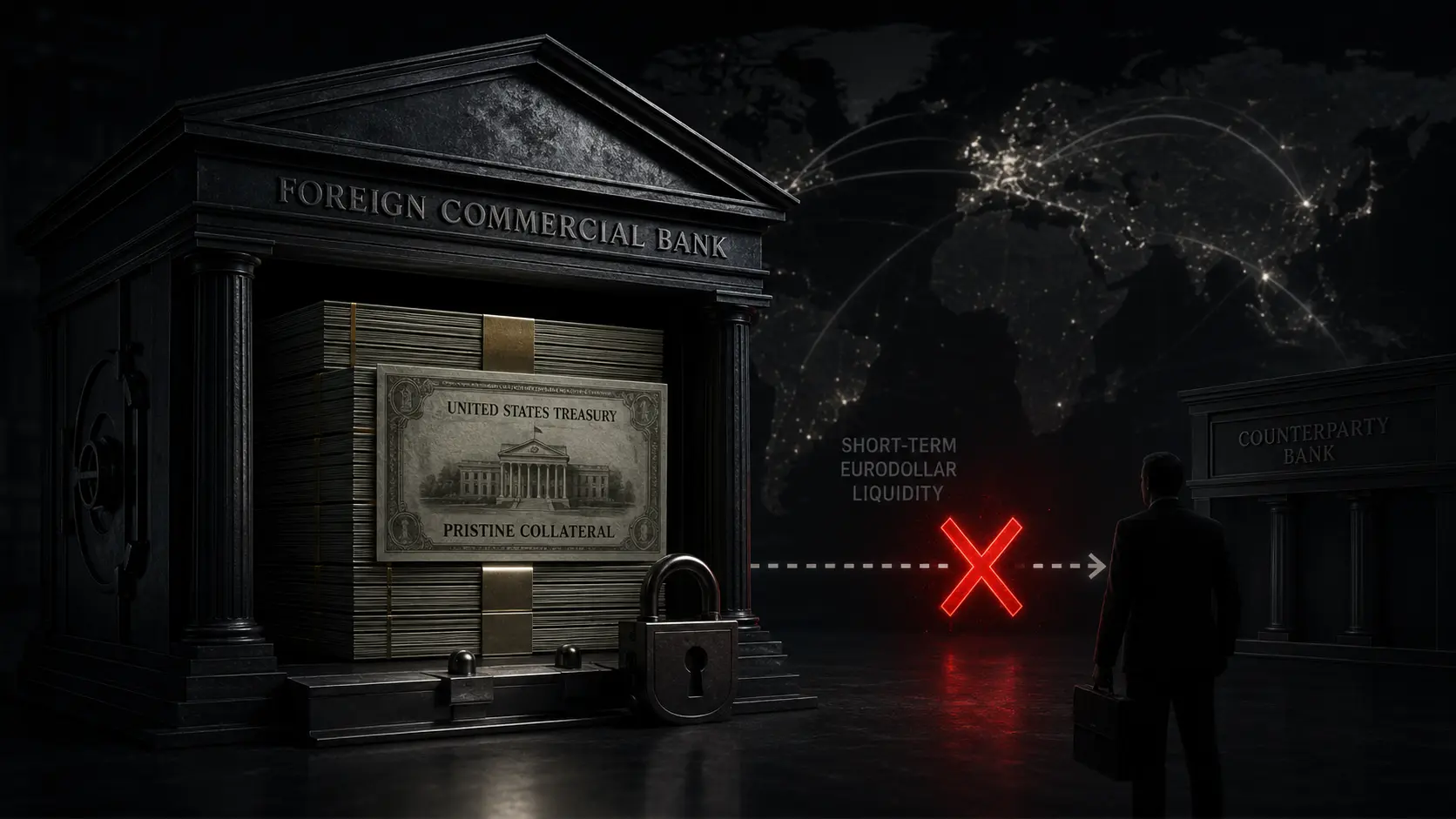
Because these offshore banks do not possess a central bank lender of last resort to bail them out, they cannot lend these synthetic dollars to each other on blind faith. They require pristine collateral. To secure an overnight Eurodollar loan, the borrowing bank must pledge an equivalent value of US Treasury bonds to the lending bank, ensuring absolute safety for the transaction.
Normally, financial mathematics dictate an upward-sloping yield curve. Lending offshore dollars for ten years inherently carries more risk than lending them for three months, so banks charge a higher interest rate for long-term loans. The inversion of this curve breaks the fundamental physics of time value.
When the Eurodollar curve inverts, short-term borrowing rates spike violently above long-term rates. This inversion physically manifests a collateral run. Commercial banks detect hidden insolvency within the offshore network, prompting them to instantly hoard their pristine US Treasuries and aggressively refuse to lend short-term cash. The mathematical inversion documents exactly how much extra yield a bank demands to overcome its immediate terror of counterparty default.
WHY IT MATTERS NOW
The Eurodollar market dictates the physical survival of global trade. When a manufacturer in South Korea purchases raw steel from a supplier in Brazil, the transaction does not clear in Korean Won or Brazilian Real. The global supply chain settles the invoice using offshore Eurodollar letters of credit.
When the Eurodollar futures curve inverts, the total supply of offshore credit physically contracts. Foreign commercial banks stop rolling over 30-day corporate loans. This forces multinational corporations to liquidate their localized assets simply to acquire the scarce dollars needed to pay their immediate physical supply chain debts.
This architectural reality reveals the absolute limits of the Federal Reserve. The American central bank publicly sets domestic interest rates, but it possesses zero direct legal authority over the total supply of global Eurodollars. The Fed cannot force a bank in Switzerland to extend a dollar loan to a bank in Singapore.
During severe offshore dollar shortages, this lack of jurisdiction threatens to freeze the entire shadow banking network. When foreign banks refuse to lend to each other, foreign corporations default, causing a deflationary shock that instantly bleeds back into the domestic American bond market.
To prevent global systemic collapse during these inversions, the Federal Reserve must deploy emergency liquidity swap lines. The Fed prints domestic dollars and swaps them with the European Central Bank or the Bank of Japan, effectively outsourcing the bailout of the Eurodollar market to foreign sovereign entities. The inversion curve signals exactly when this shadow market breaks.
WHAT MOST PEOPLE MISS
Mainstream financial media incorrectly assumes that yield curve inversions are caused entirely by central bank policy errors. They report inversions as a simple mechanical reaction to the Federal Reserve raising the federal funds rate too quickly. This completely misinterprets the autonomy of the offshore financial system.
A Eurodollar inversion represents an organic, private-market rebellion. It proves that massive global commercial banks are actively rejecting the central bank’s optimistic economic narratives. The inversion is a mathematical declaration that private balance sheets are actively positioning for a severe localized default event, completely independent of whatever the Federal Reserve announces in a press conference.
The true danger lies in collateral velocity. A single US Treasury bond in the Eurodollar system is frequently rehypothecated—pledged as collateral up to seven times simultaneously across different interbank loans. When the curve inverts and banks demand the physical return of their collateral, this highly leveraged chain instantly snaps, destroying trillions of dollars in synthetic liquidity overnight.
THE TRAJECTORY
Next 12–36 Months: Acceleration of bilateral currency swaps outside the dollar system. As Eurodollar liquidity remains permanently expensive and inverted due to high baseline rates, BRICS nations will aggressively clear short-term commodity trades using native currencies, attempting to bypass the offshore dollar shortage entirely.
Next Five Years: The tokenization of Eurodollar collateral. Shadow banks will utilize permissioned distributed ledgers to instantly verify and hypothecate US Treasuries across borders. This cryptographic visibility attempts to mathematically eliminate counterparty settlement risk, artificially expanding the velocity of scarce collateral to prevent future inversions.
Next Ten Years: The absolute contraction of the commercial Eurodollar system. The total volume of offshore, unbacked commercial bank dollars will permanently shrink. Central banks will replace this private ledger system by directly issuing Central Bank Digital Currencies (CBDCs) capable of executing atomic, cross-border gross settlement without requiring private bank intermediation.
What Could Go Wrong: A cascading sovereign collateral failure. If a major foreign nation defaults on its sovereign debt, the bonds securing trillions in Eurodollar loans instantly become worthless. This triggers a blind, automated margin call across the entire offshore banking system, freezing global trade finance and physical shipping logistics overnight.
Most Likely Outcome: The Eurodollar yield curve will function as the most accurate, unfiltered warning system for global financial collapse. It will continuously map the physical behavior of private bank survival mechanics, providing a clearer signal of global liquidity than any sovereign central bank policy statement.
KEY TERMS
- Eurodollar: A US dollar-denominated deposit held in a foreign commercial bank outside Federal Reserve jurisdiction.
- Yield Curve Inversion: A financial anomaly where short-term debt instruments carry higher interest rates than long-term instruments.
- Shadow Banking: The network of unregulated financial intermediaries that creates credit outside traditional central bank boundaries.
- Pristine Collateral: Highly liquid, universally trusted financial assets utilized to secure massive overnight offshore interbank loans.
- Rehypothecation: The legal practice where banks reuse the exact same posted collateral to secure multiple distinct loans.
SOURCES
- Bank for International Settlements (BIS) — The Macroeconomics of the Global Eurodollar System and Offshore Dollar Liquidity
- Federal Reserve Board — Foreign Exchange Swaps and the Architecture of Offshore Dollar Funding
- National Bureau of Economic Research (NBER) — Shadow Banking, Safe Assets, and the Mechanics of the Eurodollar Market
- International Monetary Fund (IMF) — Collateral Reuse and the Velocity of Global Dollar Liquidity