Advertisement
)


A global hospital network wants to use a powerful cloud-based Artificial Intelligence to analyze the medical records of one million patients to predict cancer outbreaks. However, under strict data privacy laws like HIPAA and GDPR, sending unencrypted, highly sensitive medical files to a third-party cloud server is completely illegal. Historically, cryptography offered no solution to this deadlock. We know how to encrypt data perfectly while it sits on a hard drive, and we know how to protect it while it travels across the internet. But the moment an AI model actually needs to read the data to do its job, the server has to unlock it. For that brief, vulnerable moment, the data sits completely exposed in the computer’s memory, creating a massive target for hackers, state-sponsored cybercriminals, and insider threats.
Why should you care right now? Because cryptographers have finally engineered the “holy grail” of data security. Through a mathematical breakthrough known as Fully Homomorphic Encryption (FHE), you can now hand a locked box of data to an artificial intelligence. The AI can mathematically reach inside the box, process the data, and hand you back a locked box containing the correct answer—all without ever possessing the key to open it. By completely eliminating the need to decrypt data during computation, FHE is neutralizing the greatest security bottleneck of the 21st century, allowing Fortune 500 companies to leverage external cloud AI without ever surrendering their digital sovereignty.
What is Fully Homomorphic Encryption (FHE)?
Fully Homomorphic Encryption (FHE) is an advanced cryptographic scheme that enables third-party systems to perform complex mathematical computations directly on encrypted data (ciphertext). Because the data is never decrypted during processing, it generates an encrypted result that, when unlocked by the data owner, matches the exact result of the operations as if they had been performed on plaintext.
At a Glance
- Concept: Sending a locked vault to a cloud computer. The computer does math on the vault and gives it back. Only you have the key to open the vault and read the final answer.
- Why it matters: It permanently erases the risk of cloud data breaches. Even if a cloud provider is entirely compromised by hackers, the hackers only steal useless, mathematically scrambled gibberish.
- Who uses it: Banks preventing money laundering, hospitals running predictive AI on patient data, and military intelligence agencies.
- Biggest takeaway: Historically, FHE was too slow to be useful (taking millions of times longer than standard math). A new wave of specialized microchips (ASICs) in 2026 is actively eliminating this speed limit, making real-time encrypted AI a commercial reality.
In Simple Words
Imagine you have a block of pure, highly valuable gold, and you want a master jeweler to craft it into a ring.
In Standard Encryption, you lock the gold in a safe to transport it, but once it reaches the jeweler, they have to open the safe and hold the raw gold in their hands to work on it. For that entire week, the gold is exposed and can be stolen by anyone in the workshop.
In Fully Homomorphic Encryption (FHE), you place the gold inside a heavy steel lockbox that has impenetrable, built-in mechanical gloves. You give the locked box to the jeweler. The jeweler sticks their hands into the gloves and crafts the ring perfectly using the tools inside. The jeweler never actually touches the gold, nor do they possess the key to open the box. When they are finished, they hand the locked box back to you. You use your private key to open the box and retrieve the finished ring, with absolutely zero risk of theft during the entire process.
Why This Matters
For CISOs, Cloud Architects, and Cryptographers, FHE solves the Third-Party Trust Paradox.
Currently, the artificial intelligence revolution is inherently centralizing. To utilize the most powerful AI models, companies must migrate their most valuable proprietary data—financial trading algorithms, unreleased pharmaceutical formulas, and private consumer behavior—into the data centers of mega-corporations like Microsoft, Google, or AWS. This requires absolute, unwavering trust in the cloud provider’s internal security perimeter and employee hygiene.
FHE entirely removes “trust” from the equation. It enables “Zero-Trust Computing.” A bank can utilize a state-of-the-art AI model hosted on an untrusted, public cloud server to analyze its transaction ledgers. Because the cloud provider is computing blindly on ciphertext, the bank receives the elite insights of the AI without surrendering an ounce of intellectual property or violating a single data localization law.
The History of FHE and Craig Gentry’s Breakthrough
The concept of computing on encrypted data was theorized in 1978 by Rivest, Adleman, and Dertouzos, shortly after the invention of modern public-key cryptography (RSA). However, it remained a mathematical pipe dream for 30 years.
In 2009, Craig Gentry, a Stanford researcher, published a dissertation that shocked the cryptographic world. He proved that Fully Homomorphic Encryption was mathematically possible. However, his initial prototype was horrifyingly inefficient—a simple Google search using his encryption would have taken a supercomputer millions of years to calculate. The past fifteen years of the cybersecurity industry have been dedicated entirely to optimizing Gentry’s math, transitioning FHE from an academic curiosity into a deployable enterprise software architecture.
How FHE Works: Lattice-Based Cryptography and Bootstrapping
Achieving Turing-complete computation on scrambled data requires abandoning traditional cryptography (like RSA or AES) and entering the realm of high-dimensional geometry. Here is the first-principles breakdown of the architecture.
1. The Fundamental Problem: The Decryption Bottleneck
Traditional encryption like AES is chaotic; if you change one bit of the encrypted data, the entire message collapses into irreversible garbage. Therefore, traditional encryption requires the data to be decrypted into clean plaintext before a computer’s processor (CPU) can add or multiply the numbers.
2. The Core Mechanism: Lattice-Based Cryptography
FHE discards traditional prime-number factoring and uses Lattice-Based Cryptography. Imagine a perfectly spaced, infinite 3D grid of dots (a lattice). The math relies on the “Learning With Errors” (LWE) problem.
The encryption formula looks like this:
(A · s) + e ≡ b (mod q)
Here, A is a public grid, s is your secret key, and b is the public locked data. The crucial variable is e, which stands for Noise. The encryption injects a small, random amount of mathematical noise to nudge the data slightly off the exact grid points, making it mathematically impossible for a hacker (or a quantum computer) to find the original secret key.
3. Technical Depth: The Noise Budget
Because the data relies on lattices, addition and multiplication preserve the underlying geometric structure. You can add two encrypted numbers together, and the underlying plaintext numbers successfully add together.
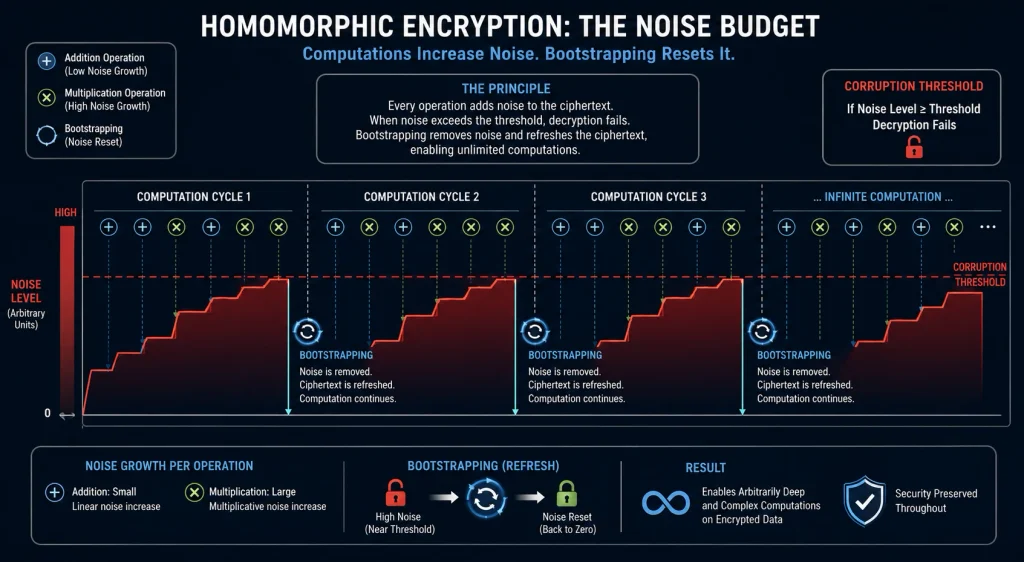
However, there is a severe penalty. Every time you perform an operation, the e (Noise) grows. Addition causes the noise to grow slightly. Multiplication causes the noise to grow exponentially. If you multiply too many times, the noise grows so massive that it drowns out the actual data. The data becomes permanently corrupted and can never be decrypted.
4. Technical Depth: Gentry’s Bootstrapping
If noise kills the data, how can an AI perform trillions of multiplications? This is Craig Gentry’s 2009 breakthrough: Bootstrapping.
Bootstrapping is essentially running the decryption algorithm inside the encryption envelope. Right before the noise budget maxes out, the system wraps the noisy data in a second layer of encryption. It then mathematically evaluates its own decryption key to strip away the first layer of noise, leaving the data clean, refreshed, and ready for infinite computations.
5. Real-World Consequences: 2026 Hardware ASICs
Bootstrapping is computationally excruciating. In software, resetting the noise budget takes massive amounts of processing power, historically resulting in a 10,000x latency penalty. To solve this, the hardware industry is introducing FHE ASICs (Application-Specific Integrated Circuits). By physically hardwiring the silicon chips to execute massive polynomial matrix multiplications (Number Theoretic Transforms) rather than relying on software, the industry is crushing the latency penalty, bringing encrypted AI inference down to near-real-time speeds.
Commercial FHE Deployments: Encrypted AI and Medical Data
The transition from academic mathematics to enterprise deployment is reshaping how highly regulated industries handle deep learning.
Encrypted Medical Diagnostics: The most immediate adoption of FHE is in bioinformatics. A hospital can encrypt thousands of patient MRI scans and send them to a centralized, cloud-hosted neural network. The AI analyzes the scans, detects microscopic tumors, and returns the encrypted diagnoses to the hospital. Because the cloud server never decrypts the images, the hospital complies flawlessly with HIPAA privacy regulations while leveraging multi-billion-dollar computing infrastructure they could never afford to build locally.
Financial AML and Fraud Detection: Banks are legally barred from sharing private customer transaction histories with competing banks. This data silo allows money launderers to avoid detection by splitting illicit transactions across multiple institutions. Using FHE, a consortium of banks can pool their encrypted transaction ledgers into a single, massive database. An AI model can execute Anti-Money Laundering (AML) algorithms across the combined encrypted data, detecting sweeping fraud rings without a single bank ever seeing another bank’s raw customer data.
Secure Biometric Authentication: When unlocking a smartphone or entering a high-security facility, your fingerprint or facial geometry is compared against a saved database. If that database is hacked, your biometric identity is stolen forever. By using FHE, the authentication server stores only an encrypted version of your face. When you scan your face, it encrypts the live scan, compares the two encrypted files mathematically, and returns a simple “Yes/No” match without ever storing or exposing the unencrypted biometric geometry.
Economic & Strategic Impact
The core strategic consequence of FHE is the Eradication of the Data Silo.
In the modern data economy, the most valuable datasets are fiercely protected and legally locked in isolated, on-premise servers. This starves artificial intelligence models of the high-quality, diverse training and inference data required to reach maximum accuracy.
FHE allows for “Secure Multi-Party Computation” (SMPC). Competing pharmaceutical companies, global militaries, or hostile intelligence agencies can collaboratively train and run AI models on their combined, encrypted datasets. The resulting AI becomes exponentially smarter by learning from the global pool of data, yet no single participant ever surrenders their proprietary secrets. FHE transforms data from a hoarded, isolated liability into a fluid, collaborative asset.
Advantages
- Zero-Trust Security: Operates on the assumption that the cloud server is already breached. Hackers capturing the server’s RAM only extract useless, randomized noise.
- Post-Quantum Resilience: Unlike RSA and Elliptic Curve Cryptography (ECC) which will be broken by quantum computers, the lattice-based mathematics underlying FHE are currently believed to be immune to Shor’s algorithm and quantum decryption.
- Regulatory Bypass: Eradicates cross-border data transfer limitations. Because the data remains cryptographically locked, it legally never “leaves” the host country’s sovereignty, simplifying global enterprise compliance.
- Turing Completeness: Thanks to bootstrapping, FHE is not limited to simple addition. It can execute any mathematical function, algorithm, or neural network inference that a standard computer can run.
Limitations
- The Latency Penalty: Despite hardware advancements, processing data homomorphically is significantly slower than plaintext math. Performing heavy backpropagation to train a large AI model on pure FHE remains computationally prohibitive; it is currently optimized primarily for inference (using an already trained model).
- Ciphertext Expansion: Encrypting a file with FHE injects so much noise and mathematical structure that the file size explodes. A 1-Megabyte image can expand into a 100-Megabyte encrypted file, creating severe network bandwidth and storage bottlenecks.
- Compiler Complexity: Writing code that efficiently tracks and manages the “noise budget” without corrupting the data requires a PhD in cryptography. While new FHE Compilers (like Google’s Fully Homomorphic Encryption C++ compiler) automate some of this, seamlessly converting standard Python/PyTorch AI code into optimized FHE circuits remains a brittle, error-prone workflow.
Common Misconceptions
Misconception: FHE hides the data from the AI, so the AI doesn’t know what it’s doing.
Reality: The AI mathematically “knows” what it is doing because the geometry of the data is perfectly preserved during encryption. The AI processes the weights and logic gates exactly as intended; it is only the human server administrator who is blind to the output.
Misconception: FHE requires a completely new internet to work.
Reality: FHE is purely a software and algorithmic layer. You can send FHE ciphertext over standard Wi-Fi, store it on standard AWS servers, and run it on standard (albeit slower) CPUs today.
Misconception: Trusted Execution Environments (TEEs) make FHE useless.
Reality: TEEs (like Intel SGX or AMD SEV) use physical hardware walls on the microchip to process unencrypted data safely. However, TEEs are frequently hacked via side-channel attacks (like Spectre or Meltdown). FHE uses pure math, requiring zero trust in the physical hardware manufacturing chain.
What Most People Miss
The disruptive intelligence value of TFHE (Fast Fully Homomorphic Encryption over the Torus).
When people hear about the horrific slowness of FHE, they are usually referencing older schemes like BGV or BFV, which batch data into massive vectors. These schemes are great for broad analytics but terrible for the specific, non-linear activation functions (like ReLU) required by neural networks.
What analysts miss is the explosive rise of TFHE. TFHE evaluates data bit-by-bit and executes bootstrapping in a matter of milliseconds rather than minutes. Because TFHE represents data exactly like a computer’s fundamental logic gates (AND, OR, XOR), it is infinitely easier to map standard software code into TFHE circuits. This specific mathematical branch is the engine driving the 2026 commercialization of encrypted AI.
Comparison Table
| Feature | Standard Encryption (AES) | Trusted Execution Environment (TEE) | Fully Homomorphic Encryption (FHE) |
| Data in Transit/Rest | Secure | Secure | Secure |
| Data in Use (Processing) | Decrypted (Vulnerable) | Encrypted (Hardware trust required) | Encrypted (Math-based security) |
| Computational Speed | Instant | Near-Instant | Slower (Hardware ASIC dependent) |
| Data Expansion | Minimal (1:1 ratio) | Minimal | Massive (10x – 100x expansion) |
| Quantum Resistance | High (AES-256) | Hardware Dependent | Absolute (Lattice-based) |
Case Study
Situation: A leading pharmaceutical consortium sought to use a highly advanced, cloud-hosted machine learning model to predict protein-folding structures for a new class of oncology drugs. However, the proprietary chemical structures were valued in the billions. Sending the plaintext chemical formulas to a public cloud provider introduced an unacceptable risk of intellectual property theft and corporate espionage.
Challenge: Execute deep neural network inference on the pharmaceutical data using a third-party cloud architecture without ever exposing the proprietary chemical strings to the cloud’s memory or operating system.
Solution (The Zama/Concrete Implementation): The consortium utilized open-source FHE compiler frameworks provided by companies like Zama (developers of the Concrete framework based on TFHE). They encrypted the chemical sequences locally. The massive, encrypted payloads were sent to the cloud. The cloud-hosted AI ran its inference algorithms strictly using homomorphic multiplication and addition, utilizing high-frequency bootstrapping to prevent noise corruption.
Outcome: The cloud server successfully completed the complex protein-folding analysis and returned an encrypted result. The consortium used their local private key to decrypt the file, revealing the highly accurate AI predictions. The cloud provider’s logs recorded only the ingestion and processing of mathematically indistinguishable white noise.
Lessons Learned: The deployment validated that FHE can decouple computational power from data sovereignty. By overcoming the latency constraints through targeted TFHE integration, the consortium proved that organizations no longer have to choose between cutting-edge AI performance and absolute cryptographic security.
Future Outlook
Next 12–24 Months
The era of FHE Co-Processors and Enterprise ASICs. The immediate future belongs to hardware. Startups like Cornami, Optalysys, and major players like Intel are releasing silicon chips designed exclusively to accelerate FHE math. These PCIe plug-in cards will sit next to standard CPUs in data centers, offloading the punishing Number Theoretic Transforms and bootstrapping math from the main processor. This hardware acceleration will drop the latency of encrypted inference to acceptable levels, moving FHE from high-security government contracts into standard enterprise cloud tiers.
Next 3–5 Years
The scaling of Encrypted Foundation Models. As the hardware matures, AI developers will begin offering “FHE-Ready” foundation models. Instead of forcing cloud architects to manually compile messy FHE logic gates, companies like Hugging Face will host models that are natively optimized to accept ciphertext. We will see the launch of “Private LLMs”—services that function exactly like ChatGPT, but guarantee mathematically that the provider cannot read a single word of the user’s prompt or the generated response.
Next 10 Years
The Post-Quantum Cryptographic Standard. By the mid-2030s, the threat of Cryptographically Relevant Quantum Computers (CRQCs) will force a global overhaul of internet security. Because the lattice-based mathematics of FHE are inherently quantum-resistant, FHE will transition from an exotic AI tool into the foundational security layer of the global internet. Cloud computing will default to “blind processing,” where all data aggregation, searching, and algorithmic sorting occurs entirely in the dark, restoring absolute privacy to the digital economy.
Most Likely Scenario
Fully Homomorphic Encryption is the definitive end-state of data privacy. While the current computational overhead is heavy, the combined forces of ASIC hardware acceleration and compiler optimization are erasing the bottleneck at an exponential rate. Within the decade, trusting a cloud provider to protect your unencrypted data will be viewed as an archaic and reckless liability. FHE will transform the cloud into an untrusted, blind utility that executes brilliant intelligence on data it is mathematically forbidden to comprehend.
Key Takeaways
- Standard encryption protects data while it is stored or moving, but the computer must unlock (decrypt) the data to read it or do math on it, exposing it to hackers.
- Fully Homomorphic Encryption (FHE) is a mathematical breakthrough that allows a computer to perform complex math and AI analysis on data while it is still encrypted.
- To keep hackers from guessing the key, FHE injects intentional mathematical “noise” into the data.
- Every time the computer does math on the data, the noise grows. If it multiplies too much, the noise destroys the data.
- In 2009, scientists invented “Bootstrapping,” a way to mathematically clean the noise out of the data mid-calculation without unlocking it, allowing for infinite computations.
- Because FHE is incredibly mathematically heavy and slow on standard computers, the tech industry is launching specialized silicon microchips (ASICs) in 2026 built exclusively to run FHE at real-time speeds.
Glossary
Bootstrapping: The vital mathematical process of cleaning the “noise” out of encrypted data mid-calculation without decrypting it, preventing the data from becoming permanently corrupted.
Ciphertext: Data that has been successfully encrypted and looks like random, unreadable gibberish. (The opposite of Plaintext).
Lattice-Based Cryptography: A highly advanced form of cryptography that relies on complex, multi-dimensional geometric grids. It forms the foundation of FHE and is heavily resistant to quantum computer attacks.
Learning With Errors (LWE): The specific mathematical problem that secures FHE. It relies on taking a perfect equation and intentionally adding a small, random error (noise) to make it impossible to reverse-engineer.
Plaintext: Raw, unencrypted data that can be read by anyone and processed easily by a computer.
Trusted Execution Environment (TEE): A physical, isolated section on a microchip designed to process unencrypted data securely. Often used as an alternative to FHE, but vulnerable to physical hardware hacks.
Sources
IBM Research: Fully Homomorphic Encryption: The Holy Grail of Cryptography
MIT Computer Science & Artificial Intelligence Lab (CSAIL): Computing on Masked Data
Zama: TFHE Deep Dive and Concrete Compiler Framework
DARPA: Data Protection in Virtual Environments (DPRIVE) Hardware Acceleration
Cornami / Intel: Accelerating Fully Homomorphic Encryption on Silicon