Advertisement
)

For the last decade, every major breakthrough in artificial intelligence—from the neural networks guiding self-driving cars to the massive Transformers powering ChatGPT—has relied on a single, unchallenged mathematical foundation: the Multi-Layer Perceptron (MLP). It is the concrete upon which the modern AI industry is built. However, MLPs have a fatal flaw: they are impenetrable black boxes. To make an MLP smarter, engineers must bloat it with billions of parameters. When the AI finally solves a complex problem, no human on Earth can look inside the network and understand exactly how it arrived at the answer. In highly regulated sectors like medical diagnostics, or high-precision fields like quantum physics, relying on an unreadable black box is an unacceptable liability.
Why should you care right now? Because elite researchers from MIT and Caltech have successfully ripped out the concrete foundation of AI and replaced it with something leaner and entirely transparent. Enter the Kolmogorov-Arnold Network (KAN). Instead of using rigid, static nodes and brute-force matrix multiplication, KANs use learnable, fluid mathematical curves called “splines.” This fundamental inversion of the neural network architecture allows a KAN with just 200 parameters to outperform an MLP with 300,000 parameters. For tech investors and MLOps engineers, KANs represent the most significant disruption to neural architecture since the Transformer, offering a path to AI that is not only highly efficient but mathematically interpretable by human scientists.
What are Kolmogorov-Arnold Networks (KANs)?
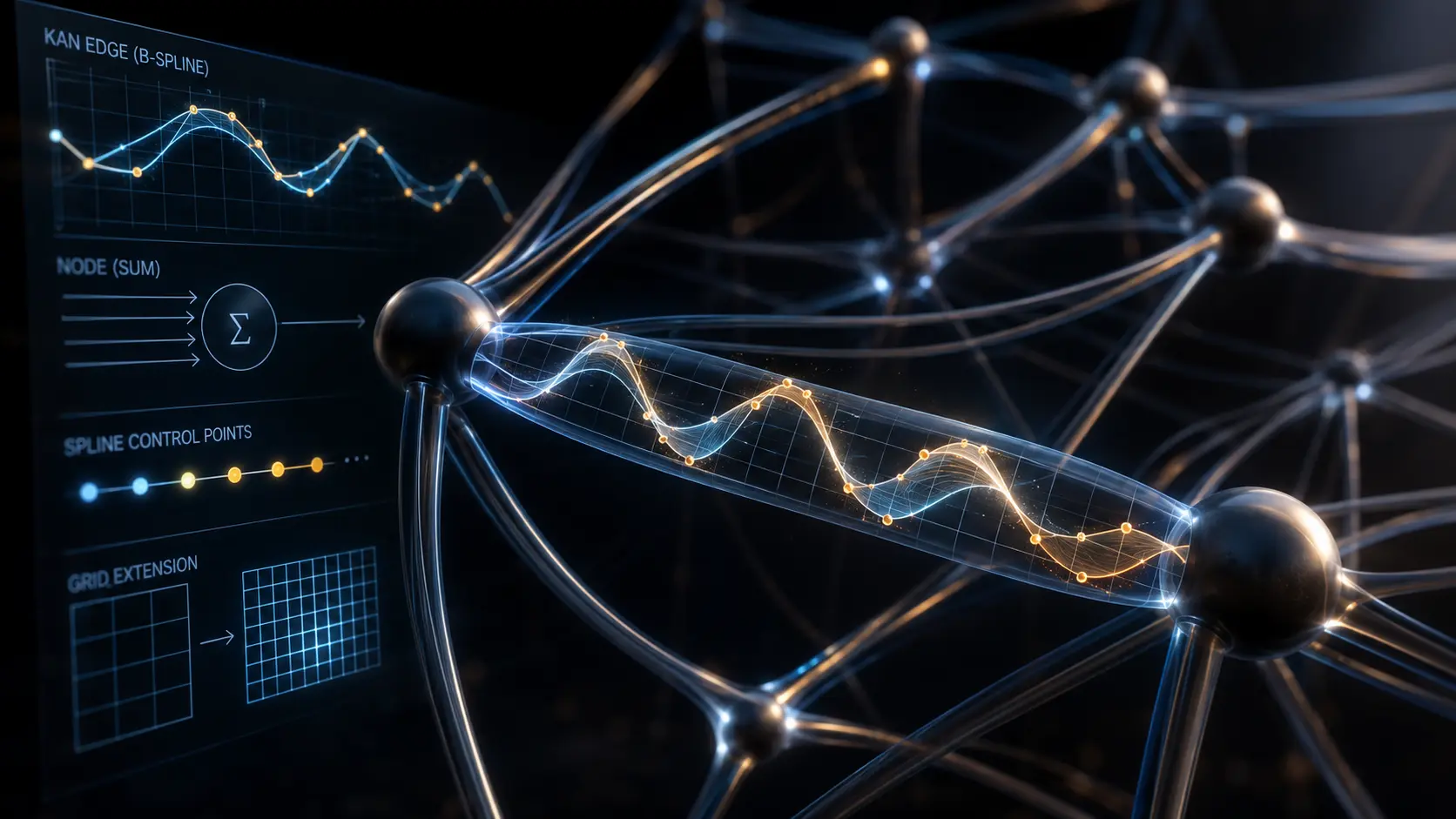
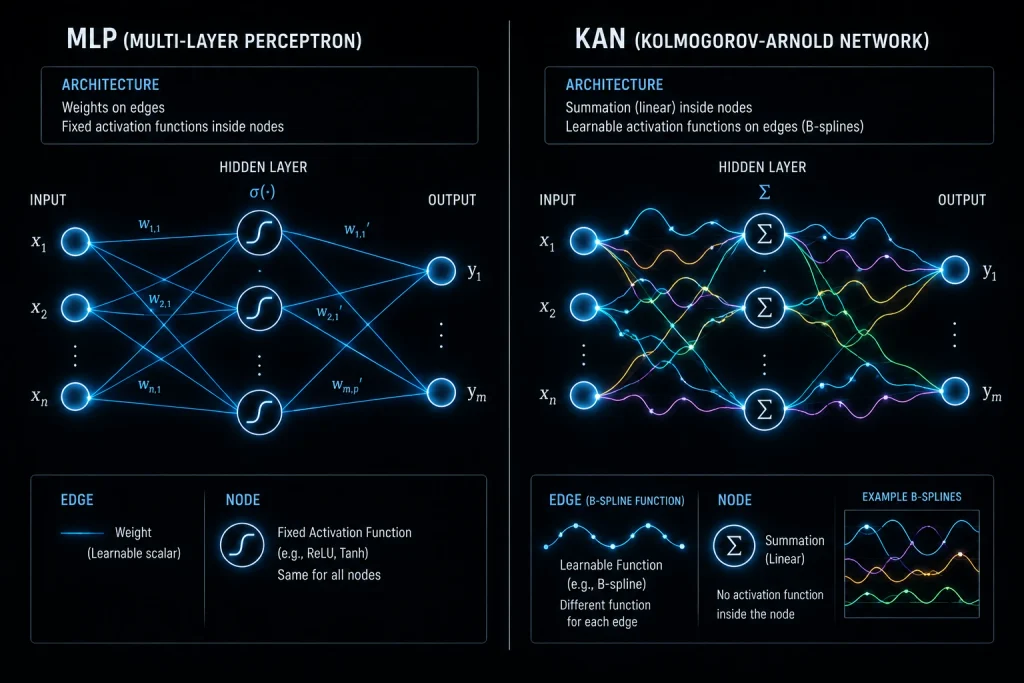
Kolmogorov-Arnold Networks (KANs) are an alternative neural network architecture inspired by the Kolmogorov-Arnold representation theorem. Unlike traditional networks that use fixed activation functions at the nodes and linear weights on the edges, KANs place learnable, non-linear activation functions (parameterized as B-splines) directly on the edges, while the nodes simply sum the signals.
At a Glance
- Concept: A new way to build the “brain” of an AI. It flips the standard architecture inside out, moving the actual learning capability from the intersections (nodes) to the connecting wires (edges).
- Why it matters: Standard AI models are massive and impossible to read. KANs use smooth mathematical curves that human scientists can visually inspect and translate back into standard algebraic equations.
- Who uses it: Physicists, materials scientists, and researchers utilizing Physics-Informed Neural Networks (PINNs) to discover new laws of physics or solve complex differential equations.
- Biggest takeaway: You can upscale a KAN without erasing its memory. If a KAN isn’t smart enough, you can make its math curves “finer” (Grid Extension) to increase its accuracy without having to retrain the AI from scratch.
In Simple Words
Imagine you are building a synthesizer board to mix music.
A traditional Multi-Layer Perceptron (MLP) gives you thousands of wires (edges) and fixed volume dials (nodes). You can only change how much electricity flows through each wire, but the dials themselves can only do one strict thing—turn the signal on or off. To create a complex symphony, you need millions of wires and dials overlapping chaotically. When it works, you have no idea which dial did what.
A Kolmogorov-Arnold Network (KAN) throws away the fixed dials. Instead, every single wire (edge) becomes a fully programmable digital equalizer screen. You can mathematically redraw the exact shape of the sound wave as it travels down the wire. Because each wire is so incredibly expressive, you only need 50 wires to make the symphony instead of a million. And if you want to know how the music was made, you can just look at the shape of the wave on the wire.
Why This Matters
For AI Researchers, MLOps Engineers, and Tech Investors, KANs solve the Black Box Interpretability Crisis.
When a standard neural network discovers a new pattern in fluid dynamics or material stress testing, it cannot explain the math to a physicist. The knowledge is trapped in a matrix of a billion floating-point numbers.
KANs natively support “Equation Discovery.” Because the edges of a KAN are parameterized as 1D B-splines (simple, smooth mathematical curves), a researcher can train a tiny KAN on experimental data, open the network, and visually match the curves on the edges to known mathematical functions (like sine, cosine, or exponentials). The AI doesn’t just give you the answer; it hands you the exact algebraic formula, permanently elevating AI from a predictive oracle into an active scientific collaborator.
The Mathematical Foundation of Kolmogorov-Arnold Networks
The mathematical theory behind KANs is over half a century old. In 1957, mathematicians Andrey Kolmogorov and Vladimir Arnold proved a stunning theorem: Any complex, multi-variable continuous function can be broken down into a combination of simple, single-variable functions and addition.
For decades, computer scientists ignored this theorem because building a neural network out of “splines” (the digital equivalent of a flexible drafting curve) was too memory-intensive. However, as the AI industry slams into the physical limits of GPU scaling, the appetite for parameter efficiency has overridden the comfort of legacy architectures. KANs resurrect a 1950s mathematical proof to break the 2020s parameter-bloat bottleneck.
How KANs Work: B-Splines and Grid Extension
Completely replacing matrix multiplication with curve evaluation requires fundamentally rewiring the backpropagation physics of the network. Here is the first-principles breakdown of the architecture.
1. The Fundamental Problem: The Matrix Bottleneck
In an MLP, the data travels along edges using a basic weight (w · x). When it reaches the node, it hits a fixed activation function (like ReLU, which just turns negative numbers to zero). To model a highly curved, complex mathematical phenomenon, an MLP has to stack thousands of these rigid, angled ReLU functions on top of each other to approximate a curve. It is a highly inefficient, brute-force approximation.
2. The Core Mechanism: Inverting the Network
KANs strip the activation function out of the node. In a KAN, the node does absolutely no math other than simple addition (summing the incoming signals). The entire learning capacity of the network is pushed onto the edges.
3. Technical Depth: B-Splines as Edges
Instead of a simple weight (w), every single edge in a KAN is a B-spline (Basis spline). A spline is a piecewise polynomial curve defined by a grid of control points. During the training phase, backpropagation does not adjust a single floating-point weight; instead, it physically moves the control points of the spline, warping and shaping the curve until it perfectly matches the underlying data.
Because a B-spline is a dynamic 1D curve rather than a static integer, a single edge in a KAN can map highly complex, non-linear relationships that would normally require a massive layer of MLP nodes to simulate.
4. Technical Depth: Grid Extension (Scaling Up)
In MLPs, if a network is too small to solve a problem, you must throw it away, build a bigger one, and retrain it from scratch.
KANs possess a native superpower: Grid Extension. If a KAN’s splines are too “blurry” to solve a problem, you can simply add more control points to the splines, making the mathematical grid finer. Because splines can be mathematically interpolated, the network instantly scales up to a higher resolution without forgetting any of the data it already learned.
5. Real-World Consequences: Symbolic Regression
Once the KAN finishes training, it is so small that a human can analyze it. Researchers use a process called “Symbolic Regression.” They look at the trained B-splines on the edges and realize, “Edge 1 looks exactly like a Sine wave, and Edge 2 looks exactly like an exponential curve.” They can mathematically prune the network and replace the splines with exact symbolic formulas (e.g.,
). The AI has successfully translated raw data into a newly discovered law of physics.
Commercial Applications: PINNs and Symbolic Regression
While KANs are currently too slow to challenge massive language models, they are absolutely dominating the high-precision sectors of scientific computing.
Physics-Informed Neural Networks (PINNs): When aerospace engineers want to simulate airflow over a hypersonic jet wing, they use PINNs to solve complex Partial Differential Equations (PDEs). MLPs struggle with PDEs because they require calculating high-order derivatives, which are messy and unstable in standard networks. KANs, built natively on smooth polynomial splines, calculate derivatives flawlessly. KAN-based PINNs solve fluid dynamics equations vastly faster, with significantly higher accuracy, and using a fraction of the parameters.
Material Science and Condensed Matter Physics: Discovering new battery chemistries or superconductors requires mapping the quantum state of electrons. This is highly non-linear math. KANs excel at avoiding “catastrophic forgetting” in these highly complex topologies, allowing scientists to model molecular interactions without the network losing its mathematical grounding as the simulation scales up.
Financial Time-Series Analysis: Algorithmic trading requires models that can instantly adapt to new, non-linear market volatilities without requiring a total retraining of the model. By utilizing KANs, quantitative hedge funds can use Grid Extension to dynamically increase the resolution of the model’s splines during periods of high market volatility, adapting to the chaos while remaining transparent enough to pass strict financial regulatory audits.
Economic & Strategic Impact
The core strategic vulnerability of KANs is The GPU Hardware Mismatch.
NVIDIA’s $3 trillion market capitalization is based entirely on the fact that its GPUs (like the H100 and B200) are heavily hardwired at the silicon level to do one specific thing flawlessly: General Matrix Multiplications (GEMMs). MLPs are entirely built on GEMMs.
KANs do not use massive matrix multiplications; they evaluate thousands of individual, independent splines. Current GPUs are terrible at doing this efficiently. Even though a KAN might have 100x fewer parameters than an MLP, it currently takes longer to train a KAN in actual wall-clock time because the hardware is not optimized for spline math.
If KANs prove to be the superior architecture for AGI, the global hardware industry will have to pivot violently, creating a massive opening for fabless startups to design custom Application-Specific Integrated Circuits (ASICs) optimized specifically for continuous function evaluation, threatening NVIDIA’s deep-learning monopoly.
Advantages
- Extreme Parameter Efficiency: Achieves parity with state-of-the-art MLPs using a microscopic fraction of the parameter count, heavily reducing the memory footprint of the model.
- Total Interpretability: The network is not a black box. The mathematical logic is visually accessible via the edge splines, enabling symbolic equation discovery for human scientists.
- Grid Extension: The ability to scale the network to a higher resolution to handle more complex data without having to restart the training process from scratch.
- High-Frequency Precision: Standard MLPs suffer from “spectral bias” (they learn low frequencies quickly but struggle with high-frequency details). B-splines natively capture high-frequency oscillations without degradation.
Limitations
- Wall-Clock Latency: Due to the lack of specialized CUDA kernels and hardware optimization for spline evaluation on modern GPUs, KANs are currently much slower to train in absolute time than optimized MLPs.
- Memory Bandwidth Intensity: Evaluating splines requires constant memory lookups to find the control points on the grid, shifting the bottleneck from raw compute (ALU) to memory bandwidth (SRAM/DRAM latency).
- Unproven at LLM Scale: While KANs destroy MLPs in 1,000-parameter physics problems, there is zero empirical evidence yet that a KAN can scale to 100 billion parameters to handle the massive, unstructured chaos of human language generation required to replace GPT-4.
Common Misconceptions
Misconception: KANs will immediately replace the Transformer architecture.
Reality: Transformers (like ChatGPT) rely on the “Attention Mechanism,” which dictates what data the network looks at. KANs replace the MLP, which dictates how the data is processed. Future models will likely be hybrids—Transformers that use KANs inside their feed-forward layers instead of standard MLPs.
Misconception: KANs are a completely new, unproven theory.
Reality: The math (Kolmogorov-Arnold theorem) is from 1957. B-splines are standard mathematical tools used in 3D graphics and engineering for decades. The breakthrough was simply figuring out how to make them differentiable so they could be trained using modern backpropagation.
Misconception: You don’t need a GPU to run a KAN because it’s so small.
Reality: While the parameter count is small, the mathematical operations to update a dynamic curve during training are highly intensive. You still require heavy, parallelized compute; you just require a different kind of compute.
What Most People Miss
The disruptive capability of Continual Learning without Catastrophic Forgetting.
When a standard MLP learns a new task (Task B), the backpropagation aggressively overwrites the weights it used to solve its previous task (Task A). The AI suffers from “catastrophic forgetting.” It becomes smart at B but goes completely stupid at A.
Because KANs use B-splines, they possess “local support.” A B-spline curve is defined by a grid. If the AI learns new data that only affects the far-right side of the curve, the backpropagation only moves the control points on the far right. The left side of the curve is mathematically untouched. KANs can continuously absorb new data streams without accidentally overwriting the knowledge they have already secured, paving the way for true, continuously learning artificial agents.
Comparison Table
| Feature | Multi-Layer Perceptron (MLP) | Kolmogorov-Arnold Network (KAN) |
| Activation Location | Fixed on the Nodes | Learnable on the Edges |
| Mathematical Core | Linear Weights + Static Non-Linearity | Dynamic 1D B-Spline Curves |
| Interpretability | Black Box (Unreadable) | Transparent (Equation Discovery) |
| Parameter Scaling | Brute-force bloat | Hyper-efficient |
| Hardware Optimization | Excellent (Native GPU matrix math) | Poor (Currently lacks optimized kernels) |
| Scaling Capability | Must retrain from scratch | Grid Extension (Scales dynamically) |
Case Study
Situation: Researchers attempting to discover the underlying mathematical formulas of complex physics phenomena (like quantum mechanics or fluid dynamics) were frustrated by the limitations of traditional Deep Learning. While standard MLPs could accurately predict how a fluid would behave, they operated as impenetrable black boxes. Physicists could not extract the underlying equations from the matrix of billions of static weights, halting theoretical scientific advancement.
Challenge: Develop a neural architecture capable of achieving high-accuracy predictive modeling while remaining small and transparent enough for scientists to directly read and extract the mathematical laws the AI had discovered.
Solution (The MIT/Caltech KAN Introduction): In 2024, researchers introduced the Kolmogorov-Arnold Network. They stripped the static activation functions from the nodes and placed learnable B-splines on the edges. They trained the KAN on a dataset of complex, high-dimensional physics data (such as identifying topological invariants in knot theory).
Outcome: The KAN achieved the same predictive accuracy as a massive MLP using orders of magnitude fewer parameters. Crucially, the researchers were able to visually inspect the trained KAN, utilize symbolic regression to identify the shapes of the splines on the edges, and cleanly translate the network into a concise, human-readable algebraic formula.
Lessons Learned: The publication validated that the future of Scientific AI (AI for Science) demands interpretable architectures. By proving that neural networks can function as active equation-discovery tools rather than just predictive oracles, KANs established themselves as the definitive computational framework for the next decade of advanced physics research.
Future Outlook
Next 12–24 Months
The era of CUDA Optimization and Hardware Compilers. The immediate hurdle for KANs is not math; it is software engineering. Over the next year, the open-source community and massive tech giants will race to develop highly optimized CUDA kernels (the software layer that talks directly to NVIDIA GPUs) designed specifically to evaluate B-splines in parallel. Once the compiler gap is closed, the wall-clock training time of KANs will plummet, neutralizing the MLP’s only remaining structural advantage.
Next 3–5 Years
The scaling of Hybrid KAN-Transformers (KAN-formers). As the latency issues are resolved, KANs will break out of the physics labs and enter Natural Language Processing (NLP). We will see the deployment of massive foundation models that utilize standard Attention mechanisms to route data, but replace the heavy, internal feed-forward MLP layers with hyper-efficient KAN layers. These hybrid models will maintain the elite reasoning of a GPT-4 architecture while operating on a fraction of the memory footprint, unlocking true enterprise-grade AI on local, edge devices.
Next 10 Years
The Automated Scientific Method. By the mid-2030s, the opacity of traditional MLPs will relegate them to legacy status. KANs will form the backbone of the automated scientific method. Autonomous AI laboratories will conduct physical experiments, feed the raw data into massive Kolmogorov-Arnold Networks, and instantly extract new, verified laws of thermodynamics and quantum chemistry. The distinction between artificial intelligence and theoretical physics will vanish, driven by an architecture that speaks the native language of the universe: mathematics.
Most Likely Scenario
Kolmogorov-Arnold Networks are not a passing fad; they are a necessary structural correction to the brute-force trajectory of modern AI. While they face a steep uphill battle against a hardware ecosystem explicitly designed for matrix multiplication, their mathematical elegance, absolute interpretability, and ability to scale via grid extension are too powerful to ignore. KANs will inevitably conquer the scientific and regulatory computing sectors, serving as the catalyst for the next generational leap in transparent, efficient artificial intelligence.
Key Takeaways
- Standard artificial intelligence (MLPs) is built on a flaw: the network is a massive, unreadable black box that requires billions of parameters to become smart.
- Kolmogorov-Arnold Networks (KANs) fix this by changing the basic math. They take the learning capability off the “nodes” and put it onto the connecting “edges” using mathematical curves called splines.
- Because the math is located on smooth curves, human scientists can easily read the network and extract exactly how it solves problems (Equation Discovery).
- KANs require exponentially fewer parameters than traditional MLPs to achieve the exact same accuracy, making them highly memory-efficient.
- If a KAN needs to be smarter, you don’t have to erase it and start over. You simply increase the resolution of its curves (Grid Extension), allowing it to scale up without forgetting what it already learned.
- The primary drawback is speed. Modern computer chips (GPUs) are perfectly designed for older MLPs, making KANs artificially slow until new, specialized software codes are written to support them.
Glossary
B-spline (Basis Spline): A flexible, continuous mathematical curve defined by a set of control points. In a KAN, the network learns by physically moving these control points to change the shape of the curve.
Catastrophic Forgetting: A flaw in standard AI where learning new information completely overwrites and destroys the AI’s ability to remember old information.
Grid Extension: The ability of a KAN to dynamically increase its own resolution (making its splines more fine-grained) to solve harder problems without having to retrain from scratch.
Multi-Layer Perceptron (MLP): The foundational architecture of modern AI. It uses static nodes and linear weights (matrix multiplication). It is effective but operates as a total black box.
Physics-Informed Neural Network (PINN): An AI model used by scientists to solve complex physics equations (like fluid dynamics or aerodynamics). KANs are highly optimized for this.
Symbolic Regression: The process of looking at a trained AI network and translating its internal math curves into a clean, traditional algebraic formula (e.g., y = x² + 3).
Sources
MIT / Caltech / Flatiron Institute (arXiv): KAN: Kolmogorov-Arnold Networks
Nature Machine Intelligence: Interpretable machine learning for science with KANs
Hugging Face Papers: Replacing MLPs with KANs in Transformer Architectures
IEEE Transactions on Neural Networks: B-spline neural networks and grid extension
Towards Data Science: Understanding the Mathematics of Kolmogorov-Arnold Networks