Advertisement
)
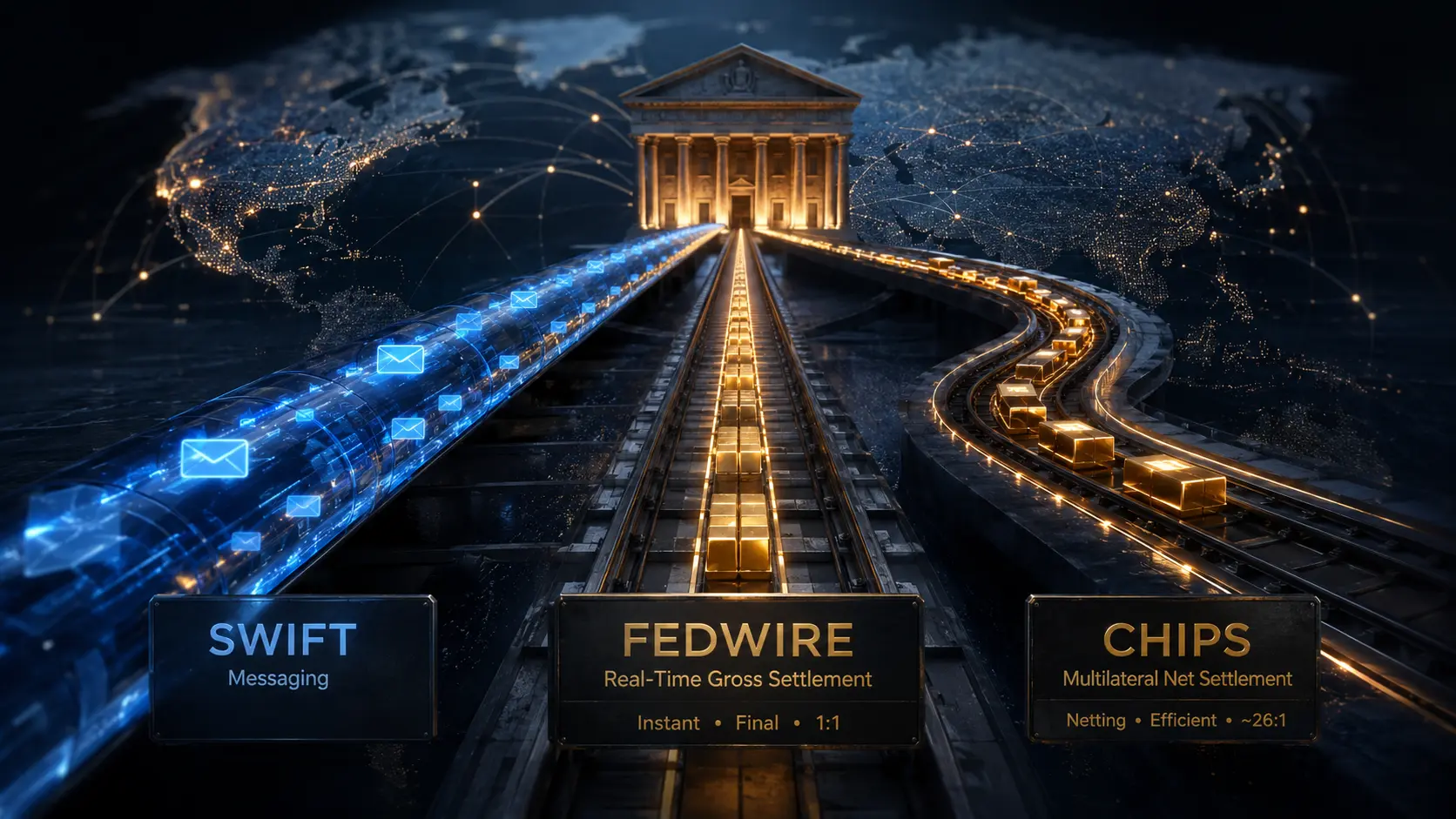

At a Glance
- Concept: The invisible financial plumbing that clears and settles over $7 trillion in global transactions every single day.
- Why it matters: Confusing the messaging layer with the settlement layer leads to catastrophic misunderstandings in corporate treasury, fintech development, and geopolitical sanctions.
- Who uses it: Multinational corporate treasurers, correspondent banks, and global central banks.
- Biggest takeaway: You cannot “send money” over SWIFT. SWIFT only sends the text message; the actual cash must move through a domestic settlement system like Fedwire or CHIPS.
In Simple Words
Imagine you and a group of friends go to a restaurant.
SWIFT is the waiter. When you want to order a drink, you tell the waiter. The waiter writes it down on a standardized notepad and securely hands the ticket to the bartender. The waiter does not cook the food or hold the money; the waiter simply transmits the information flawlessly.
Fedwire is paying for every single drink with exact change the moment it arrives at the table. If you order a $10 beer, you instantly hand the bartender a $10 bill. The transaction is final and immediate. This is highly secure, but it requires you to walk into the bar with a massive pocket full of cash.
CHIPS is running a bar tab. Instead of paying for every single drink immediately, the bartender keeps a running ledger of who ordered what. At the end of the night, instead of exchanging hundreds of individual bills, the bartender calculates the net difference. If you bought your friend a $10 drink, and your friend bought you an $8 drink, you only hand the bartender $2 at closing time. You settled $18 worth of economic activity using only $2 of actual cash.
In global finance, banks use SWIFT to place the order, and they choose between Fedwire and CHIPS to pay the tab.
Why This Matters
The U.S. dollar is the reserve currency of the world, meaning the vast majority of global trade—from Saudi oil to Taiwanese semiconductors—is priced and settled in USD. Because foreign banks cannot print U.S. dollars, they must hold accounts at U.S. banks to clear these transactions.
The systems that manage these accounts (Fedwire and CHIPS) are the absolute bedrock of the global economy. In 2026, Fedwire processes over $5.1 trillion per day, while CHIPS processes roughly $2 trillion.
For financial technology (FinTech) founders, understanding these rails is the difference between building a viable cross-border payment product and going bankrupt. For macro-economists, understanding the liquidity mechanics of these systems reveals how resilient the banking sector is to sudden shocks. Furthermore, the global banking system is currently undergoing its most traumatic technical overhaul in 50 years: the mandatory transition to the ISO 20022 messaging standard. Navigating the convergence of SWIFT, Fedwire, and CHIPS into a single, unified data language is the highest priority for every Chief Information Officer in Wall Street and the City of London.
The Big Picture
To understand global clearing, you must completely separate two concepts in your mind: Information and Liquidity.
Information is the instruction to move money (Who is paying whom? For what? What is the account number?). Liquidity is the actual cash required to make the transfer happen.
In a domestic consumer transaction (like handing someone a $20 bill), information and liquidity happen at the exact same time. In high-value global corporate banking, they are decoupled. The information travels across international borders at the speed of light through encrypted networks. The liquidity, however, is heavily regulated, massive in scale, and trapped inside domestic central bank accounts. Managing the tension between the speed of the information and the availability of the liquidity is the fundamental engineering problem of global finance.
HOW GLOBAL FINANCIAL SETTLEMENT WORKS
Moving billions of dollars safely across the planet requires a stacked architecture of messaging and settlement algorithms.
1. The Fundamental Problem: Correspondent Banking
If a bank in Tokyo wants to send $100 million to a bank in London, they have a problem: neither bank is an American bank, so neither has direct access to the U.S. Federal Reserve. To move U.S. dollars, they must use “Correspondent Banks” (major Wall Street banks like JPMorgan or Citi) that act as intermediaries. The Tokyo bank must send a highly secure instruction to its Wall Street correspondent, ordering them to move the funds.
2. The Information Layer: SWIFT
To send that instruction, the Tokyo bank uses SWIFT (Society for Worldwide Interbank Financial Telecommunication). SWIFT is essentially a highly militarized, encrypted email system for banks. It moves zero dollars. It strictly moves standardized messages (historically called MT messages, now MX messages). SWIFT tells the Wall Street bank: “Debit my account for $100 million and credit the London bank’s correspondent.”
3. The Gross Settlement Layer: Fedwire
Once the Wall Street bank receives the SWIFT message, it must physically move the U.S. dollars. If the transfer is hyper-urgent (e.g., a real estate closing or an emergency bank bailout), they use Fedwire.
Fedwire is a Real-Time Gross Settlement (RTGS) system owned and operated directly by the U.S. Federal Reserve. “Gross” means the transaction is settled individually, one by one. The Fed instantly debits the sending bank’s central reserve account and credits the receiving bank. The money is transferred immediately, irrevocably, and with zero credit risk.
The Flaw: Fedwire requires 1:1 liquidity. To send $100 million, the bank must have exactly $100 million sitting idle in its Fed account at that exact millisecond.
4. The Liquidity Solution: CHIPS
Keeping trillions of dollars sitting idle in Fed accounts is incredibly expensive for commercial banks; that money could be out earning interest. To solve this, a consortium of large private banks created CHIPS (Clearing House Interbank Payments System).
CHIPS is a multilateral netting system. Instead of settling every payment instantly, CHIPS intercepts the payments and runs them through a patented algorithmic netting engine. It continuously matches outgoing payments against incoming payments throughout the day.
5. Technical Depth: The Liquidity Efficiency Ratio
By netting the payments, CHIPS dramatically reduces the actual cash required to settle the economy. In 2025/2026, CHIPS achieved a liquidity efficiency ratio of roughly 26:1. This means that to settle $2.014 trillion worth of daily global economic activity, the participating banks only had to fund the system with about $96 billion in actual liquidity. The algorithm offsets the rest. At the end of the day (roughly 6:00 PM Eastern Time), CHIPS calculates the final net balances and uses Fedwire to settle the tiny remaining differences, closing the loop flawlessly.
Real-World Applications
These three networks interact continuously, but they serve very different strategic purposes.
SWIFT for Sanctions: Because SWIFT is the dominant global messaging layer, being disconnected from it is financially blinding. When geopolitical sanctions are levied (such as against Russia or Iran), the primary weapon is expulsion from SWIFT. Without SWIFT, the sanctioned banks can technically still move money, but they lose the ability to easily and securely communicate those orders to global correspondent banks, functionally crippling their international trade.
Fedwire for Systemic Stability: Fedwire is the ultimate arbiter of U.S. domestic liquidity. It is used almost exclusively for time-critical, high-value, and risk-averse payments. When the U.S. government issues Treasury bonds, or when the Federal Reserve injects emergency liquidity into a failing regional bank, the funds move via Fedwire. The finality of Fedwire ensures there is absolutely zero counterparty risk.
CHIPS for Cross-Border Commerce: CHIPS handles roughly 96% of the high-value, cross-border U.S. dollar payments globally. When a European auto manufacturer pays an Asian parts supplier in USD, the transaction almost certainly clears through CHIPS. The private banking sector relies on the CHIPS netting algorithm to free up hundreds of billions of dollars in intraday capital, which the banks then redirect into overnight lending and trade finance.
Economic & Strategic Impact
The global clearing architecture is currently navigating the most complex technological migration in its history: the transition to ISO 20022.
Historically, SWIFT, Fedwire, and CHIPS all spoke slightly different, proprietary computer languages. If a SWIFT message arrived from Tokyo, the U.S. correspondent bank had to painfully translate that data into a Fedwire or CHIPS format. This caused intense friction, stripped out critical compliance data, and required massive manual intervention.
ISO 20022 is a rich, XML-based, machine-readable language that is becoming the universal standard for all three networks. CHIPS migrated to ISO 20022 in April 2024. Following immense logistical coordination, the U.S. Federal Reserve implemented Fedwire’s ISO 20022 updates throughout 2025 and 2026. Simultaneously, SWIFT is ending the coexistence period of its legacy (MT) messages by late 2025 and 2026.
Economically, this convergence is revolutionary. Because all three networks now speak the exact same structured language, straight-through processing (STP) rates will approach 100%. Anti-money laundering (AML) algorithms can now read highly structured, identical data fields regardless of which rail the money took, drastically lowering compliance costs for major financial institutions.
Advantages
- SWIFT: Ubiquity. It connects over 11,000 institutions in more than 200 countries, providing a single, standardized, highly secure messaging protocol for the entire planet.
- Fedwire: Absolute Certainty. Because it is an RTGS system backed directly by the central bank, payments are immediate and irreversible, completely eliminating settlement risk.
- CHIPS: Capital Efficiency. Multilateral netting saves banks over $5 billion annually in funding costs by requiring only a tiny fraction of actual cash to settle massive economic volumes.
Limitations
- SWIFT: Does not settle funds. A successful SWIFT message does not guarantee the receiving bank actually has the liquidity to honor the payment.
- Fedwire: Highly capital intensive. Requires banks to tie up massive amounts of idle cash (1:1 funding) to facilitate the gross volume of daily payments, which drains balance sheet capacity.
- CHIPS: Settlement Risk. Because CHIPS nets payments throughout the day and settles at 6:00 PM, there is a theoretical risk that if a major participant bank goes bankrupt at 2:00 PM, the end-of-day math will fail to balance (though CHIPS heavily mitigates this with strict pre-funding buffers and loss-sharing agreements).
Common Misconceptions
Misconception: Hackers “stole money from SWIFT.”
Reality: The SWIFT network itself has never been compromised to steal funds. In famous heists (like the 2016 Bangladesh Bank robbery), hackers breached a specific bank’s internal computer system, stole their passwords, and used the bank’s terminal to send legitimate-looking, authenticated SWIFT messages ordering the Fed to move money.
Misconception: Fedwire is for the government; CHIPS is for the public.
Reality: Both systems are used heavily by commercial banks. They choose which rail to use based on urgency and cost. Fedwire is for immediate, urgent settlement; CHIPS is for standard corporate payments where saving liquidity is more important than millisecond speed.
Misconception: SWIFT, CHIPS, and Fedwire handle consumer credit cards.
Reality: These are wholesale, high-value interbank systems. When you swipe a Visa card or send a Venmo payment, you are using retail payment rails (like ACH or private card networks) which eventually batch up and settle their daily totals using Fedwire.
What Most People Miss
The interaction between Fedwire and CHIPS is perfectly symbiotic, not competitive.
CHIPS cannot exist without Fedwire. Before the CHIPS system opens at 9:00 AM, every participating bank must send a specific amount of “pre-funding” liquidity into the CHIPS central account. They do this using Fedwire.
Throughout the day, CHIPS runs its algorithm, shuffling billions of dollars of IOUs between the banks completely off-ledger from the Federal Reserve. Then, at 6:00 PM, CHIPS calculates the final winners and losers for the day. It logs into Fedwire and executes the final payout, distributing the morning’s pre-funding back to the banks based on the netted totals. Fedwire is the engine that boots CHIPS up in the morning and shuts it down at night.
Comparison Table
| Feature | SWIFT | Fedwire | CHIPS |
| Primary Function | Financial Messaging. | Real-Time Gross Settlement (RTGS). | Multilateral Net Settlement (DNS/Hybrid). |
| Operator | Cooperative Utility (Belgium). | The Federal Reserve (U.S. Govt). | The Clearing House (Private Bank Consortium). |
| Moves Actual Money? | No. | Yes (Central Bank Money). | Yes (Commercial Bank Money, finality via Fedwire). |
| Liquidity Required | Zero (It is just data). | 1:1 (Full cash required instantly). | ~1:26 (Massive liquidity savings via netting). |
| Settlement Speed | N/A (Seconds to transmit). | Instantaneous & Final. | Intraday netting; End-of-Day final settlement. |
| ISO 20022 Status | Transitioning (Legacy MT ending 2025/2026). | Transitioned (2025/2026 rollout). | Migrated (April 2024). |
Case Study
Situation: Prior to 2024, a major U.S. correspondent bank was processing 50,000 cross-border corporate payments a day.
Challenge: The incoming instructions arrived via SWIFT in the legacy MT format, which allowed for unstructured data (e.g., typing a client’s address as a single, messy line of text). The bank’s compliance software struggled to read the unstructured addresses, flagging 15% of the payments for manual Anti-Money Laundering (AML) review. This delayed the settlement of funds through CHIPS by hours, frustrating multinational corporate clients.
Solution: The 2024–2026 convergence to the ISO 20022 standard fundamentally altered the data architecture. SWIFT, Fedwire, and CHIPS all mandated the use of rich, structured XML messaging.
Outcome: The European sending bank was forced to input the client data into strict, dedicated XML fields (Street, City, Postal Code, Country). When the SWIFT message arrived at the U.S. bank, the data was perfectly parsed. The AML algorithms screened the structured data instantly, dropping the manual review rate from 15% to 2%. The bank then passed the exact same XML data structure directly into CHIPS for settlement.
Lessons Learned: The speed of global clearing is no longer constrained by the physical movement of money; it is constrained by compliance friction. By adopting a universal data language across the messaging (SWIFT) and settlement (CHIPS/Fedwire) layers, the industry solved the most expensive bottleneck in global finance.
Future Outlook
Next 12–24 Months
The banking sector will navigate the brutal “coexistence period” hangover. While CHIPS and Fedwire have moved to ISO 20022, thousands of smaller, regional banks globally are struggling to update their decades-old legacy middleware. The strict enforcement of structured data (e.g., rejecting payments with messy postal addresses) will cause a temporary spike in failed payments before the industry fully adapts to the rigid XML requirements.
Next 3–5 Years
The focus will shift from high-value batch clearing to interoperable instant payments. We will see initiatives like Project Nexus (spearheaded by the Bank for International Settlements) attempt to link domestic instant payment rails (like the U.S. FedNow system and Europe’s TIPS). This will allow 24/7 cross-border settlement, slowly eroding the dominance of traditional T+1 correspondent banking for low-to-mid value corporate transactions.
Next 10 Years
Central Bank Digital Currencies (CBDCs) pose a theoretical existential threat to the current correspondent banking model. If global central banks establish “mBridge” style networks—allowing a commercial bank in Germany to hold a direct digital wallet with the U.S. Federal Reserve—the need for a private Wall Street intermediary (and potentially the CHIPS netting engine) evaporates. The clearing architecture will flatten, moving from a multi-tiered correspondent web to a direct peer-to-peer central bank ledger.
Most Likely Scenario
Despite the hype of blockchain and CBDCs, the sheer volume, regulatory trust, and liquidity efficiency of the SWIFT/CHIPS/Fedwire triad are nearly impossible to replicate. The 2026 ISO 20022 upgrade has future-proofed this legacy plumbing. For the next decade, these three networks will remain the undisputed, highly optimized backbone of global institutional capital.
Key Takeaways
- SWIFT is strictly a messaging system that transmits data; it holds no accounts and moves no physical liquidity.
- Fedwire is a Real-Time Gross Settlement (RTGS) system that moves money instantly, requiring banks to have 100% of the cash upfront, making it highly secure but capital intensive.
- CHIPS is a multilateral netting system operated by the private sector; it batches payments together to save banks billions in liquidity, settling final balances through Fedwire at the end of the day.
- In 2025, CHIPS operated with a 26:1 liquidity efficiency ratio, settling roughly $2 trillion a day with less than $100 billion in actual funding.
- The global rollout of the ISO 20022 XML messaging standard across all three networks between 2024 and 2026 allows them to communicate in a single, frictionless language, drastically lowering compliance costs.
Glossary
Central Bank Money: Funds held directly as a liability of a central bank (like the Federal Reserve); it carries zero credit or counterparty risk.
Clearing House Interbank Payments System (CHIPS): The primary private-sector U.S. dollar clearing system for cross-border payments, utilizing a multilateral netting algorithm.
Correspondent Banking: A financial arrangement where one bank holds deposits owned by another bank and provides payment and other services on its behalf, necessary for cross-border transactions.
Fedwire: The premier U.S. Real-Time Gross Settlement (RTGS) system owned and operated by the Federal Reserve Banks.
ISO 20022: A global, XML-based messaging standard for financial transactions that provides highly structured, data-rich information to improve automated processing.
Liquidity Efficiency Ratio: A metric used by netting systems (like CHIPS) to measure how much settled value is generated for every $1 of actual cash funded into the system.
Multilateral Netting: A process where a central system offsets the incoming and outgoing payments of multiple parties, reducing the total amount of money that actually needs to change hands.
Real-Time Gross Settlement (RTGS): A payment system where transactions are settled individually (gross) and instantly (real-time), without netting.
SWIFT: Society for Worldwide Interbank Financial Telecommunication; a secure, global messaging network used by banks to send payment instructions.
Frequently Asked Questions
If SWIFT doesn’t move money, why is it so important?
Because moving money requires absolute trust and perfect instructions. Without SWIFT’s hyper-secure, standardized messaging network, banks would have no reliable, authenticated way to order the movement of funds at a global scale.
Why wouldn’t a bank just use Fedwire for everything?
Cost and capital efficiency. If a bank sends $10 billion a day, using Fedwire requires them to have $10 billion in cash sitting in their Fed account. Using CHIPS, they can settle that same $10 billion by only tying up roughly $400 million in cash. CHIPS allows banks to lend the remaining $9.6 billion out to clients to earn interest.
Does CHIPS operate 24/7?
No. CHIPS generally operates Monday through Friday, 9:00 AM to 6:00 PM Eastern Time. At 6:00 PM, the system halts, calculates the final net balances, and executes final settlement.
Is FedNow the same as Fedwire?
No. Fedwire is a wholesale system designed for massive, multi-million dollar corporate and interbank transfers during business hours. FedNow is a retail-focused, 24/7/365 instant payment rail designed for smaller consumer and mid-market B2B transactions.
Who owns these networks?
SWIFT is a cooperative utility owned by its member banks, headquartered in Belgium. Fedwire is owned entirely by the United States Government via the Federal Reserve. CHIPS is owned by The Clearing House, which is a private consortium owned by roughly 40 of the world’s largest commercial banks.
How does ISO 20022 stop money laundering?
It doesn’t stop it directly, but it makes detecting it vastly easier. Legacy messages had messy, unstructured text boxes where illicit actors could hide names or shell companies. ISO 20022 forces banks to put every piece of data (Name, Street, City, Country) into strict, designated fields, allowing AI and compliance software to scan the data instantly with near-perfect accuracy.
Sources
- The Clearing House: CHIPS Delivers Record Value and Resilience for Participants in 2025
- Federal Reserve Financial Services: Fedwire Funds Service Monthly Statistics (2025/2026)
- Bank of America Securities: ISO 20022 migration interconnects the global economy
- Federal Reserve Financial Services: ISO 20022 Upcoming Releases (2025-2026)
- RedCompass Labs: ISO 20022 is arriving all at once for US banks