Advertisement
)

AT A GLANCE
- Concept: Fiber Optics: Transmitting data as pulses of light through strands of glass thinner than a human hair.
- Concept: Erbium-Doped Amplifier: An underwater optical pump that boosts fading light signals over transoceanic distances.
- Concept: Branching Unit: A high-voltage subsea switch that splits a single cable’s data path toward multiple countries.
- Concept: BGP Routing: The digital map that physical cables use to direct internet traffic across global borders.
IN SIMPLE WORDS
When you send an email or stream a video from another continent, the data does not bounce off satellites in space. It travels underwater.
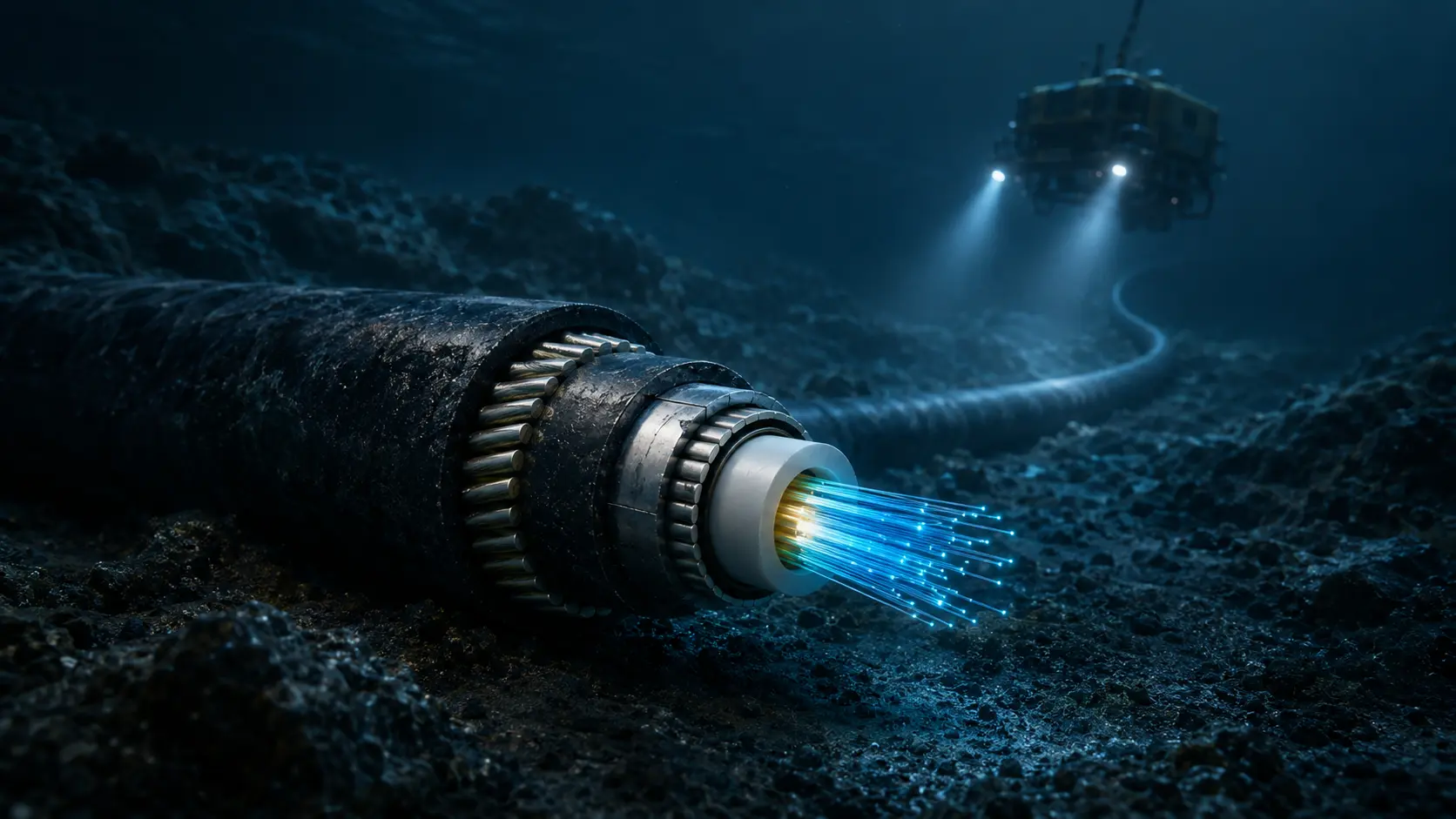
Imagine shining a flashlight down a very long, incredibly clear glass pipe. If you turn the flashlight on and off rapidly, you can send Morse code to the other end. That is exactly how the global internet works. Millions of miles of glass threads, protected by layers of steel and plastic, lie directly on the mud of the ocean floor.
These cables connect the data centers of the world. Every financial trade, text message, and artificial intelligence query crossing an ocean travels through these physical tubes. The “cloud” is not in the sky. It is a wet, vulnerable, and highly engineered network of underwater wires.
HOW SUBSEA CABLES WORK
The internet is fundamentally a physical infrastructure. To cross an ocean, data is converted into photons by land-based lasers. These photons enter a fiber-optic cable—a bundle of ultra-pure silica glass strands. Total internal reflection traps the light inside the glass, allowing it to travel thousands of miles without escaping.
However, glass is not perfectly transparent. Over massive distances, the light signal naturally degrades and scatters, a process called attenuation. To prevent the data from fading to black, engineers splice Erbium-Doped Fiber Amplifiers (EDFAs) into the cable every 50 to 100 miles.
These repeaters do not convert the light back into electricity. Instead, they use a secondary pump laser to excite erbium ions embedded in the glass. When the weak data signal passes through, the excited ions release their energy as identical photons, optically boosting the signal back to full strength.
Running hundreds of these amplifiers across the Pacific Ocean requires immense electrical power. The subsea cable itself acts as a massive extension cord. A copper tube surrounds the glass fibers, carrying up to 10,000 volts of direct current from the shore stations to power the underwater repeaters continuously.
When the cable approaches a continent, it often hits a Branching Unit. This pressurized steel node sits on the seabed and mechanically splits the optical fibers and high-voltage power, routing different wavelengths of light to different sovereign nations. Once the physical light reaches a coastal landing station, Border Gateway Protocol (BGP) software routers read the data and direct it into the terrestrial internet grid.
REAL WORLD EXAMPLE
The Marea cable, jointly funded by Microsoft and Meta, stretches over 4,000 miles across the Atlantic Ocean from Virginia Beach in the United States to Bilbao in Spain.
It contains eight pairs of fiber-optic glass and transmits over 200 terabits of data per second. When a European user accesses a Microsoft Azure database hosted in Virginia, the request physically shoots across the Atlantic seabed, gets amplified by dozens of EDFAs, and returns the data in roughly 40 milliseconds.
If a ship’s anchor accidentally drags across this specific cable, internet traffic instantly reroutes to older, slower cables. This physical disruption causes immediate latency spikes in European financial markets, slowing down algorithmic trading platforms by crucial milliseconds.
WHY IT MATTERS NOW
The architecture of global telecommunications is undergoing a structural monopoly shift. Historically, consortiums of national telecom companies built and owned subsea cables. Today, hyperscale cloud providers—Google, Meta, Microsoft, and Amazon—finance and own the majority of new transoceanic routes.
This corporate consolidation directly affects sovereign security. The physical paths of these cables determine geopolitical influence. Nations located at key landing points, such as Egypt and Singapore, extract massive political and economic leverage because they physically control the internet choke points bridging Europe, Asia, and Africa.
The vulnerability of this physical network is becoming a primary theater of modern hybrid warfare. An adversary does not need to hack a firewall to cripple a nation’s economy. They only need a deep-sea submersible or a commercial fishing trawler to physically cut the glass lines on the continental shelf.
Consequently, the United States and China are aggressively competing to wire the global south. The US government actively blocks Chinese telecommunications firms from participating in trans-Pacific cable consortiums. Intelligence agencies fear that state-backed hardware installed at the landing stations could intercept or mirror unencrypted optical traffic.
COMMON MISCONCEPTIONS
- “Satellites power the global internet.” Space-based networks like Starlink provide excellent local access, but they lack the bandwidth for heavy global traffic. Over 99% of international data travels via subsea cables.
- “Cables are massive, heavily armored pipelines.” In the deep ocean, a subsea cable is only the thickness of a garden hose. Heavy steel armor is only applied near the shallow shores to protect against fishing nets and anchors.
- “Data moves at the speed of light.” Light travels about 30% slower in glass than it does in a vacuum. The latency of a global internet ping is dictated by the physical length of the glass and this refractive delay.
WHAT MOST PEOPLE MISS
Security analysts focus heavily on the physical cutting of cables, but they miss the logical vulnerabilities of the landing stations. The subsea network relies entirely on Border Gateway Protocol (BGP) to route traffic.
If a hostile state or a rogue telecom operator maliciously broadcasts false BGP routing tables at a landing station, they can trick the network into physically sending foreign internet traffic through their own servers before passing it along. This “BGP hijacking” allows adversaries to silently copy massive streams of transoceanic data without ever touching the wet physical cable.
THE ECONOMIC AND STRATEGIC IMPACT
Hyperscale cloud providers are the absolute winners. By owning the physical glass, they eliminate transit costs paid to telecom monopolies. They prioritize their own algorithmic and artificial intelligence traffic across oceans, guaranteeing internal bandwidth superiority.
Sovereign intelligence agencies maintain a vested interest in where these cables land. The intelligence alliance known as the Five Eyes relies on the fact that a vast majority of global data naturally routes through US and UK landing stations. This geographic reality provides structural opportunities for lawful interception and bulk data collection.
Developing nations that secure new landing stations experience immediate economic benefits. A new high-capacity cable lowers the cost of regional broadband and attracts localized data center construction. It physically connects domestic businesses to global financial clearinghouses at vastly faster speeds.
THE TRAJECTORY
Next 12–36 Months: Cloud providers will broadly deploy Space-Division Multiplexing (SDM). Instead of pushing more light through existing glass, engineers will drastically increase the number of fiber pairs within a single cable to push capacities past 500 terabits per second.
Next Five Years: The rerouting of global choke points. Geopolitical tension in the Red Sea and the South China Sea will force consortiums to fund massively expensive alternative routes. New cables will bypass traditional shipping lanes to land in politically neutral territories.
Next Ten Years: The integration of quantum key distribution (QKD) across subsea infrastructure. Lasers will transmit entangled photons across the Atlantic to create mathematically unhackable encryption keys, completely altering the physics of global cyber espionage.
What Could Go Wrong: A synchronized physical attack. If a state actor simultaneously severs the three major trans-Atlantic cables during a financial crisis, the resulting data blackout would isolate North American and European banking systems. This localized internet blackout would cause immediate global market panic.
Most Likely Outcome: Subsea cables will remain the undisputed backbone of human civilization. The sheer physics of optical data transmission ensures that no satellite constellation will ever rival the raw bandwidth capacity of deep-sea glass.
KEY TERMS
- Fiber Optics: The technology of transmitting data using pulses of light through highly purified glass or plastic threads.
- Erbium-Doped Fiber Amplifier (EDFA): A subsea device that boosts fading optical signals by using a secondary laser to excite specific atoms within the glass.
- Branching Unit: A mechanical and electrical switch located on the ocean floor that allows a single cable system to split and connect to multiple different countries.
- Border Gateway Protocol (BGP): The digital routing system that maps the internet, telling data packets which physical cables to take to reach their final destination.
- Attenuation: The natural loss of signal strength that occurs as light scatters and degrades over massive physical distances.
- Landing Station: The highly secure coastal facility where a subsea cable emerges from the ocean and connects to a country’s terrestrial power and internet grids.
BEGINNER FAQ
How deep are these cables? In the open ocean, cables rest directly on the seabed, sometimes reaching depths of over 20,000 feet. At these depths, there is almost no threat from human activity or extreme weather.
Who fixes them when they break? Specialized repair ships operate on standby around the world. When a cable breaks, the ship lowers a grapnel hook to grab the ends, brings them to the surface, and technicians manually splice the glass back together.
Do sharks actually bite the cables? Historically, there were isolated incidents of shark bites on older cables, likely attracted to the electromagnetic fields. Today, cables feature protective sheathing that entirely eliminates this issue.
Can satellites replace subsea cables? No. Satellites are excellent for rural connectivity, but they lack the raw bandwidth required to support global digital infrastructure. A single modern subsea cable carries vastly more data than thousands of satellites combined.
How is a cable actually laid? A massive, specialized cable-laying ship slowly crosses the ocean, unspooling the cable from giant rotating tanks. An underwater plow often buries the cable in a shallow trench near the coastline to protect it from fishing nets.
How many cables are there? There are roughly 500 active subsea cables currently connecting the globe. Together, they span over 800,000 miles of the ocean floor.
What happens if a cable gets cut? The internet is designed to route around damage. If one cable is severed, BGP software automatically redirects the traffic to other active cables, though this can cause temporary slowdowns in the affected region.
Who owns the internet cables? Historically, telecommunication companies formed joint consortiums to share the massive costs. Today, large technology companies like Google, Meta, and Microsoft finance and own the majority of new routes.
SOURCES
- TeleGeography — Submarine Cable Map and Global Bandwidth Research
- International Telecommunication Union (ITU) — Resiliency and Vulnerability of Global Submarine Cable Networks
- Center for Strategic and International Studies (CSIS) — The Geopolitics of Subsea Cables and Data Routing
- Institute of Electrical and Electronics Engineers (IEEE) — Erbium-Doped Fiber Amplifiers and Space-Division Multiplexing