Advertisement
)
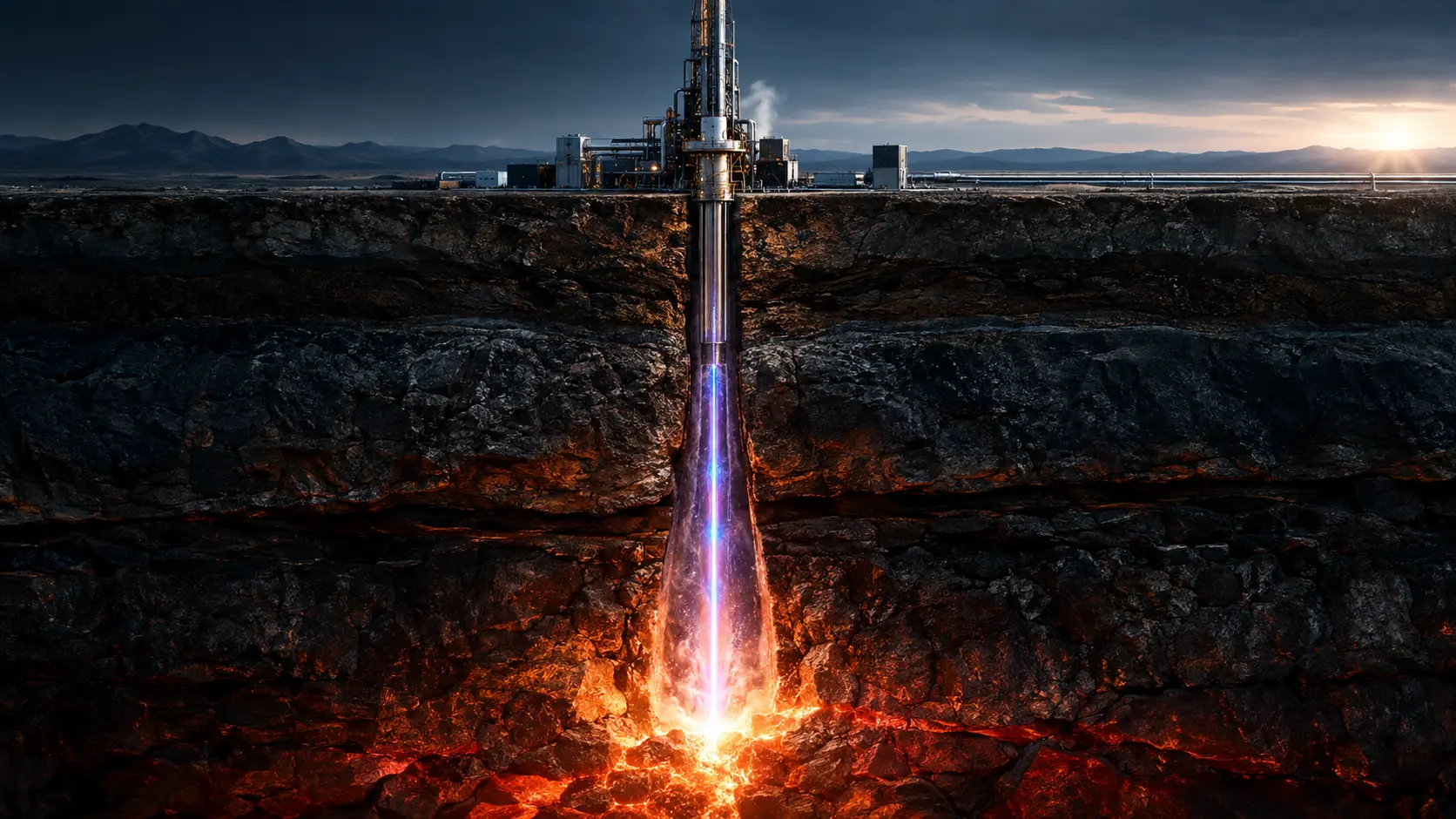

When a tungsten-carbide drill bit grinds ten kilometers into the Earth’s crust, it does not just dull—it turns to putty. The extreme heat and pressure of the deep subsurface warp the hardest metals, boil the drilling mud, and fry the directional electronics. For decades, this physical “temperature wall” has trapped geothermal energy as a niche resource. We know that limitless, zero-carbon geothermal energy baseload sits directly beneath our feet, but we have lacked the physical tools to dig deep enough to reach it.
Why should you care right now? Because applied physicists have officially abandoned the mechanical drill bit. By repurposing hardware originally designed for nuclear fusion reactors, deep-tech startups are deploying directed energy beams to literally vaporize the Earth’s crust. Known as Gyrotron Millimeter-Wave Drilling, this technology fires a megawatt of electromagnetic energy down a tube to incinerate solid granite. It is a paradigm-shattering breakthrough that decouples geothermal energy from volcanic geography. If successfully scaled, it allows us to plug abandoned coal plants directly into the Earth’s core, permanently solving the global clean baseload energy crisis.
What is Gyrotron Millimeter-Wave Drilling?
Gyrotron millimeter-wave drilling is an advanced excavation technology that uses a high-power vacuum tube (a gyrotron) to shoot a concentrated beam of electromagnetic energy deep underground. Instead of mechanically grinding rock, the beam instantly vaporizes it, allowing engineers to reach superhot geothermal depths that would otherwise melt traditional drill bits.
At a Glance
- The Physics Problem: Geothermal energy needs 400°C heat to be economically viable globally, but physical drilling equipment melts at 250°C.
- The Gyrotron Solution: A machine that shoots high-frequency microwaves down a pipe, melting and vaporizing rock without any physical moving parts touching the hot zone.
- The Double Benefit: As the beam vaporizes the center of the hole, it melts the edges. The edges cool into a solid glass pipe, “casing” the hole automatically.
- The Strategic Value: This technology can drill anywhere on Earth, meaning we can drill directly under existing fossil fuel power plants, using their old turbines to generate clean energy.
In Simple Words
Imagine trying to dig a hole into a volcano using a plastic shovel. The deeper you go, the hotter it gets, until your shovel simply melts. This is what happens when oil and gas companies try to drill deep enough to tap the Earth’s ultimate heat.
Instead of using a physical shovel, Gyrotron Drilling uses an energy beam.
Think of a magnifying glass focusing sunlight to burn a hole in a leaf. A gyrotron works on the same principle, but instead of sunlight, it uses incredibly powerful microwaves—the same type of energy used to heat plasma inside a nuclear fusion reactor. It fires this beam down a metal pipe. When the beam hits the solid granite at the bottom, the rock gets so hot, so fast, that it turns into a gas (vaporizes). A blast of clean air is pumped down the pipe to blow the rock dust back to the surface. Because the beam is just light and energy, it doesn’t care how hot the hole gets. It can drill forever.
Why This Matters
For Energy Investors, Utility Planners, and Deep-Tech VCs, Gyrotron drilling solves the Geographic Lottery Problem.
Today, geothermal energy is a geographic lottery. If your country sits on a tectonic fault line or volcanic hot spring (like Iceland or parts of California), you get cheap, 24/7 clean energy. If you live in Germany or Japan, you don’t.
However, the center of the Earth is 5,000°C. If you drill deep enough, every location on Earth has access to geothermal energy. Standard Enhanced Geothermal Systems (EGS) rely on fracking shallow rock, which is water-intensive and localized. Gyrotron drilling ignores the shallow rock and aims for the 10 to 20-kilometer depth where rock reaches 400°C to 500°C everywhere. Reaching this “superhot” rock generates supercritical water—a phase of water that holds exponentially more energy than standard steam.
Micro-Insight: Gyrotron drilling does not just make geothermal better; it transforms it into a universal, ubiquitous commodity. It makes the Earth’s crust the ultimate global battery.
Retrofitting Fossil Fuels with Superhot Rock Geothermal
We are witnessing the Retrofit of the Fossil Fuel Grid.
The hardest part of building a new solar or wind farm is not the panels—it is waiting ten years in the interconnection queue to connect to the global power grid. Gyrotron drilling bypasses the queue entirely. Because you can drill anywhere, you can drill directly underneath a decommissioned coal or natural gas power plant. You replace the coal boiler with a 20-kilometer hole to the Earth’s crust, bring up supercritical steam, and spin the exact same steam turbines that are already connected to the grid. It is the ultimate infrastructural recycling program.
How Gyrotron Millimeter-Wave Drilling Works
Vaporizing granite 20 kilometers below the surface requires orchestrating quantum physics, electromagnetics, and fluid dynamics. Here is the first-principles breakdown of the architecture.
1. The Fundamental Problem: Mechanical Thermal Limits
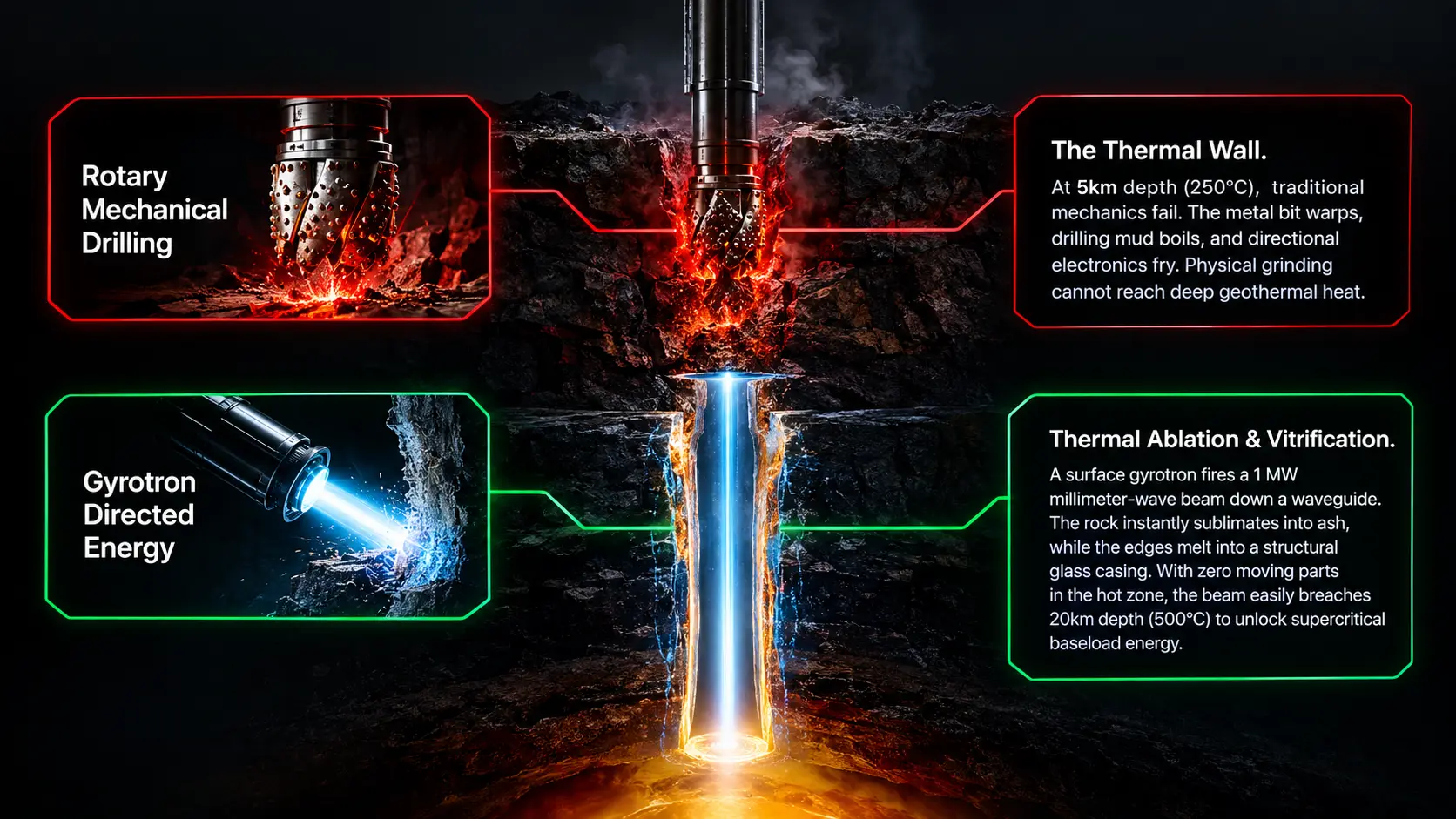
Standard rotary drilling uses a metal bit covered in industrial diamonds, lubricated by “drilling mud.” At depths of roughly 5 to 7 kilometers, temperatures approach 250°C. At this temperature, diamonds crack, the mud breaks down chemically, and the electronics used to steer the drill fail. The mechanical limit of humanity is too shallow for universal geothermal.
2. The Core Mechanism: The Gyrotron
Developed in the Soviet Union in the 1960s, a gyrotron is a massive vacuum tube. Inside, electrons are accelerated through a strong magnetic field, causing them to emit millimeter-wave electromagnetic radiation (between 30 and 300 GHz). Gyrotrons are currently used to heat plasma to 150 million degrees in fusion reactors. Quaise Energy drilling techniques simply point that fusion beam downward.
3. Technical Depth: Millimeter-Wave Ablation
The gyrotron sits safely on the surface. It fires a continuous 1-megawatt beam down a corrugated metallic tube (a waveguide). When the millimeter waves strike the granite at the bottom, they do not just melt the rock—they sublimate it. The electromagnetic energy excites the rock molecules so violently that the granite instantly sublimates from a solid into a gas through millimeter-wave ablation.
4. Technical Depth: The Purge Gas System
You cannot leave a cloud of vaporized rock at the bottom of the hole; it would block the laser-like beam. Therefore, a heavy purge gas (like Argon or Nitrogen) is continuously pumped down alongside the waveguide. The gas acts as an exhaust system, binding with the vaporized rock to form an ultrafine ash, and blowing it rapidly back up to the surface.
5. Real-World Consequences: Auto-Vitrification
In standard drilling, companies must pump thousands of tons of steel and cement into the hole to prevent it from caving in (casing). Gyrotron drilling does this automatically. The center of the beam vaporizes the rock, but the outer edge of the beam merely melts it. As the beam moves deeper, this melted edge instantly cools into a smooth, impenetrable glass wall. The hole is essentially 3D-printing its own casing as it goes.
Gyrotron vs. Mechanical Drilling Simulator
Unlocking Superhot Geothermal via Millimeter-Wave Ablation
Target Depth (km)
20.0 km
Drilling Technology
Rotary Mechanical
Gyrotron Millimeter-Wave
Current Depth
0.00 km
Rock Temperature
20 °C
Drill Integrity
100.0%
Subsurface Profile & Ablation Mechanics
STANDBY
Thermodynamic Limit vs. Drill Integrity
Real-World Applications
This is not a theoretical physics exercise. The hardware is actively being tested for commercial deployment.
Quaise Energy’s Pilot Rigs: Quaise Energy, spun out of MIT’s Plasma Science and Fusion Center, is the undisputed leader in this space. Armed with hundreds of millions in venture capital, they have moved from lab-scale rock vaporization to field-deployable rigs. They use standard rotary drilling for the first 3 to 5 kilometers (which is cheap and fast in soft rock) and then swap to the gyrotron beam to punch through the ultra-hard, ultra-hot basement granite for the final 10 kilometers.
Supercritical Geothermal Power Plants: The ultimate application is accessing “supercritical” water. At 400°C and immense pressure, water enters a supercritical phase where it is neither a liquid nor a gas. It holds up to ten times more usable energy than standard steam. Pumping water down a gyrotron-drilled hole into 500°C rock and bringing supercritical steam back up allows a small geothermal footprint to generate the massive 500 MW to 1 GW output of a traditional nuclear reactor.
The Clean Repowering of Coal: The most immediate economic application is retrofitting stranded assets. A modern coal plant is essentially a massive steam turbine connected to the grid. Quaise’s business model involves buying decommissioned coal plants, using gyrotrons to drill 20km deep directly beneath the plant, and piping the supercritical earth-steam into the existing turbine. This avoids the multi-billion-dollar cost of building new turbines, transmission lines, and grid interconnections.
Economic & Strategic Impact
The core strategic consequence of Gyrotron Drilling is The Elimination of the Energy Storage Paradox.
The great paradox of the modern energy transition is that solar and wind are cheap, but storing their energy for when the sun goes down (via lithium-ion batteries) is astronomically expensive. Grids need “baseload” power—energy that is always on, regardless of the weather.
Currently, the only zero-carbon baseload option is nuclear, which takes 15 years and $20 billion to build. Gyrotron drilling creates a second option. Superhot geothermal is dispatchable, 24/7 baseload power. If gyrotron drilling achieves cost-parity, it eliminates the need to build trillion-dollar battery storage networks, fundamentally altering the macroeconomic blueprint of the 2030s energy grid.
Strategic Advantages of Directed Energy Drilling
- Universal Geography: Can theoretically unlock 400°C rock anywhere on the planet, eliminating the need to discover specific geological hot springs.
- Zero Tool Wear: The “drill bit” is a beam of light. There are no moving parts at the bottom of the hole, eliminating the costly downtime of tripping pipe to replace broken drill bits.
- Auto-Casing: The vitrification of the rock walls creates a natural glass casing, saving millions of dollars in steel piping and concrete.
- Massive Energy Density: Accessing supercritical heat allows a geothermal well to produce 10x the power of a standard shallow well, matching the output of fossil fuels.
Engineering Bottlenecks and Limitations
- Waveguide Attenuation: The millimeter-wave beam must travel perfectly straight down a 20-kilometer metallic tube. Any microscopic bending of the pipe or misalignment causes the beam to bounce off the walls, losing energy as heat before it reaches the rock.
- Ash Evacuation: Vaporizing rock creates a massive volume of fine particulate ash. Pumping enough purge gas down a 20km hole to blast the ash back to the surface against the force of gravity requires immense, energy-intensive compressors.
- Water Requirements: Deep rock is often dry. To generate power, operators must pump millions of gallons of water down the hole to be heated. Sourcing and recycling this water in arid regions poses a logistical challenge.
Takeaway: The physics of vaporizing rock are solved. The physics of generating the beam are solved. The sole remaining hurdle is a plumbing problem: scaling a perfectly straight pipe 20 kilometers deep and keeping it clear of ash.
Common Misconceptions
Misconception: Gyrotron drilling uses lasers.
Reality: Lasers use optical light frequencies. Gyrotrons use millimeter-waves (high-frequency microwaves). Microwaves are much better at penetrating thick clouds of dust and ash; a laser would simply reflect off the rock dust and blind itself instantly.
Misconception: This is just a new form of fracking.
Reality: Fracking (Enhanced Geothermal Systems or EGS) involves pumping high-pressure fluids to crack shallow rock and connect existing fractures. Gyrotron drilling is a closed-loop system that creates a massive, dedicated underground heat exchanger without intentionally triggering seismic fractures.
Misconception: The beam could cause earthquakes.
Reality: The beam melts and vaporizes a highly localized 8-inch hole. It does not cause massive seismic fracturing. The risk of induced seismicity is vastly lower than standard fluid-injection fracking.
What Most People Miss
The disruptive capability of The Hybrid Drilling Sequence.
Many assume that gyrotron drilling will completely replace the oil and gas drilling industry. In reality, it will heavily subsidize it. Gyrotrons are excellent at destroying hard, hot crystalline basement rock, but they are inefficient at drilling through soft, wet, shallow sedimentary rock.
The future of geothermal relies on a hybrid model. Oil and gas contractors will be hired to drill the first 5 kilometers using standard rotary rigs, utilizing their decades of expertise. Then, the rig is swapped out, and the gyrotron is dropped in to finish the final 15 kilometers. Far from killing the oil and gas workforce, deep geothermal will become the primary employer of traditional rig operators over the next decade.
Comparison Table
| Metric | Rotary Mechanical Drilling | Enhanced Geothermal (Fracking) | Gyrotron Millimeter-Wave Drilling |
| Drilling Mechanism | Physical grinding | High-pressure fluid cracking | Electromagnetic ablation (Vaporization) |
| Max Viable Temperature | ~250°C | ~250°C | >500°C (Limitless) |
| Geographic Viability | Restricted (Shallow heat needed) | Restricted (Requires specific rock) | Universal (Drill anywhere) |
| Casing Method | Heavy Steel & Cement | Heavy Steel & Cement | In-situ Vitrification (Glass-lined) |
| Primary Bottleneck | Bit melting / mud breakdown | Induced seismicity risk | Waveguide transmission loss |
Future Outlook
Next 12–24 Months
The era of Shallow Field Validation. Over the next two years, Quaise Energy will execute its first major field demonstrations, attempting to drill 1 to 2 kilometers using the gyrotron hybrid system. These tests will not aim for supercritical heat; they will serve solely to prove that the waveguide can remain aligned and that the purge gas can successfully clear the ash out of a real-world borehole without clogging.
Next 3–5 Years
The scaling of The Pilot Retrofits. By 2029, as drilling depths cross the 5 to 10-kilometer threshold, we will see the first pilot integrations at decommissioned fossil fuel plants. Deep-tech developers will partner with legacy utility companies to drill moderate-depth wells beneath retired coal plants, proving that retrofitted steam turbines can generate stable, zero-carbon electricity without requiring new transmission lines.
Next 10 Years
The Supercritical Global Scale-Up. By the mid-2030s, gyrotron drilling will reliably breach the 15 to 20-kilometer depth limit. The ability to guarantee 400°C supercritical steam anywhere on Earth will trigger a massive capital pivot. Geothermal will transition from a niche grid supplement to the dominant replacement for global baseload power. Heavy industries, such as steel and concrete manufacturing, will drill dedicated gyrotron wells directly under their factories, bypassing the electric grid entirely for direct process heat.
Most Likely Scenario
The energy transition cannot survive solely on intermittent solar and wind; it requires immense, localized, always-on baseload power. Traditional geothermal failed to scale because mechanical engineering could not defeat the thermodynamic limits of the Earth’s crust. By shifting the paradigm from mechanical friction to directed electromagnetic energy, gyrotron drilling sidesteps the temperature wall entirely. While waveguide scaling remains a formidable challenge, the financial upside of tapping into the Earth’s infinite reactor ensures that millimeter-wave ablation will become the foundation of next-generation global infrastructure.
Key Takeaways
- To access 400°C “supercritical” geothermal energy everywhere on Earth, engineers must drill 10 to 20 kilometers deep.
- Standard mechanical drill bits and electronics melt and fail at temperatures above 250°C, making universal deep geothermal impossible with legacy tech.
- Gyrotron drilling solves this by firing a 1-megawatt beam of millimeter-wave energy down the hole, bypassing the liquid phase to instantly vaporize (ablate) the solid rock.
- Because the beam melts the edges of the hole, it creates a solid glass wall, naturally “casing” the borehole without needing expensive steel pipes.
- If successfully scaled, this technology allows utilities to drill anywhere, specifically targeting abandoned coal plants to reuse their existing steam turbines for zero-carbon baseload power.
Glossary
Ablation: The physical process of removing material from a surface by vaporizing it with directed energy, completely skipping the liquid melting phase.
Baseload Power: The minimum amount of electrical power needed to be supplied to the electrical grid at any given time, 24/7. Must be reliable and not subject to weather.
Enhanced Geothermal Systems (EGS): A method of extracting geothermal energy by artificially fracturing hot, dry rock and pumping water through the cracks (similar to fracking).
Gyrotron: A high-power linear-beam vacuum tube that generates high-frequency electromagnetic radiation (millimeter waves), heavily used in nuclear fusion plasma heating.
Supercritical Water: A state of water achieved at extreme temperature (400°C+) and pressure, where it possesses properties of both a liquid and a gas, holding immense energy density.
Vitrification: The process of transforming a substance into glass. In drilling, the extreme heat of the beam melts the rock walls, which cool into a smooth, structural glass casing.
Sources
Quaise Energy: Millimeter Wave Drilling for Deep Geothermal (Technical Whitepapers)
Massachusetts Institute of Technology (MIT) Plasma Science and Fusion Center: Gyrotron Applications in Rock Ablation
ARPA-E (Department of Energy): Geothermal Energy from Supercritical Water Environments
Geothermal Rising: The Role of Superhot Rock in the Energy Transition
International Energy Agency (IEA): The Future of Geothermal Energy and Baseload Replacement