Advertisement
)
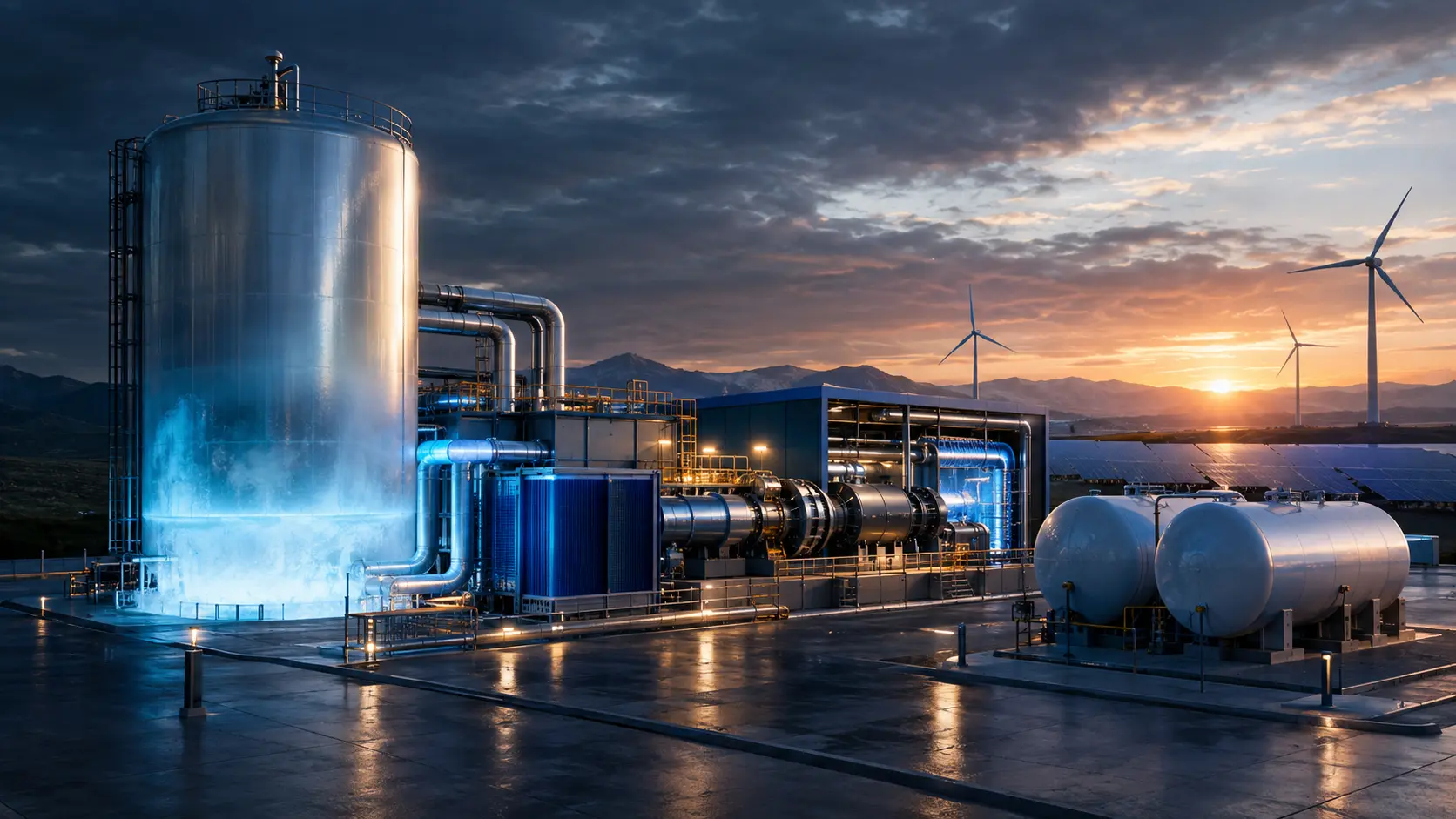

The global energy transition has a terrifying blind spot: lithium-ion batteries only last for four hours. While massive battery farms are excellent at smoothing out daily solar fluctuations, they are mathematically incapable of keeping the grid alive during a multi-day winter storm when the wind stops blowing and the sun refuses to shine. Building enough chemical batteries to store a week’s worth of electricity would bankrupt the global economy and exhaust the planet’s supply of rare earth metals. We need long-duration energy storage, and we need it at a gigawatt scale.
Why should you care right now? Because industrial engineers have solved the multi-day storage crisis using nothing but the air we breathe. By utilizing excess wind and solar power to super-chill ambient air to -196°C, a technology called Liquid Air Energy Storage (LAES) turns the sky into a massive, zero-emission battery. As commercial-scale facilities prepare to come online in 2026, LAES proves we don’t need toxic chemicals to store the future of energy—we just need steel tanks, turbines, and the laws of thermodynamics.
What is Liquid Air Energy Storage (LAES)?
Liquid Air Energy Storage (LAES) is a cryogenic energy storage technology that uses excess electricity to cool ambient air to -196°C, converting it into a liquid. When power is needed, the liquid air is heated, rapidly expanding into a gas to drive a turbine and generate zero-emission electricity.
At a Glance
- The Chemistry Problem: Lithium-ion batteries degrade quickly, require mined rare earth metals, and are only economically viable for 2 to 4 hours of storage.
- The Thermodynamic Solution: LAES uses excess renewable energy to compress and refrigerate ordinary air until it turns into a dense liquid, storing it in massive, insulated thermos tanks.
- The Mechanism: When the grid needs power, the liquid air is exposed to ambient heat. It violently expands by 700 times its volume, spinning a generator turbine.
- The Strategic Value: LAES decouples power from capacity. To store more energy, you do not need to buy more expensive batteries; you simply build a larger, cheap steel tank.
In Simple Words
Imagine a tightly coiled spring inside a box.
A Lithium-Ion Battery stores energy chemically. It is fantastic for quick, short bursts of energy, but the chemicals eventually wear out. After 10 years, the battery can barely hold a charge, and you must throw the entire expensive box away.
Liquid Air Energy Storage stores energy physically. When the wind is blowing hard and electricity is cheap, the system uses that power to “coil the spring”—in this case, crushing air down until it becomes a freezing cold liquid. The liquid sits perfectly still in a giant metal thermos for days or weeks. When the wind stops blowing, you simply open the thermos. The liquid warms up, violently expands back into a gas (uncoiling the spring), and spins a fan to generate electricity.
Because it relies on steel and air rather than degrading chemicals, the system can charge and discharge endlessly for 50 years without losing any capacity.
Why This Matters
For Utility Planners, Energy Investors, and Cleantech VCs, LAES provides essential Dunkelflaute grid buffering.
“Dunkelflaute” is a German term meaning “dark doldrums.” It describes the terrifying multi-day periods in winter when solar panels produce zero power due to heavy cloud cover, and wind turbines sit perfectly still. As nations retire reliable coal and nuclear plants, a 5-day Dunkelflaute poses an existential threat to grid stability.
Lithium-ion cannot solve this. If you want a lithium-ion battery to provide 10 times more energy, you must buy 10 times more battery cells, making the Capital Expenditure (CapEx) scale linearly and prohibitively. LAES scales asymmetrically. The expensive parts are the compressor and the turbine. The actual storage medium—the liquid air tank—is incredibly cheap. To survive a 5-day Dunkelflaute, a utility simply builds a larger steel tank, slashing the levelized cost of storage (LCOS) for long durations and ensuring the lights stay on when the weather fails.
Micro-Insight: LAES fundamentally transitions energy storage from the constraints of rare-earth mining to the limitless scalability of heavy mechanical engineering.
The Need for Grid Synchronous Inertia
We are witnessing the Rebirth of Grid Synchronous Inertia.
The grid doesn’t just need raw power; it needs “inertia” to remain stable. Massive, spinning steel generators in legacy coal and nuclear plants naturally smooth out dangerous frequency spikes in the grid. Because solar panels and chemical batteries have no moving parts, they provide zero physical inertia, making the modern grid highly brittle. Because LAES relies on a massive, physical spinning turbine to generate electricity, it seamlessly replaces the critical, heavy-metal synchronous inertia that was lost when the fossil fuel plants were shut down.
How Liquid Air Energy Storage (LAES) Works
Extracting energy by freezing the sky requires mastering extreme temperature gradients. Here is the first-principles breakdown of the architecture.
1. The Fundamental Problem: Air Expansion
If you compress a gas into a tight space and then release it, it generates power. This is the basis of Compressed Air Energy Storage (CAES). However, storing highly compressed gas requires massive, geologically stable underground salt caverns, strictly limiting where the plants can be built.
2. The Core Mechanism: The Claude Liquefaction Cycle
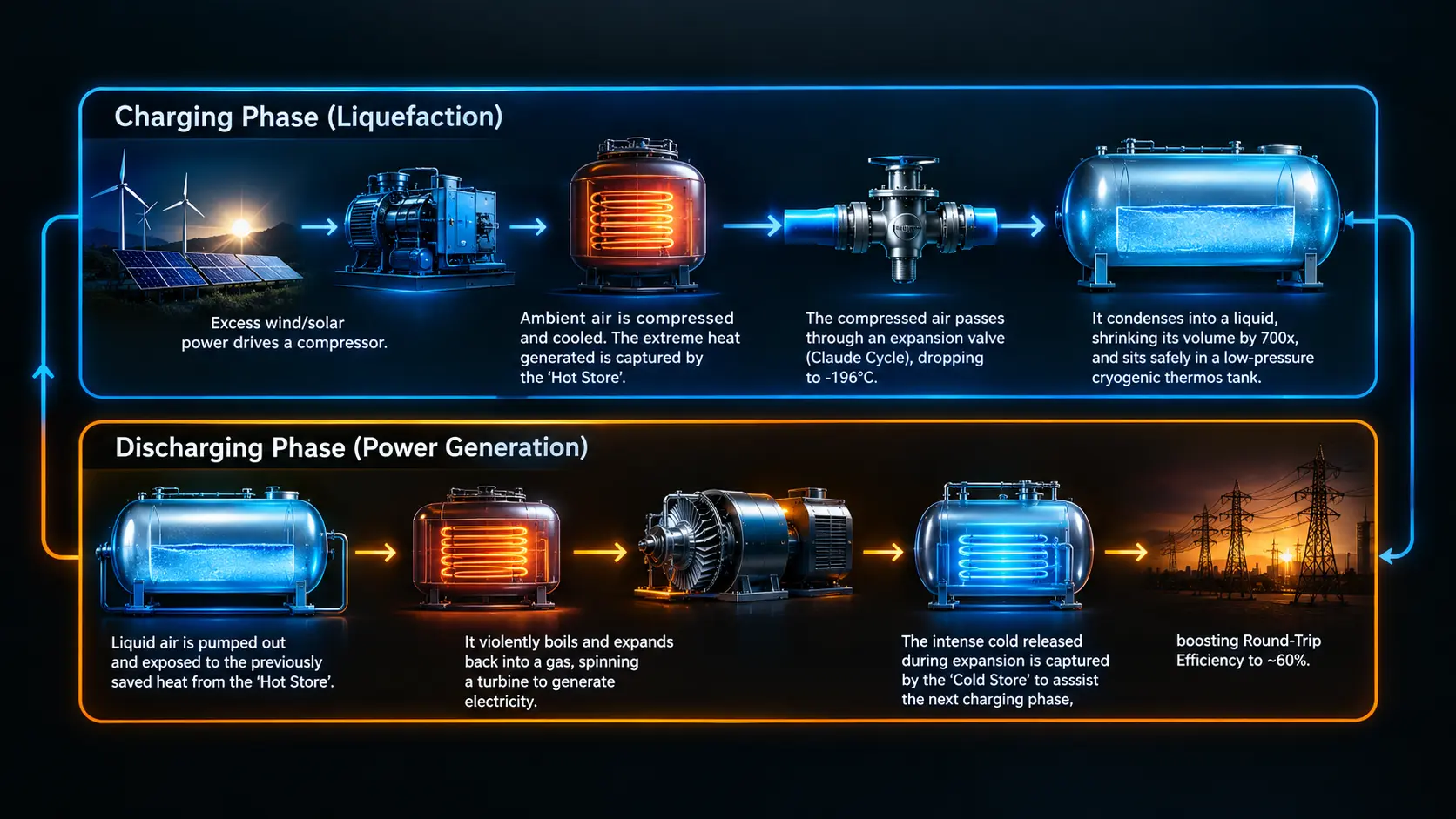
LAES bypasses the geographic limits of CAES by turning the gas into a liquid. During the “charging” phase, excess renewable electricity powers a compressor. The air is compressed, cooled, and expanded through a throttle valve (a variation of the Claude thermodynamic cycle) until its temperature drops to -196°C (-320°F). At this extreme cryogenic temperature, the air condenses into a liquid, shrinking to 1/700th of its original volume [cite: topic-1.1.2]. It is pumped into low-pressure, insulated steel tanks.
3. Technical Depth: High-Grade Thermal Integration
If you only compress, cool, and expand the air, the Round-Trip Efficiency (RTE) of the system is mathematically terrible—roughly 15% to 25% [cite: topic-1.2.4]. The system wastes massive amounts of heat during compression and massive amounts of cold during expansion.
To make LAES commercially viable, engineers added two critical components:
- The Hot Store: During the charging (compression) phase, the air gets incredibly hot. This heat is captured and stored in thermal tanks (often using synthetic oil or crushed rock).
- The Cold Store: During the discharging (expansion) phase, the liquid air releases immense amounts of cryogenic “cold” as it boils back into a gas. This cold is captured in a high-grade cold store (often using a methanol/propane mixture or packed gravel beds).
Plain-English Takeaway: The system recycles its own waste. It saves the heat from yesterday to boil the liquid today, and it saves the cold from today to help freeze the liquid tomorrow.
4. Technical Depth: The Discharge Cycle
When electricity is needed, the liquid air is pumped out of the thermos to high pressure (e.g., 6.5 MPa) [cite: topic-1.2.4]. It is routed through the Hot Store, absorbing the previously saved heat. The liquid violently boils, instantly expanding by 700 times into a high-pressure gas. This rushing gas is blasted through a multi-stage turbine, generating zero-emission electricity.
5. Real-World Consequences: Achieving Commercial Efficiency
By meticulously recycling the waste heat and waste cold, the thermodynamic penalty of liquefaction is severely mitigated. The integration of these thermal stores boosts the final Round-Trip Efficiency of modern commercial LAES plants to between 50% and 60% [cite: topic-1.2.2]. While this is lower than a lithium-ion battery (~90%), it is achieved with a system that lasts five times longer and scales to gigawatt-hours flawlessly.
LAES vs. Lithium-Ion Storage Simulator
Cryogenic Thermodynamic Decoupling vs. Electrochemical Scaling
Target Storage Duration
8 Hours
Storage Architecture
Lithium-Ion BESS
Cryogenic LAES
Energy Capacity (50 MW Base)
400 MWh
Round-Trip Efficiency (RTE)
58.5%
Degradation / Lifespan
0% Fade (50 Yrs)
Thermodynamic & Physical Footprint Layout
CHARGING: LIQUEFACTION (-196°C)
Grid Dispatch & Storage Dynamics (24-Hour Cycle)
Capacity Retained: 100% (Zero Degradation)
Real-World Applications
LAES has moved past the academic prototype phase and is currently securing massive institutional capital for global grid deployment.
Highview Power Carrington plant: Backed by a £300 million investment round led by the UK Infrastructure Bank and Centrica, Highview Power is currently constructing the world’s largest commercial-scale LAES facility in Carrington, Manchester [cite: topic-1.1.2]. Scheduled to be fully operational in 2026, the plant will deliver 300 MWh of storage and an output of 50 MW for six hours [cite: topic-1.1.1]. Crucially, it utilizes existing substation infrastructure, proving that LAES can act as a massive grid stabilizer right in the heart of major demand centers without requiring extensive new transmission lines.
The Millennium Series (Hunterston): Highview is already planning the next evolution. The upcoming Hunterston facility in North Ayrshire is designed to deliver a staggering 3.2 GWh of storage with a 300 MW output for over 12 hours, coming online in 2027 [cite: topic-1.1.1]. These "Millennium Series" plants are specifically engineered to provide extreme grid stability services, including 3.8 GVAs of system inertia and 300MVAr of reactive power [cite: topic-1.1.1], effectively acting as direct, 1-to-1 replacements for retiring baseload fossil fuel plants.
LNG Terminal Symbiosis: The greatest thermodynamic hack for LAES is co-location. Highview is developing projects (such as a 5 MW facility in Australia) that sit directly adjacent to Liquified Natural Gas (LNG) terminals [cite: topic-1.1.1]. When LNG is vaporized to be piped into homes, it releases massive amounts of high-grade waste cold. By piping this free, industrial waste cold directly into the LAES chiller, the system drastically reduces the electrical power required to liquefy the air, pushing the round-trip efficiency of the plant well beyond the standard 60% baseline.
Economic & Strategic Impact
The core strategic consequence of LAES is The Decoupling of Power and Energy CapEx.
In the battery industry, Power (how fast you can discharge electricity) and Energy (how much total electricity you can hold) are physically bound together in the same chemical cell. If you want a battery farm to last for 24 hours instead of 4 hours, your Capital Expenditure (CapEx) increases by roughly 600%.
LAES physically separates these metrics.
- Power (MW) is dictated by the size of the compressor and the turbine.
- Energy (MWh) is dictated by the size of the liquid air storage tank.
Because building a slightly larger, low-pressure steel tank is incredibly cheap, scaling an LAES plant from 4 hours of storage to 24 hours of storage requires minimal additional CapEx. This asymmetric scaling destroys the financial viability of lithium-ion at any duration beyond 8 hours, offering utility planners a deeply discounted path to grid resilience.
Advantages of Cryogenic Long-Duration Storage
- Zero Capacity Degradation: Because LAES stores energy physically rather than chemically, a plant experiences 0% capacity fade. It will hold exactly as much energy on Day 10,000 as it did on Day 1, offering a 50+ year lifespan [cite: topic-1.1.1].
- No Rare Earth Minerals: The system requires no lithium, cobalt, or nickel. It is constructed from standard steel, aluminum, and readily available industrial compressors and turbines [cite: topic-1.1.2].
- Geographical Independence: Unlike Pumped Hydro (which requires mountains) or Compressed Air Energy Storage (which requires underground salt caverns), LAES can be built anywhere on Earth, including directly inside industrial urban centers.
- Synchronous Inertia: The spinning mass of the LAES discharge turbine provides physical, synchronous inertia to the grid, actively preventing blackouts caused by sudden voltage or frequency drops [cite: topic-1.1.1].
Round-Trip Efficiency (RTE) Limitations of LAES
- Round-Trip Efficiency (RTE) Penalty: Even with perfect thermal integration, LAES tops out at roughly 60% RTE [cite: topic-1.2.2]. This means for every 100 MW of renewable power put in, you only get 60 MW back. A lithium-ion battery returns over 90 MW.
- High Initial Footprint Cost: The mechanical complexity of the compressors, thermal stores, and turbines makes the base cost of a small LAES plant extremely expensive. It only becomes economically viable when scaled up to massive, multi-megawatt, long-duration sizes.
- Mechanical Maintenance (OpEx): While it avoids chemical degradation, LAES relies on heavy, high-speed rotating machinery operating at extreme pressure and cryogenic temperatures. This necessitates a highly skilled workforce and rigorous mechanical maintenance cycles.
Takeaway: You do not use LAES to store power for 30 minutes. The thermodynamics only make sense when you need to swallow a massive glut of midday solar and hold it safely until the sun has been down for three days.
Common Misconceptions
Misconception: The liquid air is explosive or flammable.
Reality: Liquid air is primarily composed of liquid nitrogen and oxygen. It is completely non-toxic, non-flammable, and poses zero fire risk, meaning LAES plants can be safely built near dense residential populations, unlike highly flammable lithium-ion battery farms.
Misconception: The plant constantly leaks air and needs to be "refilled."
Reality: While some minor "boil-off" occurs in the cryogenic tanks, it is simply venting harmless, breathable air back into the atmosphere. The system pulls fresh ambient air to replace it during the next charging cycle.
Misconception: It requires massive amounts of water.
Reality: Unlike pumped hydro, LAES is a closed-loop thermal system. While it requires some water for standard industrial cooling towers during compression, its geographical flexibility means it can utilize dry cooling systems in arid environments if necessary.
What Most People Miss
The disruptive capability of The Trilateral Thermal Revenue Stream.
LAES is not just a battery; it is an industrial thermal management engine. When co-located with heavy industry, an LAES plant doesn't just sell electricity back to the grid.
During compression, it generates massive amounts of high-grade heat. Instead of storing all of it, the plant can sell this heat directly to a neighboring factory for industrial drying processes or district heating. Conversely, if a nearby data center requires intense cooling, the LAES plant can vent excess cryogenic cold from the expansion cycle directly into the data center's HVAC system. This turns a single LAES facility into a multi-revenue asset, monetizing electricity, heat, and cold simultaneously.
Comparison Table
| Metric | Lithium-Ion Battery | Pumped Hydro | Liquid Air Energy Storage (LAES) |
| Economical Duration | 2 to 4 Hours | 8 to 24 Hours | 6 to 24+ Hours |
| Round-Trip Efficiency | High (~90%) | Moderate (~75%) | Moderate (~55 - 60%) |
| Lifespan / Degradation | 10–15 Years (High Degradation) | 50+ Years (Zero Degradation) | 50+ Years (Zero Degradation) |
| Geographical Constraints | None | Severe (Requires mountains/water) | None |
| Grid Stability (Inertia) | Zero (Requires synthetic inverters) | High (Spinning turbines) | High (Spinning turbines) |
Future Outlook
Next 12–24 Months
The era of Commercial Scale Validation. Over the next two years, the entire global energy market will be watching the commissioning of Highview Power's Carrington facility [cite: topic-1.1.2]. If the plant successfully achieves its targeted 60% RTE and consistently delivers synchronous inertia during UK grid stress events, it will permanently validate the bankability of LAES. This will trigger a massive influx of private equity capital, shifting utility procurement away from short-term chemical batteries and toward mechanical long-duration assets.
Next 3–5 Years
The scaling of Industrial Waste-Cold Symbiosis. By 2029, standalone LAES plants will become secondary to co-located integrations. We will see LAES facilities heavily integrated into global Liquified Natural Gas (LNG) import terminals and deep-freeze logistics hubs. By directly absorbing the millions of dollars of high-grade industrial waste cold currently being vented into the atmosphere, these symbiotic LAES plants will break the 60% RTE barrier, drastically lowering the levelized cost of storage.
Next 10 Years
The Baseload Decarbonization Backbone. By the mid-2030s, gigawatt-scale LAES facilities (like the planned 3.2 GWh Millennium Series) [cite: topic-1.1.1] will replace the remaining natural gas "peaker" plants. Because LAES physically decouples power generation from energy capacity, utilities will build massive cryogenic tank farms capable of storing weeks of curtailed spring solar energy, effectively establishing a synthetic, zero-carbon baseload that permanently inoculates the grid against extreme weather and Dunkelflaute events.
Most Likely Scenario
The linear cost scaling and rapid chemical degradation of lithium-ion batteries make them mathematically incapable of solving the multi-day energy storage crisis. By mastering the Claude thermodynamic cycle and integrating high-grade thermal storage, engineers have transformed ambient air into a scalable, geographically independent storage medium. While the initial CapEx and mechanical complexity are high, the ability to store gigawatt-hours of zero-emission power in cheap steel tanks guarantees that Liquid Air Energy Storage will become the foundational heavy infrastructure required to finalize the global energy transition over the next decade.
Key Takeaways
- Lithium-ion batteries are economically unviable for long-duration storage (beyond 4 hours) and suffer from severe chemical degradation over a 10-year lifespan.
- Liquid Air Energy Storage (LAES) uses excess renewable power to refrigerate ambient air to -196°C, condensing it into a dense liquid stored in low-pressure steel tanks.
- When power is needed, the liquid air is heated, violently expanding by 700 times its volume to drive a standard generator turbine.
- To achieve commercial viability (50% to 60% efficiency), LAES perfectly recycles its own thermodynamic waste, capturing the heat of compression to assist expansion, and capturing the cold of expansion to assist liquefaction.
- Highview Power’s Carrington facility, backed by £300M, will prove the commercial scale of LAES in 2026, delivering 300 MWh of storage and critical synchronous inertia to the UK grid.
Glossary
Claude Cycle: A thermodynamic cycle used to liquefy air or other gases, combining compression, cooling via heat exchangers, and expansion through a turbine.
Dunkelflaute: A period of time in which little to no energy can be generated with the use of wind and solar power, severely threatening grids reliant on renewable energy.
Levelized Cost of Storage (LCOS): The total lifetime cost of an energy storage technology divided by its cumulative delivered electricity.
long-duration energy storage LDES: Any technology capable of dispatching electrical energy at its rated power for an extended period, typically defined as 10 hours or more.
Round-Trip Efficiency (RTE): The percentage of electricity put into a storage system that is later retrieved. If you put in 100 MWh and get back 60 MWh, the RTE is 60%.
Synchronous Inertia: The kinetic energy stored in the massive spinning rotors of traditional power plants, which acts as a physical shock absorber against sudden drops in grid frequency.
Sources
Highview Power: Carrington Facility and UK Infrastructure Bank Funding
Applied Energy: Enhancement of round trip efficiency of liquid air energy storage through effective utilization of heat of compression
PSE Community / LAPSE: Liquid Air Energy Storage System (LAES) Assisted by Cryogenic Air
ResearchGate: Thermodynamic analysis of a liquid air energy storage system
MathWorks: Liquid Air Energy Storage System Simulation and Claude Cycle Expansion