Advertisement
)

At a Glance
- Concept: Using hydrogen gas instead of carbon to chemically purify raw iron ore.
- Why it matters: Traditional steelmaking produces 8% of global CO₂; this technology eliminates those emissions almost entirely.
- Who uses it: Heavy industrial manufacturers, European green steel startups, and global automotive supply chains.
- Biggest takeaway: You cannot simply plug a traditional blast furnace into a solar panel; decarbonizing steel requires entirely redesigning the underlying chemical reactions.
In Simple Words
Look at any skyscraper, bridge, or automobile. They are all made of steel. To make steel, you have to dig raw iron ore out of the ground.
Raw iron ore is essentially just rusted iron—it has oxygen atoms trapped inside it. For hundreds of years, the only way to get that oxygen out was to dump the rock into a massive, 2,000-degree blast furnace filled with coal. The carbon in the coal binds with the oxygen in the rock, pulling it out and escaping into the atmosphere as carbon dioxide (CO₂). This single chemical reaction is responsible for a massive percentage of all human greenhouse gas emissions.
Green Hydrogen Direct Reduced Iron (H2-DRI) completely rewrites this chemistry.
Instead of using dirty coal to pull the oxygen out, engineers pump pure hydrogen gas into a reactor tower filled with iron ore. The hydrogen binds with the oxygen in the rock. But when hydrogen and oxygen combine, they do not create a greenhouse gas. They create H₂O. The reactor purifies the iron and releases harmless water steam into the sky. It is the holy grail of heavy industry: forging the strongest material on Earth using nothing but water and renewable electricity.
Why This Matters
The global economy cannot survive without steel, but the climate cannot survive traditional steelmaking.
As the world transitions to a green economy, we need millions of tons of steel to build wind turbine towers, electric vehicle frames, and high-voltage transmission pylons. Building the infrastructure required to save the climate using heavily polluting, coal-fired steel creates a catastrophic environmental paradox.
This technological shift is no longer just an environmental goal; it is a hard financial mandate.
On January 1, 2026, the European Union’s Carbon Border Adjustment Mechanism (CBAM) entered its definitive financial compliance phase. This policy acts as a strict carbon tariff. Importers bringing steel into the EU must now surrender CBAM certificates priced dynamically against the EU carbon market. In Q1 2026, this price was set at €75.36 per tonne of CO₂ equivalent.
Because traditional blast furnaces emit nearly two tonnes of CO₂ for every tonne of steel produced, this new regulation effectively adds a massive, multi-billion-euro tax penalty to dirty steel imports. Manufacturers who fail to adopt green hydrogen technologies will be entirely priced out of the European market, making H2-DRI the most urgent industrial engineering priority of the 2020s.
The Big Picture
To understand why hydrogen is necessary, you must understand that industrial decarbonization is fundamentally different from consumer decarbonization.
If you want to decarbonize a passenger car, you simply swap the gas engine for an electric battery. You change the power source.
In heavy industry, you cannot just change the power source. A traditional blast furnace does not just use coal for heat; it uses coal as a chemical ingredient (a reducing agent) to physically alter the molecular structure of the rock. You cannot simply wrap an electric heating coil around a blast furnace. To remove the carbon emissions, you must find a replacement molecule that behaves exactly like carbon at an atomic level, but without the toxic byproducts. In the entire periodic table of elements, hydrogen is the only commercially viable candidate.
How It Works
Replacing a centuries-old industrial process requires massive, interconnected infrastructure. The H2-DRI process abandons the blast furnace entirely in favor of a new, three-step metallurgical pathway.
1. The Fundamental Chemical Problem
Raw iron ore is mined as iron oxide (Fe₂O₃). To make steel, you need pure iron (Fe). The fundamental problem of metallurgy is breaking the incredibly strong atomic bonds between the iron and the oxygen. Historically, adding carbon monoxide (derived from coal) stripped the oxygen away to form CO₂.
2. The Insufficiency of Traditional Electrification
Engineers initially tried to melt iron ore using massive electric heaters, hoping to avoid using coal. However, simply melting the rock does not separate the oxygen from the iron. When the molten rock cools, it remains useless iron oxide. A chemical “reducing agent” is absolutely mandatory to physically pull the oxygen atoms away from the iron atoms.
3. The Core Mechanism: Direct Reduction
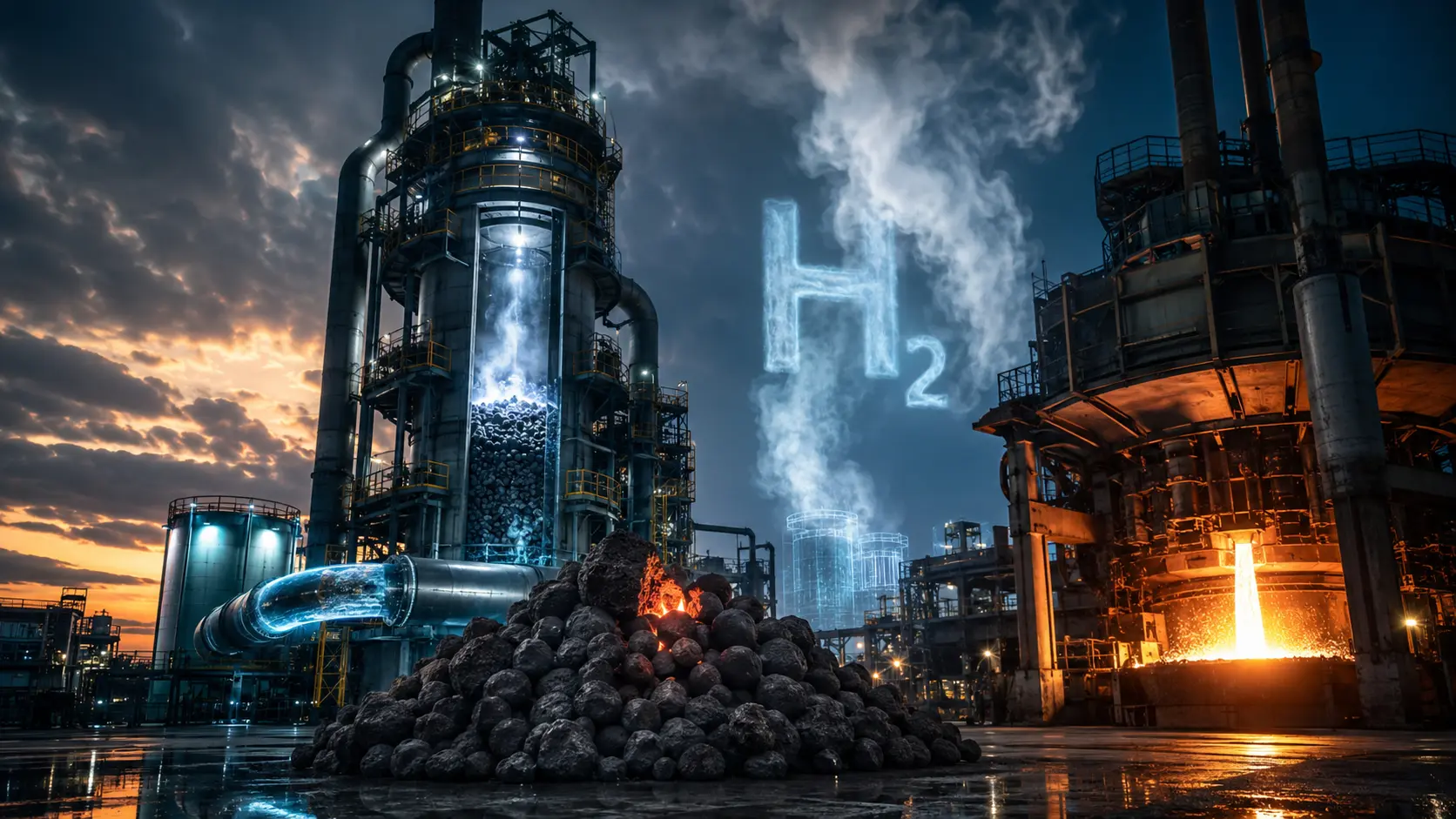
In the H2-DRI process, iron ore pellets are fed into the top of a massive vertical shaft called a Direct Reduction reactor. The reactor is not heated to melting temperatures; the iron remains in a solid state. Pure hydrogen gas (H₂) is pumped into the bottom of the reactor. As the hydrogen gas rises through the hot, solid iron ore, it chemically bonds with the oxygen atoms.
The equation is simple: Fe₂O₃ + 3H₂ → 2Fe + 3H₂O. The iron is purified, and the byproduct escapes as water vapor. The resulting solid, porous metal is called “sponge iron” or Direct Reduced Iron (DRI).
4. Technical Depth: Integration with the EAF
Sponge iron is pure, but it is not yet steel. It must be melted down, and specific amounts of carbon and alloys must be precisely mixed back in to give the steel its required strength. The DRI is transported into an Electric Arc Furnace (EAF). Giant graphite electrodes are lowered into the furnace, passing a massive electrical current through the sponge iron, generating an artificial lightning bolt that melts the metal at 3,000°C using purely renewable electricity.
5. Managing the Endothermic Penalty
Using hydrogen introduces a severe thermodynamic penalty. Traditional carbon reduction in a blast furnace is an exothermic reaction—it naturally releases its own heat, keeping the furnace perpetually hot. Hydrogen reduction is an endothermic reaction. It rapidly absorbs heat, chilling the reactor. To prevent the chemical reaction from freezing and stalling, engineers must continuously pump massive amounts of external, renewable thermal energy into the hydrogen gas stream before it enters the shaft.
Real-World Applications
The theoretical chemistry of green steel has now reached massive commercial scale.
European Green Mega-Plants: In Boden, Sweden, a company named Stegra (formerly H2 Green Steel) is constructing the world’s most advanced large-scale green steel facility. Scheduled to become operational in 2026, the plant uses a 700 MW electrolyzer to produce its own green hydrogen on-site. By completely replacing coal with hydrogen, Stegra aims to cut CO₂ emissions by up to 95% compared to traditional blast furnaces.
Global Automotive Supply Chains: Automakers are facing immense pressure to produce “zero-carbon” vehicles. Companies like Porsche, Mercedes-Benz, and Volvo Group have signed massive off-take agreements to purchase premium-priced green steel from facilities like Stegra years before the plants are even finished. They use this H2-DRI steel to stamp vehicle chassis, drastically lowering the Scope 3 supply chain emissions of their electric vehicle fleets.
The Middle East Transition: Nations in the Middle East and North Africa (MENA) are aggressively pivoting toward H2-DRI. With access to vast, cheap solar energy, these nations can generate green hydrogen at a fraction of European costs. They are transitioning from exporting liquid crude oil to exporting solid “green sponge iron” briquettes, supplying the raw, decarbonized materials to European Electric Arc Furnaces.
Economic & Strategic Impact
The transition to H2-DRI completely redraws the geopolitical map of heavy industry.
Historically, global steel dominance was dictated by geology. Nations with massive domestic reserves of metallurgical coal and iron ore—like China, the United States, and Germany—became industrial superpowers.
Green hydrogen severs the connection between steel and coal. The new geographic advantage belongs to regions with an overabundance of cheap, reliable renewable electricity. Because the H2-DRI process requires staggering amounts of electricity (both to run the Electric Arc Furnaces and to power the massive water electrolyzers that create the green hydrogen), steel production is migrating toward areas with massive hydroelectric dams or intense solar irradiance, such as Scandinavia, Australia, and the Middle East.
Financially, the industry is entering a high-stakes transition period. Generating green hydrogen is currently significantly more expensive than burning cheap coal. However, as the EU CBAM financial penalties scale upward throughout the late 2020s, the “green premium” (the extra cost to produce clean steel) will be completely eclipsed by the “carbon penalty” (the tax applied to dirty steel). In April 2026, Stegra secured a massive €1.4 billion financing round to complete its Boden plant, proving that institutional capital now views green steel as a highly lucrative, structurally protected asset class.
Advantages
Absolute Decarbonization
Unlike carbon capture and storage (CCS) systems that attempt to trap pollution after it is created, H2-DRI eliminates the creation of CO₂ entirely at the chemical level, yielding up to a 95% reduction in total emissions.
Operational Flexibility
Traditional blast furnaces must run continuously for decades; shutting them down causes the molten slag to freeze and destroys the furnace. H2-DRI and EAF plants can be ramped up or powered down quickly, allowing them to operate dynamically when local wind and solar energy is cheapest.
Geographic Independence
Because hydrogen can be separated from standard water using renewable electricity, steel mills are no longer shackled to complex, global maritime supply chains for metallurgical coal.
Limitations
Massive Renewable Electricity Demands
Creating the pure hydrogen required for the reaction requires gigawatts of constant electrical power for electrolysis. A single full-scale green steel plant can consume as much electricity as a mid-sized European city, placing immense strain on local power grids.
The Iron Ore Grade Constraint
Traditional blast furnaces melt the rock, easily separating the iron from cheap, low-quality rocky impurities (gangue). Because the H2-DRI reactor keeps the iron in a solid state, those rocky impurities remain trapped inside the sponge iron. Therefore, H2-DRI requires highly pure, premium-grade iron ore, which is globally scarce and expensive.
The Endothermic Heat Penalty
Because hydrogen reduction absorbs heat rather than generating it, maintaining the reactor’s internal temperature requires highly complex external heating systems, adding significant engineering complexity and operational costs to the facility.
Common Misconceptions
Misconception: Green steel is made by simply running a steel mill on solar panels instead of a coal power plant.
Reality: Running the factory on solar power only eliminates the electricity emissions. You still have to eliminate the chemical emissions of the smelting process itself. Only a physical reducing agent like hydrogen can strip the oxygen from the rock without creating CO₂.
Misconception: Direct Reduced Iron (DRI) is a brand new, untested technology.
Reality: DRI technology has existed for decades. However, older DRI plants used “grey” hydrogen extracted from fossil-fuel natural gas. The revolutionary breakthrough of the 2020s is using water electrolyzers to generate “green” hydrogen, making the entire process carbon-free.
Misconception: Green steel is structurally weaker than traditional steel.
Reality: Steel is an alloy of iron and precise amounts of carbon. Once the sponge iron is melted in the Electric Arc Furnace, metallurgists carefully add exact traces of carbon and alloys. The final product is metallurgically identical to, and often higher quality than, blast furnace steel.
What Most People Miss
The true bottleneck to the green steel revolution is not the cost of hydrogen; it is the scarcity of high-grade rocks.
Because the H2-DRI process does not melt the iron ore during the purification phase, any dirt, silica, or rocky impurities attached to the mined iron ore pass directly into the final sponge iron. When this dirty sponge iron is eventually melted in an Electric Arc Furnace, those impurities severely damage the delicate graphite electrodes and consume massive amounts of excess electricity to boil away.
To operate efficiently, H2-DRI plants require “DR-grade” iron ore—pellets that are at least 67% pure iron. Currently, DR-grade ore makes up less than 5% of the global iron ore supply. The entire global steel industry is racing to transition to hydrogen, but they are all fighting over a tiny, heavily constrained pool of premium geology.
Comparison Table
| Feature | Blast Furnace / Basic Oxygen Furnace (BF-BOF) | Green Hydrogen Direct Reduced Iron (H2-DRI-EAF) |
| Reducing Agent | Carbon (Metallurgical Coal / Coke). | Pure Hydrogen Gas (H₂). |
| Chemical Byproduct | Carbon Dioxide (CO₂). | Water Vapor / Steam (H₂O). |
| Operating State | Melts the ore into liquid pig iron. | Keeps the ore solid, creating porous sponge iron. |
| Energy Source | Fossil fuels (Exothermic, generates own heat). | Renewable Electricity (Endothermic, requires external heat). |
| Ore Requirement | Can process cheap, low-grade iron ore. | Requires scarce, highly pure DR-grade iron ore pellets. |
| CBAM Penalty | Extremely High (Subject to heavy 2026 tariffs). | Near Zero (Bypasses carbon import taxes). |
Case Study
Situation: European automotive and construction sectors faced a looming crisis. To meet their aggressive 2030 corporate climate pledges, they needed access to millions of tons of zero-carbon steel. However, legacy steel giants were moving too slowly to retrofit their massive, century-old coal blast furnaces.
Challenge: Building a greenfield H2-DRI plant from scratch requires billions in capital, securing massive amounts of green electricity, and proving that the untested commercial scale of hydrogen metallurgy could actually turn a profit.
Solution: In 2020, Stegra (then known as H2 Green Steel) was founded in Boden, northern Sweden. They positioned the plant specifically to leverage the region’s massive, pre-existing hydroelectric power grid. Instead of waiting to build the plant to find buyers, they pre-sold the unmade green steel at a premium to major corporations like Volvo, Porsche, and ZF Group.
Outcome: Using these binding customer off-take agreements, Stegra secured immense financial backing. In April 2026, the company secured a €1.4 billion financing round led by Wallenberg Investments to complete the plant. By utilizing a massive 700 MW on-site electrolyzer to generate green hydrogen, Stegra proved that the market will willingly pay a premium for decarbonized heavy materials.
Lessons Learned: The decarbonization of heavy industry is entirely achievable when the end-buyer (automakers) guarantees the revenue stream. By treating green steel as a premium technological product rather than a cheap, bulk commodity, deep-tech startups can secure the billions required to disrupt legacy industrial monopolies.
Future Outlook
Next 12–24 Months
The European Union’s CBAM financial enforcement will send shockwaves through global supply chains. Asian and American steel exporters will scramble to calculate and report their embedded emissions. Projects like the Stegra Boden plant will begin initial commissioning and hot-testing their DRI towers, proving the viability of giga-scale commercial hydrogen integration.
Next 3–5 Years
A massive bottleneck in “DR-grade” iron ore will force heavy innovation in the mining sector. Mining giants like Vale and Rio Tinto will deploy new, energy-intensive beneficiation techniques (like magnetic separation and flotation) to artificially upgrade cheap, low-quality ores into the premium pellets required by the booming H2-DRI sector.
Next 10 Years
We will witness the great uncoupling of the steel supply chain. Because transporting raw hydrogen gas is incredibly expensive and dangerous, countries with cheap renewable energy (like Australia and Saudi Arabia) will process their own iron ore into solid “Hot Briquetted Iron” (HBI) using domestic solar power. They will ship these solid, green iron bricks across the ocean to Europe and the US, where local Electric Arc Furnaces will melt them into finished steel.
Most Likely Scenario
Green hydrogen will completely replace coal as the primary reducing agent in global steelmaking, but the transition will be highly localized. Regions protected by strong carbon tariffs (like Europe) will scale immediately. Regions lacking carbon pricing or cheap renewable electricity will stubbornly cling to traditional blast furnaces, creating a bifurcated, two-tier global market for steel commodities.
Key Takeaways
- H2-DRI replaces heavily polluting coal with renewable hydrogen to chemically strip oxygen from raw iron ore.
- The chemical reaction produces solid “sponge iron” and releases harmless water steam instead of carbon dioxide.
- The sponge iron is subsequently melted in an Electric Arc Furnace (EAF) using clean electricity to forge finished steel.
- The EU’s 2026 CBAM regulation places heavy financial taxes on dirty imported steel, forcing global adoption of H2-DRI.
- H2-DRI is an endothermic reaction, meaning it absorbs heat and requires highly complex external thermal management.
- The process currently requires extremely pure, globally scarce “DR-grade” iron ore to function efficiently.
- Facilities like Stegra’s Boden plant prove that large-scale, 95% emission-free commercial green steel is a financial reality.
Glossary
Blast Furnace: A massive, highly polluting traditional industrial tower that uses coal and extreme heat to melt and purify iron ore.
Carbon Border Adjustment Mechanism (CBAM): An EU regulation effective in 2026 that places a financial carbon tariff on imported heavy industrial goods, equalizing the cost of green production.
Direct Reduced Iron (DRI): Also known as sponge iron; it is iron ore that has been purified in a solid state without being melted.
Electric Arc Furnace (EAF): An industrial furnace that heats material by passing a massive electrical current through graphite electrodes, melting the metal without fossil fuels.
Electrolyzer: A machine that uses massive amounts of renewable electricity to split standard water into oxygen and pure green hydrogen.
Endothermic Reaction: A chemical reaction that absorbs heat from its environment, chilling the reactor.
Exothermic Reaction: A chemical reaction that releases its own heat, keeping the surrounding environment hot.
Green Hydrogen: Hydrogen gas produced exclusively by splitting water using 100% renewable electricity (wind, solar, hydro).
Reducing Agent: A chemical element (like carbon or hydrogen) used in metallurgy to physically strip oxygen atoms away from raw mineral ores.
Frequently Asked Questions
Does the hydrogen explosion melt the iron?
No. In the H2-DRI process, the hydrogen does not explode, and the iron does not melt. The hydrogen simply acts as a chemical magnet, pulling the oxygen out of the solid rock at temperatures far below iron’s melting point.
Is green steel more expensive than normal steel?
Currently, yes. Producing green hydrogen requires immense amounts of renewable electricity, making the input costs higher than cheap coal. However, carbon taxes (like the EU CBAM) are making dirty steel artificially expensive, closing the price gap rapidly.
Where does the green hydrogen come from?
It is manufactured on-site. Massive machines called electrolyzers take standard water and shock it with renewable electricity, splitting the H₂O into oxygen (which is vented) and pure hydrogen (which is pumped into the DRI reactor).
Why can’t we just recycle old steel instead of making new green steel?
We do. Recycling scrap steel in an Electric Arc Furnace is highly efficient. However, global demand for steel is growing so fast that all the scrap steel in the world cannot meet the demand. We must forge “virgin” steel from raw ore to build new infrastructure.
Why is it called “sponge iron”?
When the hydrogen pulls the oxygen atoms out of the solid iron ore pellet, it leaves behind microscopic empty holes. Under a microscope, the resulting pure iron pellet looks highly porous, exactly like a sponge.
Are other industries using green hydrogen?
Yes. Beyond steelmaking, green hydrogen is being aggressively targeted to decarbonize heavy marine shipping (as ammonia fuel) and the global fertilizer industry, which currently relies heavily on fossil-fuel-derived hydrogen.
Can any iron ore be used for H2-DRI?
No. Because the rock is never melted in the DRI tower, any dirt or impurities stay trapped inside the sponge iron. Therefore, the process requires highly pure, premium “DR-grade” iron ore, which is significantly rarer than standard blast-furnace ore.
What is the difference between DRI and HBI?
DRI (sponge iron) is highly reactive; if it gets wet on a cargo ship, it can rapidly oxidize and catch fire. To ship it safely across the ocean, the DRI is mechanically crushed and compressed into dense blocks called Hot Briquetted Iron (HBI).
Sources
- Devera AI: CBAM Carbon Border Adjustment Mechanism: 2026 Guide
- ICAP Carbon Action: EU CBAM enters compliance phase and outlines path ahead (2026)
- Stegra: Building Europe’s First Integrated Green Steel Plant
- InnoEnergy: Stegra secures €1.4 billion to complete its green steel plant (April 2026)
- Hy24: Building the world’s first large scale green steel plant