Advertisement
)
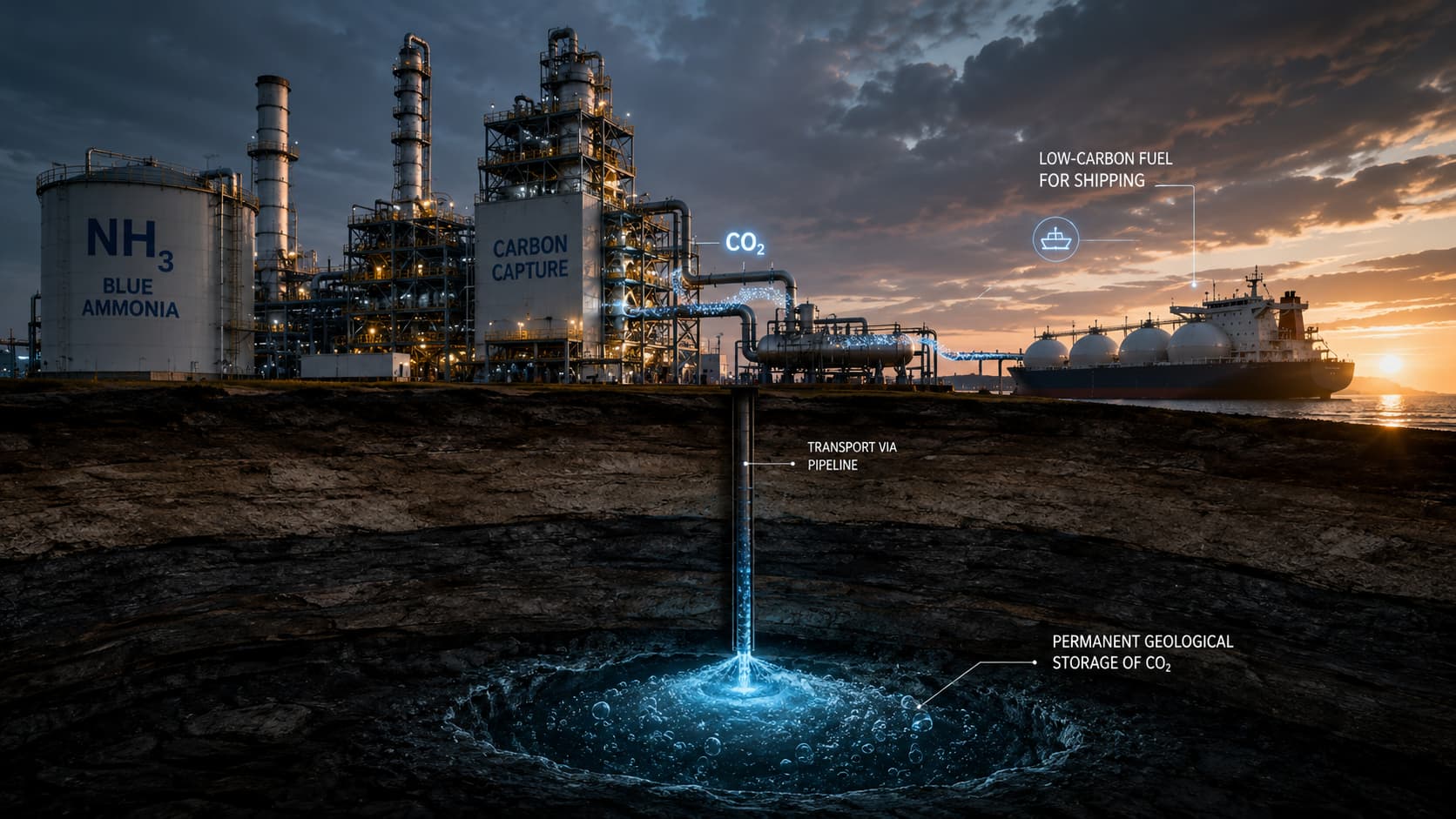

Half of the human body’s nitrogen comes from a single industrial process: the creation of synthetic ammonia for fertilizer. Without it, the global food supply would collapse. However, producing this vital chemical requires tearing nitrogen from the air and extracting hydrogen from natural gas—a violent, energy-intensive reaction that releases hundreds of millions of tons of carbon dioxide into the atmosphere every year. The paradox of modern agriculture is that feeding the planet actively degrades its climate.
Why should you care right now? Because the heavy industrial sector has discovered a highly lucrative, multi-billion-dollar engineering pivot. Rather than waiting decades for expensive, purely renewable “green” ammonia to scale, petrochemical giants are re-engineering their massive gas plants today. They are capturing the exhaust before it hits the sky and permanently burying it thousands of feet underground. This process, known as blue ammonia, is rapidly becoming the dominant decarbonization strategy for heavy industry. By turning atmospheric pollution into a heavily subsidized financial asset, energy companies are rewriting the economics of global agriculture and maritime shipping for the 21st century.
What is Low-Carbon Blue Ammonia?
Low-carbon blue ammonia is synthetic ammonia NH3 produced using natural gas as a feedstock, but structurally integrated with Carbon Capture and Storage (CCS). The carbon dioxide generated during the upstream hydrogen extraction phase is captured and permanently stored deep underground, providing a low-emission alternative to traditional unabated ammonia while utilizing existing fossil fuel infrastructure.
At a Glance
- Concept: Modifying traditional ammonia factories to capture and bury the CO2 emissions generated during hydrogen production.
- Why it matters: The global sector produces 183 million tonnes of ammonia annually, primarily for fertilizers. Blue ammonia decarbonizes this massive volume faster and cheaper than renewable-based green ammonia.
- Who uses it: Major agricultural corporations, maritime shipping conglomerates transitioning to low-carbon fuels, and Asian power utilities aiming to co-fire ammonia with coal.
- Biggest takeaway: The global blue ammonia market is accelerating rapidly, with estimates projecting market value to reach between $17.1 billion and $18.96 billion by the early 2030s. This expansion is fiercely subsidized by policies like the U.S. 45Q tax credit, which provides $85 per ton of stored CO2.
In Simple Words
Making standard “grey” ammonia is like burning wood in a closed room; the heat does the job you need, but the room fills with toxic smoke.
“Blue” ammonia uses the exact same wood and produces the exact same heat. The difference is entirely in the chimney. Instead of letting the smoke vent into the open air, engineers attach a massive, specialized vacuum to the exhaust pipe. This vacuum captures all the smoke, compresses it into a liquid, and pumps it deep underground where it can never escape. The final product—the ammonia—is chemically identical to what we have always used, but the atmospheric damage is entirely removed from the equation.
Why This Matters
For Energy Investors and Industrial Engineers, blue ammonia represents the ultimate transition asset. The global fertilizer industry cannot simply shut down to wait for renewable energy grids to mature. Furthermore, the regulatory environment is closing in. The European Union’s Carbon Border Adjustment Mechanism (CBAM) will soon impose escalating carbon costs on imported industrial goods exceeding benchmark emission levels.
Unabated grey ammonia will face CBAM exposure that could surge from approximately $25 to $30 per tonne of NH3 in 2026 to nearly $280 to $300 per tonne by 2034. By producing blue ammonia with a significantly lower carbon intensity (typically 0.15 to 0.35 tonnes of CO2 per tonne of NH3, producers secure a massive, structural competitive advantage against foreign competitors facing ruinous carbon tariffs.
The Transition to Low-Carbon Blue Ammonia
Blue ammonia operates as a critical bridge technology. The chemical molecule itself remains exactly the same, relying on the century-old Haber-Bosch synthesis loop. The innovation occurs purely upstream during the hydrogen generation and CO2 capture stages.
Because it leverages existing, deeply mature natural gas networks and proven chemical engineering, blue ammonia allows petrochemical titans to instantly pivot their massive operational footprints toward decarbonization. It reduces the sector’s carbon intensity on a timeline vastly faster than green ammonia, which remains bottlenecked by the requirement for massive new renewable electricity and expensive electrolysis capacity.
How Low-Carbon Blue Ammonia Production Works
Eliminating millions of tons of greenhouse gases from an industrial chemical plant requires fundamentally altering the thermodynamic architecture of hydrogen extraction. Here is the first-principles breakdown of the process.
1. The Fundamental Problem: Hydrogen Extraction
Ammonia (NH3) is composed of nitrogen and hydrogen. While nitrogen is easily pulled from the ambient air, hydrogen must be violently stripped from natural gas (methane, CH4). Breaking the methane molecule apart inherently releases massive amounts of carbon dioxide as a byproduct.
2. The Insufficiency of Traditional SMR
Historically, the industry relied on Steam Methane Reforming (SMR), which currently accounts for approximately 75% of global hydrogen production. However, SMR is highly inefficient for carbon capture. It generates CO2 in two separate places: a concentrated process stream and a highly dilute flue gas stream in the furnace. Capturing both streams requires entirely different, expensive technologies, making retrofitting old SMR plants financially prohibitive.
3. The Core Mechanism: Autothermal Reforming (ATR)
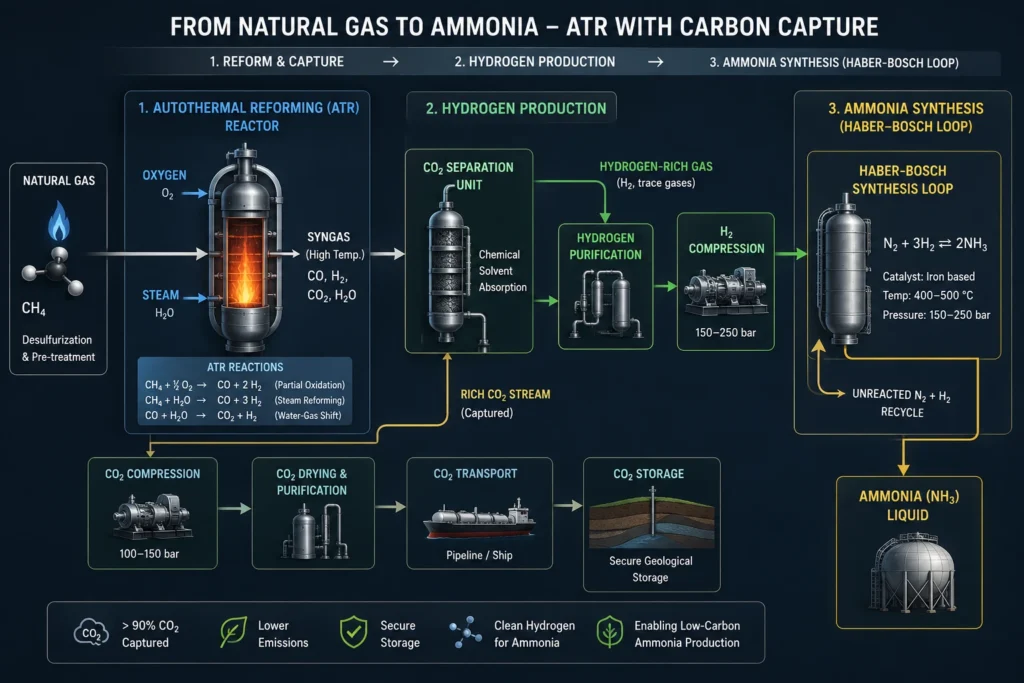
To solve the capture bottleneck, developers are prioritizing Autothermal Reforming (ATR). ATR combines partial oxidation of methane with catalytic steam reforming inside a single, oxygen-blown reactor. This oxygen-blown operation generates a much cleaner, highly concentrated stream of CO2 compared to SMR flue gas. This concentrated stream makes Carbon Capture and Storage (CCS) integration exponentially more efficient and cost-effective.
4. Technical Depth: Pre-Combustion Capture
Modern blue ammonia designs utilize a multi-step sequence: hydrocarbon feedstock preheating, sulfur removal, reforming to syngas (a mix of CO, CO_2, H_2, H_2O, CH_4), followed by a water-gas shift reaction. During this phase, pre-combustion carbon capture separates the gas into a CO_2 -rich stream and a hydrogen-rich stream. The concentrated CO_2 is immediately diverted to pipelines for permanent geological storage.
5. Real-World Consequences: The Haber-Bosch Loop
Once the pure, decarbonized hydrogen is secured, the process enters the traditional Haber-Bosch synthesis loop. The hydrogen is combined with atmospheric nitrogen under extreme conditions (100–200 bar and 400–500°C) to synthesize the final product:
N2 + 3H2 ⇌ 2NH3
Because the upstream carbon was captured, the resulting blue ammonia exits the plant completely chemically identical to grey ammonia, ready to drop seamlessly into existing global supply chains.
Industrial Applications for Blue Ammonia
Blue ammonia is rapidly transitioning from a theoretical climate concept into a commercially contracted industrial commodity.
Decarbonizing Global Agriculture: Fertilizers hold the dominant application share within the blue ammonia market, standing at roughly 46% as of 2026. Because ammonia is the core building block for nitrogen-based fertilizers feeding the global food supply, blue ammonia directly substitutes conventional grey ammonia with zero required modifications to existing downstream agricultural infrastructure.
Zero-Carbon Maritime Fuel: The global shipping industry is under intense pressure to decarbonize. Ammonia burns without emitting carbon dioxide, making it a premier candidate for next-generation marine engines. The increasing demand for low-carbon fuels—energy sources that generate significantly lower CO2 emissions than conventional fossil fuels—is a massive driver for the blue ammonia market.
Power Sector Co-Firing: In regions lacking abundant land for renewables, utility firms are utilizing ammonia as a high-density hydrogen carrier. In East Asia, particularly Japan, dense fertilizer manufacturing capacity and firm utility co-firing programs are driving regional demand. However, markets like South Korea remain in transition; policy uncertainties regarding clean hydrogen portfolio standards have made South Korea a potential, but not yet fully bankable, demand center.
Economic & Strategic Impact
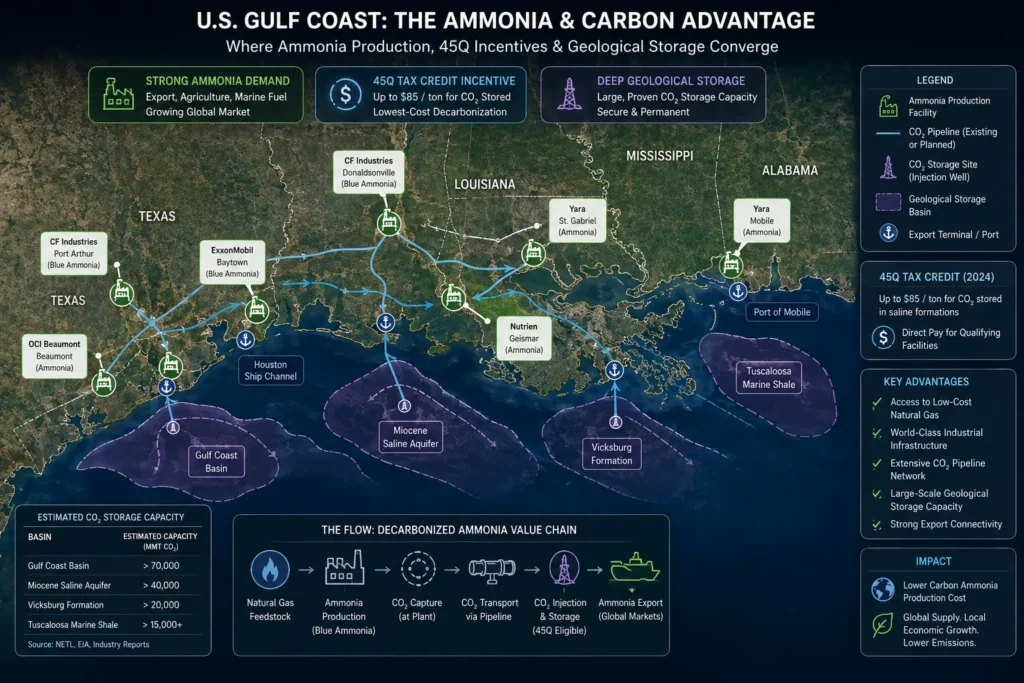
The geopolitical epicenter of the blue ammonia boom is the United States Gulf Coast.
The U.S. Gulf Coast is currently the most execution-ready supply region on the planet, supported by established infrastructure, access to emerging CO_2 pipelines, and cheap shale gas feedstock. The definitive economic catalyst is the U.S. Internal Revenue Code Section 45Q tax credit, which rewards producers with $85 per ton of carbon dioxide securely stored underground.
This massive federal backing provides Gulf Coast producers with an insurmountable cost edge over rival supply regions. It enables firms to ship low-carbon ammonia to buyers in Europe and Asia far cheaper than those nations could ever produce it domestically. Simultaneously, regions like Western Canada are emerging as strategic rivals, offering lower gas costs, a cleaner electrical grid, and a significantly shorter shipping route across the Pacific to Japan (~14 days versus ~28 days from the US Gulf Coast via the Panama Canal).
Advantages
- Infrastructure Compatibility: Blue ammonia is a “drop-in” replacement for grey ammonia. It requires absolutely no modifications to the existing ships, pipelines, or agricultural machinery that already handle the 183 million tonnes traded annually.
- High Capture Rates: Advanced Autothermal Reforming (ATR) plants integrated with carbon capture are prioritized by developers because their capture efficiencies can routinely exceed 95%.
- Regulatory Shielding: By drastically reducing Scope 1 and Scope 2 emissions, blue ammonia insulates producers from crippling international tariffs like the European Union’s Carbon Border Adjustment Mechanism (CBAM).
Limitations
- High CapEx and Infrastructure Dependency: Producing blue ammonia requires immense upfront capital to construct dedicated carbon capture facilities, CO_2 compression systems, transportation pipelines, and secure geological storage networks.
- The Scope 3 Blind Spot: While plant emissions (Scope 1) are low (~0.04–0.06 tonnes of CO_2 per tonne of NH_3), evaluating the true lifecycle carbon intensity requires including Scope 3 emissions. This includes upstream methane leaks during natural gas extraction and the emissions generated by long-haul maritime shipping logistics.
- Cracking Losses: If blue ammonia is exported simply to be used as a carrier for hydrogen, it must be “cracked” back into H_2 upon arrival. This cracking process results in energy losses of 15% to 25%, threatening its competitiveness against direct liquid hydrogen pathways.
Common Misconceptions
Misconception: Blue ammonia is chemically different from standard ammonia.
Reality: It is exactly the same chemical (NH_3). It is the upstream production process—specifically the integration of carbon capture—that defines it as “blue,” not the physical molecule itself.
Misconception: Steam Methane Reforming (SMR) is the future of clean ammonia.
Reality: While SMR currently holds a dominant 63% to 75% share of global production infrastructure, it is highly inefficient for carbon capture. The industry is aggressively pivoting toward Autothermal Reforming (ATR) for all new-build low-carbon plants due to its superior CO_2 concentration.
Misconception: Blue ammonia is a permanent, final climate solution.
Reality: Much of the academic and policy literature frames blue ammonia explicitly as a “bridge technology”. It serves a finite but critical role in decarbonizing heavy industry today, acting as a placeholder until the cost curves for 100% renewable “green” ammonia eventually converge with market realities.
What Most People Miss
The hidden advantage of Inherent CO2 Separation.
While post-reforming capture on ATR plants is the current standard, the next generation of engineering is focusing on Gas Switching Reforming (GSR). This is an advanced chemical looping concept that achieves inherentCO_2 separation directly during the reforming process. By eliminating the need for a massive, separate post-reforming amine-scrubbing capture unit, GSR enables the simultaneous co-production of hydrogen and nitrogen directly suited for the Haber-Bosch loop, potentially slashing the capital costs of future blue ammonia facilities.
Comparison Table
| Feature | Grey Ammonia | Blue Ammonia (ATR + CCS) | Green Ammonia |
| Feedstock | Natural Gas or Coal | Natural Gas | Renewable Electricity + Water |
| Production Tech | Steam Methane Reforming (SMR) | Autothermal Reforming (ATR) | Electrolysis |
| Carbon Emissions | Very High (Vented to atmosphere) | Low (Captured & Stored) | Zero |
| CBAM Tax Exposure | Extreme (up to $300/t by 2034) | Low (~$20–60/t by 2034) | Zero |
| Technological Maturity | Fully Mature | Scaling Rapidly (Bridge Tech) | Early Stage (High CapEx) |
| Primary Incentive | Low Baseline Cost | Section 45Q Tax Credits ($85/t) | ESG Mandates |
Case Study
Situation: The global push to decarbonize heavy industry placed massive pressure on traditional fertilizer producers in the United Kingdom. Operating within the Northeast of England industrial belt, chemical firms faced firm carbon cost pressure and strict carbon pricing under the European Union Emissions Trading System.
Challenge: Transitioning completely to green ammonia via electrolysis was financially and logistically impossible in the near term due to the lack of sufficient surplus renewable energy on the local grid.
Solution (The Carbon Cluster): The UK capitalized on strong government funding tied to the Northeast of England industrial carbon capture cluster. Fertilizer producers retrofitted existing infrastructure and integrated new blue ammonia production architectures. They utilized nearby, depleted North Sea geological storage basins to permanently bury the captured CO_2 emissions.
Outcome: The regional UK blue ammonia market established a secure, low-cost carbon storage path practically adjacent to existing plant sites, scaling the local market value near $161 million by 2026.
Lessons Learned: The deployment proved that blue ammonia thrives specifically where heavy industrial clusters overlap geographically with accessible geological storage (like the North Sea or the US Gulf Coast). It validated that utilizing existing infrastructure and localized storage basins is the most practical, economically viable method to bypass the massive capital hurdles of the energy transition.
Future Outlook
Next 12–24 Months
The era of ATR Dominance and Pilot Deployments. Throughout the end of 2026 and 2027, developers will overwhelmingly prioritize autothermal-reforming (ATR) plants over legacy SMR retrofits, driven by the requirement to hit 95%+ capture efficiencies to maximize federal tax credits. The market will see intense engineering focus on finalizing front-end engineering design (FEED) studies for massive US Gulf Coast facilities seeking to lock in Section 45Q funding before regulatory windows narrow.
Next 3–5 Years
The scaling of Maritime Fuel and Asian Export Corridors. By 2030, the global blue ammonia market will approach the $18.96 billion mark. During this window, the demand profile will shift significantly toward the shipping industry as maritime emission mandates force a pivot to low-carbon fuels. Concurrently, massive export corridors will mature, with specialized tanker fleets transporting millions of tons of blue ammonia from cheap-gas hubs in North America directly to utility co-firing programs in Japan.
Next 10 Years
The Lifecycle Carbon Auditing Reckoning. By the mid-2030s, the competitive landscape will no longer be dictated purely by the cost of natural gas. As standards bodies (like ISO) finalize strict lifecycle assessment methodologies, the market will aggressively penalize “Scope 3” emissions. Blue ammonia producers who fail to eliminate upstream methane leaks at the wellhead or rely on high-emission shipping logistics will find themselves locked out of premium European and Asian markets, forcing a total supply-chain purification to maintain the “blue” designation.
Most Likely Scenario
Blue ammonia is not the final destination of the energy transition, but it is the indispensable bridge. By aligning the immediate financial interests of legacy oil and gas giants with the decarbonization mandates of the global agricultural sector, blue ammonia will command massive capital deployment throughout the 2020s and 2030s, successfully stalling atmospheric damage until green hydrogen technologies achieve true commercial parity.
Key Takeaways
- Blue ammonia is synthetic ammonia produced from natural gas, where the resulting CO_2 emissions are captured and permanently stored underground (CCS) rather than vented into the atmosphere.
- The market is experiencing exponential growth—projected to reach over $17 billion by the 2030s—driven by decarbonization mandates in the 183-million-tonne global fertilizer industry.
- Autothermal Reforming (ATR) is replacing traditional Steam Methane Reforming (SMR) for new projects because ATR generates a concentrated CO_2 stream that makes carbon capture vastly more efficient and cheaper.
- The U.S. Gulf Coast is the dominant global hub for production, heavily incentivized by the Section 45Q tax credit which pays producers 85 for every ton of CO_2 they securely bury.
- Blue ammonia serves as a critical defense against the EU’s Carbon Border Adjustment Mechanism (CBAM), drastically lowering a producer’s carbon tax exposure compared to grey ammonia.
- While plant-level emissions (Scope 1 and 2) are incredibly low, the long-term viability of the industry depends on controlling upstream methane leaks and shipping logistics (Scope 3).
Glossary
Autothermal Reforming (ATR): An advanced hydrogen production technology that combines partial oxidation and steam reforming in a single reactor, generating a highly concentrated CO_2 stream that is ideal for carbon capture.
Carbon Border Adjustment Mechanism (CBAM): A European Union regulation that places a carbon tax on imported goods (like ammonia) based on the greenhouse gas emissions generated during their production.
Haber-Bosch Process: The century-old, energy-intensive chemical synthesis loop that combines pure hydrogen gas with atmospheric nitrogen under extreme heat and pressure to create ammonia.
Scope 3 Emissions: The indirect greenhouse gas emissions that occur in a company’s value chain, such as upstream methane leaks from natural gas extraction and downstream transportation emissions.
Section 45Q: A highly lucrative provision in the U.S. Internal Revenue Code that provides a substantial tax credit ($85/tonne) to companies that capture and permanently store carbon dioxide geologically.
Steam Methane Reforming (SMR): The legacy industrial process for extracting hydrogen from natural gas. It is highly inefficient for carbon capture because it creates dilute CO_2 streams.
Sources
- Blue ammonia production technology landscape 2026 – Patsnap
- Blue Hydrogen Market Size, Growth & Industry Trends 2031 – Mordor Intelligence
- Blue ammonia competing in emerging markets – BC Insight
- Blue Ammonia Market Report 2026 – Research and Markets
- Blue Ammonia Market Size, Share & Future Scope – 2033
- Blue Ammonia Market Size, Share, Growth & Demand Forecast to 2034