Advertisement
)

AT A GLANCE
- Concept: Reverse Osmosis: Pushing saltwater against a semi-permeable membrane to separate pure water molecules from salt ions.
- Concept: Isobaric Energy Recovery: Capturing the hydraulic pressure from waste brine to power the next cycle of incoming seawater.
- Concept: Semi-Permeable Membrane: A tightly wound polymer filter with pores so small they block dissolved salt while allowing water to pass.
- Concept: High-Pressure Pump: The massive mechanical engine required to overcome the natural osmotic pressure of the ocean.
IN SIMPLE WORDS
In nature, water naturally wants to dilute salt. If you place fresh water and saltwater next to each other separated by a thin filter, the fresh water will naturally flow through the filter to mix with the salt.
Megascale desalination forces nature to run backward. Because entire nations in the Middle East and North Africa have exhausted their natural groundwater, they must drink the ocean to survive. To do this, giant coastal factories use massive mechanical pumps to shove raw seawater against tightly wound plastic filters at crushing pressures.
The pressure overpowers the natural flow of water, squeezing pure, drinkable water through the microscopic pores while leaving the salt behind. By doing this on an industrial scale, these mega-plants generate enough artificial rivers to sustain entire modern cities in the middle of bone-dry deserts.
HOW MEGASCALE DESALINATION WORKS
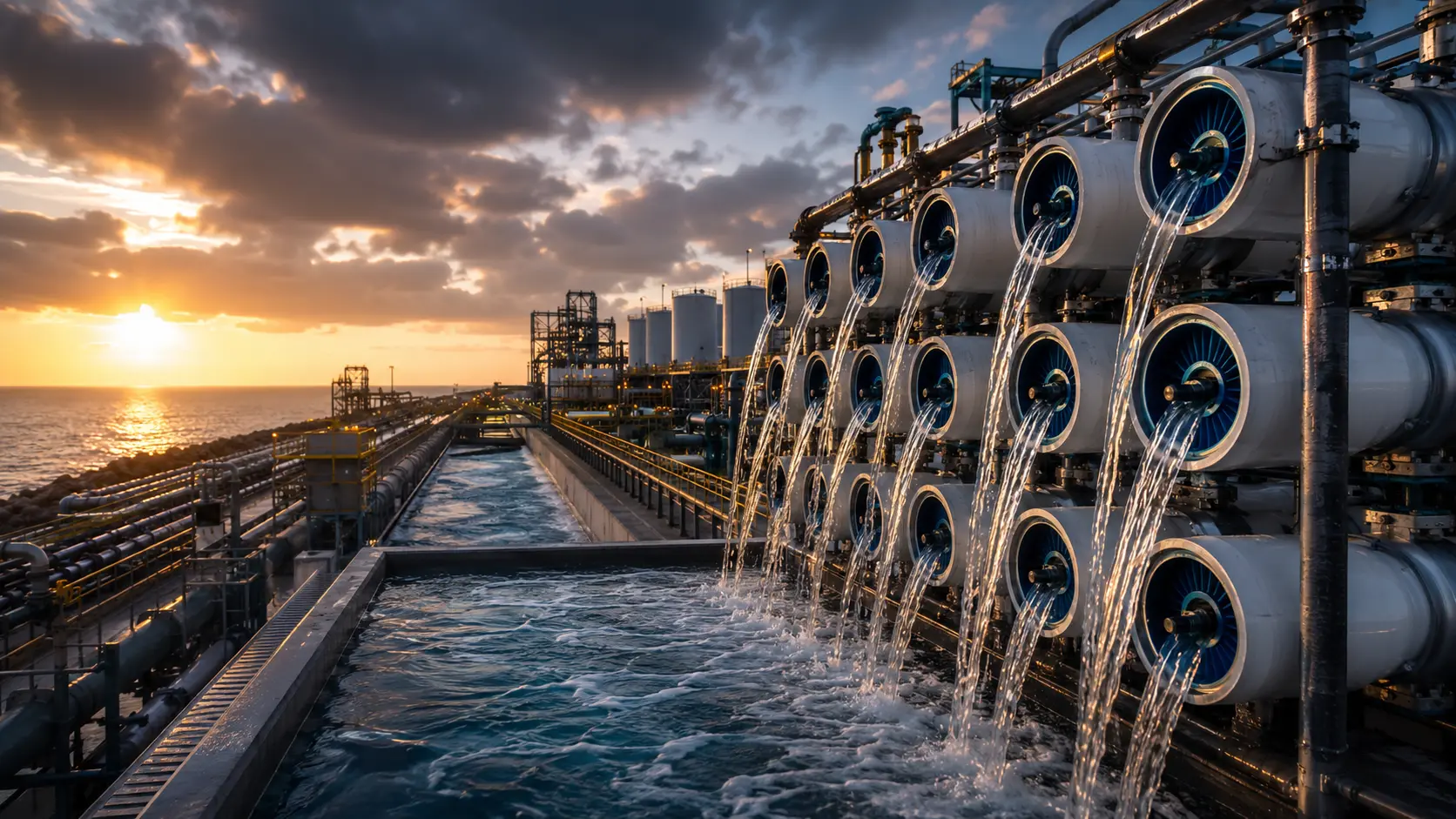
The architecture of a megascale Sea Water Reverse Osmosis (SWRO) plant is dictated entirely by fluid dynamics and thermodynamics. When raw seawater enters the facility, it undergoes extensive pre-treatment. Massive dissolved air flotation tanks and gravity sand filters strip away algae, microplastics, and suspended solids that would otherwise physically blind the delicate downstream membranes.
Once clarified, the seawater hits the high-pressure pumps. Natural osmotic pressure forces water toward higher salt concentrations. To reverse this, the pumps must apply hydrostatic pressure exceeding 800 pounds per square inch (psi) to the saltwater.
The pressurized fluid then enters the pressure vessels, which house hundreds of semi-permeable thin-film composite membranes. These polyamide membranes feature pores measuring roughly 0.1 nanometers across. As the high-pressure seawater sweeps across the membrane surface, pure water molecules are forced through the polymer matrix.
The pure water, now called permeate, collects in a central tube for final chemical stabilization. However, only about 50 percent of the incoming seawater converts to fresh water. The remaining 50 percent becomes a highly concentrated, highly pressurized salt solution known as brine.
Historically, this pressurized brine was simply dumped back into the ocean, wasting massive amounts of mechanical energy. Modern mega-plants solve this extreme thermodynamic loss using Isobaric Energy Recovery Devices (ERDs).
Inside a rotary pressure exchanger, the high-pressure waste brine physically collides with the incoming low-pressure seawater inside narrow ceramic ducts. Because the exposure lasts only milliseconds, the fluids transfer their pressure without mixing their salt content. This elegant physical energy transfer reduces the electrical load on the main high-pressure pumps by up to 60 percent.
REAL WORLD EXAMPLE
The Taweelah Reverse Osmosis plant in Abu Dhabi operates as the largest single desalination facility on Earth. Located on the coast of the Arabian Gulf, the complex filters roughly 240 million gallons of seawater every single day.
To achieve this scale, Taweelah utilizes advanced Spanish-engineered pressure exchangers that recapture immense amounts of hydraulic energy. This allows the plant to produce drinking water using less than 3.0 kilowatt-hours of electricity per cubic meter. By integrating directly with a massive on-site solar farm, Taweelah successfully decoupled the nation’s drinking water supply from its historical reliance on burning natural gas.
WHY IT MATTERS NOW
The global hydrologic cycle is structurally failing human demand. Megacities from Chennai to Cape Town have experienced “Day Zero” events, where municipal reservoirs physically run dry. Climate volatility guarantees that historic rainfall patterns will no longer reliably refill interior lakes and aquifers.
Desalination is the only mathematically guaranteed source of fresh water that is entirely independent of the weather. For arid nations in the Middle East, it is not a supplemental resource; it is absolute existential infrastructure. Saudi Arabia currently relies on desalinated water for over 50 percent of its municipal supply.
This creates a massive capital expenditure cycle for water infrastructure. Global infrastructure funds are pouring billions of dollars into independent water and power projects (IWPPs) across the Mediterranean and South America. Financial markets now treat treated water as a highly predictable, sovereign-backed commodity.
Furthermore, water security directly dictates food security and industrial capacity. Semiconductor fabrication plants and green hydrogen electrolyzers require millions of gallons of ultra-pure water daily. Nations that fail to secure megascale desalination capabilities will simply be forced to abandon high-tech manufacturing entirely.
COMMON MISCONCEPTIONS
- “Desalination boils the ocean.” Older thermal plants used extreme heat to boil seawater into steam. Modern reverse osmosis plants do not use heat; they use mechanical pressure to squeeze water through filters at room temperature.
- “The ocean will run out of water.” The oceans hold roughly 350 million cubic miles of water. Human desalination extracts a mathematically imperceptible fraction of a fraction of a percent of this total volume.
- “It solves the agricultural crisis.” Desalinated water is still far too expensive to use for cheap crop irrigation like wheat or corn. It is strictly reserved for high-value municipal drinking water and specialized industrial processes.
WHAT MOST PEOPLE MISS
Environmental analysts intensely focus on the carbon footprint of the electricity used, but they frequently overlook the acute marine biology impact of the waste brine.
When a mega-plant extracts half the pure water, the remaining waste stream is dumped back into the ocean at twice the normal salinity. This heavy, hypersaline brine sinks to the seafloor, creating toxic underwater deserts that suffocate local benthic marine life. Managing this brine discharge—by installing massive diffuser pipes that aggressively mix the waste across miles of ocean currents—is the most complex environmental engineering challenge of building a new plant.
THE ECONOMIC AND STRATEGIC IMPACT
The primary financial beneficiaries are the specialized chemical and polymer engineering firms holding patents on thin-film composite membranes, such as DuPont and Toray. Because these membranes must be periodically replaced, they generate highly lucrative, recurring revenue streams for the manufacturers.
Strategically, megascale desalination fundamentally alters riparian geopolitics. Historically, nations fought bitter proxy wars over the damming of shared rivers, such as the disputes over the Nile and the Tigris-Euphrates basins. Coastal desalination allows a nation to permanently bypass these upstream conflicts, buying absolute political autonomy with infrastructure capital.
However, it introduces severe asymmetric vulnerability. A coastal mega-plant is an exposed, fragile glass jaw. If a hostile state or proxy group strikes a nation’s primary desalination intake pipes with a loitering munition, the targeted city will run completely out of drinking water in less than 72 hours.
THE TRAJECTORY
Next 12–36 Months: The integration of artificial intelligence into membrane fouling prediction. AI models will constantly analyze the chemical composition of incoming seawater to dynamically adjust chemical dosing. This will prevent algae blooms from destroying the delicate polymer membranes, extending their operational lifespan by years.
Next Five Years: The commercialization of zero liquid discharge (ZLD) technologies. Instead of dumping toxic brine back into the ocean, advanced facilities will mine the waste stream. They will extract highly valuable lithium, magnesium, and rare earth elements directly from the concentrated salt, turning a disposal liability into a lucrative critical minerals pipeline.
Next Ten Years: The deployment of biomimetic aquaporin membranes. Engineers will abandon standard plastics and weave synthetic proteins modeled after the water-channeling biology of human kidneys. These biological membranes will filter salt with near-zero friction, drastically lowering the hydrostatic pressure required and slashing the electricity cost of desalination by another 30 percent.
What Could Go Wrong: A catastrophic localized red tide event. If a massive, toxic algal bloom overwhelms a coastal region’s intake pipes, the biological slime will instantly blind the reverse osmosis membranes. The entire facility will be forced into an emergency shutdown, cutting off the municipal water supply indefinitely until the ocean clears.
Most Likely Outcome: Megascale reverse osmosis will become the mandatory baseline infrastructure for global coastal cities. As membrane technology matures and renewable energy drives down operational costs, the ability to manufacture endless fresh water will permanently sever human survival from the unpredictable cycles of natural rainfall.
KEY TERMS
- Reverse Osmosis (RO): A water purification process that uses high mechanical pressure to force a solvent through a semi-permeable membrane, leaving the dissolved salts behind.
- Isobaric Energy Recovery Device (ERD): A mechanical system that transfers the high hydraulic pressure from waste brine directly to incoming seawater, drastically saving electricity.
- Semi-Permeable Membrane: A highly engineered polymer filter with microscopic pores that allows water molecules to pass while physically blocking larger salt ions.
- Brine: The highly concentrated, hypersaline waste solution created after the pure water has been extracted from the ocean.
- Osmotic Pressure: The natural physical force that drives pure water to mix with salty water across a barrier.
- Thin-Film Composite: The multi-layered plastic material used to manufacture modern reverse osmosis filters to withstand extreme pressure without tearing.
BEGINNER FAQ
What is megascale desalination? It is the industrial process of removing salt from ocean water on a massive scale to create millions of gallons of fresh, drinkable water for cities.
How does reverse osmosis work? Imagine a microscopic sieve. The plant uses giant pumps to push salty ocean water against the sieve at incredibly high pressure. The pure water squeezes through, but the salt is too big and gets left behind.
Is it safe to drink? Yes. Reverse osmosis filters out everything, including salt, bacteria, and viruses. The water that comes out is actually so pure that engineers have to add healthy minerals back into it before it goes to your tap.
Why don’t we do this everywhere? It is highly expensive. Pushing water at that level of pressure requires massive amounts of electricity. It is only built in places where natural fresh water is entirely gone or highly unreliable.
What happens to the leftover salt? The leftover water, which is now twice as salty, is pumped back into the ocean. Engineers have to spray it out over a wide area so it does not settle on the ocean floor and harm marine life.
Do these plants use a lot of energy? Historically, yes. But modern plants use special devices to capture the pressure from the waste water and recycle it, which has cut the total electricity needed by more than half.
Can we use this water for farming? Typically, no. The cost of electricity makes the water too expensive to use for growing cheap crops like corn or wheat. It is mostly used for drinking water and high-tech manufacturing.
What happens if a plant loses power? The city stops getting water immediately. Because these plants are critical to survival, they are usually built with massive backup power generators and connected directly to local power plants.
SOURCES
- International Desalination Association (IDA) — Global Water Security and Desalination Capacity Report
- Massachusetts Institute of Technology (MIT) — Energy Efficiency and Thermodynamics of Reverse Osmosis Systems
- The World Bank — The Economics of Desalination and Brine Management
- Journal of Membrane Science — Biomimetic Membranes and the Future of Aquaporin Filtration