Advertisement
)

At a Glance
- Concept: Utilizing advanced additive manufacturing technologies—primarily Powder Bed Fusion and Directed Energy Deposition—to construct flight-ready metal components from digital blueprints.
- Why it matters: The aerospace sector is desperate to reduce vehicle weight to increase fuel efficiency and payload capacity. Metal 3D printing allows engineers to consolidate assemblies of 300 individual parts into a single, seamless, lightweight print.
- Who uses it: SpaceX, Blue Origin, GE Aerospace, and defense contractors utilizing hardware from major 3D printing manufacturers like EOS, Velo3D, SLM Solutions, and GE Additive.
- Biggest takeaway: Printing the part is only half the battle. Melting metal with lasers introduces extreme thermal stress. The hidden bottleneck of the industry is the complex post-processing—including Hot Isostatic Pressing (HIP)—required to ensure the metal achieves the flawless, void-free density demanded by aviation safety regulators.
In Simple Words
Traditional manufacturing is like sculpting a statue from a block of marble. You start with a massive, heavy chunk of expensive titanium and use computer-guided drills (CNC machines) to cut away the material you do not need. This wastes expensive metal and restricts you to shapes that a drill bit can physically reach.
Metal 3D printing (Additive Manufacturing) is like building a house out of microscopic, metallic sand.
Inside a sealed chamber, a machine spreads a layer of fine metal dust, thinner than a human hair. A high-powered laser fires from above, tracing a cross-section of a digital blueprint. The laser instantly melts and welds the dust together into solid metal. The machine lowers the platform a fraction of a millimeter, spreads another layer of dust, and fires the laser again. It repeats this process thousands of times.
Because you are building the part from the ground up, you can create hollow insides, hidden cooling channels, and complex organic shapes that a drill could never reach. Instead of assembling a rocket engine by welding 100 separate pipes and valves together, you simply print the entire engine as one solid, leak-proof piece of metal.
Why This Matters
The commercial space race and the push for net-zero commercial aviation have hit a metallurgical wall.
Every extra pound placed into orbit costs thousands of dollars in rocket fuel. To build lighter rockets and more fuel-efficient jet engines, engineers must design parts with extreme geometric complexity. Subtractive manufacturing (cutting metal) has reached its physical limits. Additive manufacturing (3D printing) breaks those limits.
The economic impact is staggering. By 2026, the global aerospace additive manufacturing market reached USD 2.7 billion, with the overall metal 3D printing market projected to surge past USD 14 billion before the end of the decade. The technology fundamentally rewrites aerospace supply chains. If an aerospace contractor needs a specialized titanium bracket, they no longer have to wait six months for a forge to cast a custom mold. They simply send a digital file to a local 3D printing facility, completely bypassing global supply chain friction and reducing production lead times from months to days.
The Big Picture
The true superpower of metal 3D printing is unlocked by a software concept called Topological Optimization.
In traditional engineering, a metal bracket holding a jet engine is usually shaped like a solid block or an “L” because flat, straight lines are easy to machine. However, flat blocks contain a lot of “lazy” metal—material that adds weight but carries no actual stress.
Topological optimization uses artificial intelligence to analyze exactly where the physical stress flows through a part. The software mathematically erodes all the lazy metal away, leaving only the material strictly necessary to carry the load. The result looks like alien bone or a spiderweb. These organic, bionic shapes are up to 40% lighter but just as strong as the original block. Metal 3D printing is the only manufacturing method on Earth capable of physically fabricating these mathematically perfect, highly irregular geometries.
Here is a glimpse of the complex internal geometries and lightweight lattice structures achievable only through additive manufacturing:
How It Works
Forging aerospace-grade titanium with lasers requires absolute control over extreme physical and chemical environments. Here is the first-principles breakdown of the process.
1. The Fundamental Problem: Heat and Geometry
Aerospace components, especially in rocket propulsion and jet turbine hot-sections, operate in environments exceeding 1,500 degrees Celsius. To survive, they must be made of superalloys (like Inconel or Titanium Ti-6Al-4V). Furthermore, these engines require highly complex internal cooling channels winding through the metal to keep the part from melting.
2. The Insufficiency of Subtractive Manufacturing
Traditional CNC machining cannot drill a curved, complex cooling channel deep inside a solid block of Inconel. To build these cooling channels traditionally, manufacturers must cast dozens of separate, simple parts and braze or weld them together. Every weld is a point of structural weakness and a potential failure point under the extreme vibration of a rocket launch.
3. The Core Mechanism: Laser Powder Bed Fusion (LPBF)
The industry standard for intricate parts is Laser Powder Bed Fusion (also known as DMLS or SLM). The machine consists of a build plate and a powder dispenser. A recoater blade spreads a 30-micron to 50-micron layer of metallic powder across the plate. One or more fiber lasers (often operating between 400W and 1,000W) fire down through a galvanometer mirror system, directing the beam at speeds exceeding several meters per second to precisely melt the powder into the shape of the current cross-section.
4. Technical Depth: Melt-Pool Thermodynamics and Argon Gas
When a laser hits metal powder, it creates a microscopic “melt pool.” The thermodynamics of this melt pool dictate the success of the print. If the laser moves too fast, the powder does not fully melt, leaving microscopic voids. If it moves too slow, the metal boils and vaporizes, causing splatter.
Crucially, hot titanium and aluminum will instantly react with oxygen in the air, ruining the metal and potentially causing a fire. Therefore, the entire printing process must occur inside a hermetically sealed build chamber flooded with an inert gas, usually highly purified Argon, ensuring the oxygen level remains below 0.1 percent.
5. Real-World Consequences: Thermal Stress and Support Structures
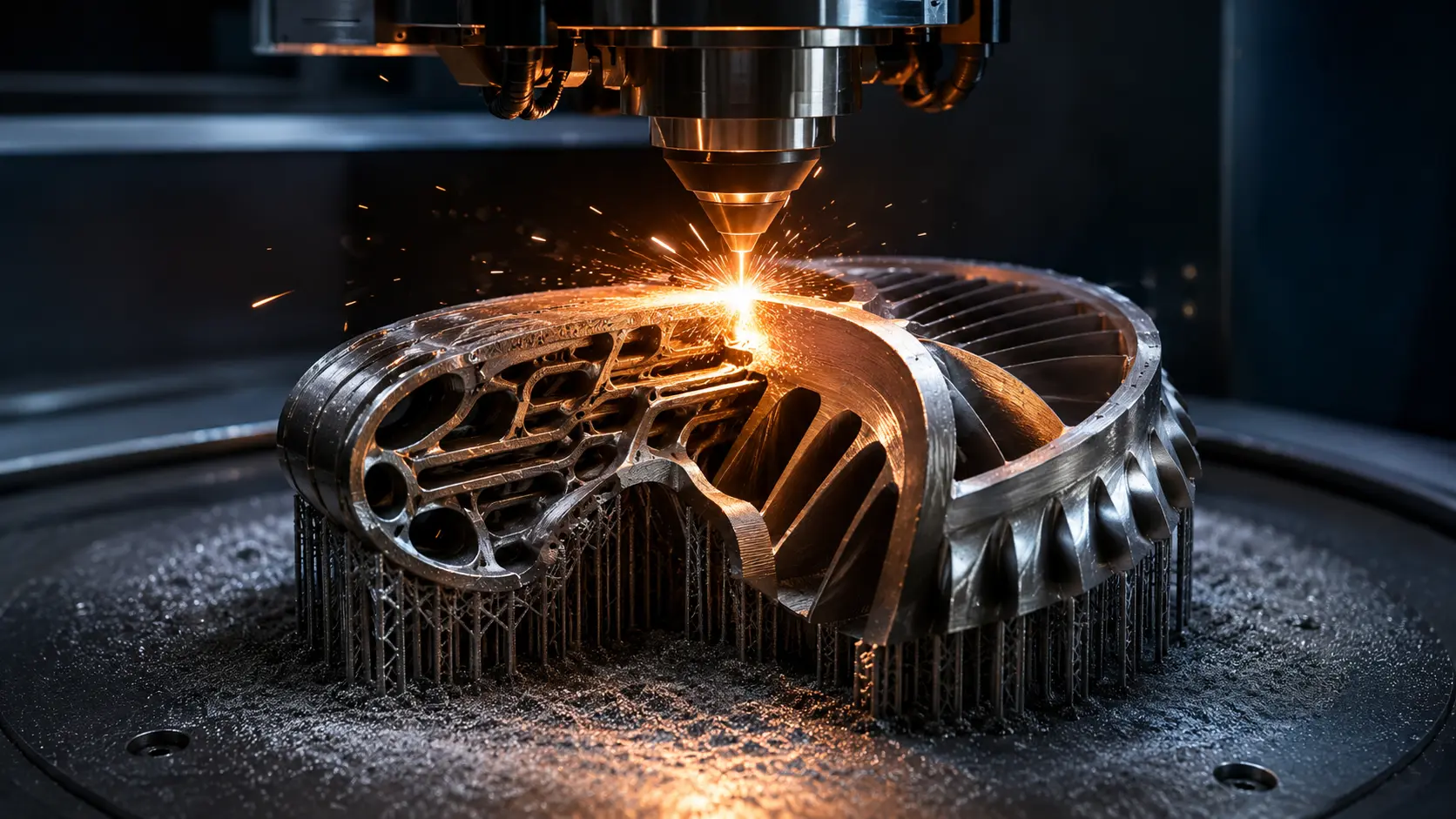
The extreme temperature gradients—the laser instantly heating the metal to thousands of degrees while the surrounding powder is relatively cool—cause the metal to warp and curl as it solidifies. To prevent the part from ripping itself off the build plate, engineers must print sacrificial “support structures” underneath overhangs to physically anchor the part down and pull heat away. After the print is finished, the part must undergo intense heat treatment in an oven to relieve these built-up residual stresses before the supports can be physically sawed off.
Here are finished examples of the complex, consolidated geometries that aerospace manufacturers produce, integrating cooling channels and structural supports into singular seamless builds:
Real-World Applications
Metal additive manufacturing is heavily deployed across three distinct aerospace verticals.
Rocket Propulsion Systems: Liquid-fueled rocket engines require complex “injector heads” that mix fuel and liquid oxygen flawlessly. Historically, an injector head was an assembly of over 100 individually machined parts. Space companies now use LPBF to print the entire injector head as a single, monolithic piece of Inconel. This eliminates dozens of failure-prone welds, cuts manufacturing time from six months to two weeks, and drastically reduces the engine’s mass.
Commercial Aviation Turbines: Jet engine manufacturers like GE Aerospace utilize metal 3D printing to create turbine blades and fuel nozzles. By printing the fuel nozzles, GE was able to consolidate 20 parts into one, reduce the nozzle’s weight by 25%, and engineer complex internal pathways that mix the jet fuel more efficiently, directly resulting in lower carbon emissions and increased fuel efficiency for commercial airliners.
Satellite Chassis and Antennae: The space sector uses additive manufacturing to build custom brackets, radio frequency (RF) antennae, and structural chassis for satellites. Because the launch cost to Low Earth Orbit is strictly tied to weight, applying topological optimization to satellite components provides an immediate, massive financial return on investment.
Economic & Strategic Impact
The proliferation of metal 3D printing is fundamentally reversing the trend of aerospace globalization.
For decades, aerospace OEMs built highly fragmented, global supply chains, sourcing specialized castings from Asia, machining from Europe, and final assembly in the United States. This exposed the industry to severe geopolitical shocks and tariff fluctuations.
Additive manufacturing enables “digital inventory” and supply chain localization. A defense contractor does not need to maintain a massive physical warehouse of spare parts for a fighter jet. They simply store the digital CAD files on a secure server. If a part breaks, they send the file to a secure, domestic 3D printing facility near the airbase and print the replacement on demand. This shift toward localized, high-tech manufacturing protects defense and aerospace supply chains from international shipping delays and geopolitical embargoes on precision components.
Advantages
- Mass Consolidation: Replaces complex, multi-part assemblies with a single, continuous printed part, eliminating the need for fasteners, brazing, and welds.
- Impossible Geometries: Unlocks the physical creation of topologically optimized bionic structures and internal conformal cooling channels that subtractive drills cannot reach.
- Rapid Iteration: Engineers can modify a digital design in the morning and begin printing the new physical prototype in the afternoon, drastically accelerating the aerospace R&D cycle.
- Material Efficiency: Traditional machining wastes up to 80% of a titanium block as metal shavings. PBF only melts the powder it needs, and the unused powder in the bed can be sifted and recycled for the next print.
Limitations
- Slow Production Speeds: While 3D printing is fantastic for prototyping and low-volume aerospace parts, it cannot match the sheer speed of traditional stamping, casting, or forging for high-volume, mass-market manufacturing (like building a million identical car doors).
- High Capital Expenditure: Industrial multi-laser metal 3D printers cost millions of dollars, and the specialized aerospace-grade metal powders (like atomized titanium) are incredibly expensive.
- Surface Finish: Parts straight out of a powder bed fusion printer have a rough, sandpaper-like surface finish. Any surface that requires an airtight seal (like a valve or a bearing) must undergo secondary CNC machining to achieve the required smoothness.
Common Misconceptions
Misconception: The part is ready to use as soon as it leaves the printer.
Reality: Post-processing is often more expensive and time-consuming than the print itself. A part must be meticulously de-powdered, heat-treated in a furnace to relieve stress, cut off the metal build plate using an electrical discharge machine (EDM), stripped of support structures, subjected to Hot Isostatic Pressing (HIP), and then finally CNC machined for surface tolerance.
Misconception: You can just load any metal into the printer.
Reality: The metal must be perfectly spherical, highly pure, microscopic powder created through gas atomization. If the powder is irregular or contaminated with moisture, it will not spread evenly and the laser will create a flawed, brittle part.
Misconception: 3D printing will replace all traditional manufacturing.
Reality: 3D printing is a specialized tool, not a universal replacement. It dominates in high-value, high-complexity, low-volume manufacturing (aerospace, medical implants). For simple, highly repetitive parts, traditional casting and machining remain vastly cheaper and faster.
What Most People Miss
To achieve flight certification from the FAA or military regulators, 3D printed parts must be mathematically perfect. Even the best printers occasionally leave microscopic air bubbles (voids) inside the solid metal during the laser melting process.
The industry solves this with Hot Isostatic Pressing (HIP).
After the part is printed, it is placed inside a massive, specialized pressure vessel. The vessel is flooded with argon gas and heated to just below the melting point of the metal, while the gas pressure is cranked up to extreme levels (often exceeding 15,000 psi). This immense heat and uniform pressure literally crush the solid metal part inward on a microscopic level. It physically squeezes out any internal voids or pores, completely solidifying the crystalline grain structure of the metal to ensure it meets strict aerospace fatigue limits.
Comparison Table
| Feature | Powder Bed Fusion (LPBF / SLM) | Directed Energy Deposition (DED) |
| The Mechanism | A laser melts a pre-spread bed of powder layer-by-layer. | A nozzle blows powder (or feeds wire) directly into a laser beam on the fly. |
| Resolution / Detail | Extremely high (capable of microscopic cooling channels). | Low to Moderate (often requires heavy post-machining). |
| Build Size Limit | Constrained by the size of the enclosed powder bed chamber. | Massive (can be mounted on large robotic arms to build meters-long parts). |
| Primary Aerospace Use | Highly complex, internal-geometry parts (injectors, turbine blades). | Building massive structural frames, rocket nozzles, and repairing damaged metal parts. |
| Material Deposition Rate | Slow and meticulous. | Fast and bulky. |
Case Study
Situation: When General Electric (GE) Aerospace set out to design the Catalyst turboprop engine, they faced the traditional aerospace bottleneck: a highly complex engine design requiring hundreds of separate parts, vast networks of suppliers, and extensive assembly time, resulting in a heavier engine with a higher failure risk due to complex joints and welds.
Challenge: GE needed to drastically reduce the engine’s weight to improve fuel efficiency and power output, while simultaneously shrinking the supply chain and assembly timeline to remain commercially competitive in the turboprop market.
Solution (The Consolidation): GE Additive engineers utilized advanced Laser Powder Bed Fusion technologies to completely redesign the engine’s architecture. Instead of designing for traditional subtractive machining, they designed specifically for additive manufacturing, optimizing the internal geometries for airflow and heat exchange without worrying about physical tool-path constraints.
Outcome: The results redefined aerospace engineering. GE successfully consolidated 855 traditionally manufactured components into just 12 3D-printed parts. This massive consolidation reduced the overall weight of the engine by roughly 5%, improved the specific fuel consumption by 1%, and allowed the engine to generate 10% more cruising power. By eliminating hundreds of parts, they removed the need for numerous inspections, assembly steps, and supplier contracts.
Lessons Learned: The Catalyst engine proved that metal 3D printing is not just a tool for prototyping; it is a mature, flight-ready production method. The true value of additive manufacturing is realized not by printing traditional parts, but by radically consolidating assemblies to achieve engineering performance that was previously impossible under the laws of subtractive physics.
Future Outlook
Next 12–24 Months
The focus is strictly on mass scale and multi-laser productivity. Major printer manufacturers like Nikon SLM Solutions and Velo3D are deploying massive format printers equipped with 8 to 12 synchronized lasers operating simultaneously on the same powder bed. This parallel processing drastically reduces the print time for large aerospace components, directly lowering the cost-per-part and making additive manufacturing competitive for a broader range of mid-volume aerospace applications.
Next 3–5 Years
In-situ monitoring and AI-driven quality control will revolutionize the certification process. Currently, aerospace parts must undergo expensive, time-consuming CT scans and ultrasonic testing after they are printed. Next-generation printers will use high-speed cameras, thermal sensors, and AI algorithms to monitor the melt-pool in real time. The software will instantly adjust laser power on the fly to correct anomalies and will automatically generate a digital certification report proving the part is structurally flawless the second the print finishes.
Next 10 Years
We will witness the maturation of multi-material metal printing. Future additive systems will be capable of seamlessly blending two different metals within the same continuous print. An aerospace engineer could print a rocket nozzle where the outer jacket is made of a lightweight, highly conductive copper alloy to pull heat away, smoothly transitioning at the atomic level into a super-resilient Inconel interior wall to withstand the direct blast of the exhaust—achieving material optimization that defies all legacy metallurgical boundaries.
Most Likely Scenario
Metal 3D printing will completely subsume the production of complex hot-section components in the aerospace industry. While cheap, structural aluminum fuselage panels will still be stamped or machined conventionally, the heart of every rocket, satellite, and jet engine built in the 2030s will rely entirely on the bionic geometries, rapid iteration, and extreme performance unlocked by laser-driven additive manufacturing.
Key Takeaways
- Metal 3D printing, specifically Laser Powder Bed Fusion (LPBF), uses high-powered lasers to selectively melt microscopic layers of metal powder into solid structures.
- The technology solves a fundamental aerospace problem: building extremely complex internal geometries (like conformal cooling channels) that traditional drills cannot machine.
- Topological optimization software designs organic, “bionic” shapes that remove all unnecessary weight while maintaining structural strength, which can only be manufactured via 3D printing.
- The printing process requires an inert argon gas environment to prevent oxidation and fires, and introduces severe thermal stress that must be managed with physical support structures.
- To achieve flight-certified density, printed parts must undergo Hot Isostatic Pressing (HIP) to crush microscopic voids out of the metal.
- By consolidating assemblies of hundreds of parts into single monolithic prints, aerospace giants like SpaceX and GE are drastically cutting vehicle weight, manufacturing time, and supply chain complexity.
Glossary
Directed Energy Deposition (DED): An additive manufacturing process where a nozzle blows metal powder or feeds a wire directly into a laser or electron beam on the fly, ideal for massive parts or repairing existing metal.
Hot Isostatic Pressing (HIP): A critical post-processing step that subjects metal parts to extreme heat and uniform gas pressure to compress and eliminate internal microscopic voids, ensuring aerospace-grade density.
Inconel: A family of nickel-chromium-based superalloys favored in aerospace 3D printing for their extreme resistance to high temperatures and oxidation, commonly used in rocket engines and jet turbines.
Laser Powder Bed Fusion (LPBF): The most common industrial metal 3D printing technology, where a laser selectively melts cross-sections in a tightly controlled bed of metal powder.
Subtractive Manufacturing: Traditional manufacturing methods (like CNC milling or lathing) that create parts by cutting and removing material from a larger solid block.
Topological Optimization: Mathematical software that analyzes the stress loads on a part and removes all unnecessary material, resulting in highly organic, lightweight, bionic structures designed specifically for 3D printing.
Frequently Asked Questions
Is metal 3D printing strong enough for airplanes?
Yes. When properly post-processed (using heat treatment and Hot Isostatic Pressing), 3D printed aerospace parts exhibit mechanical properties—such as tensile strength and fatigue resistance—that are equal to, and sometimes superior to, traditionally cast or forged metal parts.
Why does the printer need to be filled with Argon gas?
When metals like titanium or aluminum are reduced to a microscopic powder and exposed to high-powered lasers, they become highly reactive. If oxygen is present in the chamber, the hot metal will instantly oxidize (ruining the metallurgical properties) and poses a severe risk of catching fire or exploding. Argon is an inert gas that creates a safe, non-reactive environment for the laser to operate.
How long does it take to print a rocket engine part?
It depends entirely on the size of the part and the number of lasers in the machine. A complex injector head or small thruster can take anywhere from a few days to two weeks of continuous printing. While this sounds slow, traditional casting and machining of the same consolidated assembly would take months.
Can 3D printers print with multiple metals at once?
Currently, most commercial LPBF systems are strictly single-metal systems (e.g., you fill the machine with titanium powder, you get a titanium part). However, advanced R&D is rapidly developing specialized DED systems capable of transitioning between different metal powders mid-print to create functionally graded, multi-material parts.
What happens to the metal powder that doesn’t get melted?
It is highly recyclable. At the end of the print, the part is buried in the unfused powder. Technicians extract the part and vacuum up the loose powder. The powder is then run through an industrial sieve to remove any microscopic splatter or oversized particles, and it can be reused for the next print, drastically reducing material waste.
Is metal 3D printing replacing traditional CNC machining?
No. They are highly complementary. 3D printing excels at complex, internal geometries and consolidation. However, it leaves a rough surface finish. Nearly every critical aerospace 3D printed part must be placed into a CNC machine afterward to precisely smooth out the mating surfaces, threads, and flanges where it connects to other parts.
Sources
- Research and Markets: Metal 3D Printing Market Global Report 2026
- Global Market Insights: Aerospace Additive Manufacturing Market Size Report (2025/2026)
- Persistence Market Research: Powder Bed Fusion Market Size and Industry Report 2026-2033
- MET3DP: Metal Additive Manufacturing for Aerospace in 2026: Flight-Ready AM Solutions