Advertisement
)

AT A GLANCE
- Concept: Polymerization: Chemical reactors link single acrylonitrile molecules into long, continuous plastic chains.
- Concept: Wet Spinning: Extruding liquid polymer through microscopic holes into a chemical bath to align the molecules.
- Concept: Thermal Stabilization: Carefully heating the white plastic threads to create a rigid, fireproof molecular ladder.
- Concept: Void Defects: Microscopic air bubbles trapped during spinning that mathematically destroy the final material’s tensile strength.
HOW IT WORKS
Engineers cannot mine carbon fiber from the earth. They must synthesize it from petroleum derivatives, starting with acrylonitrile, a highly volatile liquid monomer. Chemical reactors force these individual molecules to bond together, forming long, continuous chains of a plastic polymer known as polyacrylonitrile (PAN).
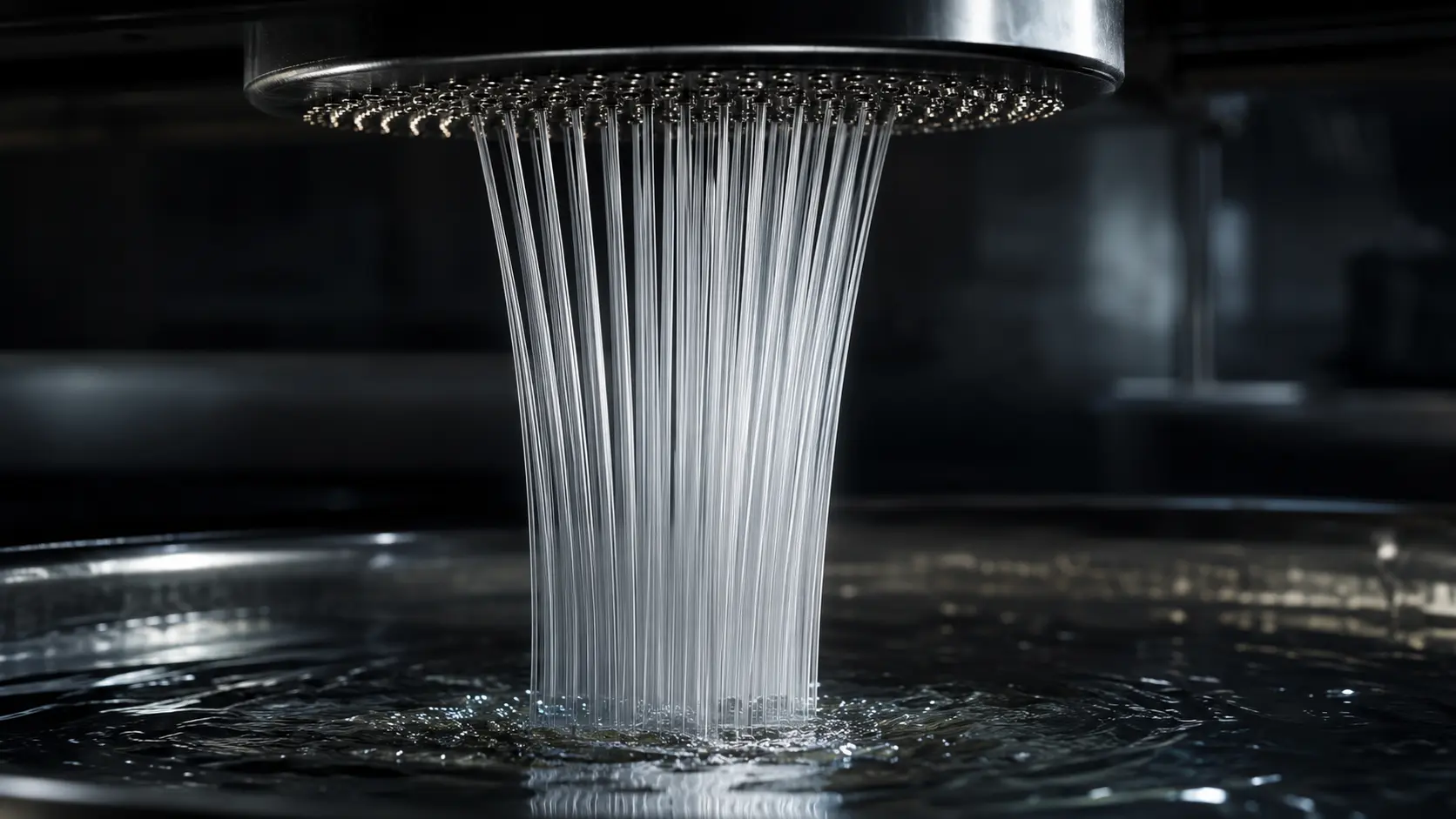
Manufacturers dissolve this raw PAN powder into a thick, highly caustic chemical solvent. To transform this syrup into distinct physical fibers, pumps force the liquid at high pressure through a spinneret. This metal plate contains thousands of microscopic holes and sits submerged directly inside a coagulation bath.
This specific process, known as wet spinning, physically pulls the liquid into solid white plastic threads as the solvent washes away. The mechanical tension of the pulling machinery forces the chaotic, tangled polymer chains to align perfectly parallel to the fiber’s vertical axis.
Following the spinning phase, engineers execute thermal stabilization. They slowly heat these white threads in an oxygen-rich environment between 200°C and 300°C. This precise application of thermal energy alters the atomic bonds, converting the linear plastic molecules into rigid, fireproof hexagonal ladders.
Finally, the stabilized material enters a nitrogen-filled furnace operating at 2,000°C. The extreme carbonization heat violently drives off all non-carbon atoms—including hydrogen, nitrogen, and oxygen. The process leaves behind a nearly pure, tightly bonded carbon lattice that possesses exceptional stiffness and tensile strength.
WHY IT MATTERS NOW
Aerospace dominance dictates modern geopolitical power, and carbon fiber strictly dictates aerospace dominance. Fifth-generation stealth fighters like the F-35 rely entirely on advanced composite skins. These materials maintain strict radar invisibility while enduring the immense structural G-forces generated at supersonic speeds.
The commercial aviation sector faces identical structural mandates. Aircraft designers construct platforms like the Boeing 787 and Airbus A350 using carbon fiber composites for over half of their total airframe weight. Airlines utilize this material substitution to massively reduce physical weight, drastically lowering fuel burn and determining the financial profitability of global flight routes.
Hypersonic missile development accelerates this industrial demand to absolute extremes. When a weapon travels at Mach 5, atmospheric friction generates severe kinetic heat that instantly melts traditional aluminum or steel. High-end carbon composites serve as the only known structural medium capable of surviving these specific thermal loads while maintaining aerodynamic stability.
Control over the PAN precursor supply chain represents a massive, highly consolidated strategic chokepoint. While many developing nations possess the furnaces required to bake raw threads into carbon fiber, only a handful of chemical conglomerates in Japan and the United States hold the intellectual property required to synthesize aerospace-grade PAN precursors.
Export restrictions on these specific precursor spools function as a direct mechanism for economic warfare. By cutting off access to high-purity PAN, western governments can instantly stall rival military aviation programs, starving adversaries of the exact raw materials required to construct modern aerospace components.
WHAT MOST PEOPLE MISS
Industrial commentators frequently assume that the final high-temperature carbonization furnace defines the absolute strength of the carbon fiber. They entirely miss that the structural ceiling of the material is permanently locked in during the initial wet spinning of the liquid precursor.
If the wet spinning process traps a microscopic solvent void, or if the machinery fails to align the polymer chains perfectly, that microscopic defect survives the 2,000°C baking process. A bad PAN precursor chemically cannot yield a strong carbon fiber, regardless of the baking temperature.
When extreme physical stress hits the final aerospace wing, it mathematically concentrates at that exact microscopic void. This localized stress concentration initiates a catastrophic structural fracture across the entire composite part, causing a multi-million-dollar airframe to fail in mid-flight simply due to a microscopic air bubble formed months earlier in a chemical bath.
THE TRAJECTORY
Next 12–36 Months: Major defense contractors will aggressively acquire mid-stream chemical manufacturers. Securing guaranteed access to high-purity PAN precursor production lines will become a mandatory requirement for bidding on next-generation hypersonic weapon contracts.
Next Five Years: The integration of continuous acoustic emission monitoring during wet spinning. Manufacturers will deploy machine learning sensors to instantly detect microscopic chain misalignments in the liquid bath. The system will dynamically adjust extrusion pressure to eliminate void defects in real time.
Next Ten Years: The commercialization of carbon nanotube integration. Chemical engineers will successfully synthesize single-walled carbon nanotubes directly into the PAN matrix before the spinning phase. This integration will drastically amplify both the electrical conductivity and the tensile strength of the final aerospace composite.
What Could Go Wrong: Severe acrylonitrile supply shocks. The raw monomer required for PAN synthesis is a direct chemical byproduct of global propylene refining. A sudden geopolitical embargo on specific petrochemical processing hubs could instantly freeze the global production of all high-end aerospace composites.
Most Likely Outcome: PAN-based carbon fiber will maintain its absolute monopoly over structural aerospace engineering. The molecular physics of polyacrylonitrile alignment provide an unmatched and currently irreplaceable foundation for maximizing the tensile strength of lightweight materials.
KEY TERMS
- Polyacrylonitrile (PAN): A synthetic organic polymer resin that serves as the primary chemical precursor for producing high-strength carbon fiber.
- Wet Spinning: A manufacturing process that extrudes dissolved liquid polymers into a chemical bath to precipitate solid, highly aligned continuous fibers.
- Tensile Strength: The maximum amount of physical stretching stress a material can withstand before its atomic bonds fail and the structure snaps.
- Thermal Stabilization: The careful low-temperature heating of PAN fibers in an oxygen environment to chemically lock the molecular chains into a rigid ladder structure.
- Carbonization: The extreme high-temperature baking of stabilized fibers in a nitrogen atmosphere to expel non-carbon atoms and fuse a pure carbon lattice.
SOURCES
- Oak Ridge National Laboratory (ORNL) — Advanced Carbon Fiber Manufacturing and Precursor Chemistry
- Journal of Materials Science — The Effects of PAN Precursor Microstructure on Carbon Fiber Tensile Strength
- Department of Defense (DoD) — Strategic and Critical Materials Report on Aerospace Composites
- Institute of Electrical and Electronics Engineers (IEEE) — Defect Monitoring in Wet-Spun Polyacrylonitrile Fibers