Advertisement
)

AT A GLANCE
- Concept: Grain Boundary: The microscopic physical seam where two separate metal crystals meet and weaken the structure.
- Concept: Directional Solidification: Slowly freezing molten metal in one specific direction to align its internal atomic structure.
- Concept: Grain Selector: A spiral ceramic bottleneck that physically chokes off all but one growing metal crystal.
- Concept: Nickel Superalloy: A highly complex metal mixture designed to maintain extreme physical strength near its melting point.
HOW A SINGLE-CRYSTAL FURNACE WORKS
Jet engines operate at temperatures that physically exceed the melting point of the metal inside them. Standard metal casting pours liquid metal into a mold, where it cools randomly into millions of tiny individual crystals. The microscopic seams where these crystals meet, called grain boundaries, act as structural fault lines. Under the extreme centrifugal force and heat of a spinning turbine, these grain boundaries slide apart, causing the blade to permanently stretch and eventually snap.
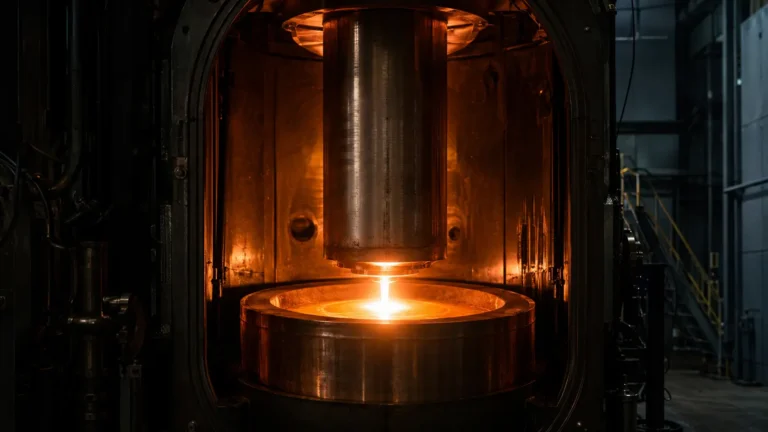
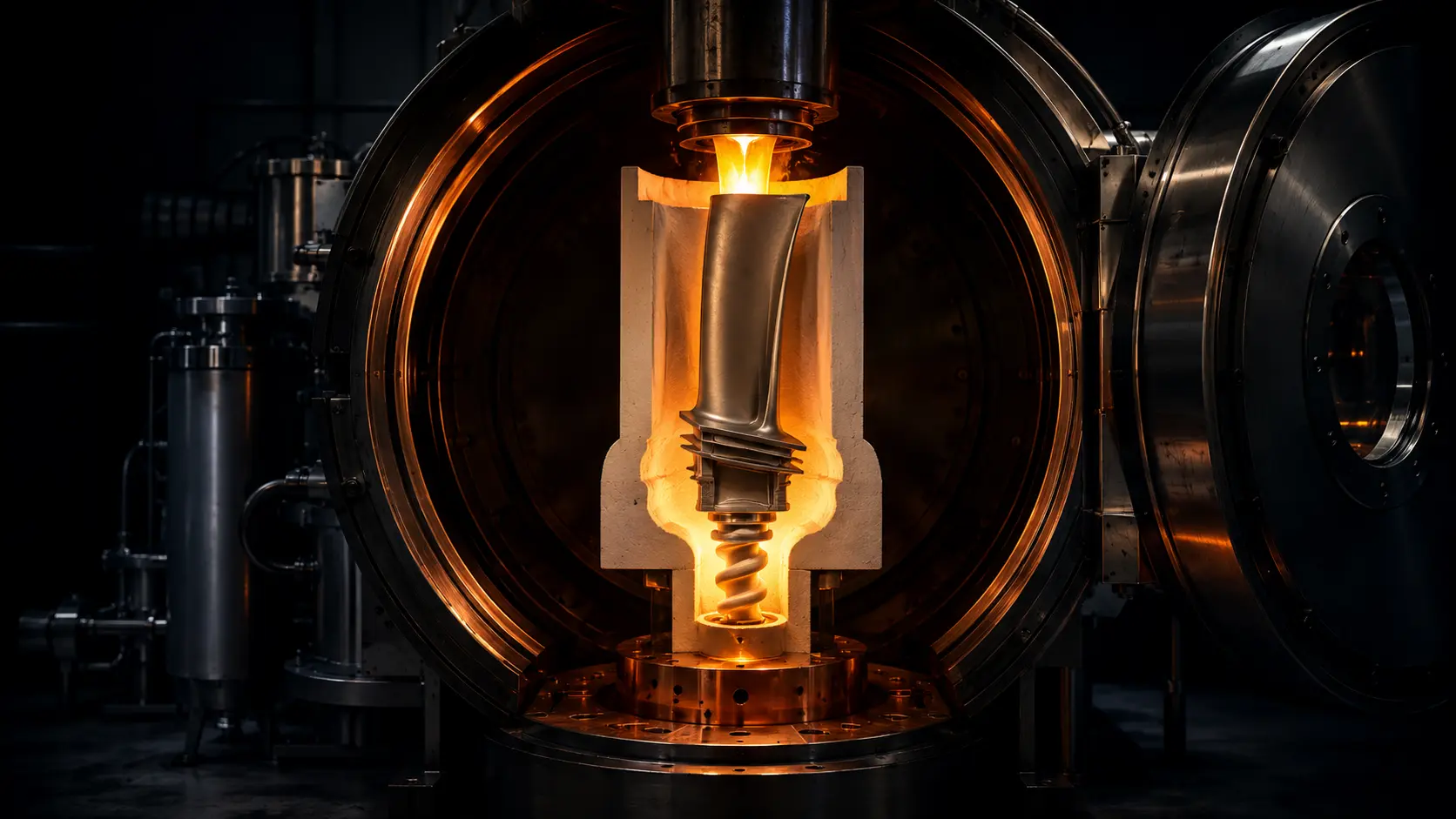
To eliminate these physical fault lines, aerospace foundries grow the entire turbine blade as one single, uninterrupted atom-to-atom crystal. Engineers place a ceramic mold inside a vacuum induction furnace, sitting it on a water-cooled copper chill plate. They pour molten nickel-based superalloy into the top of the heated ceramic mold.
The furnace establishes a violent thermal gradient, keeping the top of the mold liquid while the bottom touches the freezing copper plate. The metal begins to solidify at the very bottom, growing vertical columnar crystals upwards.
To isolate just one crystal, the bottom of the mold features a microscopic, corkscrew-shaped tunnel called a grain selector. As the multiple vertical crystals grow upward into this spiral pigtail, they physically crash into the twisting ceramic walls. Only one single crystal successfully navigates the geometric maze to enter the main blade cavity.
An automated mechanical elevator slowly pulls the mold downward out of the heating zone, passing through a physical baffle ring. The machine withdraws the mold at a precise speed of a few millimeters per minute, perfectly matching the speed of the freezing metal. This carefully managed thermal gradient allows that single surviving crystal to grow upward, filling the entire turbine blade mold without forming a single grain boundary.
WHY IT MATTERS NOW
The absolute physical law of aviation dictates that a hotter jet engine produces vastly more thrust while consuming significantly less fuel. Commercial airlines rely entirely on this thermal efficiency to turn a financial profit on transoceanic routes. Single-crystal nickel superalloy blades allow the high-pressure turbine section to operate at temperatures exceeding 1,500°C, a physical impossibility for conventionally cast metals.
Geopolitical air superiority relies directly on these specific metallurgical yield rates. The F-135 engine powering the F-35 fighter jet subjects its high-pressure turbine blades to extreme thermal shocks during supersonic combat maneuvers. Without the structural perfection of single-crystal casting, these engines would physically melt themselves within minutes of engaging an afterburner.
Building a jet engine requires mastering the withdrawal mechanics of the single-crystal furnace. While emerging military powers can easily acquire raw nickel, cobalt, and rhenium on the open market, they frequently struggle to replicate the proprietary thermal gradient software used by elite aerospace foundries. This metallurgical barrier to entry physically limits the domestic engine production capabilities of rival nation-states.
The commercial aerospace supply chain frequently experiences severe production bottlenecks directly tied to these casting facilities. Producing a single-crystal blade takes hours of continuous furnace operation and suffers from notoriously high scrap rates. A minor fluctuation in the withdrawal elevator speed ruins the crystal structure, creating a permanent capacity constraint for major commercial aircraft deliveries.
WHAT MOST PEOPLE MISS
Aerospace analysts assume the single-crystal metal alone survives the heat. They entirely miss the internal cooling mechanics required to keep the blade intact. A single-crystal blade is entirely hollow, featuring a microscopic labyrinth of internal air channels created by inserting a fragile ceramic core into the mold before casting. The engine forces relatively cool air from the compressor through these internal channels, physically bleeding heat out of the metal from the inside out.
The true yield limitation of a single-crystal furnace is not the metal; it is the ceramic core. The ceramic must perfectly maintain its microscopic geometry while submerged in 1,500°C molten nickel for hours, and then safely dissolve away in a chemical bath after the metal freezes. Mastering this specific ceramic formulation dictates the actual factory output of a sovereign aerospace program far more than the raw metal supply.
THE TRAJECTORY
Next 12–36 Months: Major aerospace foundries will integrate continuous acoustic and optical emission monitoring directly into the vacuum furnaces. These sensors will detect microscopic crystal nucleation errors in real time, allowing algorithms to dynamically adjust the elevator withdrawal speed and salvage blades before they fail quality control.
Next Five Years: The optimization of algorithmic alloy design. Metallurgists will use machine learning models to design new superalloys that require lower concentrations of highly expensive, geostrategically vulnerable rhenium, achieving identical high-temperature creep resistance through optimized crystal lattice geometries.
Next Ten Years: The structural transition toward Ceramic Matrix Composites (CMCs). As military engines push operating temperatures toward 2,000°C, single-crystal nickel will reach its absolute physical exhaustion point. Manufacturers will replace the hottest metallic turbine stages with silicon carbide composites, fundamentally shifting aerospace supply chains away from metal casting.
What Could Go Wrong: Severe raw material embargoes. Single-crystal superalloys require a precise chemical cocktail of rare earth elements and heavy metals. A coordinated geopolitical embargo on aerospace-grade titanium, hafnium, or rhenium could instantly paralyze Western furnace operations, grounding future aircraft production lines.
Most Likely Outcome: Single-crystal casting will maintain its monopoly over the high-pressure turbine sections of all commercial aircraft for the next two decades. The extreme capital cost and proprietary learning curves of vacuum induction metallurgy will keep aerospace dominance consolidated among a few elite global manufacturers.
KEY TERMS
- Grain Boundary: The physical interface where two individual metal crystals meet, serving as the primary failure point for material stretching under high heat.
- Directional Solidification: A casting technique that controls the cooling rate of liquid metal to force crystal growth along one specific geometric axis.
- Vacuum Induction Melting: An industrial process that uses electromagnetic fields to melt metal inside a vacuum, preventing atmospheric oxygen from contaminating the alloy.
- Superalloy: A specialized metal mixture engineered specifically to resist thermal deformation and surface oxidation at temperatures close to its melting point.
- Thermal Gradient: The precise, controlled physical transition zone between the extreme heat of the liquid metal and the cold sink of the chilling plate.
SOURCES
- National Aeronautics and Space Administration (NASA) — Single Crystal Superalloys and Turbine Blade Metallurgy
- Journal of Materials Processing Technology — Thermal Gradient Control and Grain Selection in Directional Solidification
- Department of Defense (DoD) — Supply Chain Vulnerabilities in Aerospace Casting and Forging
- American Institute of Aeronautics and Astronautics (AIAA) — Advanced Cooling Architectures in Single-Crystal Turbine Blades