Advertisement
)
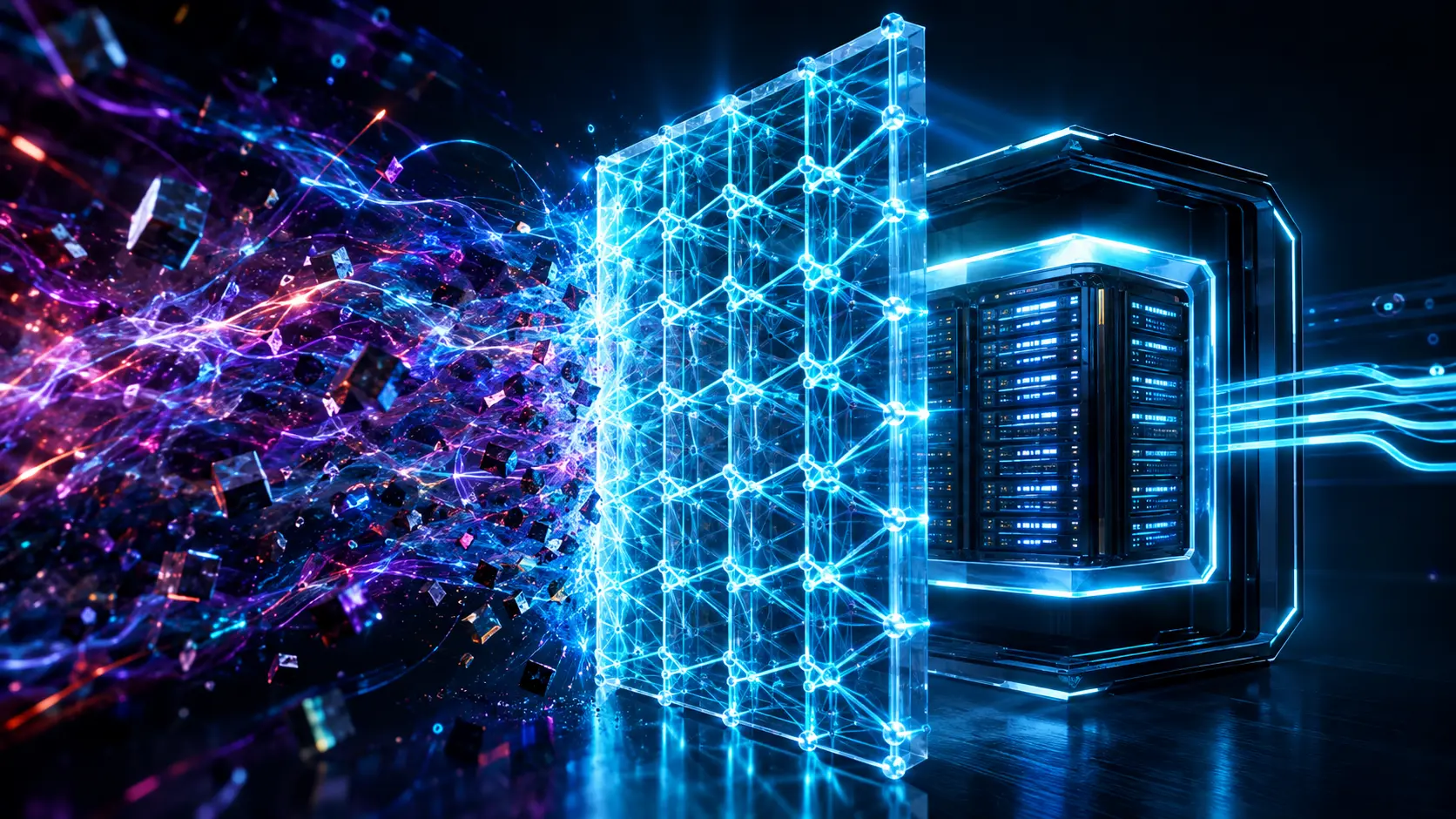

Every time you check your bank balance, send a secure message, or log into a cloud server, your data is protected by a mathematical lock called RSA. This lock relies on a simple premise: multiplying two massive prime numbers together is easy, but guessing which two primes were used is practically impossible for a traditional computer. It would take the fastest supercomputer on Earth 300 trillion years to crack a standard 2048-bit RSA key. But what happens when the computer doing the guessing isn’t traditional?
Why should you care right now? Because quantum computers are rapidly approaching the physical threshold where they can run a mathematical shortcut that will shatter RSA encryption not in trillions of years, but in hours. We are facing a cryptographic apocalypse. To prevent a total collapse of global digital trust, the US National Institute of Standards and Technology (NIST) has officially finalized the world’s new post-quantum cryptographic standards. Every bank, government, and Fortune 500 company is now legally and operationally mandated to rip out the old locks and install new mathematical armor, triggering the most expensive and urgent IT overhaul in internet history.
What is Post-Quantum Cryptography (PQC)?
Post-Quantum Cryptography (PQC) is a new generation of cryptographic algorithms designed to secure digital communications against the massive processing power of future quantum computers. By relying on highly complex geometric structures, like multi-dimensional math lattices, PQC creates encryption locks that both classical and quantum computers are mathematically incapable of breaking.
At a Glance
- Concept: Upgrading the math that protects the internet before super-powered quantum computers can break the old math.
- Why it matters: Hackers are stealing encrypted banking and government data today and storing it. When quantum computers arrive, they will unlock all of it. PQC stops this.
- Who uses it: Cloud providers (AWS, Google Cloud), secure messaging apps (Signal, Apple iMessage), and global central banks.
- Biggest takeaway: You don’t need a quantum computer to use Post-Quantum Cryptography. PQC algorithms run on standard laptops and smartphones; they are just mathematically immune to quantum attacks.
In Simple Words
Imagine you protect your diary with a combination lock. A normal computer tries to open the lock by testing every single number combination one by one (1-2-3, 1-2-4, etc.). Because there are billions of combinations, the computer will die of old age before it opens the lock. This is how the internet works today.
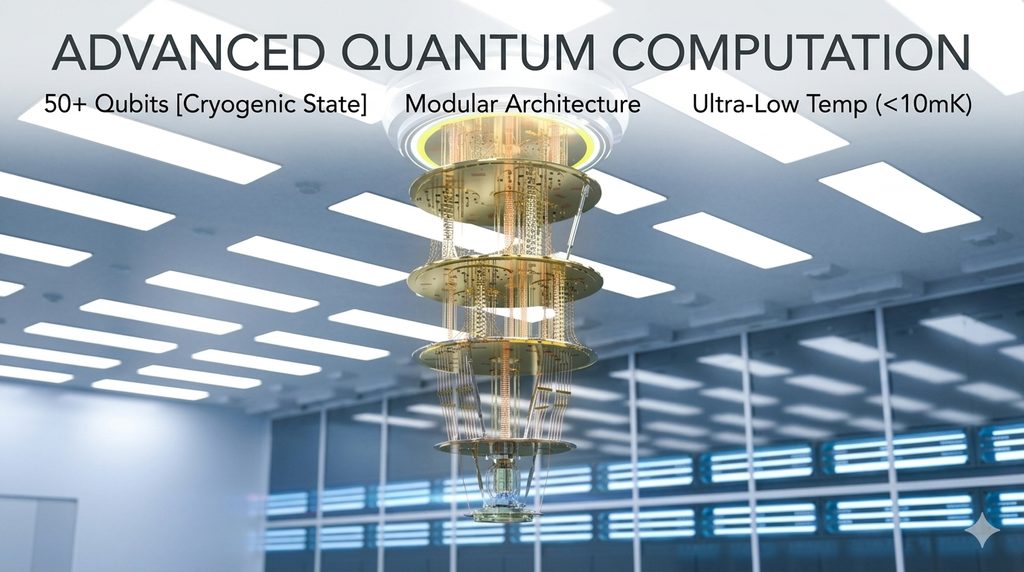
A Quantum Computer doesn’t try combinations one by one. Through the bizarre physics of quantum mechanics, it can test massive groups of combinations simultaneously, finding the exact right combination in minutes. The old lock is completely useless.
Post-Quantum Cryptography (PQC) is a brand new type of lock. Instead of a number combination, it hides the key inside a massive, 500-dimensional maze. Even though the quantum computer is incredibly fast at guessing numbers, it is mathematically terrible at navigating complex geometric mazes. The new lock stops the quantum computer cold.
Why This Matters
For CISOs, Cloud Architects, and FinTech Developers, PQC solves the “Harvest Now, Decrypt Later” (HNDL) threat.
The common executive response to the quantum threat is: “Quantum computers won’t be powerful enough to break encryption for another 5 to 10 years, so we have time to wait.”
This is a fatal misunderstanding of modern cyber warfare. Adversarial nation-states are not waiting. They are currently siphoning petabytes of encrypted data running across global fiber-optic cables. They cannot read this data today because it is protected by RSA or ECC encryption. But they are downloading and storing it in massive, cold-storage server farms.
They are simply hoarding the data until “Q-Day”—the day a Cryptographically Relevant Quantum Computer (CRQC) comes online. On that day, they will retroactively decrypt everything they have stolen over the last decade. If your company is transmitting long shelf-life data today (like trade secrets, nuclear designs, or human intelligence assets), that data is already compromised unless it is encrypted with PQC right now.
The Transition to Cryptographic Agility
We are witnessing the Y2K of Cryptography, but with significantly higher stakes.
Unlike Y2K, which was a known date to fix a simple two-digit calendar bug, the PQC migration is a race against an unknown deadline to replace the fundamental mathematical foundation of the entire internet.
Every single piece of connected software—from your web browser’s TLS certificates, to your VPN router, to the firmware updates in your car—relies on public-key cryptography. Replacing these algorithms requires ripping into the absolute lowest levels of global IT infrastructure. The migration will take years, cost billions in labor, and permanently alter how enterprise software is architected.
How Post-Quantum Cryptography (PQC) Defeats Shor’s Algorithm
Defeating a quantum computer requires abandoning the math of prime numbers and embracing the geometry of lattices. Here is the first-principles breakdown of the new architecture.
1. The Fundamental Problem: Shor’s Algorithm
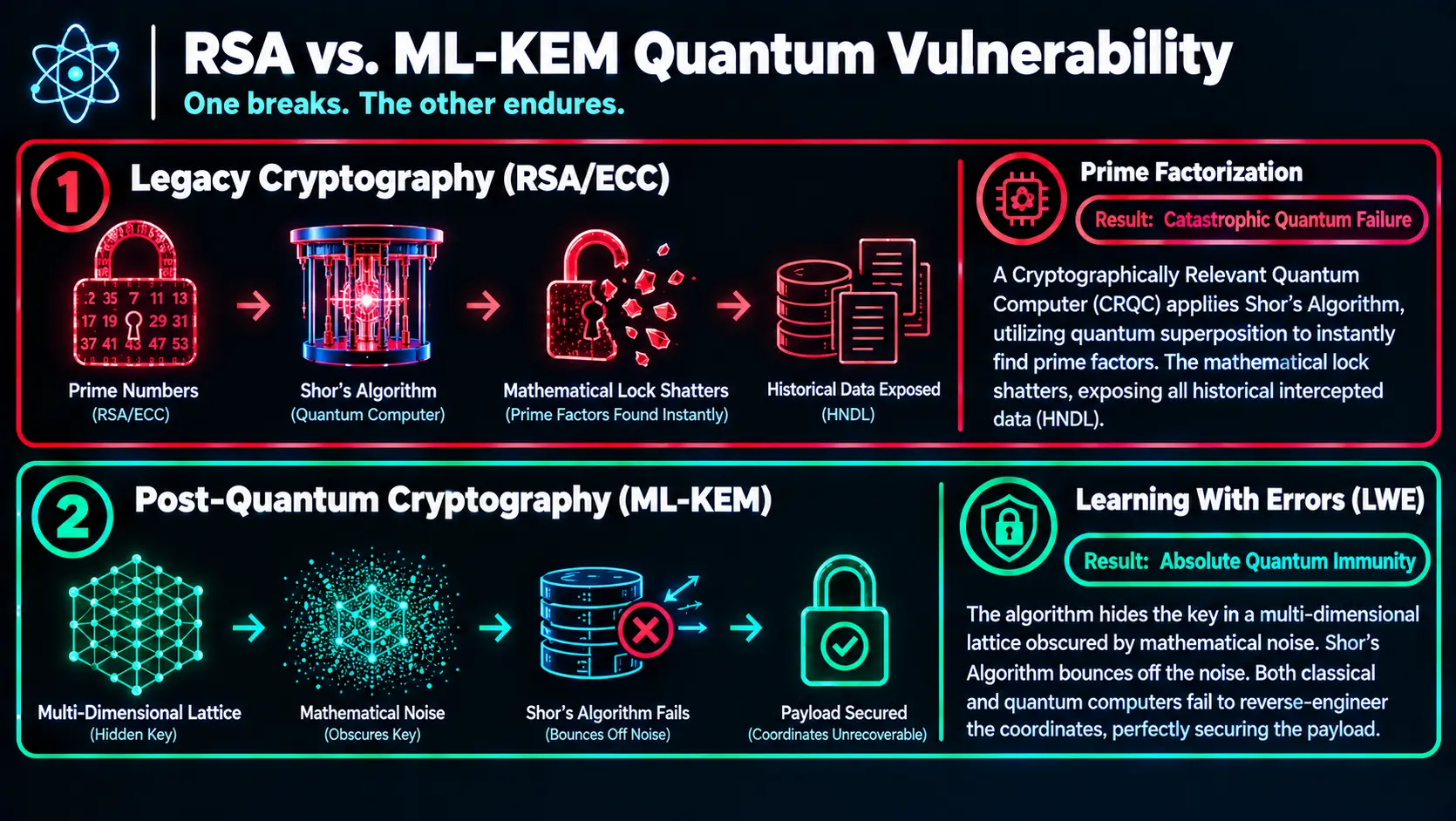
Classical encryption (RSA) is built on the fact that multiplying two prime numbers is a “one-way function.” It is easy to multiply 13 x 17 to get 221. It is incredibly hard for a computer to look at a 600-digit number and figure out which two primes created it. In 1994, Peter Shor proved that a quantum computer can use quantum superposition to find the hidden periodic sequence of those numbers, turning a 300-trillion-year math problem into a 10-hour math problem.
2. The Core Mechanism: The Multi-Dimensional Lattice
To replace RSA, NIST selected algorithms based on Lattice Cryptography. Imagine an infinite grid of dots (a lattice), like graph paper, but instead of 2 dimensions, it has 500 or 1,000 dimensions.
The mathematical problem is called the “Shortest Vector Problem.” If you are dropped at a random point in a 500-dimensional grid, finding the exact shortest path back to the origin point (the center) is brutally difficult. Quantum computers offer absolutely no shortcut for navigating this specific type of geometric chaos.
3. Technical Depth: Learning With Errors (LWE)
The specific standard NIST finalized for key exchange is FIPS 203, known mathematically as Module-Lattice-Based Key-Encapsulation Mechanism (ML-KEM), formerly called CRYSTALS-Kyber.
ML-KEM uses a concept called “Learning With Errors.” It takes a complex system of linear equations (which a computer could normally solve) and injects a tiny amount of mathematical “noise” or random error into the equations. This slight distortion makes the equations impossible to reverse-engineer without the exact secret key.
Micro-Insight: The “error” in Learning With Errors is the secret sauce. By slightly warping the mathematical grid, it forces the quantum computer to guess blindly, completely neutralizing its quantum advantage.
4. Technical Depth: The Hybrid TLS Handshake
When your browser connects to a bank website, it performs a TLS (Transport Layer Security) handshake to agree on a secret encryption key. Because PQC algorithms are brand new, security engineers are terrified of undiscovered math bugs. To solve this, the industry is deploying Hybrid Key Exchange. The TLS handshake creates two locks: one using traditional ECC math, and one using the new ML-KEM post-quantum math. A hacker would have to break both simultaneously to steal the data.
5. Real-World Consequences: Cryptographic Agility
Historically, companies hard-coded RSA directly into their software. If the math broke, the software had to be completely rewritten. The PQC migration is forcing companies to adopt Cryptographic Agility. Instead of hard-coding the math, developers must use modular software architectures where cryptographic algorithms are treated as swappable plugins. If a new quantum attack breaks ML-KEM tomorrow, the CISO can swap the algorithm out with a click, without bringing down the entire banking platform.
Quantum vs. Lattice Cryptography
Simulating RSA Vulnerability to Shor’s Algorithm vs. Post-Quantum ML-KEM Immunity
Adversary Compute Power
Classical
Encryption Standard
Classical RSA-2048
Post-Quantum ML-KEM
Decryption Progress
0.0%
Estimated Time to Crack
300 Trillion Yrs
Data Vault Status
SECURE
Cryptographic Target: Threat Vector vs Math Shield
STANDBY
Decryption Progress Over Time
Enterprise Use Cases for PQC and ML-KEM
The deployment of post-quantum cryptography is already actively protecting consumer and enterprise networks.
Consumer Secure Messaging (Signal PQXDH): The encrypted messaging app Signal was one of the first major platforms to upgrade. They implemented the Post-Quantum Extended Diffie-Hellman (PQXDH) protocol. When you send a message on Signal today, the key exchange is protected by both standard classical elliptic curves and a post-quantum key encapsulation mechanism, ensuring that future quantum computers cannot read your text messages.
Apple iMessage (PQ3): In 2024, Apple rolled out the PQ3 cryptographic protocol to billions of iPhones globally. PQ3 uses post-quantum math to secure the initial key establishment between devices, and crucially, it continuously re-keys the conversation using post-quantum algorithms. This means even if a quantum computer manages to steal one key, it cannot read past or future messages in the chat.
Cloud Provider FIPS Compliance: Major hyperscalers (AWS, Google Cloud, Microsoft Azure) are overhauling their internal Key Management Services (KMS). Because US federal agencies are mandated by National Security Memorandum 10 (NSM-10) to migrate to PQC by 2035, cloud providers are integrating FIPS 203 and FIPS 204 algorithms into their load balancers and API gateways today to ensure they don't lose massive government cloud contracts.
Economic & Strategic Impact
The core strategic consequence of the PQC migration is the Discovery and Remediation Cost Burden.
Replacing the math is easy; finding the math is incredibly hard. Massive Fortune 500 companies have decades of technical debt. They have thousands of forgotten servers, outdated microservices, and shadow IT infrastructure running hard-coded RSA certificates.
Before a company can migrate to PQC, they must execute a massive cryptographic discovery phase. They have to scan their entire network to find every single piece of encryption running in their environment. This requires buying expensive new scanning software, hiring specialized cryptographic consultants, and risking network downtime as old servers are forcibly upgraded. Analysts predict the global PQC migration will generate a multi-billion-dollar windfall for cybersecurity vendors and consulting firms over the next decade.
Advantages
- Quantum Immunity: Relies on mathematical problems (like shortest-vector lattices) that are proven to resist the specific computational advantages of quantum mechanics.
- Classical Compatibility: PQC algorithms do not require a quantum computer to run. They are designed to be executed by standard CPUs on normal laptops and servers.
- Forces Cryptographic Agility: The urgency of the migration forces lazy IT departments to finally build agile, modular software architectures, improving overall network hygiene.
Limitations
- The Bandwidth and Latency Penalty: PQC algorithms (especially lattice-based ones) require significantly larger key sizes than traditional RSA or ECC. A massive ML-KEM public key takes up more space in a data packet. This increases the bandwidth required for every single internet connection, potentially slowing down IoT devices and high-frequency trading platforms.
- The Unknown Math Threat: RSA has been attacked by brilliant mathematicians for 40 years and has survived. ML-KEM is relatively new. There is a small but terrifying risk that a classical mathematician might discover a standard algebraic shortcut that breaks ML-KEM without even needing a quantum computer.
- Hardware Implementation Friction: Many smartcards, secure enclaves, and IoT devices have tiny, specialized microchips physically hard-wired to do fast RSA math. They physically do not have the memory or the processing power to run massive PQC algorithms, requiring billions of dollars in hardware replacement.
Takeaway: PQC solves the quantum threat, but it makes the internet "heavier." The keys are bigger, the math takes up more memory, and it will require ripping out perfectly good, embedded hardware worldwide.
Common Misconceptions
Misconception: We can just use larger RSA keys to stop quantum computers.
Reality: Doubling an RSA key from 2048-bit to 4096-bit makes it slightly harder for a classical computer, but Shor's Algorithm slices through it exponentially. A quantum computer will break a massive RSA key almost as fast as a small one. Only a fundamental change in the math (lattices) stops the attack.
Misconception: I need to buy a quantum computer to use PQC.
Reality: No. "Post-Quantum" simply means the math is resistant to quantum attacks. The actual encryption software runs perfectly fine on your current iPhone or standard Intel desktop processor.
Misconception: Symmetric encryption (like AES-256) is completely broken too.
Reality: Quantum computers are terrible at breaking symmetric encryption (like AES). A quantum attack called Grover's Algorithm weakens AES, but you can fix it simply by upgrading from AES-128 to AES-256. The real apocalypse is focused entirely on Asymmetric Public-Key Cryptography (RSA/ECC), which handles internet key exchange and digital signatures.
What Most People Miss
The disruptive capability of State-Sponsored Firmware Downgrade Attacks.
When analysts discuss the PQC migration, they assume an orderly transition. What they miss is the vulnerability window.
As enterprises adopt Hybrid Key Exchange (running both RSA and PQC simultaneously), adversarial hackers will execute "downgrade attacks." During the TLS handshake, the hacker will intercept the traffic and trick the server into thinking the client's computer is too old to support PQC. The server will silently fall back to using only standard RSA. The hacker will then record that RSA-encrypted data and store it for future quantum decryption, completely bypassing the expensive new PQC defenses without the CISO ever knowing.
Comparison Table
| Metric | Classical Cryptography (RSA / ECC) | Post-Quantum Cryptography (ML-KEM) |
| Mathematical Basis | Prime Factorization / Discrete Logs | Multi-dimensional Lattices (LWE) |
| Vulnerable to Shor's Algorithm? | Yes (Completely Broken) | No (Quantum-Immune) |
| Key Size | Very Small (Efficient) | Large (Requires more bandwidth) |
| Primary Vulnerability | "Harvest Now, Decrypt Later" | Implementation Bugs / Downgrade Attacks |
| Standardization Status | Legacy Standard | NIST FIPS 203/204 (Finalized 2024) |
Future Outlook
Next 12–24 Months
The era of Inventory and Hybridization. Through 2026, the primary focus for the Fortune 500 is simply finding where their cryptography lives. Network monitoring tools will be deployed aggressively to map out RSA dependencies. In tandem, major web browsers (Chrome, Edge) and cloud load balancers will default to Hybrid TLS 1.3, wrapping traditional elliptic curves in the new ML-KEM armor to immediately neutralize the "Harvest Now, Decrypt Later" threat.
Next 3–5 Years
The scaling of Digital Signature Revocation. While encrypting data in transit (ML-KEM) is the immediate priority, the secondary priority is upgrading Digital Signatures (ML-DSA). Digital signatures prove that a software update is actually from Microsoft and not a Russian hacker. By 2029, companies will face a massive operational nightmare as they revoke thousands of classical RSA code-signing certificates and attempt to push post-quantum firmware updates to legacy hardware devices across the globe.
Next 10 Years
The Post-Quantum Native Internet. By the 2030s, the concept of "hybrid" cryptography will be retired. Classical algorithms like RSA and ECC will be officially deprecated by NIST and removed from compliance frameworks (like PCI-DSS and FedRAMP). The entire internet backbone will run natively on lattice-based math, forcing any company that failed to migrate into total isolation, as their servers will physically be rejected by modern web browsers and APIs.
Most Likely Scenario
The migration to Post-Quantum Cryptography is not an optional security upgrade; it is an existential enterprise mandate. The finalization of the NIST standards has fired the starting gun on a decade-long, multi-billion-dollar IT overhaul. While the transition will be painful—plagued by bandwidth penalties, legacy hardware friction, and massive discovery costs—companies that embrace cryptographic agility today will secure their data against the inevitable arrival of Q-Day, while those that delay will see their deepest corporate secrets exposed to the world.
Key Takeaways
- Quantum computers possess a unique mathematical capability (Shor's Algorithm) that will allow them to effortlessly break the RSA and ECC encryption protecting the modern internet.
- Hackers are executing "Harvest Now, Decrypt Later" attacks—stealing uncrackable encrypted data today so they can decrypt it when quantum computers come online in the future.
- To stop this, NIST has finalized Post-Quantum Cryptography (PQC) standards based on complex, multi-dimensional math lattices that quantum computers cannot solve.
- PQC algorithms do not require a quantum computer to run; they run on standard laptops and servers. They simply protect data against quantum computers.
- Migrating to PQC requires a massive corporate overhaul. Companies must find every old encryption key hidden in their networks and replace it, forcing the adoption of "Cryptographic Agility."
Glossary
Cryptographic Agility: Building software in a modular way so that underlying encryption math can be swapped out instantly without breaking the entire application.
Cryptographically Relevant Quantum Computer (CRQC): A future quantum computer that has enough stable, error-corrected qubits to actually run Shor's Algorithm and break real-world internet encryption.
Harvest Now, Decrypt Later (HNDL): A cyberattack strategy where hackers steal encrypted data today, knowing they can't read it, but hoard it until quantum computers exist to break the locks.
Lattice-Based Cryptography: A new type of math that uses infinitely complex, multi-dimensional geometric grids to hide data. It is currently the global standard for stopping quantum attacks.
ML-KEM (Module-Lattice-Based Key-Encapsulation Mechanism): The official NIST standard (FIPS 203) for post-quantum key exchange, formerly known by its research name, CRYSTALS-Kyber.
Shor's Algorithm: The mathematical formula invented by Peter Shor in 1994 that proves a quantum computer can easily factor massive prime numbers, effectively destroying RSA encryption.
Sources
National Institute of Standards and Technology (NIST): FIPS 203, FIPS 204, and the Post-Quantum Cryptography Standardization Process
Cybersecurity and Infrastructure Security Agency (CISA): Quantum-Readiness: Migration to Post-Quantum Cryptography
Cloud Security Alliance (CSA): The Executive Guide to the "Harvest Now, Decrypt Later" Threat
Signal Foundation: Post-Quantum Extended Diffie-Hellman (PQXDH) Specification
Apple Security Research: iMessage with PQ3: The New State of the Art in Quantum-Secure Messaging