Advertisement
)

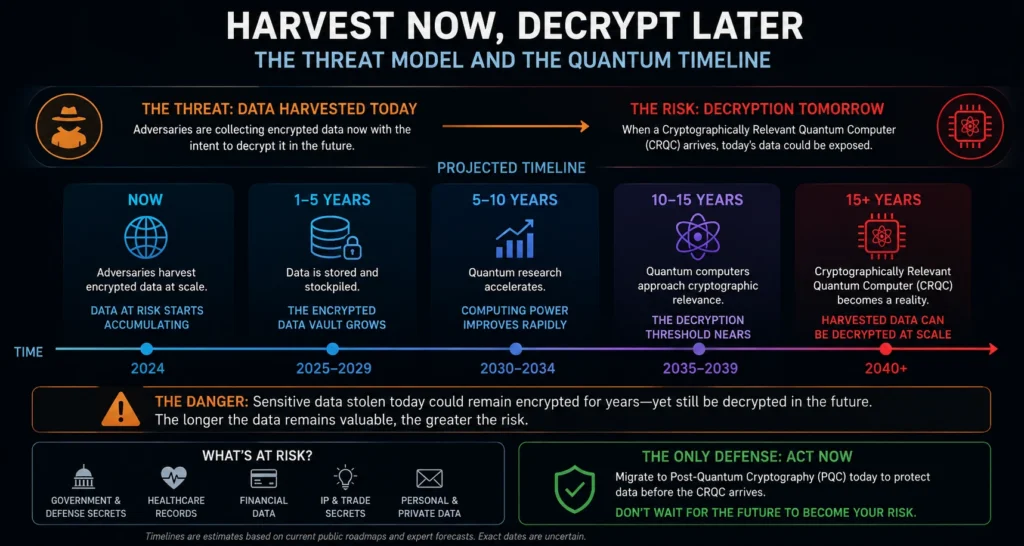
Right now, adversarial nation-states are vacuuming up petabytes of heavily encrypted financial records, military communications, and proprietary corporate data. They cannot read a single line of it. But they are hoarding it anyway, storing the encrypted files in massive server farms, waiting for a singular, inevitable event: “Q-Day.”
Q-Day is the moment a quantum computer is powered on with enough processing capability to instantly shatter the mathematical locks that secure the modern internet. Every password, wire transfer, secure website (HTTPS), and software update relies on a cryptographic system invented in the 1970s. For half a century, that math held strong. Soon, it will be entirely obsolete.
To prevent the total collapse of global digital trust, the United States government has officially published a new suite of quantum-proof mathematics. The transition to Post-Quantum Cryptography (PQC) is no longer a theoretical exercise for academic physicists; it is a mandatory, trillion-dollar infrastructure upgrade. For Chief Information Security Officers (CISOs) and network architects, ripping out the foundational plumbing of enterprise security—and replacing it without breaking the network—is the most complex, high-stakes IT challenge of the decade.
What is Post-Quantum Cryptography (PQC)?
Post-Quantum Cryptography (PQC) refers to a new generation of cryptographic algorithms designed to be secure against both conventional computers and future quantum computers. Unlike existing quantum technology, PQC does not require quantum hardware; it consists of classical mathematical software that can run on standard smartphones, laptops, and enterprise servers.
At a Glance
- Concept: Upgrading the math that scrambles our data. We are moving from math based on factoring prime numbers (RSA) to math based on multi-dimensional geometry (Lattices).
- Why it matters: A quantum computer can use Shor’s Algorithm to break traditional encryption in hours. Without an upgrade, every secret on the internet becomes public.
- Who uses it: Every digital entity on Earth. The migration is being mandated by federal governments, pushed through web browsers (Google Chrome, Apple Safari), and integrated into enterprise VPNs.
- Biggest takeaway: You cannot wait for the quantum computer to be built before you upgrade. Because hackers are stealing data today to decrypt it later, data with a long shelf-life (like medical records or national security secrets) is already compromised if it isn’t protected by PQC right now.
In Simple Words
Cryptography is the science of hiding information using math.
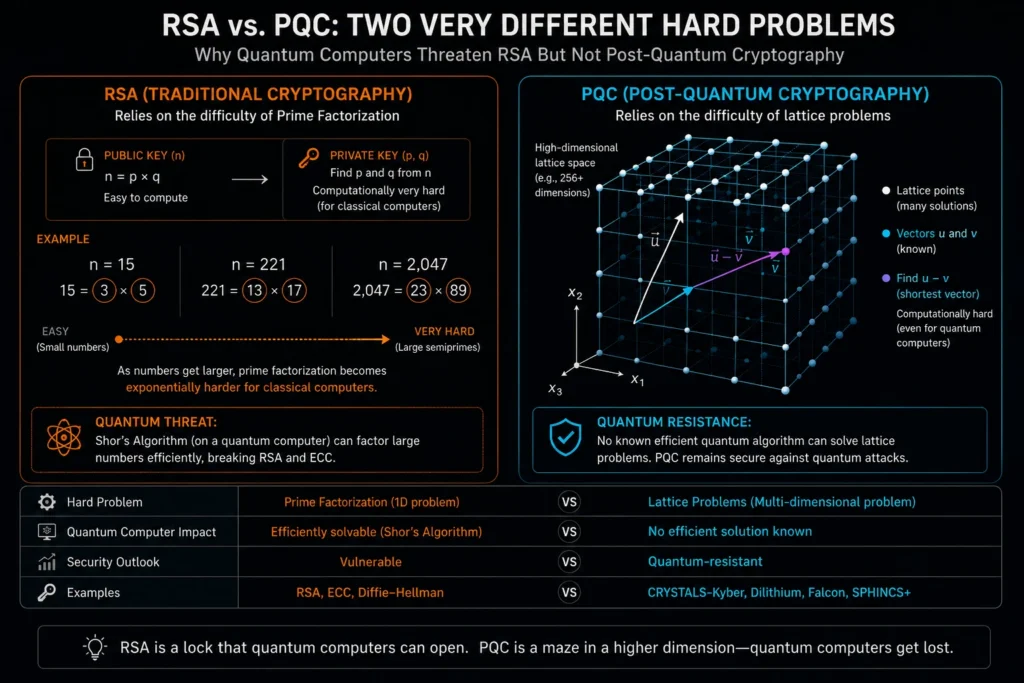
The current gold standard is RSA. It works by multiplying two massive prime numbers together to create an even larger number. For a normal computer, multiplying them is easy, but trying to reverse the process—figuring out which two prime numbers created the result—is incredibly difficult. It would take a standard supercomputer millions of years to guess the answer by brute force.
A Quantum Computer cheats. Because quantum computers can evaluate multiple possibilities simultaneously, they don’t have to guess one by one. Using a specific trick called “Shor’s Algorithm,” a quantum computer can find those hidden prime numbers in a few hours.
Post-Quantum Cryptography (PQC) changes the lock. Instead of using prime numbers, PQC hides the secret key inside a massive, multi-dimensional grid of dots (a Lattice) and adds random “noise” to the coordinates. Even with its incredible processing tricks, a quantum computer gets completely lost in the noise of the grid. Because the math problem is fundamentally different, the quantum computer’s cheat code no longer works.
Why This Matters
The urgency of the PQC migration is driven entirely by the Harvest Now, Decrypt Later (HNDL) threat model.
Many executives assume that because a Cryptographically Relevant Quantum Computer (CRQC) does not exist today, the problem can be deferred. This is a fatal miscalculation. Adversaries are actively recording encrypted internet traffic today. If your company transmits a highly classified 10-year strategic blueprint over a standard RSA-encrypted VPN in 2026, the adversary simply records the encrypted data package.
If Q-Day arrives in 2032, the adversary feeds that recorded data into their new quantum computer, decrypts it, and reads your 10-year blueprint with four years of strategic value still remaining. Therefore, the deadline to implement PQC is not Q-Day; the deadline is Q-Day minus the shelf-life of your data. For national security systems and deep corporate IP, that deadline passed years ago.
NIST PQC Standards: FIPS 203, 204, and 205
The chaotic uncertainty of PQC ended on August 13, 2024.
After an exhaustive eight-year global competition, the National Institute of Standards and Technology (NIST) officially finalized the primary PQC standards: FIPS 203, FIPS 204, and FIPS 205. This publication fired the starting gun for the global tech industry. Hardware vendors, cloud providers, and software engineers finally had the exact, iron-clad mathematical blueprints required to update their products.
This initiated the regulatory cascade. The U.S. National Security Agency (NSA) issued the Commercial National Security Algorithm Suite 2.0 (CNSA 2.0), mandating that all national security systems must complete their migration to PQC by 2035. The private sector is following suit. Compliance frameworks (like PCI-DSS for credit cards and HIPAA for healthcare) are rapidly drafting updates to penalize organizations that continue relying solely on legacy RSA and ECC encryption.
How Lattice-Based Cryptography Defeats Quantum Attacks
Replacing the mathematical foundation of the internet requires transitioning from prime factorization to complex geometry. Here is the first-principles breakdown.
1. The Fundamental Problem: Shor’s Algorithm
In 1994, Peter Shor proved that a quantum computer could factor large numbers exponentially faster than a classical computer. RSA-2048 encryption relies on a 617-digit number. A classical computer would take billions of years to find its two prime factors. A quantum computer, utilizing quantum superposition and interference, can find the periodicity of the function and deduce the factors in a matter of hours, instantly extracting the private key.
2. The Insufficiency of Existing Solutions
Why not just make the RSA key bigger? You could increase the key size from RSA-2048 to RSA-16384. However, the computational power required to encrypt and decrypt data with keys that massive would cripple modern web servers and drain mobile phone batteries in minutes. We cannot out-scale the quantum threat using old math; we need an entirely new mathematical trapdoor.
3. The Core Mechanism: Lattice-Based Cryptography
NIST’s primary selections rely on Lattice-based cryptography. Imagine a 2-dimensional grid of points (like graph paper). Finding the shortest distance between two points is easy. Now, scale that grid up to 1,000 dimensions. Next, slightly shift the points off the exact grid intersections by adding random mathematical “noise.” The challenge is called the “Learning with Errors” (LWE) problem. Finding the original, un-shifted point in a 1,000-dimensional space is mathematically devastating. Crucially, Shor’s Algorithm provides no advantage in solving geometric lattice problems.
4. Technical Depth: Key Encapsulation vs. Digital Signatures
The NIST standards address the two fundamental pillars of public-key infrastructure (PKI):
- FIPS 203 (ML-KEM):Derived from CRYSTALS-Kyber. This is a Key Encapsulation Mechanism. It is used to securely establish a shared secret key between two parties (e.g., your browser and a banking website) so they can encrypt their communication.
- FIPS 204 (ML-DSA):Derived from CRYSTALS-Dilithium. This is a Digital Signature Algorithm. It is used for identity and authentication, proving that a software update actually came from Microsoft and not a malicious hacker.
5. Real-World Consequences: The Payload Penalty
While lattice algorithms are fast to compute, they come with a physical tax: their keys and ciphertexts are significantly larger than RSA. An ML-KEM public key is roughly 800 to 1,500 bytes, compared to roughly 256 bytes for standard ECC. Pushing these larger keys across the internet requires more bandwidth and introduces latency. Network architects must actively redesign their handshake protocols (like TLS 1.3) to prevent these larger payloads from slowing down web traffic and timing out legacy firewalls.
Enterprise PQC Migration Strategies and Use Cases
The migration has already begun invisibly beneath the surface of the consumer internet.
Hybrid TLS in Web Browsers: You are likely already using PQC. Google Chrome and Apple Safari have rolled out “Hybrid” key exchange (X25519Kyber768) for TLS connections. When your browser connects to a supported server (like Cloudflare), it secures the connection using both a traditional classical algorithm (ECC) and a post-quantum algorithm (ML-KEM). If a hidden flaw is discovered in the new PQC math, the classical math still protects the session.
Encrypted Messaging Protocols: Secure messaging platforms like Signal and Apple’s iMessage (via the PQ3 protocol) have fully integrated post-quantum key encapsulation into their end-to-end encryption. This specifically neutralizes the “Harvest Now, Decrypt Later” threat, ensuring that state-sponsored intelligence agencies cannot decrypt intercepted text messages when quantum computers come online.
Enterprise VPNs and Zero Trust: Corporate IT departments are upgrading their Virtual Private Networks (VPNs) and Zero Trust Network Access (ZTNA) gateways. Because VPNs carry massive streams of sensitive internal data, vendors like Cisco and Palo Alto Networks are rapidly integrating FIPS 203 compliance to secure the remote workforce against quantum surveillance.
Economic & Strategic Impact
The PQC migration is triggering an enterprise IT reckoning known as the Cryptographic Discovery Crisis.
For decades, developers hardcoded RSA and ECC algorithms deep into the source code of enterprise applications, IoT devices, and database servers. Most CISOs today have absolutely no idea where cryptography is actively running within their own networks.
Before a company can migrate to PQC, it must find all its old keys. This is spawning a massive sub-industry of cybersecurity software dedicated to “Cryptographic Inventory.” Companies are spending millions on scanning tools to map their network, locate obsolete certificates, and physically rewrite legacy code. For the cybersecurity sector, the PQC migration represents a guaranteed, compliance-driven revenue pipeline that will span the entirety of the late 2020s and early 2030s.
Advantages
- Quantum Immunity: Neutralizes the catastrophic threat of Shor’s Algorithm, preserving the fundamental security architecture of the digital economy.
- Classical Speed:Algorithms like ML-KEM (Kyber) are actually faster to compute (encryption/decryption operations) than legacy RSA, partially offsetting the bandwidth penalty of their larger key sizes.
- Regulatory Future-Proofing:Early adoption guarantees compliance with looming federal mandates (like CNSA 2.0), preventing disruptive panic-migrations as the 2030 deadlines approach.
Limitations
- Bandwidth and Latency: The massive size of lattice-based public keys and digital signatures causes network congestion. In highly constrained environments (like low-power IoT sensors or satellite communications), transmitting these large keys can cause connection timeouts.
- The Novelty Risk: RSA has been battle-tested by the world’s greatest hackers for 50 years. The new NIST algorithms are mathematically sound, but they lack decades of real-world stress testing. There is a non-zero risk that a classical cryptanalyst could discover a fatal mathematical flaw in ML-KEM tomorrow, completely unrelated to quantum computing.
- Hardware Incompatibility: Billions of smart cards, secure enclaves, and legacy routers contain physical microchips hardwired strictly to perform RSA or ECC math. These hardware devices cannot simply receive a software update; they must be physically ripped out and replaced.
Common Misconceptions
Misconception: We don’t need PQC until a quantum computer is actually built.
Reality: The “Harvest Now, Decrypt Later” strategy means your data is vulnerable today. If your data must remain secret for 10 years, and a quantum computer is built in 8 years, you are already too late.
Misconception: You need a quantum computer to run Post-Quantum Cryptography.
Reality: PQC is entirely classical software. It runs perfectly on your current iPhone, standard Intel/AMD processors, and traditional cloud servers. It is simply complex math designed to confuse a quantum machine.
Misconception: PQC protects against all quantum attacks.
Reality: PQC specifically defends Public Key Cryptography (asymmetric encryption like RSA used to share keys). Quantum computers also pose a minor threat to Symmetric Cryptography (like AES-256 used to encrypt the actual data) via Grover’s Algorithm. However, AES-256 is already considered quantum-safe; you simply need to use longer keys, not entirely new math.
What Most People Miss
The strategic necessity of Crypto-Agility.
The greatest lesson of the PQC transition is not that we must adopt lattice-based cryptography; it is that we must never hardcode a cryptographic algorithm again.
What most enterprise architects miss is that PQC is just the first wave. If ML-KEM is broken in five years, the industry will have to migrate again. The modern enterprise goal is “Crypto-Agility”—designing software and network infrastructure so that cryptographic algorithms act like plug-and-play modules. If a standard is compromised, the CISO should be able to update a central policy and instantly swap out the underlying math across the entire enterprise in seconds, without requiring application developers to rewrite a single line of code.
Comparison Table
| Feature | Legacy Cryptography (RSA/ECC) | Post-Quantum Cryptography (ML-KEM / ML-DSA) |
| Mathematical Basis | Prime Factorization / Discrete Logs | Lattice-Based (Module Learning with Errors) |
| Quantum Vulnerability | Extremely High (Broken by Shor’s) | Immune (As currently understood) |
| Key Size | Small (e.g., 256 bytes for ECC) | Large (e.g., 800 – 1,500+ bytes) |
| Computational Speed | Slower (Heavy mathematical factoring) | Fast (Efficient matrix multiplication) |
| Trust Factor | 40+ years of battle-testing | High theoretical trust, low historical testing |
Case Study
Situation: The U.S. National Security Agency (NSA) required absolute assurance that highly classified military and intelligence communications would survive the advent of quantum computing.
Challenge: Migrating the Department of Defense (DoD) away from legacy cryptography is a monumental task. The NSA could not simply flip a switch to PQC without risking severe network outages, nor could they completely trust the brand-new PQC algorithms, which lacked decades of historical stress-testing against classical hacking groups.
Solution (The Hybrid Migration): The NSA implemented the Commercial National Security Algorithm Suite 2.0 (CNSA 2.0). Rather than immediately dropping legacy systems, the directive mandates a transitional “Hybrid” approach. Systems must encapsulate keys using both a traditional, approved classical algorithm and a new NIST PQC algorithm (like ML-KEM).
Outcome: By nesting the encryptions, the NSA achieved immediate quantum resistance while retaining classical safety nets. Even if a brilliant mathematician discovers a flaw in ML-KEM next year, the communication remains protected by the classical algorithm. This hybrid mandate set the gold standard for the private sector, dictating how banks and hyperscalers execute their own migrations.
Lessons Learned: The case study proves that cryptographic migrations must prioritize redundancy. In the high-stakes environment of data security, “rip and replace” is reckless. Successful enterprise transitions require a multi-year hybrid overlap, gradually phasing out legacy math only after the new PQC standards have survived years of real-world exposure.
Future Outlook
Next 12–24 Months
The explosion of Cryptographic Inventory Automation. Following the finalization of FIPS 203, 204, and 205, federal agencies and highly regulated industries (finance, healthcare) will initiate massive audits. We will see the widespread deployment of AI-driven scanning tools designed to trawl through enterprise networks to build comprehensive Cryptographic Bill of Materials (CBOMs). Companies will discover vast troves of shadow IT and obsolete RSA certificates hidden in their infrastructure, triggering a heavy cycle of remediation and patching.
Next 3–5 Years
The Hardware Upgrade Cycle. By the late 2020s, the software transition will hit the physical hardware wall. Millions of legacy firewalls, load balancers, and IoT devices lack the RAM and processing power to handle the massive key sizes of lattice-based cryptography. This will force a massive Capital Expenditure (CapEx) cycle as enterprises are forced to physically rip out and replace networking hardware to comply with incoming PQC compliance mandates.
Next 10 Years
The Deprecation of RSA. By the early to mid-2030s, the transition will finalize. Major web browsers will begin actively blocking connections to servers that only offer RSA or ECC encryption, treating them with the same “Not Secure” warnings currently applied to unencrypted HTTP sites. The NIST guidance explicitly points to deprecating legacy public-key algorithms by 2030, and the NSA targets full migration for national security systems by 2035. RSA will officially join DES and MD5 in the graveyard of obsolete cryptographic history.
Most Likely Scenario
The migration to PQC will be messy, expensive, and largely invisible to the average consumer. However, for enterprise IT, it will fundamentally mature the discipline of cybersecurity. By forcing organizations to map their digital assets and implement crypto-agility, the PQC transition will inadvertently solve decades of technical debt, leaving the global internet significantly more resilient to both classical and quantum threats.
Key Takeaways
- Post-Quantum Cryptography (PQC) replaces legacy encryption math (RSA/ECC) with new algorithms designed to withstand attacks from future quantum computers.
- You do not need a quantum computer to run PQC; it is classical software that runs on standard enterprise servers and smartphones.
- The transition is urgent because of “Harvest Now, Decrypt Later”—adversaries are currently stealing encrypted data and waiting for quantum computers to read it.
- In August 2024, NIST finalized the primary global standards: FIPS 203 (ML-KEM for key exchange) and FIPS 204 (ML-DSA for digital signatures).
- These new algorithms use “Lattice-based” math, which is fast to compute but results in much larger key sizes, requiring network architects to manage increased bandwidth and latency.
- The immediate challenge for enterprises is “Cryptographic Discovery”—finding where legacy encryption is hiding in old code before it can be updated to the new standards.
Glossary
Cryptographically Relevant Quantum Computer (CRQC): A future, theoretical quantum computer that possesses enough stable, error-corrected qubits to successfully run algorithms capable of breaking modern encryption.
Crypto-Agility: The structural design of an IT network that allows cryptographic algorithms to be swapped out quickly and seamlessly without requiring massive code rewrites.
FIPS 203 (ML-KEM): The newly finalized NIST standard for Key Encapsulation, based on the CRYSTALS-Kyber algorithm, used to securely establish shared secrets across networks.
Harvest Now, Decrypt Later (HNDL): A cyberattack strategy where an adversary steals and stores heavily encrypted data today, intending to decrypt it years later when quantum computers are available.
Lattice-Based Cryptography: A class of cryptographic math that relies on the extreme difficulty of finding specific, noise-obscured points in a massive, multi-dimensional grid.
Shor’s Algorithm: A quantum computer algorithm formulated by Peter Shor in 1994 that exponentially speeds up the process of finding prime factors, effectively breaking RSA encryption.
Frequently Asked Questions
Will a quantum computer break AES-256 encryption?
No. AES-256 is “symmetric” encryption (used to lock the actual file). Quantum computers (using Grover’s Algorithm) can weaken it, but AES-256 is already considered mathematically large enough to withstand the threat. PQC is specifically needed to replace “asymmetric” public-key encryption (RSA), which is used to share the keys over the internet.
Do I need to buy quantum hardware for my servers to use PQC?
Absolutely not. PQC algorithms are written in standard code (like C or Rust). They run on your current CPU. They are called “post-quantum” because they defend against quantum attacks, not because they require quantum hardware.
How do I know if my company is vulnerable?
Every company is vulnerable. If your company uses VPNs, secure websites, or digital signatures, you are using RSA or ECC. The first step is executing a cryptographic inventory audit to map exactly where these vulnerable algorithms exist in your network.
Why are browsers using “Hybrid” encryption right now?
Because the new PQC algorithms haven’t been tested in the wild for decades, there is a tiny risk that a human mathematician could find a fatal flaw in the math tomorrow. By wrapping the data in both old RSA/ECC and new PQC, tech companies ensure that if the new math fails, the old math still protects the session.
Has the U.S. Government mandated this?
Yes. Through various executive orders and the NSA’s CNSA 2.0 directive, federal agencies and national security systems are required to map their vulnerable cryptography and complete full migration to PQC by 2035.
Sources
[1] National Institute of Standards and Technology (NIST): NIST Post-Quantum Cryptography Standards: FIPS 203, FIPS 204, and FIPS 205 (August 2024)
[2] U.S. National Security Agency (NSA): Commercial National Security Algorithm Suite 2.0 (CNSA 2.0) Cybersecurity Advisory
[3] Encryption Consulting: PQC Standardization Overview and Timelines (July 2026)
[4] DigiCert: Tracking the progress toward post-quantum cryptography (November 2024)
[5] PQShield: NIST Approved PQC Algorithms Updates (August 2024)