Advertisement
)

At a Glance
- Concept: A central bank expanding its balance sheet by swapping newly created digital reserves for long-term financial assets held by commercial banks.
- Why it matters: It is the primary tool that prevented economic collapse in 2008 and 2020, but it is heavily responsible for the massive inflation of global stock and housing markets.
- Who uses it: The U.S. Federal Reserve, the European Central Bank, the Bank of Japan, and the Bank of England.
- Biggest takeaway: Quantitative easing does not actually involve printing physical cash; it is a digital asset swap that removes safe, yield-bearing bonds from the market, forcing investors to buy riskier assets like stocks.
In Simple Words
Imagine a massive swimming pool representing the economy, and water representing money.
Normally, the central bank controls the water level by adjusting a simple valve: short-term interest rates. If the economy is drying up, they open the valve (lower rates) so money flows easier. But during a severe financial crisis, they open the valve all the way to zero, and the pool is still drying up. They cannot open the valve any further.
To prevent a total collapse, the central bank brings in fire hoses. They go to massive commercial banks and offer to buy billions of dollars worth of government bonds. How do they pay for these bonds? They simply type numbers into a computer, magically adding digital “reserves” to the commercial banks’ accounts at the central bank.
The central bank has injected billions of new digital “water” into the financial system without printing a single paper bill. The commercial banks, now sitting on mountains of zero-yield cash instead of steady bonds, are forced to lend that money out to businesses and consumers, flooding the economy with liquidity and driving up the prices of investments. This process is Quantitative Easing.
Why This Matters
Quantitative Easing has defined the modern financial era. Before the 2008 Global Financial Crisis, QE was considered a radical, experimental theory primarily isolated to Japan. Today, it is the standard operating procedure for global central banking.
The scale of this intervention is difficult to comprehend. In February 2020, the U.S. Federal Reserve’s balance sheet stood at roughly $4.2 trillion. To combat the economic freeze of the COVID-19 pandemic, the Fed launched an unprecedented round of QE, purchasing trillions in Treasury bonds and mortgage-backed securities. Within two years, the Fed’s balance sheet had soared to nearly $9 trillion.
This matters because this massive influx of digital capital permanently alters wealth distribution. When a central bank buys trillions in bonds, it intentionally drives bond yields down. Investors seeking a return on their money are forced to buy stocks, real estate, and venture capital. This “Portfolio Balance Channel” successfully restarts the economy, but it overwhelmingly enriches the asset-owning class, widening the gap between Wall Street and Main Street. Understanding QE is no longer optional for investors; it is the fundamental gravity that dictates global asset prices.
The Big Picture
To understand why central banks resort to Quantitative Easing, you must understand the limits of traditional monetary policy.
Under normal circumstances, the Federal Reserve manages the U.S. economy using the Federal Funds Rate—the interest rate at which commercial banks lend to each other overnight. By moving this single, short-term rate up or down, the Fed influences everything from credit card rates to business loans.
However, traditional policy hits a hard mathematical limit: the “Zero Lower Bound.” You cannot easily lower interest rates below zero percent without destroying the banking system. When a catastrophic recession hits and short-term rates are already at zero, traditional monetary policy is paralyzed. The central bank needs a new weapon to bypass short-term rates and directly force long-term borrowing costs (like 30-year mortgages and 10-year corporate loans) downward.
Quantitative Easing is that weapon. It allows the central bank to intervene directly in the long-term bond market.
HOW QUANTITATIVE EASING WORKS
Injecting trillions of dollars into a highly regulated global banking system requires a specific, tightly controlled accounting mechanism.
Here is exactly how the Federal Reserve executes Quantitative Easing.
1. The Target Asset Selection
The central bank announces a schedule to purchase massive quantities of specific, long-term assets. In the United States, this is almost exclusively U.S. Treasury bonds and Agency Mortgage-Backed Securities (MBS). By targeting these specific assets, the Fed ensures it is lowering the borrowing costs for the U.S. government and the U.S. housing market.
2. Open Market Operations
The Federal Reserve cannot directly buy bonds from the U.S. Treasury (which would be illegal “monetization of debt”). Instead, it buys them on the open market from a select group of massive commercial banks known as “Primary Dealers” (e.g., JPMorgan, Goldman Sachs).
3. The Digital Asset Swap
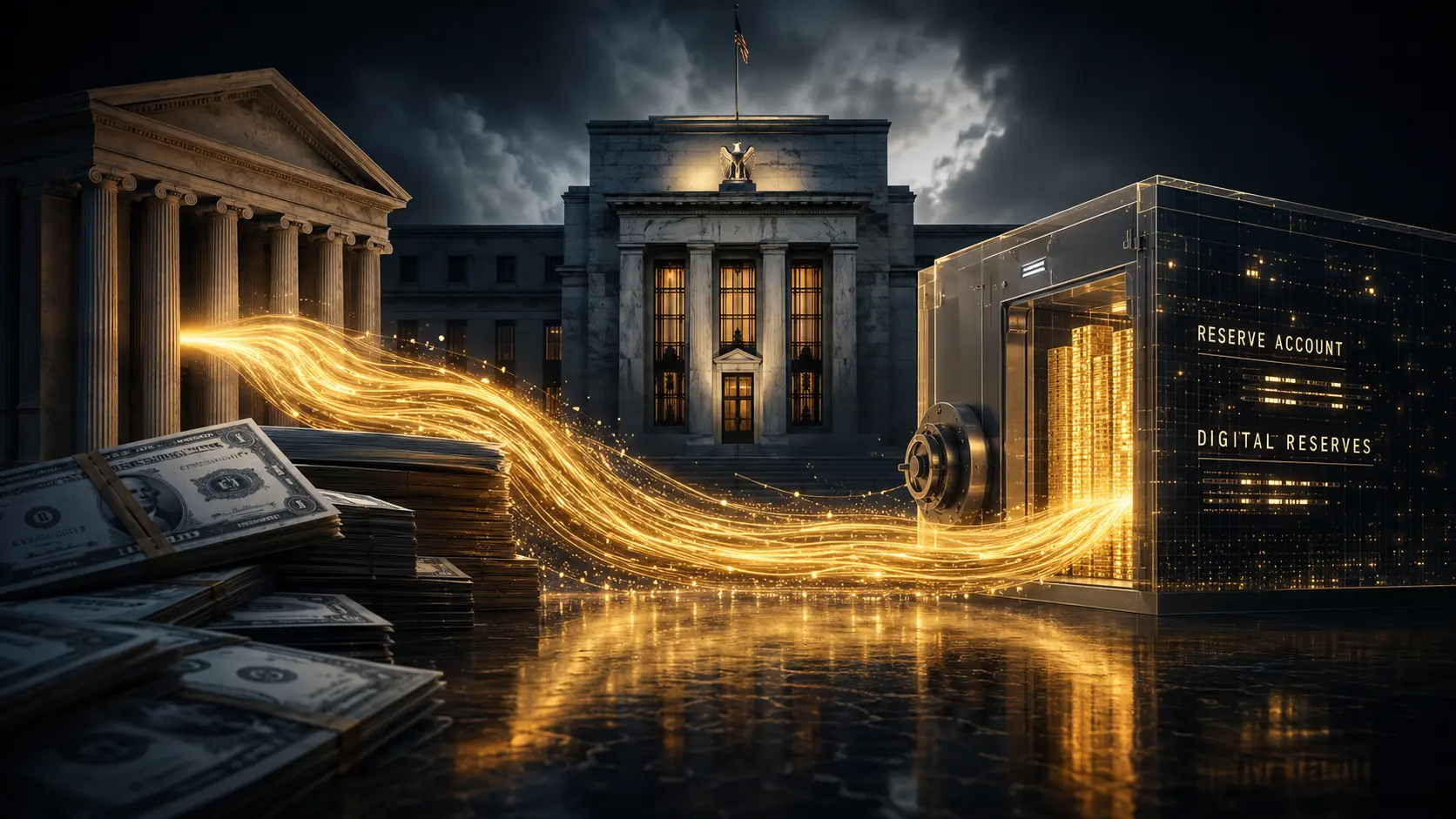
When the Fed buys $1 billion in Treasury bonds from a Primary Dealer, no physical cash changes hands. The Fed takes ownership of the bonds. In exchange, the Fed credits the Primary Dealer’s “Reserve Account” at the Federal Reserve with $1 billion. The Fed literally types the money into existence on a digital ledger. This is an asset swap: the commercial bank traded a bond for highly liquid digital reserves.
4. Extracting Duration Risk
By taking these long-term bonds off the open market, the Fed extracts “duration risk.” Because there are now fewer bonds available for the public to buy, the price of the remaining bonds goes up. In finance, when bond prices go up, bond yields (interest rates) go down. The Fed successfully forces long-term interest rates downward across the entire economy.
5. The Portfolio Balance Channel
This is the psychological transmission mechanism of QE. Imagine a pension fund that needs a 5% return to survive. They used to buy safe U.S. Treasuries to get that 5%. But because the Fed bought all the Treasuries and crushed the yield down to 1%, the pension fund is forced to look elsewhere. To get their 5%, they must take more risk—buying corporate debt, tech stocks, or real estate. This pushes a wall of money into the broader financial markets, artificially inflating asset prices and loosening financial conditions.
Real-World Applications
Quantitative Easing has been the primary tool for combating global deflationary crises over the past two decades.
The 2008 Global Financial Crisis: Following the collapse of Lehman Brothers, the global banking system froze. The U.S. Federal Reserve, led by Ben Bernanke, initiated “QE1,” purchasing $600 billion in toxic Mortgage-Backed Securities. This effectively removed the radioactive assets from commercial bank balance sheets, restoring trust to the interbank lending market and saving the global financial system from total collapse.
The COVID-19 Pandemic: When the global economy deliberately shut down in 2020, financial markets entered a freefall. The Federal Reserve responded with “QE Infinity,” committing to buy unlimited amounts of bonds to keep markets functioning. This massive intervention stabilized the panic within days and triggered the fastest, most aggressive stock market rally in human history.
The Bank of Japan (Yield Curve Control): Japan has battled severe deflation since the 1990s. The Bank of Japan (BOJ) took QE to its extreme logical conclusion with “Yield Curve Control” (YCC). Instead of committing to buy a certain dollar amount of bonds, the BOJ committed to buying infinite bonds necessary to pin the 10-year government bond yield exactly at 0%. This required the central bank to absorb more than half of the entire Japanese national debt onto its own balance sheet.
Economic & Strategic Impact
The implementation of QE drastically changes the relationship between a sovereign government and its debt.
Normally, when a government runs a massive budget deficit, it must issue millions of new bonds. If investors do not want to buy them, the government must offer a higher interest rate to attract buyers. This “bond vigilante” effect traditionally prevents governments from reckless spending.
QE neutralizes this discipline. When the central bank acts as a guaranteed, price-insensitive buyer of last resort, the government can issue trillions of dollars in new debt without fear of interest rates spiking. During 2020 and 2021, the Federal Reserve essentially absorbed the majority of the newly issued U.S. pandemic debt, masking the true cost of the government’s massive fiscal stimulus.
Strategically, this creates a severe trap. When a central bank’s balance sheet grows to 20% or 30% of a nation’s Gross Domestic Product (GDP), reversing the policy becomes incredibly dangerous. If the central bank stops buying and tries to sell the bonds back to the market—a process called Quantitative Tightening (QT)—interest rates can violently spike, crashing the very stock market the central bank spent a decade propping up.
Advantages
- Bypasses the Zero Lower Bound: Allows central banks to stimulate the economy even when traditional short-term interest rates cannot be cut any lower.
- Lowers Mortgage and Corporate Rates: By specifically buying long-term bonds and Mortgage-Backed Securities, QE directly lowers the borrowing costs for home buyers and expanding businesses.
- Prevents Deflationary Spirals: Flooding the banking system with liquid reserves ensures that commercial banks do not hoard cash during a panic, preventing a systemic credit freeze.
- Boosts Consumer Wealth (The Wealth Effect): By forcing investors into stocks and real estate, asset prices rise. Consumers feel wealthier and spend more money, indirectly stimulating the real economy.
Limitations
- Severe Wealth Inequality: Because the majority of stocks and real estate are owned by the wealthiest 10% of the population, QE disproportionately enriches the wealthy while offering little direct benefit to wage-earning laborers.
- Cannot Fix Supply Chain Shocks: QE solves liquidity crises, but it is useless against physical problems. If a pandemic shuts down factories, printing digital money cannot manufacture more microchips or pump more oil.
- Creates Asset Bubbles: By forcing interest rates to the floor, QE encourages reckless corporate borrowing and speculative behavior, often resulting in massive, unstable bubbles in tech stocks or crypto assets.
- The “Roach Motel” Problem: It is easy to get into QE, but nearly impossible to get out without causing a recession.
Common Misconceptions
Misconception: Quantitative Easing is literally “printing money.”
Reality: Central banks do not print physical paper bills during QE. They simply change the digital numbers in the reserve accounts of commercial banks. It is an accounting maneuver, an asset swap of a bond for a digital reserve.
Misconception: The money from QE goes directly to ordinary citizens.
Reality: QE money never directly enters the real economy. It stays trapped in the banking system as reserves. The only way it reaches Main Street is if commercial banks choose to lend those reserves out to businesses and consumers.
Misconception: QE instantly causes hyperinflation.
Reality: Following the 2008 crisis, critics warned QE would cause hyperinflation. It did not. Because the money remained trapped as bank reserves and was not actively circulating in the real economy (low money velocity), it caused asset inflation (stocks going up) rather than consumer inflation (groceries going up). True consumer inflation only occurred in 2021 when QE was combined with massive government stimulus checks mailed directly to citizens.
What Most People Miss
Quantitative Easing completely alters the fundamental structure of the banking system by moving to an “Ample Reserves Regime”.
Before 2008, banks kept very few reserves at the Federal Reserve. They actively lent money to each other every single night in the interbank market to meet their daily cash requirements. The system ran on “scarce reserves.”
Because of years of QE, banks are now flooded with trillions of dollars in excess digital reserves. The interbank lending market is largely dead because no bank needs to borrow money from another bank; they all have more than enough liquidity sitting at the Fed. The central bank now controls interest rates not by adjusting the supply of money, but by simply paying banks a specific interest rate on those massive, idle reserve balances (Interest on Reserve Balances, or IORB).
Comparison Table
| Feature | Traditional Rate Cuts | Quantitative Easing (QE) | Helicopter Money (Fiscal Stimulus) |
| Mechanism | Central bank lowers the overnight borrowing rate. | Central bank buys long-term bonds with digital reserves. | Government mails cash directly to citizens. |
| Target Audience | Commercial banks (lowering prime rates). | Financial markets and long-term bond yields. | Everyday consumers and businesses. |
| Impact on Money Supply | Expands broad money if banks choose to lend. | Expands central bank base money (bank reserves). | Directly and immediately expands broad money. |
| Inflationary Risk | Moderate (stimulates standard credit cycles). | Low to Moderate (often results in asset price bubbles). | Extremely High (causes immediate consumer price inflation). |
| Execution Authority | Independent Central Bank. | Independent Central Bank. | Elected Government (Treasury/Congress). |
Case Study
Situation: After peaking at nearly $9 trillion in 2022 due to pandemic-era QE, the Federal Reserve faced runaway consumer inflation. To cool the economy, they had to reverse course and shrink their balance sheet, a highly delicate process known as Quantitative Tightening (QT).
Challenge: The Fed needed to drain liquidity from the system without crashing the Treasury market or causing short-term lending markets to freeze.
Solution: Starting in June 2022, the Fed initiated a passive QT strategy. Instead of actively selling bonds and crashing prices, they simply allowed their existing bonds to mature and “roll off” the balance sheet without reinvesting the principal. They slowly withdrew liquidity over three years.
Outcome: On December 1, 2025, the Federal Reserve officially ended its balance sheet normalization. However, the balance sheet did not return to its pre-pandemic level of $4.2 trillion. Instead, it plateaued at roughly $6.7 trillion as of early 2026. The Fed realized they could not shrink it further without risking severe volatility in short-term money markets.
Lessons Learned: Quantitative Tightening is not a symmetrical reversal of Quantitative Easing. Once a central bank expands its balance sheet by trillions of dollars to save an economy, the banking system becomes permanently addicted to that higher level of liquidity. The “new normal” baseline is always permanently higher.
Future Outlook
Next 12–24 Months
The Federal Reserve and global central banks have fully settled into the “ample reserves regime,” maintaining balance sheets structurally larger than their historical averages. The primary focus will shift to managing the composition of these massive balance sheets, intentionally rotating out of Mortgage-Backed Securities and exclusively holding short-term U.S. Treasuries to avoid distorting the housing market.
Next 3–5 Years
Governments across the developed world face a sovereign debt wall, with trillions in pandemic-era debt needing to be refinanced at much higher interest rates. If private markets refuse to absorb this massive debt issuance, central banks will be forced to quietly re-initiate targeted QE programs to prevent government bond auctions from failing, blurring the line between monetary policy and fiscal monetization.
Next 10 Years
Quantitative Easing will cease to be viewed as an “unconventional emergency measure.” It will be permanently codified as the standard response to any minor economic slowdown. Furthermore, central banks will increasingly experiment with targeted QE—buying corporate bonds or even equity ETFs (as seen in Japan) to surgically prop up specific failing sectors of the economy.
Most Likely Scenario
The era of the “small” central bank balance sheet is permanently over. Central banks are now the largest and most important players in global bond markets. Whenever the next systemic crisis occurs, the starting point for balance sheet expansion will be vastly higher, ensuring that central bank intervention remains the ultimate floor beneath global asset prices.
Key Takeaways
- Quantitative Easing is an asset swap where a central bank creates digital reserves to buy long-term bonds from commercial banks.
- It is deployed when traditional short-term interest rates are already at zero and cannot be cut further.
- By buying bonds, the central bank extracts duration risk from the market, forcing long-term interest rates (like mortgages) downward.
- The “Portfolio Balance Channel” forces investors to seek higher returns in riskier assets, directly causing stock market and real estate booms.
- QE does not print physical cash or hand money directly to citizens; it traps liquidity in the banking system.
- Reversing the policy (Quantitative Tightening) is exceptionally difficult, as the banking system becomes addicted to the new, higher baseline of liquidity.
- Following the 2025 end of QT, the U.S. Federal Reserve permanently stabilized its balance sheet at a structurally higher baseline of approximately $6.7 trillion.
Glossary
Ample Reserves Regime: A monetary policy framework where a central bank supplies so much liquidity to the banking system that banks never need to borrow from each other, allowing the central bank to control rates via administered interest.
Asset Swap: An exchange of one financial instrument for another. In QE, commercial banks swap government bonds for central bank digital reserves.
Duration Risk: The risk that an investor takes on by locking their money into a long-term bond, exposed to inflation and future interest rate changes.
Federal Funds Rate: The target interest rate set by the Federal Reserve at which commercial banks borrow and lend their excess reserves to each other overnight.
Open Market Operations (OMO): The buying and selling of government securities in the open market by a central bank to expand or contract the amount of money in the banking system.
Portfolio Balance Channel: The economic theory explaining how QE forces investors out of safe, low-yield bonds and into riskier assets like stocks and corporate debt to maintain their desired returns.
Primary Dealers: A pre-approved network of massive commercial banks and broker-dealers authorized to trade directly with a central bank.
Quantitative Tightening (QT): The reversal of QE, where a central bank shrinks its balance sheet by letting bonds mature without reinvesting the proceeds, draining liquidity from the financial system.
Frequently Asked Questions
Does Quantitative Easing cause inflation?
It causes asset inflation (stocks and housing) because the newly created digital money stays within the financial system. It generally does not cause consumer inflation (groceries) unless the government simultaneously runs massive deficits and gives that money directly to citizens.
Where does the Federal Reserve get the money to buy the bonds?
They create it out of thin air. As the sole issuer of the currency, the central bank literally types digital numbers into the reserve accounts of the banks they are buying the bonds from.
Why doesn’t the Fed just give the money to the people instead of banks?
That would be “Helicopter Money” or fiscal policy, which is the legal responsibility of Congress and the Treasury. The Federal Reserve is an unelected central bank; it only has the legal authority to interact with the banking system.
Did Quantitative Tightening successfully reverse Quantitative Easing?
No. After peaking at nearly $9 trillion, the Fed’s QT program ended in late 2025, leaving the balance sheet plateaued at roughly $6.7 trillion. The balance sheet was not restored to its pre-crisis level; it simply normalized at a higher baseline.
Why do banks agree to sell their bonds to the Fed?
Because the Fed acts as a massive, price-insensitive buyer. They are willing to pay a premium price for the bonds, making it highly profitable for the primary dealers to sell to them.
What is the difference between QE and Yield Curve Control (YCC)?
In standard QE, a central bank commits to buying a fixed dollar amount of bonds per month. In YCC, a central bank commits to buying an infinite amount of bonds to force the bond’s interest rate to hit a specific mathematical target (e.g., exactly 0%).
If the Fed creates trillions out of thin air, why do we pay taxes?
Taxes create the underlying demand for the currency and control inflation by destroying money. If the government entirely funded itself by having the central bank print money without taxing it back out of the economy, it would trigger immediate hyperinflation and currency collapse.
What happens if the Federal Reserve goes bankrupt?
It is functionally impossible. Because the Federal Reserve can create the U.S. Dollars it owes out of thin air, it can never suffer a technical default on its dollar-denominated obligations.
Sources
- Federal Reserve: Federal Reserve Balance Sheet Developments (May 2026)
- Federal Reserve: The Central Bank Balance-Sheet Trilemma (Jan 2026)
- CFC Solutions Cooperative News: Fed Ends Balance Sheet Normalization (Dec 2025)
- CaixaBank Research: What are the implications of the Fed slowing down its balance sheet reduction process?