Advertisement
)

AT A GLANCE
- Concept: The Millikelvin Threshold: Superconducting qubits mathematically fail if exposed to ambient thermal energy exceeding 15 thousandths of a degree above absolute zero.
- Concept: Isotopic Phase Separation: Below one Kelvin, a liquid mixture of Helium-3 and Helium-4 spontaneously separates into two distinct physical layers.
- Concept: Endothermic Evaporation: Forcing Helium-3 atoms across this liquid boundary absorbs massive amounts of heat, driving temperatures downward.
- Concept: The Tritium Bottleneck: Helium-3 does not exist naturally on Earth in harvestable quantities; it must be sourced from the radioactive decay of nuclear weapons material.
HOW IT WORKS
Classical computers process information using silicon transistors that generate massive amounts of waste heat. Quantum computers reverse this paradigm entirely. A superconducting qubit, the foundational logic gate of systems built by IBM and Google, operates by manipulating the quantum states of microwave photons.
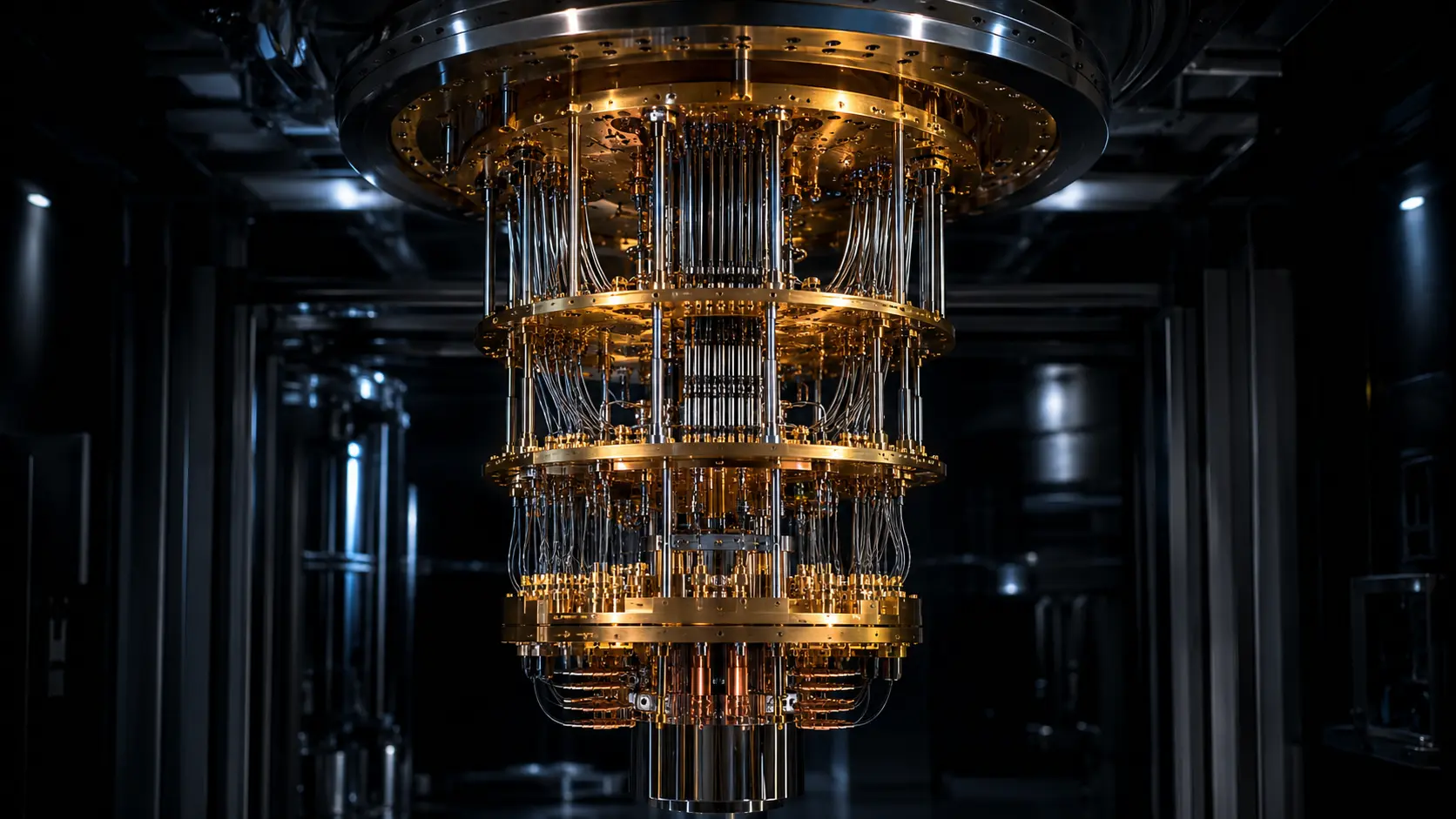
If a qubit absorbs even a fraction of ambient room-temperature thermal radiation, its delicate quantum state collapses instantly. This physical failure is known as decoherence. To prevent decoherence, engineers must isolate the quantum processor inside a cryostat—a multi-layered, gold-plated vacuum chamber colloquially called a chandelier.
Standard refrigeration cannot achieve the necessary extreme cold. Liquid nitrogen boils at 77 Kelvin. Standard liquid Helium-4 boils at 4.2 Kelvin. Superconducting qubits require an operating environment of 15 millikelvins (0.015 Kelvin). To cross this final thermodynamic threshold, physicists utilize a dilution refrigerator to manipulate the quantum properties of two specific isotopes: Helium-3 (³He) and Helium-4 (⁴He).
Inside the lowest mixing chamber of the cryostat, the temperature drops below 0.8 Kelvin. At this precise thermal boundary, the mixture of the two isotopes spontaneously phase-separates. The lighter Helium-3 forms a concentrated liquid layer floating directly on top of a heavier, dilute layer consisting primarily of superfluid Helium-4.
The superfluid Helium-4 possesses zero physical viscosity and acts as a mechanical vacuum. When massive external pumps remove Helium-3 atoms from the dilute phase, the physical laws of equilibrium force new Helium-3 atoms to cross the boundary from the concentrated phase to replace them. This physical phase transition requires energy. The Helium-3 atoms literally absorb the surrounding ambient heat to fuel their journey across the liquid boundary, continually driving the temperature of the attached quantum processor down to near absolute zero.
WHY IT MATTERS NOW
The commercial viability of quantum computing relies strictly on scaling the number of physical qubits. A 100-qubit processor fits on a small silicon wafer. A 10,000-qubit processor requires a physical footprint the size of a dinner table.
Cooling a silicon wafer to 15 millikelvins is a solved laboratory exercise. Cooling a massive, multi-chip array flooded with thousands of microwave control cables is a heavy-industry engineering crisis. Every coaxial cable running from room-temperature servers down to the quantum chip acts as a physical thermal bridge, continually bleeding parasitic heat back into the processor.
Companies like Bluefors and IBM are abandoning laboratory-scale cryostats in favor of massive, industrial-grade cryogenic architectures. IBM’s “Project Goldeneye” engineered a super-refrigerator possessing a volume larger than a commercial cargo van. Operating these machines requires immense localized electrical power to drive the external dry pumps and helium compressors, completely altering the physical design of the modern data center.
This thermodynamic requirement exposes a severe geopolitical supply chain vulnerability. Helium-3 is not a commercially mined commodity. It is an exceedingly rare isotope harvested almost exclusively as a byproduct of the radioactive decay of Tritium, a heavy hydrogen isotope bred strictly inside government nuclear reactors to boost thermonuclear warheads.
The entire global supply of Helium-3 is metered by the national security apparatuses of the United States and Russia. As the quantum computing industry attempts to mass-produce dilution refrigerators, they are competing directly for an isotope whose global reserve is measured in mere kilograms. The absolute physical limit on global quantum computing capacity is dictated entirely by the availability of this specific nuclear byproduct.
WHAT MOST PEOPLE MISS
Technology media endlessly debate the algorithmic superiority of different quantum error-correction codes. They completely miss the reality that quantum computing is fundamentally an exercise in exotic fluid dynamics and extreme plumbing.
A quantum computer is not a software product; it is a thermodynamic isolation chamber. Maintaining 15 millikelvins requires absolutely perfect vacuum seals, vibration-dampening structures, and closed-loop isotopic circulation. A single microscopic leak in a dilution refrigerator’s plumbing does not just cause a system error; it permanently vents hundreds of thousands of dollars of irreplaceable Helium-3 into the atmosphere, rendering the multi-million-dollar quantum processor permanently dead.
THE TRAJECTORY
Next 12–36 Months: Cryostat manufacturers will deploy massive, multi-chamber dilution refrigerators capable of housing distributed quantum networks. These systems will cool multiple distinct processors simultaneously, utilizing internal superconducting microwave cables to link qubits across separate cooling zones.
Next Five Years: The industry will standardize localized, closed-loop Helium-3 recovery systems. Quantum data centers will construct clean-room gas capture infrastructure directly around the cryostats to ensure absolute zero-loss handling of the isotopic mixture during routine maintenance cycles.
Next Ten Years: The sheer scarcity of terrestrial Helium-3 will force the quantum industry to fund alternative sourcing. Advanced nuclear startups will design highly specialized commercial breeder reactors explicitly engineered to manufacture Tritium solely to secure the Helium-3 supply chain required for global quantum infrastructure.
What Could Go Wrong: A severe geopolitical embargo restricts the commercial sale of Helium-3. Without fresh isotope supplies, new dilution refrigerators cannot be commissioned. The scaling roadmaps of major quantum hardware developers freeze instantly, stranding billions of dollars in venture capital and stalling the realization of fault-tolerant quantum algorithms.
Most Likely Outcome: The thermodynamic overhead of operating dilution refrigerators will centralize the quantum industry. Rather than desktop quantum computers, civilization will rely on a handful of massive, sovereign-backed cryogenic data centers, allowing users to access the hardware strictly via remote cloud interfaces.
KEY TERMS
- Dilution Refrigerator: A highly specialized cryogenic device that achieves millikelvin temperatures by mixing and evaporating two isotopes of helium.
- Helium-3 (³He): A light, non-radioactive isotope of helium featuring two protons and one neutron, primarily sourced from decaying nuclear weapons material.
- Superfluidity: A rare state of matter where a supercooled liquid flows with exactly zero physical viscosity or friction.
- Decoherence: The rapid collapse of a delicate quantum state caused by the introduction of external thermal noise or electromagnetic interference.
- Absolute Zero: The theoretical lowest possible temperature (0 Kelvin or -273.15°C) where all atomic kinetic motion permanently ceases.
SOURCES
- National Institute of Standards and Technology (NIST) — Cryogenic Infrastructure for Superconducting Quantum Computers
- Department of Energy (DOE) — The Global Helium-3 Supply Chain and Tritium Decay Harvesting
- IBM Quantum Research — Project Goldeneye and the Scaling of Advanced Dilution Refrigerators
- Journal of Low Temperature Physics — Thermodynamics of Phase Separation in Helium-3/Helium-4 Mixtures