Advertisement
)

AT A GLANCE
- Concept: The CPU Bottleneck: Standard network traffic forces the receiving CPU to unpack, sort, and deliver the data, creating massive microsecond delays.
- Concept: Kernel Bypass: RoCE allows the network interface card (NIC) to ignore the operating system entirely and inject data directly into the target GPU’s memory.
- Concept: Converged Ethernet: It adapts the extreme, low-latency performance of specialized supercomputer networks (InfiniBand) to run over standard, cheaper Ethernet cables.
- Concept: Straggler Mitigation: In a 10,000-GPU cluster, if a single GPU waits a few extra milliseconds for data, the entire billion-dollar cluster halts, making network latency the ultimate cost driver.
HOW ROCE WORKS
When a standard server sends data across the internet using TCP/IP, the process is highly bureaucratic. The data arrives at the Network Interface Card (NIC), which interrupts the Central Processing Unit (CPU). The CPU stops what it is doing, copies the data from the NIC into the operating system kernel, inspects it, and then copies it again into the application’s memory space.
This double-copying process requires intense CPU processing power and adds tens of microseconds of latency. For streaming a movie, this delay is invisible. For training a trillion-parameter Large Language Model (LLM) across 10,000 GPUs, this delay is mathematically fatal. The GPUs calculate math so quickly that if they have to wait for the CPU to deliver the data, they spend the majority of their time idling, burning massive amounts of electricity to do zero work.
Remote Direct Memory Access (RDMA) eliminates the CPU from the transaction entirely. When Server A needs to send data to Server B, the RDMA-enabled NIC on Server A grabs the data directly from its own memory and fires it across the wire. The NIC on Server B receives the data and writes it directly into the physical memory of Server B’s GPU.
Neither CPU is interrupted. Neither operating system kernel is involved. This is known as “kernel bypass.” The data transfer occurs in roughly one to two microseconds, operating entirely at the hardware level.
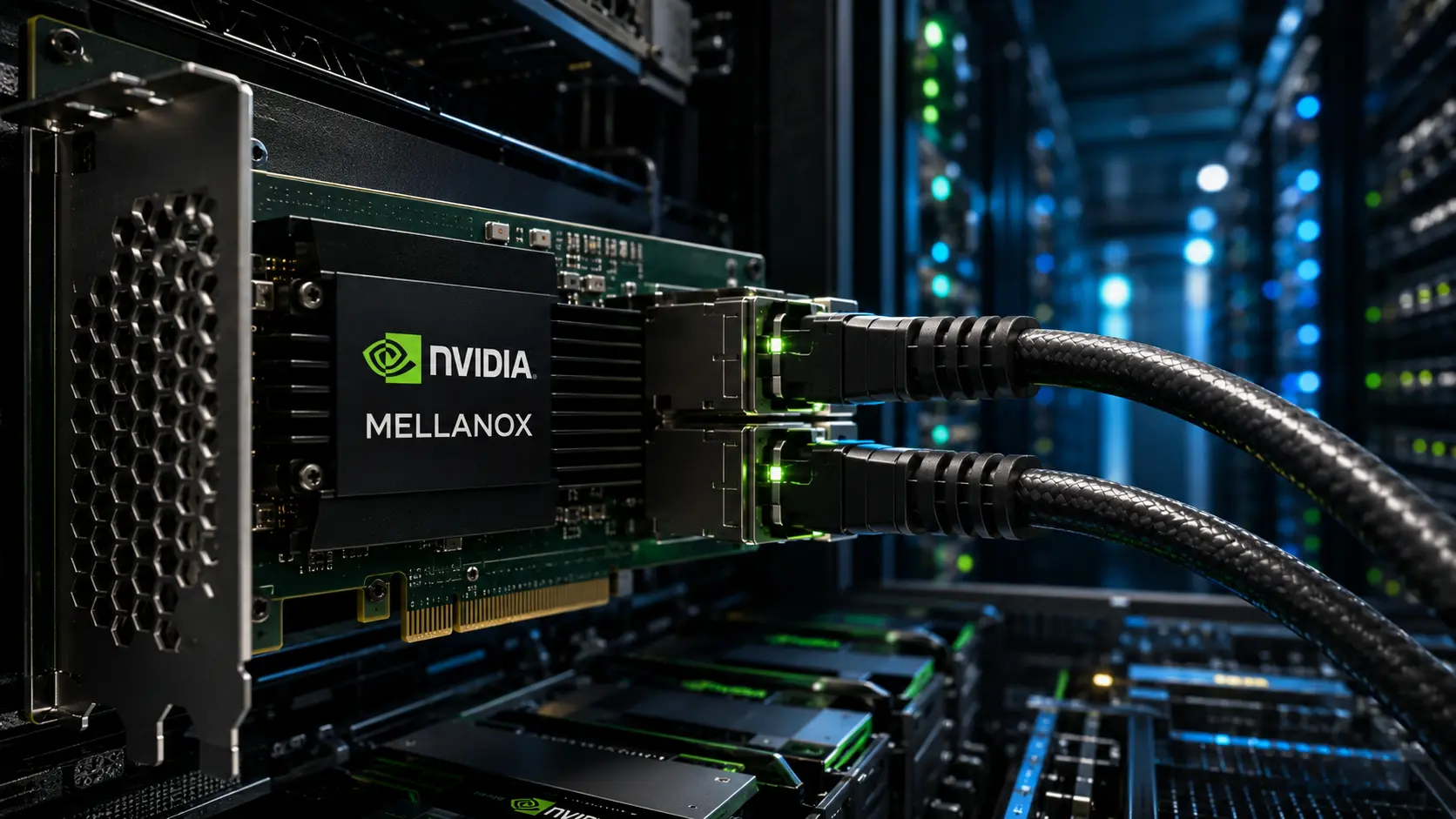
Historically, RDMA required a highly specialized, expensive, and proprietary networking standard called InfiniBand (heavily dominated by Nvidia/Mellanox). RoCE (specifically RoCEv2) was engineered to democratize this capability. It takes the exact RDMA hardware instructions and encapsulates them inside standard UDP/IP Ethernet packets. This allows hyperscale cloud providers to achieve supercomputer-level latency using the standard Ethernet switches and cables they already have installed in their data centers.
WHY IT MATTERS NOW
Artificial intelligence models have grown too large to fit inside a single computer. Training a model like GPT-4 requires taking the neural network, fracturing it into thousands of pieces, and distributing those pieces across a massive cluster of GPUs.
These GPUs must constantly talk to each other to update their mathematical weights after every single calculation. This process is called “all-reduce.” If a cluster has 16,000 GPUs, 15,999 GPUs cannot proceed to the next calculation until the slowest GPU finishes its math and sends its data across the network.
The entire cluster operates at the speed of the slowest network link—a phenomenon known as the “straggler problem.” If standard TCP/IP networking causes one GPU to lag by 50 microseconds, the entire $500 million cluster halts for 50 microseconds. Over a three-month training run, those microsecond delays compound, adding weeks of wasted time and tens of millions of dollars in unnecessary electricity costs.
RoCEv2 solves this physical economic limit. By guaranteeing near-zero latency and massive throughput over standard Ethernet, it allows companies like Meta, Microsoft, and OpenAI to successfully network tens of thousands of GPUs together. Without RDMA kernel bypass, the modern generative AI industry would physically hit a scaling wall, as the network delay would mathematically erase the computational gains of adding more GPUs.
This protocol is currently the center of a brutal hardware war. Nvidia aggressively pushes InfiniBand to lock customers into their proprietary, high-margin networking ecosystem. In response, a massive coalition of tech giants—including AMD, Broadcom, and Intel—are heavily standardizing and open-sourcing RoCEv2 (via the Ultra Ethernet Consortium) to break Nvidia’s networking monopoly and commoditize AI interconnects.
WHAT MOST PEOPLE MISS
Tech media endlessly compares the raw teraflops (calculating speed) of different AI chips. They completely miss the reality that in a distributed cluster, the network interface card is arguably more important than the processor itself.
Buying the fastest GPU on Earth is a waste of capital if the network cannot feed it data fast enough to keep it busy. Furthermore, deploying RoCEv2 is notoriously difficult. Standard Ethernet is a “lossy” network; it expects packets to drop and simply resends them. RDMA requires a “lossless” network; a single dropped packet forces the NIC to halt and renegotiate, destroying the low-latency advantage. Making cheap Ethernet behave like expensive InfiniBand requires configuring Priority Flow Control (PFC) across every single switch in a data center perfectly—a brutal, highly specialized network engineering dark art that frequently cripples novice AI startups.
THE TRAJECTORY
Next 12–36 Months: The Ultra Ethernet Consortium (UEC) will release standardized architectural profiles explicitly designed to optimize RoCEv2 for AI workloads. This will solve the fragile “lossless” configuration problem, allowing enterprise data centers to easily deploy high-performance GPU clusters without requiring specialized InfiniBand engineers.
Next Five Years: The integration of SmartNICs and Data Processing Units (DPUs). The network card will evolve from a simple data pipeline into an active computer. The DPU will offload the complex “all-reduce” mathematical aggregation from the GPUs directly onto the network card itself, further freeing up the GPUs to focus strictly on pure neural network training.
Next Ten Years: The physical limit of copper cables will force the entire data center to transition to co-packaged optics. The RoCE network interface will abandon electrical signals entirely, using microscopic lasers to stream RDMA data across the cluster, pushing bandwidth past 1.6 Terabits per second per port while drastically reducing thermal energy consumption.
What Could Go Wrong: If RoCEv2 traffic is improperly isolated on a shared corporate network, a massive AI training run will instantly saturate the bandwidth, triggering Priority Flow Control pause frames across the switches. This “congestion spreading” can violently cascade through the data center, physically locking up all other regular server traffic and paralyzing the company’s traditional cloud operations.
Most Likely Outcome: RoCEv2 will entirely displace InfiniBand as the default networking standard for hyperscale computation. The ability to achieve microsecond, direct-memory data transfer over commodity Ethernet hardware will commoditize AI infrastructure, stripping away the proprietary networking margins currently commanded by incumbent hardware monopolies.
KEY TERMS
- Remote Direct Memory Access (RDMA): A hardware technology that allows two computers to exchange data directly between their physical memories without involving the operating system or CPU.
- RoCE (RDMA over Converged Ethernet): A network protocol that encapsulates RDMA instructions inside standard Ethernet packets, bringing supercomputer latency to traditional data centers.
- Kernel Bypass: The technique of allowing a network interface card to read and write data directly to an application’s memory, entirely skipping the operating system’s software processing layers.
- Priority Flow Control (PFC): A strict network switch configuration required by RoCE to pause data transmission before a buffer overflows, creating the “lossless” environment required for RDMA.
- InfiniBand: A highly specialized, expensive, and low-latency proprietary networking standard traditionally used in supercomputers, currently competing directly against RoCE.
SOURCES
- IEEE Communications Magazine — RDMA over Converged Ethernet (RoCE): Protocol, Architecture, and Performance Evaluation
- Ultra Ethernet Consortium (UEC) — High-Performance Networking Standards for AI and HPC Workloads
- Microsoft Research — RDMA in the Cloud: Scaling RoCEv2 for Hyperscale Data Centers
- Nvidia / Mellanox — Network Interface Architecture and Direct GPU Memory Access (GPUDirect)