Advertisement
)

Imagine trying to supply a massive army, but instead of shipping millions of heavy weapons across the ocean, you just email the blueprints and let the soldiers 3D-print their own arsenals directly on the battlefield. During the COVID-19 pandemic, standard mRNA vaccines operated like a massive physical supply chain. Scientists had to manufacture every single blueprint in giant, multi-million-dollar bioreactors. If the required human dose was 30 micrograms of RNA, the factory had to churn out exactly 30 micrograms for every single arm. This created catastrophic global supply bottlenecks, extreme manufacturing costs, and severe cold-chain storage nightmares.
What if the vaccine could manufacture itself inside your body?
Biotech engineers have unlocked the next frontier of immunology: self-amplifying RNA (saRNA). By stripping the microscopic copying machinery out of natural viruses and attaching it to synthetic vaccines, scientists have created a genetic payload that exponentially multiplies the moment it enters a human cell. Why should you care right now? Because this “replicon” architecture drastically cuts the required drug dosage by up to 90%. A single biomanufacturing facility can now protect ten times as many people overnight. This marks the death of the multi-billion-dollar biological supply bottleneck, shifting the global pharmaceutical industry from brute-force chemical volume to elegant, self-replicating code.
What is Self-Amplifying RNA (saRNA)?
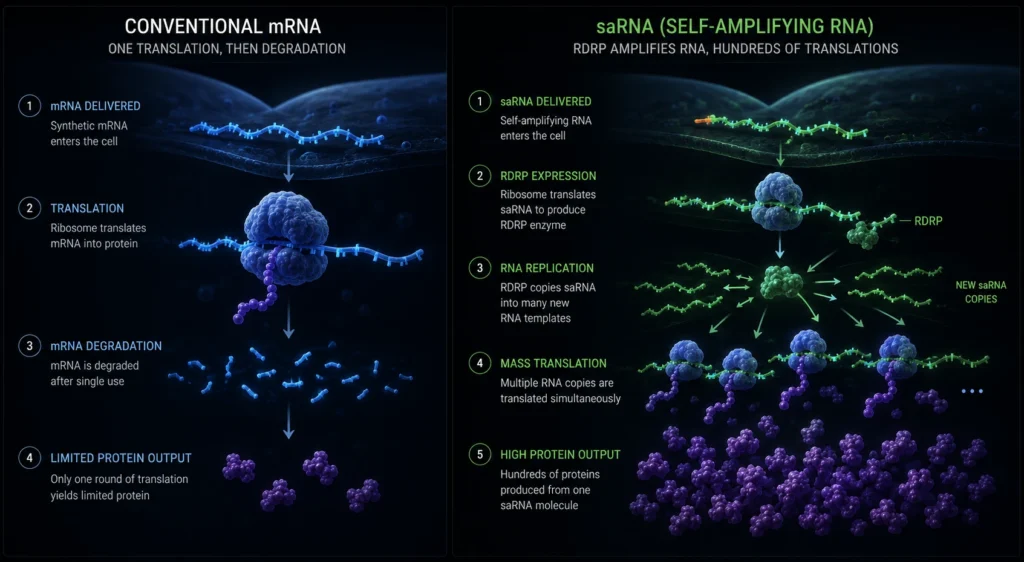
Self-amplifying RNA (saRNA) is an advanced genetic medicine that enters human cells and uses built-in viral replicase enzymes to continuously copy itself. Unlike conventional mRNA, which translates a protein once and quickly degrades, saRNA exponentially multiplies its antigen blueprints. This drastically lowers the required dosage and prolongs immune stimulation.
At a Glance
- Concept: A genetic payload that contains both the instructions to build an immune antigen and the instructions to build a biological copy machine.
- Why it matters: Conventional mRNA requires high doses because the signal collapses in a few days. saRNA reduces the required RNA mass by roughly six to tenfold (down to 1–5 µg) by amplifying the signal over several weeks.
- Who uses it: Pharmaceutical leaders (CSL Seqirus), biotech innovators (Arcturus Therapeutics), and sovereign health ministries deploying rapid-response vaccine stockpiles.
- Biggest takeaway: The dose-sparing nature of saRNA mathematically eliminates vaccine shortages. One liter of synthesized saRNA can immunize significantly more people than the equivalent volume of conventional mRNA, entirely reshaping global pandemic response logistics.
In Simple Words
If you want to bake a cake, traditional mRNA is like someone handing you a recipe written on a piece of ice. You have to read the recipe as fast as you can, bake the cake, and then the recipe melts away. If you want more cakes, the chef has to hand you another piece of ice. Because the instructions disappear so quickly, doctors have to inject a massive amount of mRNA into your arm to make sure your body produces enough “cakes” (antigens) to train your immune system.
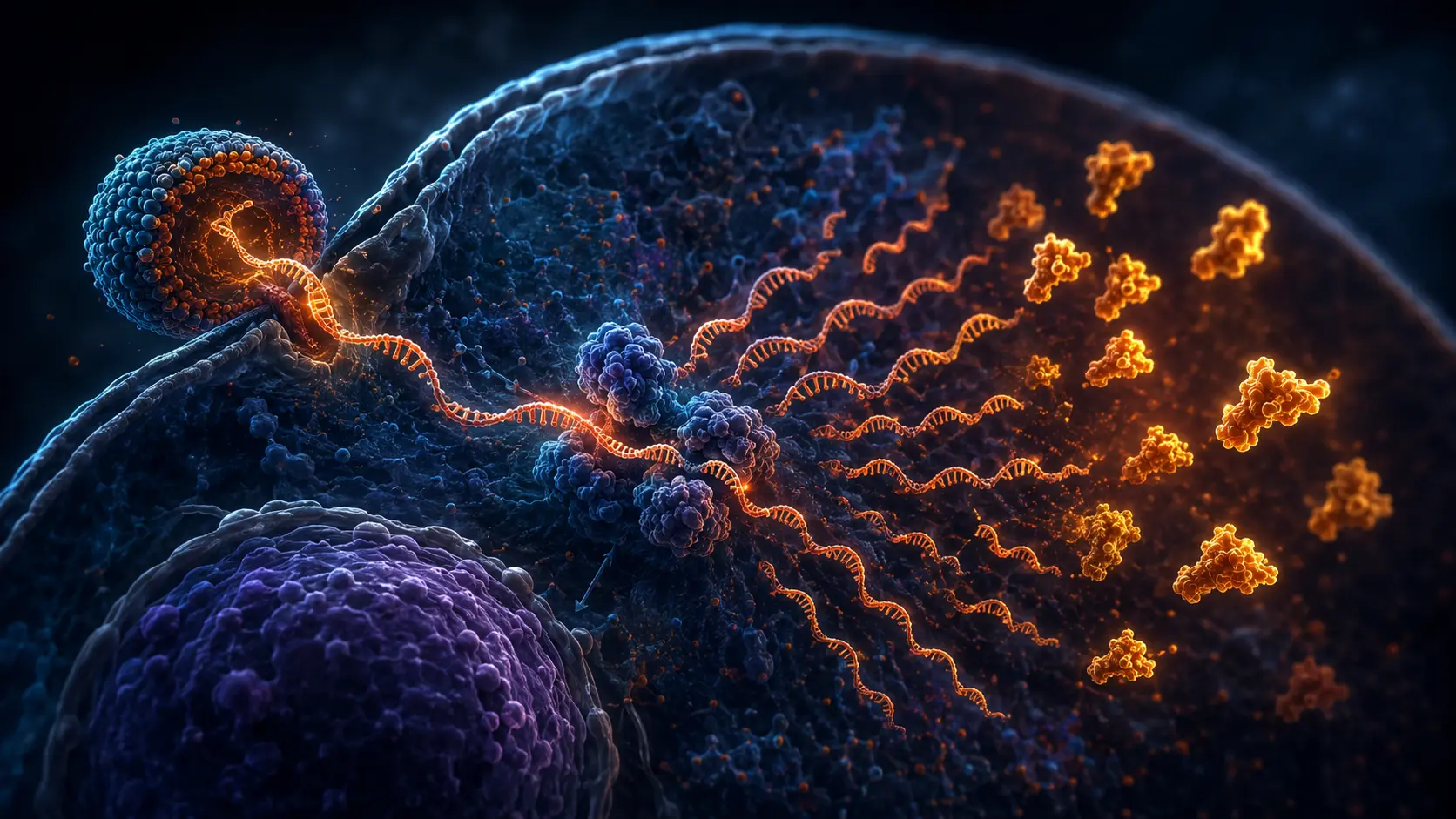
Self-Amplifying RNA (saRNA) is different. The chef hands you a recipe, but attached to the bottom is a miniature printing press.
The moment this recipe enters your cell, the printing press turns on. It instantly prints hundreds of fresh, identical copies of the recipe. Your cells read all these new copies and start baking massive amounts of the antigen. Because the recipe copies itself, the doctor only needs to inject a tiny microscopic fraction of the medicine. The medicine does the heavy lifting, maintaining a strong, steady output for weeks rather than fading away in a few days.
Why This Matters
The delivery system for all modern RNA therapies is the Lipid Nanoparticle (LNP)—a microscopic bubble of fat that protects the delicate genetic code. However, LNPs are not entirely benign; they possess intrinsic adjuvant effects that can trigger significant inflammatory responses in the human body.
For Biotech Investors and Pharma Execs, saRNA is the ultimate LNP-reduction strategy. In conventional mRNA therapies, injecting 30 to 100 micrograms of RNA means injecting a proportionately massive load of inflammatory lipids. These high lipid doses are largely responsible for the fever, body aches, and fatigue associated with vaccination. Because saRNA achieves the same protein expression with only 1 to 5 micrograms of RNA, the total lipid payload injected into the patient collapses. This dose-sparing mechanism drastically improves the tolerability of the vaccine, directly addressing the vaccine hesitancy and side-effect fatigue that plagued early mRNA rollouts.
The Global Approval of saRNA Vaccines (ARCT-154)
The commercial viability of the saRNA platform was officially validated on the global stage on November 27, 2023. Japan’s Ministry of Health, Labour and Welfare granted regulatory approval to ARCT-154, a COVID-19 vaccine jointly developed by CSL and Arcturus Therapeutics.
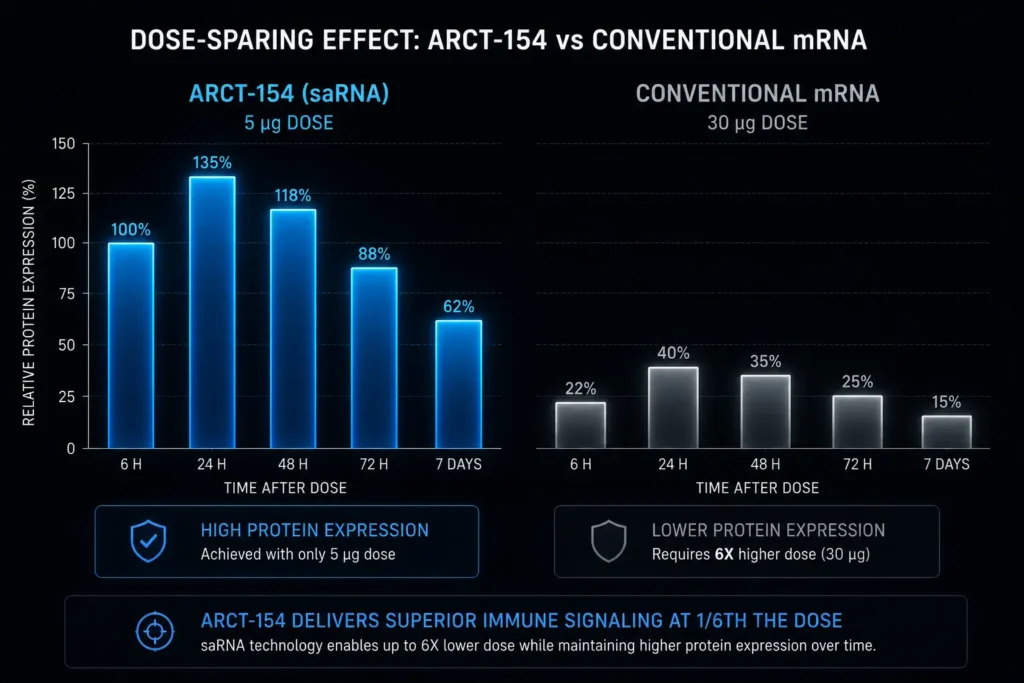
This was a watershed moment in medical history. ARCT-154 became the world’s first saRNA vaccine authorized for commercial marketing. It achieved a humoral immune response at the exact same magnitude as the incumbent conventional mRNA vaccines, but it did so using a 6-fold lower administered dose (5 µg instead of 30 µg). This single approval moved saRNA from a theoretical academic exercise to a commercially scaling, deregulated pharmaceutical asset.
How Self-Amplifying RNA (saRNA) Works
Forcing human cells to host a self-replicating factory without triggering immediate cellular death requires extreme genetic precision. Here is the first-principles breakdown of the saRNA architecture.
1. The Fundamental Problem: Rapid Degradation
Following lipid nanoparticle-mediated delivery, conventional therapeutic mRNA exhibits a rapid onset within 2 to 6 hours, peaks at 24 to 48 hours, and exponentially declines over 7 to 14 days as cellular enzymes destroy the foreign code. This rapid fading is a fundamental constraint for creating a lasting immune memory.
2. The Insufficiency of Megadosing
To counteract rapid degradation, traditional vaccines inject large initial payloads (tens of micrograms). However, megadosing saturates the cellular translation machinery and introduces dose-limiting toxicities, primarily driven by the inflammatory nature of the ionizable lipid components.
3. The Core Mechanism: The Alphavirus Replicase
saRNA solves degradation by borrowing the genome of alphaviruses. An alphavirus normally contains structural genes (the shell of the virus) and non-structural genes (the replication engine). Bioengineers delete the structural genes so the saRNA physically cannot generate an infectious virus, ensuring absolute biological safety. They leave the non-structural proteins (nsP1-4) intact and splice the therapeutic vaccine antigen gene into the empty slot.
4. Technical Depth: RNA-Dependent RNA Polymerase (RDRP)
After entering the cytoplasm, the saRNA first translates the non-structural proteins to form an RNA-dependent RNA polymerase (RDRP). This specialized enzyme uses the original positive-sense RNA strand as a template to synthesize complementary antisense RNA strands. It then uses these antisense strands as a mold to rapidly mass-produce hundreds of copies of the original positive-sense RNA.
5. Real-World Consequences: Prolonged Dose-Sparing
Because one incoming strand bootstraps its own biological factory, a 1-microgram dose of saRNA generates the same antigen load as 10 micrograms of conventional mRNA. In in vivo luciferase tracking models, while conventional mRNA collapsed to baseline within roughly one week, the saRNA signal peaked around day 8 and remained highly detectable in mice for roughly one month, validating the immense power of the amplification dividend.
Commercial Applications of saRNA Technology
The dose-sparing leverage of the replicon architecture is extending beyond COVID-19 into highly complex immunological targets.
Next-Generation Influenza Vaccines: Seasonal influenza mutates rapidly, requiring updated vaccines annually. Recent preclinical evaluations of saRNA vaccines against seasonal influenza across multiple subtypes demonstrated enhanced immunogenicity and dose-sparing efficacy compared to conventional baselines. Because saRNA requires a fraction of the raw material, global health organizations can stockpile and distribute strain-specific influenza vaccines drastically faster in the event of an unexpected avian flu (H5N1) crossover event.
Personalized Cancer Immunotherapies: The global self-amplifying RNA cancer immunotherapy platforms market is forecast to expand rapidly, projected to reach $643.2 million by 2036. These platforms are highly focused on “Personalized neoantigen saRNA.” By biopsying a patient’s specific solid tumor, scientists sequence the unique mutations (neoantigens) and encode them into an saRNA vector. The prolonged protein expression driven by the saRNA replicon acts as a constant, targeted training beacon, teaching the patient’s own T-cells to continuously hunt and destroy the cancer cells over several weeks.
Veterinary Medicine and Zoonotic Defense: Managing livestock infections and preventing zoonotic spillover requires cheap, highly efficient mass vaccination. The ultra-low dosages required by saRNA make it highly economically viable for animal health applications, where the profit margins per dose are severely constrained compared to human medicine.
Economic & Strategic Impact
The saRNA architecture fundamentally disrupts the Biomanufacturing CapEx Curve.
Constructing a sterile, Good Manufacturing Practice (GMP) facility to produce conventional mRNA lipid nanoparticles requires hundreds of millions of dollars in capital expenditure. The output of that factory is strictly bottlenecked by the physical mass of RNA it can synthesize per hour.
By transitioning to saRNA, the exact same factory instantly multiplies its effective output. If a 1,000-liter bioreactor run previously produced 10 million doses of a 30 µg mRNA vaccine, transitioning that run to a 3 µg saRNA vaccine means the factory just produced 100 million doses. This 10x capacity expansion fundamentally alters the unit economics of genetic medicine, lowering the cost of goods sold (COGS) to a level where advanced RNA therapeutics can be profitably deployed in low- and middle-income countries.
Advantages
- Ultra-Low Dose Requirement: Generates equivalent or superior immune responses using up to 90% less RNA mass than conventional platforms.
- Prolonged Antigen Exposure: The continuous replication of the RNA template extends protein expression from days to weeks, producing a highly durable antibody and cellular T-cell response.
- Reduced LNP Toxicity: Lower RNA doses mandate lower total lipid nanoparticle volumes, mitigating the injection-site inflammation and systemic reactogenicity common with high-dose boosters.
- Non-Integrating Safety: Like conventional mRNA, saRNA operates entirely within the cell’s cytoplasm and lacks the mechanical ability to enter the nucleus or integrate into the host DNA, ensuring zero risk of genomic alteration.
Limitations
- Innate Over-Activation (dsRNA): The replication process inherently creates double-stranded RNA (dsRNA) intermediates. Human cells recognize dsRNA as a sign of viral infection, which can trigger an aggressive innate immune response. While excellent for vaccines (acting as a natural adjuvant), this over-activation makes saRNA difficult to use for chronic, non-vaccine protein replacement therapies.
- Complex Molecular Size: saRNA molecules are roughly three to four times larger than conventional mRNA (often exceeding 9,000 nucleotides) because they must carry the massive non-structural viral replicase genes. Synthesizing, purifying, and packaging these fragile, massive molecules into LNPs without breaking them is a severe chemical engineering hurdle.
- Lag Phase Kinetics: saRNA takes 6 to 12 hours to build its replicase machinery before it begins pumping out the target protein, creating a delayed onset compared to the rapid 2-hour spike of conventional mRNA.
Common Misconceptions
Misconception: saRNA is a live, weakened virus.
Reality: saRNA is completely synthetic code. It is an empty, chemical shell. All the structural genes that would allow it to assemble a viral body and spread to other cells have been completely deleted. It can only replicate its specific blueprint locally before eventually succumbing to cellular degradation.
Misconception: Because it multiplies, it stays in the body forever.
Reality: The amplification is robust but finite. The innate immune system of the cell eventually detects the foreign RNA and deploys nucleases to destroy it. In animal models, the signal is virtually undetectable after approximately one month.
Misconception: saRNA alters human DNA.
Reality: The entire lifecycle of saRNA, from entry to replication to degradation, occurs strictly within the cytosol. It physically lacks the transport signals and enzymes required to cross the nuclear membrane, eliminating any risk of integration into the host genome.
What Most People Miss
The critical mechanism of Cellular and Humoral Divergence.
In clinical and animal evaluations, researchers noticed that reducing the dose of RNA didn’t just maintain the antibody (humoral) response; it actually improved the T-cell (cellular) response.
In a lethal challenge model using humanized mice exposed to SARS-CoV-2, a 2 µg dose of saRNA protected 100% of the animals, whereas a dose-matched conventional mRNA protected only roughly 70%. What most people miss is that the prolonged, slow-burn expression of saRNA perfectly mimics the kinetics of a real, live viral infection. This sustained presentation trains the T-cells much more effectively than the rapid, massive flash of standard mRNA, creating a deeper, more resilient layer of systemic immunity.
Comparison Table
| Feature | Conventional mRNA | Self-Amplifying RNA (saRNA) |
| Genetic Payload | Antigen genes only | Antigen genes + Viral Replicase (nsP1-4) |
| Typical Dose Required | 30 µg to 100 µg | 1 µg to 5 µg |
| Expression Kinetics | Peaks rapidly (24-48 hrs), drops fast | Lags initially, peaks Day 8, sustains for weeks |
| Self-Replication | None (Single translation) | Exponential via RDRP |
| Innate Immune Trigger | Moderate | High (driven by dsRNA intermediates) |
| Molecule Size | Small (~4,000 nucleotides) | Massive (~9,000 to 12,000 nucleotides) |
Case Study
Situation: The global rollout of mRNA COVID-19 vaccines proved the platform’s efficacy, but subsequent booster campaigns were hampered by severe dose-limiting reactogenicity. Patients routinely experienced fevers and debilitating fatigue, primarily driven by the large volumes of ionizable lipid nanoparticles required to deliver 30 to 50 micrograms of standard mRNA.
Challenge: Develop a next-generation RNA booster that could provide equal or superior protective neutralizing titers against emerging variants, but drastically reduce the physical mass of the required injection to mitigate systemic side effects and ease manufacturing bottlenecks.
Solution (The ARCT-154 Authorization): Arcturus Therapeutics, in collaboration with CSL Seqirus, engineered ARCT-154, an saRNA vaccine targeting the spike protein of SARS-CoV-2. By embedding an alphavirus-derived replicon into the payload, the vaccine was designed to self-amplify inside the host cytosol.
Outcome: During clinical trials and subsequent phase 3 non-inferiority trials, participants received ARCT-154 at an administered dose 6-fold lower than the conventional Pfizer-BioNTech (BNT162b2) baseline. The results demonstrated that the saRNA vaccine successfully induced a humoral immune response at the exact same magnitude as the higher-dose conventional mRNA, with no severe adverse events reported and only short-lived, mild incidences. Consequently, on November 27, 2023, the Japanese Ministry of Health, Labour and Welfare granted the world’s first official marketing approval for an saRNA vaccine.
Lessons Learned: The approval of ARCT-154 unequivocally validated the commercial viability of the replicon mechanism. It proved that mathematical dose-sparing translates directly into clinical safety and equivalent immunological efficacy, setting a new regulatory standard for all future pandemic preparedness platforms.
Future Outlook
Next 12–24 Months
The era of Bivalent and Multivalent Integration. As the regulatory pathway is now cleared by ARCT-154, pharmaceutical companies will aggressively pivot toward combining multiple saRNA antigens into a single LNP. Because the required dose per antigen is so low (1 µg), developers can combine vaccines for Influenza, COVID-19, and RSV into a single, low-volume annual shot without breaching the toxicity thresholds of the lipid envelope, offering a unified respiratory defense vector.
Next 3–5 Years
The explosion of Personalized Oncology Pipelines. The most lucrative shift for saRNA will occur in solid tumor therapies. By 2030, the ability to sequence a patient’s tumor and print a customized saRNA immunotherapy that continuously trains CD8+ T-cells for an entire month will transition from clinical trials to standard-of-care. The self-amplifying nature guarantees that the patient’s immune system receives sustained, relentless exposure to the cancer antigen without requiring daily hospital injections.
Next 10 Years
The Trans-Amplifying RNA (taRNA) Separation. The ultimate evolution of this architecture is separating the engine from the payload. In trans-amplifying systems, the massive replicase machinery is placed on one RNA molecule, and the therapeutic antigen is placed on a second, much smaller RNA molecule. By delivering them together, scientists can overcome the chemical manufacturing limits of massive, 10,000-nucleotide saRNA strands. This will unlock the ability to deliver massive genetic circuits, curing complex multi-gene disorders and revolutionizing the limits of transient gene therapy.
Most Likely Scenario
Conventional mRNA acted as the brute-force sledgehammer required to break through the pandemic. Self-amplifying RNA is the precision scalpel that will follow. By utilizing biological leverage to print its own therapeutics directly inside the host, saRNA will permanently depress the cost of genetic medicine, expanding the reach of RNA technology far beyond global pandemics into the targeted eradication of endemic infectious diseases and aggressive malignancies.
Key Takeaways
- Self-amplifying RNA (saRNA) incorporates viral replicase enzymes (nsP1-4) that allow the therapeutic genetic code to copy itself exponentially inside a human cell.
- Because the RNA multiplies autonomously, saRNA vaccines require roughly 6 to 10 times less active ingredient than conventional mRNA vaccines to trigger an equal immune response.
- The continuous replication prolongs antigen exposure, maintaining high cellular expression for weeks compared to the rapid 48-hour decline of traditional mRNA.
- Japan approved ARCT-154 in late 2023, making it the first saRNA vaccine authorized for global marketing, successfully delivering a 5 µg dose compared to a standard 30 µg alternative.
- Dose-sparing drastically reduces the amount of inflammatory Lipid Nanoparticles (LNPs) injected into the patient, significantly improving the tolerability and safety profile of the vaccine.
- The replication process creates double-stranded RNA (dsRNA), which acts as a powerful immune stimulant (adjuvant) but makes saRNA difficult to use for chronic, non-vaccine therapeutic applications.
Glossary
Alphavirus: A family of viruses whose genetic structure provides the blueprint for saRNA. Scientists harness their self-copying machinery while entirely removing their ability to cause disease.
Dose-Sparing: The clinical ability to achieve the desired therapeutic effect using a drastically lower amount of the active drug, primarily lowering manufacturing costs and side effects.
Lipid Nanoparticle (LNP): The microscopic sphere of specialized fats used to safely encapsulate delicate RNA molecules and transport them through the bloodstream into the cytoplasm of target cells.
RNA-Dependent RNA Polymerase (RDRP): The critical enzyme translated from saRNA that acts as a biological printing press, synthesizing multiple new copies of the target RNA sequence.
Self-Amplifying RNA (saRNA): A large RNA molecule engineered to contain both the antigen coding sequence and a viral replicase sequence, enabling autonomous, exponential replication inside host cells.