Advertisement
)
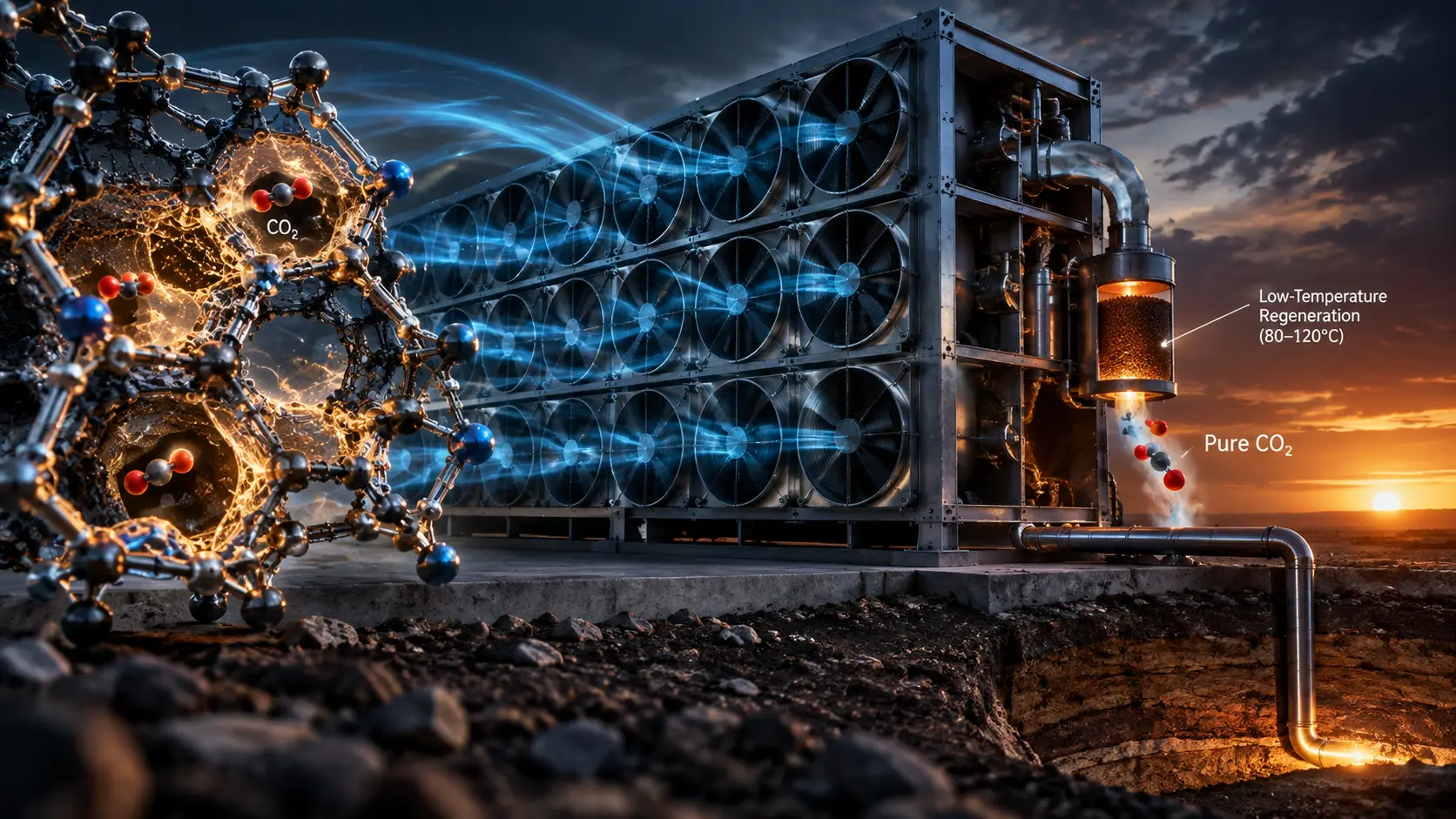

For decades, removing carbon dioxide directly from the open atmosphere seemed economically impossible. Because CO2 makes up only about 420 parts per million (0.04%) of the air we breathe, extracting it is like trying to find a single drop of ink dissolved in an Olympic-sized swimming pool. Early Direct Air Capture (DAC) systems relied on brute-force chemistry: blowing massive amounts of air over cascading walls of liquid alkaline solvents. While this trapped the carbon, the thermodynamic penalty was catastrophic. To release the trapped carbon so it could be buried, the liquid had to be boiled in massive calcination kilns at temperatures approaching 900°C, consuming astronomical amounts of natural gas and defeating the very purpose of a climate-saving technology.
Why should you care right now? Because materials scientists have fundamentally rewritten the thermodynamics of carbon removal. By replacing massive liquid vats with microscopic, highly porous crystals known as Metal-Organic Frameworks (MOFs), engineers have created physical sponges that suck carbon out of the sky and release it at temperatures as low as 80°C to 120°C. This breakthrough eliminates the need for fossil-fuel kilns, allowing massive commercial DAC hubs to run entirely on low-grade renewable heat. This technological pivot is rapidly driving the cost of atmospheric carbon removal down from $1,000 per ton toward a commercially viable threshold, unlocking a multi-billion-dollar market for permanent climate restoration.
What is Solid Sorbent Direct Air Capture (DAC)?
Solid Sorbent Direct Air Capture (DAC) is an advanced carbon removal technology that uses highly porous, solid crystalline materials, such as Metal-Organic Frameworks (MOFs) or amine-functionalized resins, to selectively bind with atmospheric CO2. Unlike liquid solvent systems, solid sorbents release the trapped carbon dioxide through low-temperature vacuum-swing adsorption, drastically reducing the energy required for continuous operation.
At a Glance
- Concept: Utilizing microscopic, 3D crystalline cages to physically or chemically trap CO2 molecules straight out of ambient air, then applying mild heat and a vacuum to squeeze the pure CO2 back out.
- Why it matters: Solid sorbents regenerate at 80°C to 120°C. This allows DAC facilities to be powered entirely by waste heat from industrial plants or geothermal energy, slashing the Levelized Cost of Carbon Removal (LCCR).
- Who uses it: Mega-scale climate infrastructure developers like Climeworks and Global Thermostat, leveraging filter technologies from partners like Svante to scale U.S. Department of Energy-funded mega-hubs.
- Biggest takeaway: The core engineering challenge is moisture stability. Because air contains vastly more water vapor than CO2, the solid sorbent must be chemically tuned to ignore water molecules, ensuring the crystal structure does not degrade over thousands of capture-and-release cycles.
In Simple Words
Imagine a specialized molecular sponge.
If you leave a normal sponge on your kitchen counter, it absorbs water. But a Metal-Organic Framework (MOF) is a custom-built, programmable sponge. Scientists design the microscopic holes inside this crystal to be the exact size and chemical charge needed to attract one specific molecule: Carbon Dioxide CO2.
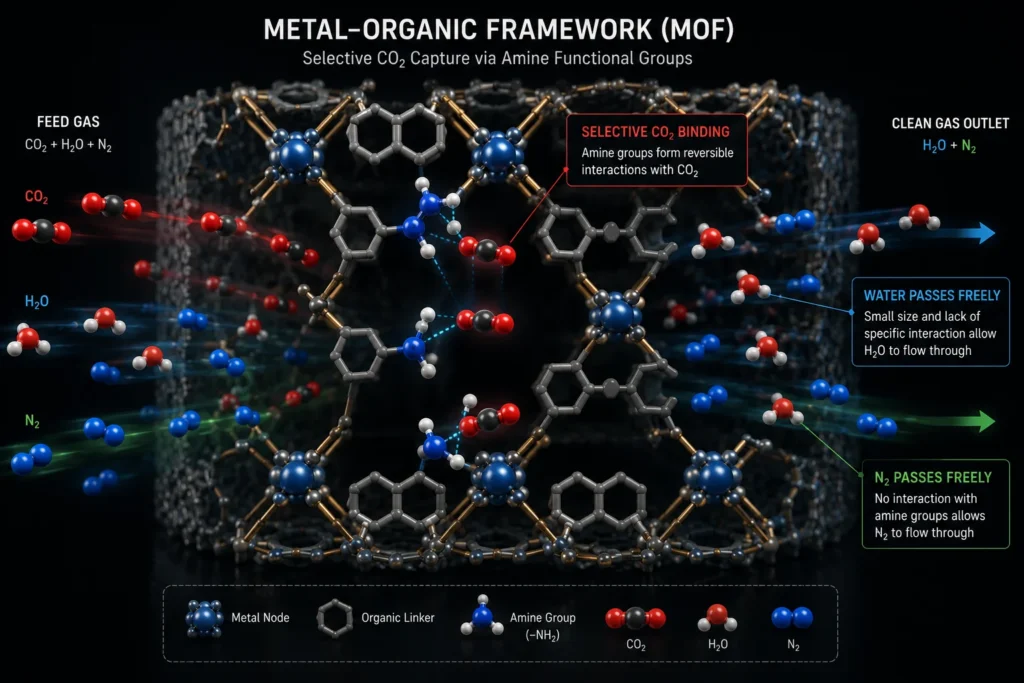
Giant fans pull normal, outdoor air through large containers filled with these solid sponges. The oxygen and nitrogen pass right through, but the CO2 gets stuck to the inside of the microscopic holes.
Once the sponge is full of carbon, the container is sealed. Instead of using a blast furnace to melt the carbon out (which is what older liquid systems do), the system simply lowers the air pressure (creating a vacuum) and warms the sponge up slightly to about 100°C (roughly the temperature of boiling water). This mild environment causes the sponge to let go of the CO2. The pure CO2 is sucked away to be pumped deep underground, and the empty sponge is ready to be used again.
Why This Matters
The global carbon removal market is shifting from voluntary corporate ESG pledges to hard, government-subsidized infrastructure.
For Climate Tech Investors and Energy Engineers, the distinction between liquid solvent DAC and solid sorbent DAC dictates where billions in capital expenditures (CapEx) will flow. Liquid DAC systems require massive scale and intense heat, restricting them to locations with abundant natural gas. Solid sorbent systems are highly modular. They can be stacked like shipping containers and deployed anywhere with a renewable energy grid or geothermal heat source. As initiatives like the U.S. Department of Energy’s Regional DAC Hubs push to deploy 1 million-ton-per-year facilities, companies utilizing advanced solid sorbents are aggressively outcompeting legacy systems on both energy efficiency and geographic flexibility.
The Evolution of Metal-Organic Frameworks (MOFs)
The evolution of solid sorbents is a triumph of reticular chemistry. At the turn of the decade, scientists proved that MOFs could physically capture carbon (physisorption), but they struggled in open-air environments where humidity degraded the crystalline structures.
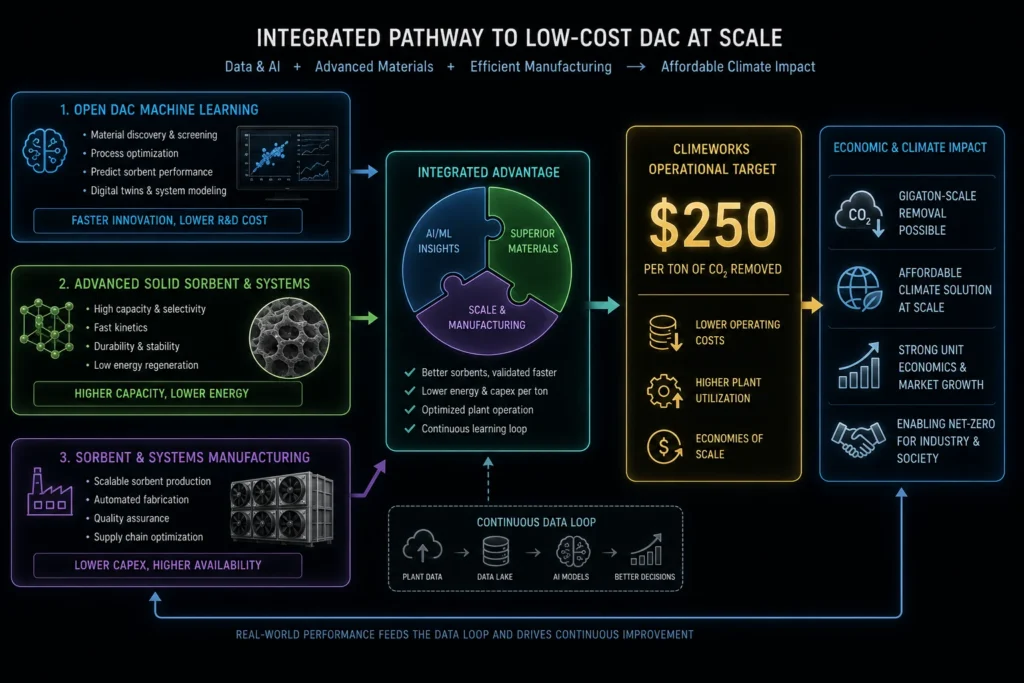
To bridge the gap to commercialization, computational research drastically accelerated. Massive open-source initiatives, such as the OpenDAC dataset produced by Meta AI and Georgia Tech, deployed machine learning to screen roughly 400 million hours of quantum chemistry calculations, rapidly identifying the ideal metal nodes and organic linkers required for optimal CO2 binding. Today, the industry has transitioned to amine-functionalized MOFs that capture ultra-dilute CO2 through strong chemical bonds (chemisorption) while successfully repelling competitive water molecules, enabling continuous field operations across diverse, global climates.
How Solid Sorbent Direct Air Capture Works
Capturing 400 parts per million of a specific gas from an open atmosphere requires hacking the physical chemistry of adsorption. Here is the first-principles breakdown of the process.
1. The Fundamental Problem: Ultra-Dilute Capture
The concentration of CO2 in ambient air is roughly 350 times lower than the concentration found in smokestacks from coal power plants. Because the target gas is so scattered, the capture material must possess immense surface area and highly specific chemical binding sites to capture the CO2 without wasting energy capturing inert nitrogen or oxygen.
2. The Insufficiency of Liquid Solvents
Legacy DAC systems use aqueous potassium hydroxide or sodium hydroxide to capture CO2. While effective, recovering the CO2 requires a complex chemical precipitation loop (causticizing) and heating calcium carbonate to 900°C in a calcination kiln. This massive thermal demand inherently limits the geographic deployment of liquid DAC to areas with cheap, high-heat fossil fuels.
3. The Core Mechanism: Metal-Organic Frameworks (MOFs)
Solid sorbent systems replace the liquid loop with a static filter bed. The filter utilizes Metal-Organic Frameworks: highly ordered, three-dimensional crystalline structures composed of metal ion clusters linked by organic molecules. A single gram of a MOF can have an internal surface area larger than a football field, providing billions of microscopic “parking spaces” specifically tuned for CO2 molecules.
4. Technical Depth: Amine-Functionalization and Chemisorption
To ensure the MOF grabs CO2 instead of water (humidity), scientists “functionalize” the pores by grafting amine groups into the framework. When air flows through the filter, the CO2 reacts with the amines via chemisorption. Because this interaction is highly selective, it aggressively pulls CO2 out of the air even at 400 ppm, while allowing the overwhelming majority of atmospheric water vapor to pass through.
5. Real-World Consequences: Temperature-Vacuum Swing Adsorption (TVSA)
Once the sorbent is saturated, the system must be regenerated. The facility seals the capture unit, drops the internal pressure (Vacuum Swing), and introduces low-grade heat, typically between 80°C and 120°C (Temperature Swing). This thermodynamic shift breaks the amine-CO2 bond.
Under optimal TVSA conditions, advanced MOFs can achieve a specific energy consumption of roughly 3.5 MJ/kg of CO2, releasing a stream of ~98% pure CO2 gas that is compressed and pumped into deep geological storage.
Commercial Deployments of Solid Sorbent DAC
Solid sorbent technology is rapidly transitioning from laboratory quantum-chemistry models into massive, industrial-scale infrastructure.
Project Cypress (Louisiana, USA): Awarded massive funding from the U.S. Department of Energy’s Regional Direct Air Capture Hubs program, Project Cypress is a commercial milestone aiming to capture 1 million tons of CO2 annually. The hub utilizes solid-sorbent and thermal-regeneration filter technology developed by Svante Technologies, operated alongside developers like Climeworks. By locating in Louisiana, the project benefits from access to abundant geological storage formations, proving that massive solid sorbent arrays can be scaled up to meet industrial mandates.
Climeworks Generation 3 Modular Hubs: Climeworks is pioneering the aggressive modularization of solid sorbents. Their Generation 3 technology, planned for construction in Louisiana, shifts away from bespoke architecture toward highly replicated, shipping-container-sized modules. This iteration aims to slash energy consumption per module by 50% and drive carbon capture costs down to the critical threshold of $250 to $350 per metric ton, drastically accelerating the deployment velocity of commercial DAC fields.
Industrial Emissions Management: While DAC focuses on ambient air, companies like Svante are leveraging the exact same advanced solid sorbent architectures to manage high-concentration industrial flue gas. By installing MOF-based filters directly onto the exhaust stacks of hard-to-abate sectors—such as steel and cement manufacturing—the technology prevents fresh CO2 from entering the atmosphere in the first place, bridging the gap between carbon capture and pure carbon removal.
Economic & Strategic Impact
The primary economic metric determining the survival of the solid sorbent industry is Cyclic Durability.
A MOF that captures CO2 efficiently on day one is useless if its microscopic structure collapses after a month of use. Atmospheric air is hostile; it contains fluctuating levels of moisture, airborne particulates, and corrosive trace gases. Water molecules compete fiercely for the same chemical binding sites as CO2.
To achieve positive unit economics, a commercial solid sorbent filter must survive thousands of consecutive temperature and vacuum swings (typically targeting 5,000+ cycles) without structural degradation. If the sorbent degrades too quickly, the facility faces massive ongoing CapEx to continually replace the filters. The biotech-style intellectual property race currently defining the DAC market is intensely focused on synthesizing durable, humidity-resistant organic linkers that ensure the sorbent lives long enough to amortize its high initial synthesis cost.
Advantages
- Low-Temperature Regeneration: Solid sorbents release captured CO2 at temperatures between 80°C and 120°C, allowing facilities to use waste heat, geothermal, or basic electrical heat pumps, completely eliminating the need for fossil-fuel combustion.
- Modular Scalability: Unlike liquid DAC plants that require massive, centralized fluid processing loops, solid sorbent beds can be packaged into small, stackable collector modules, allowing facilities to scale capacity incrementally.
- Highly Tunable Chemistry: Reticular chemistry allows engineers to precisely design the pore size, geometry, and surface chemistry of a MOF, creating bespoke materials optimized for specific climates (e.g., highly humid coastal regions vs. arid deserts).
Limitations
- Massive Airflow Requirements: Because CO2 is ultra-dilute (420 ppm), solid sorbent facilities must use massive arrays of industrial fans to push millions of cubic meters of air through the filters, consuming significant parasitic electrical power just to move the air.
- Moisture Competition: In highly humid environments, water molecules can saturate the sorbent, blocking the active amine sites from capturing CO2 and potentially degrading the crystalline structure of the MOF over repeated cycles.
- High Sorbent Manufacturing Costs: While cheap at the laboratory scale, manufacturing thousands of tons of high-purity, amine-functionalized Metal-Organic Frameworks requires complex chemical synthesis that currently keeps the initial capital cost of the filter material extremely high.
Common Misconceptions
Misconception: Solid sorbents permanently trap the CO2 inside the crystal.
Reality: The MOF acts purely as a temporary, reusable sponge. It grabs the CO2 for a few hours, releases it into a pipeline when heated, and is instantly reused. The permanent trapping happens later, when the pipeline pumps the pure CO2 gas thousands of feet underground into geological rock formations.
Misconception: Direct Air Capture replaces the need to reduce emissions.
Reality: DAC is the most energy-intensive climate solution available due to the laws of thermodynamics. It is mathematically designed to address historical emissions and hard-to-abate sectors. It is not an economic substitute for decarbonizing the primary electrical grid.
Misconception: Solid sorbents require massive amounts of water to function.
Reality: This is a major advantage over legacy systems. Liquid solvent DAC systems lose massive amounts of water to evaporation because they blow open air across wet chemical walls. Solid sorbent systems operate dry, drastically reducing their geographic water footprint and allowing deployment in arid regions.
What Most People Miss
The strategic impact of Machine Learning Interatomic Potentials.
For over a decade, identifying a new MOF for carbon capture required grueling, slow physical experimentation in a laboratory or wildly expensive Density Functional Theory (DFT) supercomputer simulations.
What most observers miss is that artificial intelligence has fundamentally broken this bottleneck. By releasing massive open-source datasets (like OpenDAC), researchers have trained machine learning models to instantly predict how a hypothetical, un-synthesized MOF will interact with CO2 at the atomic level. This allows developers to screen millions of candidate materials computationally for a fraction of the cost, accelerating the discovery of perfect, humidity-resistant sorbents from a timeline of years down to a matter of weeks.
Comparison Table
| Feature | Liquid Solvent DAC | Solid Sorbent DAC (MOFs) |
| Capture Medium | Aqueous Potassium/Sodium Hydroxide | Solid Crystalline Frameworks / Resins |
| CO2 Binding Mechanism | Chemical reaction forming carbonates | Chemisorption via amine-functionalized pores |
| Desorption Process | Calcination in a high-heat kiln | Temperature-Vacuum Swing Adsorption (TVSA) |
| Regeneration Temp. | ~900°C | 80°C – 120°C |
| Primary Energy Source | Natural Gas (historically) | Low-grade Waste Heat / Geothermal / Electric |
| Water Consumption | High (Evaporative loss) | Very Low |
| Modularity | Low (Requires massive centralized plants) | High (Containerized, scalable modules) |
Case Study
Situation: The United States committed to scaling the nascent Direct Air Capture industry to commercial maturity, recognizing that achieving a cost below $100 per metric ton was impossible without massive, subsidized infrastructure deployment.
Challenge: Transitioning DAC from small-scale European pilot plants (which captured a few thousand tons annually) to megaton-scale American hubs without relying on the extreme fossil-fuel heat required by liquid solvent architectures.
Solution (Project Cypress): The Department of Energy’s Office of Clean Energy Demonstrations awarded funding to Project Cypress, a massive DAC hub in Louisiana managed by Battelle. To achieve scalable, low-energy capture, the project partnered with Climeworks and utilized the highly advanced solid-sorbent and thermal-regeneration filters developed by Svante Technologies.
Outcome: By leveraging solid sorbents, Project Cypress bypassed the need for 900°C calcination kilns. Climeworks integrated its Generation 3 technology, targeting a 50% energy reduction per module. The hub was engineered to securely transport the pure CO2 stream to a fully permitted geological storage partner for permanent subterranean sequestration, establishing a blueprint for 1-million-ton-per-year, low-heat carbon removal networks.
Lessons Learned: Project Cypress proved that government policy and thermodynamic optimization are inextricably linked. By subsidizing the deployment of low-temperature solid sorbents, the initiative forced the commercial supply chain to mature, creating a viable economic pathway for heavy industry to manage carbon emissions out of the atmosphere without bankrupting their energy budgets.
Future Outlook
Next 12–24 Months
The era of Generative Sorbent Synthesis. Armed with massive computational datasets like OpenDAC, the next two years will witness a flood of proprietary MOF patents. Startups will utilize AI to design composite sorbents with optimized mass transfer kinetics and diffusion pathways. The defining announcements in 2027 will not be about building larger fans, but about achieving adsorption rates exceeding 0.1 mmol CO2/g·min while maintaining absolute selectivity against water vapor over thousands of cycles.
Next 3–5 Years
The scaling of The Megaton Hubs. By the end of the decade, the DOE-funded Regional DAC Hubs (including Project Cypress) will move from initial planning into active, full-scale operations, collectively pulling millions of tons of CO2 from the sky. During this period, the unit cost of solid sorbents will crash as chemical manufacturing scales up. The industry will rapidly approach the Climeworks benchmark of $250 to $350 per ton, transitioning the market from government-subsidized demonstrations into a financially viable, self-sustaining asset class for corporate carbon offsetting.
Next 10 Years
The Electro-Swing Adsorption (ESA) Transition. While Temperature-Vacuum Swing Adsorption (TVSA) dominates the late 2020s, the mid-2030s will see the commercialization of Electro-Swing Adsorption (ESA). Instead of using heat and pressure to force the MOF to release the carbon, ESA systems will use direct electrical currents to alter the chemical binding affinity of the sorbent. This will allow DAC facilities to operate purely on electricity without requiring any thermal management infrastructure, further shrinking the physical footprint and complexity of the capture modules.
Most Likely Scenario
Solid sorbents are the undisputed thermodynamic victors of the Direct Air Capture race. The ability to regenerate at the temperature of boiling water ensures that future DAC networks will be powered entirely by renewable energy or industrial waste heat. As machine learning perfects the crystalline architecture of MOFs, the atmosphere will increasingly be treated not as a limitless dumping ground, but as an actively managed, programmable chemical reservoir.
Key Takeaways
- Solid Sorbent Direct Air Capture uses advanced crystalline materials (MOFs) to selectively trap CO2 directly from ambient air.
- Unlike older liquid solvent systems that require 900°C natural gas kilns, solid sorbents release their trapped carbon using mild heat (80°C – 120°C) and a vacuum (TVSA).
- Because they require low-grade heat, solid sorbent facilities can be powered by geothermal energy or industrial waste heat, drastically lowering the total energy penalty.
- Engineers “functionalize” the microscopic pores of the MOFs with amine groups, ensuring they chemically grab CO2 (chemisorption) while largely ignoring the abundant water vapor in the air.
- The U.S. Department of Energy’s Project Cypress is actively scaling this technology in Louisiana, utilizing Climeworks and Svante solid-sorbent filters to target 1 million tons of annual carbon removal.
- The primary commercial hurdle is cyclic durability; the sorbents must survive thousands of heating and vacuum cycles without their microscopic structure degrading.
Glossary
Amine-Functionalization: The process of chemically grafting nitrogen-based compounds (amines) into the pores of a material. Amines have a high chemical affinity for CO2, allowing them to selectively pull the gas out of ultra-dilute atmospheric air.
Chemisorption: A process where a gas (like CO2) forms strong chemical bonds with the surface of a solid material. It is highly effective for trapping gas but requires specific heat or pressure to break the bond later.
Direct Air Capture (DAC): A technology that uses chemical or physical processes to extract carbon dioxide directly from the ambient atmosphere, completely independent of a specific point-source (like a factory smokestack).
Metal-Organic Frameworks (MOFs): Highly ordered, three-dimensional crystalline structures made of metal ion clusters linked by organic molecules. They possess exceptionally large internal surface areas that act as programmable sponges for specific gases.
OpenDAC: A massive open-source computational dataset released by Meta AI and Georgia Tech that used quantum chemistry calculations to screen millions of MOF combinations for optimal CO2 capture properties.
Temperature-Vacuum Swing Adsorption (TVSA): The continuous industrial process of trapping CO2 in a solid filter (adsorption), sealing the chamber, lowering the air pressure (vacuum), and applying heat (temperature) to force the filter to release the pure CO2.
Frequently Asked Questions
Why is Direct Air Capture so much harder than putting filters on smokestacks?
The concentration of CO2 in a coal plant smokestack is roughly 15%. The concentration of CO2 in the open atmosphere is roughly 0.04% (420 ppm). DAC is exponentially harder because the machines have to process and filter vastly larger volumes of air just to find the scattered carbon molecules.
What happens to the CO2 after it is captured by the solid sorbent?
Once the sorbent releases the pure CO2, the gas is highly pressurized and typically pumped through pipelines to injection wells. It is then permanently trapped thousands of feet underground in specific, secure geological rock formations.
Do these facilities take up a lot of land?
No, and this is a key advantage of DAC compared to planting trees (afforestation). A solid sorbent DAC facility can capture millions of tons of CO2 using a land footprint that is exponentially smaller than the thousands of acres of forest required to capture the same amount of carbon.
Will rain or humidity ruin the solid sorbent?
It is one of the primary engineering challenges. Early MOFs struggled heavily with moisture stability. However, modern amine-functionalized MOFs are chemically tuned to prioritize CO2 over water, allowing them to operate reliably even in humid environments like Louisiana (the site of Project Cypress).
Is this technology profitable?
Standalone DAC is currently not profitable simply by selling the captured CO2. It relies on a combination of voluntary corporate carbon credit purchases (companies paying a premium to offset their emissions) and massive government subsidies, such as the U.S. Section 45Q tax credit, to reach commercial viability.
Sources
- Direct air capture – Wikipedia
- US DOE Green Lights Project Cypress DAC Hub – JPT/SPE
- Capturing Carbon from Thin Air: The Race to Scale Direct Air Capture – Alabama Next Gen
- CO2 Capture Solvents and Solid Sorbents Market Size, Share & 2031 Growth Trends Report
- Challenges and Opportunities: Metal-Organic Frameworks for Direct Air Capture – NSF PAR
- Direct Air Capture Sorbents vs Metal-Organic Frameworks: Adsorption Rate
- Dynamic Temperature–Vacuum Swing Adsorption for Sustainable Direct Air Capture: Parametric Optimisation for High-Purity CO2 Removal – MDPI