Advertisement
)
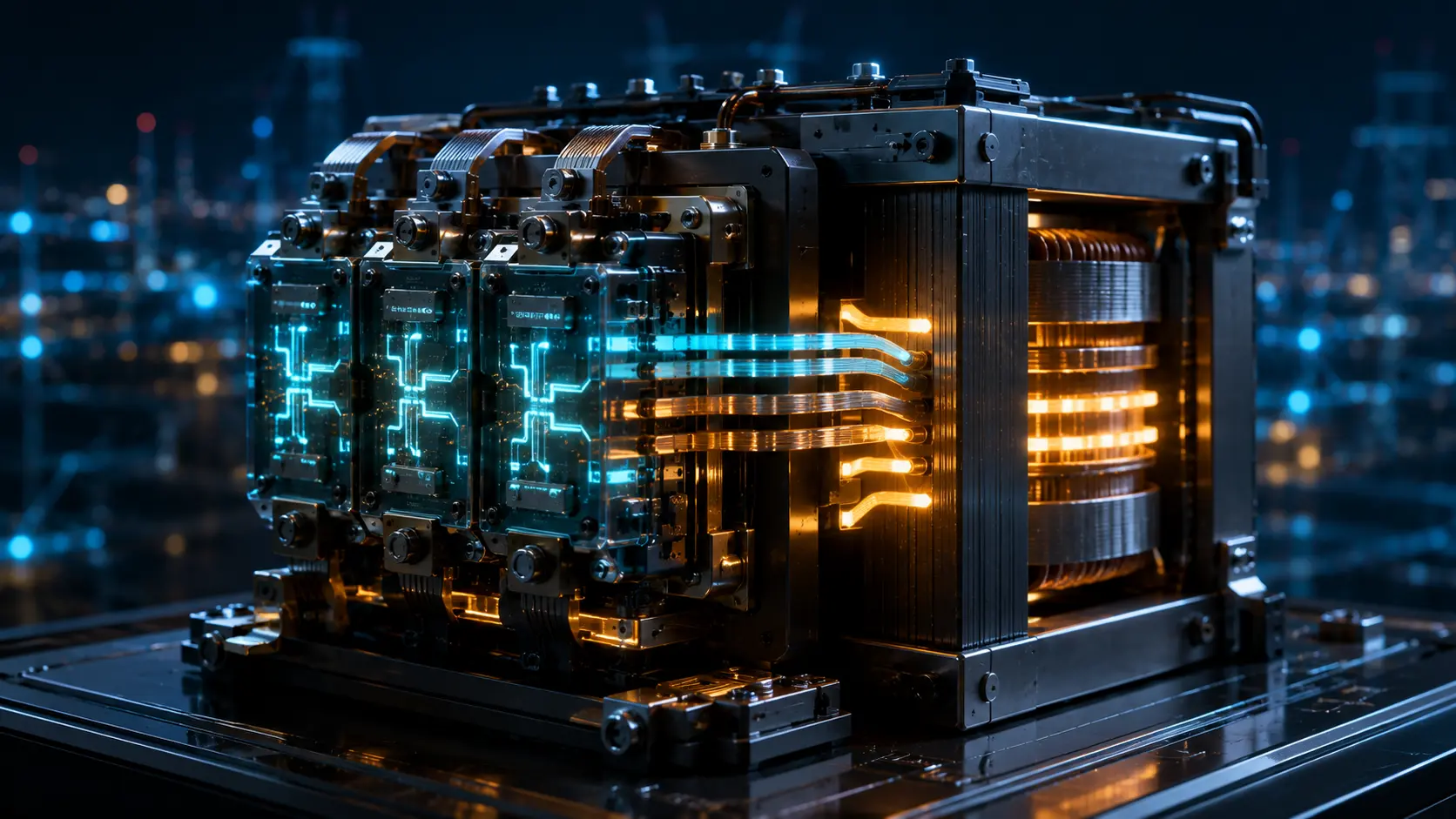

Intelligence & Data Confidence Assessment
In accordance with INDEX26 intelligence standards, the claims in this briefing are classified by evidence strength:
- Verified Evidence (High Confidence): The physical principles of high-frequency magnetic core reduction (up to 70% volume reduction). The electrical efficiency and thermal resilience of Silicon Carbide (SiC) MOSFETs over legacy Silicon IGBTs. The structural capability of SSTs to manage bi-directional power flow and provide reactive power compensation without external capacitor banks.
- Needs Validation (Moderate Uncertainty): Long-term operational lifespan. Traditional iron transformers have a proven 50-year field lifespan. SSTs contain thousands of complex, heat-generating electronic components; multi-decade empirical reliability in harsh weather environments requires further longitudinal validation.
- Data Unavailable (High Uncertainty): The exact timeline for cost-parity. While SiC wafer manufacturing is scaling, predicting the exact year an SST will reach upfront capital cost-parity with a simple, mass-produced residential pole-mounted iron transformer remains highly speculative.
At a Glance
- Concept: Utilizing high-frequency power electronics (like Silicon Carbide transistors) to step voltage up or down, while adding the ability to instantly control power flow and format (AC vs. DC).
- Why it matters: The electrical grid was built 100 years ago for one-way, Alternating Current (AC) power. Today, we are flooding it with Direct Current (DC) from solar panels, batteries, and electric vehicles. SSTs bridge this gap, acting as universal adapters that prevent the legacy grid from collapsing under new demands.
- Who uses it: Grid operators, EV fast-charging network developers, microgrid architects, and heavy rail/locomotive manufacturers.
- Biggest takeaway: An SST is not just smaller and lighter. Its true value lies in the “DC Link”—an internal direct-current bridge that allows solar panels and battery storage to plug directly into the transformer without needing separate, expensive inverters.
In Simple Words
A traditional electrical transformer is a blunt, physical tool. It is essentially two coils of copper wire wrapped around a heavy block of iron. If high-pressure electricity (high voltage) flows into one side, the physical ratio of the coils steps the pressure down to a safer level for your house. It is reliable, but it is “dumb.” It cannot stop a power surge, it cannot reverse the flow of electricity easily, and it only speaks one language: Alternating Current (AC).
A Solid-State Transformer (SST) replaces much of that heavy iron with computer chips—specifically, power transistors.
Instead of passively letting electricity flow through copper, the SST actively chops the electricity up, digitizes it, converts it to Direct Current (DC), speeds up its frequency, pushes it through a microscopic physical transformer, and reformats it perfectly on the other side.
If a traditional transformer is a basic plumbing funnel, an SST is a programmable, digital smart-valve. It can detect a grid anomaly in milliseconds, fix voltage drops, and seamlessly blend power from your rooftop solar panels, your electric car, and the main grid simultaneously.
Why This Matters
The global energy transition is colliding with the physical limits of 19th-century infrastructure.
To decarbonize the economy, we are electrifying everything. We are building massive hyperscale AI data centers, deploying millions of DC fast chargers for electric vehicles, and connecting gigawatts of decentralized solar and wind power.
Traditional transformers are massive, heavy, and require hundreds of gallons of mineral oil to stay cool. They are currently facing a devastating global supply chain shortage, with lead times for large power transformers stretching beyond three years.
Furthermore, traditional transformers cannot manage the chaotic, bi-directional flow of modern energy. When a neighborhood of solar panels suddenly injects power back into the grid at noon, it causes voltage spikes that traditional transformers cannot smooth out. Solid-State Transformers solve this. By using semiconductors to buffer and route the electricity, SSTs stabilize the grid, isolate faults instantly to prevent blackouts, and drastically shrink the physical footprint required for electrical substations.
The Big Picture
The evolution of the transformer is an exercise in materials science, driven by the need to manipulate frequency.
The size of a magnetic transformer core is inversely proportional to the frequency of the electricity passing through it. The global power grid operates at a very low frequency: 50 or 60 Hertz (Hz). Because the frequency is so low, the iron core required to transfer the magnetic energy without saturating must be huge and incredibly heavy.
For decades, engineers knew that if they could increase the frequency to 10,000 Hz (10 kHz) or higher, they could shrink a 10,000-pound transformer down to the size of a suitcase. However, traditional silicon computer chips would melt if you tried to push grid-level voltages through them at those speeds.
The breakthrough of the 2020s was the commercial maturation of Wide-Bandgap (WBG) semiconductors, specifically Silicon Carbide (SiC). SiC transistors can switch thousands of volts on and off tens of thousands of times per second without overheating. This material breakthrough officially moved the SST from a theoretical university whitepaper into a deployable industrial product.
How It Works
Replacing static copper with active silicon requires a complex, multi-stage electronic choreography.
1. The Fundamental Problem: Low Frequency and AC/DC Friction
The legacy grid operates on low-frequency AC. Modern technology (batteries, solar, electronics) operates natively on DC. Historically, connecting a DC solar farm to the AC grid required a massive, low-frequency transformer to step up the voltage, paired with a massive, separate inverter to change the DC to AC. This dual-hardware setup wastes energy, occupies vast amounts of physical real estate, and introduces multiple points of failure.
2. The Insufficiency of Basic Inverters
Standard power inverters can change DC to AC, but they do not provide galvanic isolation. Galvanic isolation means there is a physical break in the electrical circuit, ensuring a massive lightning strike on the grid cannot instantly travel down the wire and electrocute a user or fry a connected EV battery. Isolation requires a magnetic field—which means you still need a physical transformer.
3. The Core Mechanism: The Three-Stage AC/DC/AC Topology
The modern SST solves this using a high-frequency, three-stage architecture:
- Stage 1 (AC to DC Rectification): The high-voltage 60 Hz AC power from the grid enters the SST. Power transistors immediately rectify (convert) it into a smooth, high-voltage DC pool.
- Stage 2 (High-Frequency DC-to-DC Conversion): This is the magic step. The DC power is chopped up into incredibly fast AC (e.g., 20,000 Hz). This high-frequency AC is pushed through a microscopic physical transformer (providing the crucial galvanic isolation). On the other side, it is converted back to low-voltage DC.
- Stage 3 (DC to AC Inversion): The low-voltage DC is then converted back into whatever specific AC frequency and voltage the end-user requires (or kept as DC for native EV charging).
4. Technical Depth: Silicon Carbide (SiC) MOSFETs
Switching electricity on and off at 20,000 Hz generates immense thermal and switching losses. Traditional silicon IGBTs (Insulated-Gate Bipolar Transistors) cannot survive this. SSTs rely entirely on Silicon Carbide (SiC) MOSFETs. SiC has a wider “bandgap,” meaning electrons require more energy to jump the gap. This allows the chip to operate at vastly higher voltages, switch significantly faster, and bleed far less energy as heat, unlocking the high-frequency requirements of Stage 2.
5. Real-World Consequences: The DC Link and Reactive Power
Because Stage 1 and Stage 2 create an intermediate “pool” of DC power inside the machine (known as the DC Link), engineers can physically plug DC devices (like solar panels or battery storage) directly into the center of the SST. Furthermore, because the SST uses digital transistors to output the final AC waveform, it can artificially adjust the phase of the voltage and current. This is called Reactive Power Compensation. If the local grid’s voltage starts sagging, the SST can artificially prop it up, acting as an instant grid-stabilizer without needing external capacitor banks.
Real-World Applications
SSTs are currently deployed where weight, space, and power control are more critical than upfront hardware costs.
Megawatt EV Charging Hubs: Charging a fleet of electric semi-trucks requires multi-megawatt power draws. A traditional AC transformer and separate DC rectifiers for an 8-stall truck depot require the physical footprint of a small house. By using an SST, developers can plug the DC truck chargers directly into the SST’s internal DC link. This shrinks the substation footprint by 50% and dramatically reduces the energy lost during conversion, making urban fleet electrification physically possible in space-constrained cities.
Locomotives and Rail: Electric trains draw power from high-voltage overhead lines. Historically, trains had to carry massive, incredibly heavy iron transformers onboard to step the voltage down for the motors. By swapping iron for SSTs, train manufacturers shave tons of weight off the locomotive, drastically increasing energy efficiency, acceleration, and payload capacity.
Renewable Microgrids: When a hospital or military base wants to operate independently of the main grid (a microgrid), they rely on solar and batteries. An SST serves as the “brain” connecting the microgrid to the main utility. If the main grid fails, the SST detects the drop in milliseconds and severs the connection, smoothly running the hospital off the integrated battery’s DC link without a flicker of power loss.
Economic & Strategic Impact
The transition from traditional transformers to SSTs represents a massive value shift in the industrial supply chain.
Traditional transformer manufacturing is a heavy-industry business reliant on global supplies of electrical steel, copper, and mineral oil. It is a slow, capital-intensive process currently suffering from acute geopolitical supply chain bottlenecks.
SSTs shift this value to the semiconductor industry. The cost and performance of an SST are strictly dictated by the yield and fabrication of Silicon Carbide wafers. This aligns grid infrastructure with Moore’s Law. As SiC manufacturing scales up (driven largely by the EV industry), the cost of the power electronics inside the SST drops predictably. Strategically, nations that control advanced SiC foundries (like Wolfspeed in the U.S., or Infineon and STMicroelectronics in Europe) will ultimately control the hardware supply chain for the 21st-century smart grid.
Advantages
- Extreme Size and Weight Reduction: Operating at high frequencies shrinks the physical magnetic core, reducing the weight and volume of the transformer by up to 70%.
- Bi-Directional Power Flow: Seamlessly manages power flowing from the grid to a house, or from a house’s solar panels back to the grid.
- Built-in Fault Isolation: If a short circuit occurs, the SST’s transistors can shut off the power flow in microseconds, preventing cascading blackouts and eliminating the need for bulky external circuit breakers.
- Direct DC Integration: The internal “DC Link” acts as a universal adapter, allowing native integration of solar, wind, and battery storage without redundant inverters.
Limitations
- High Capital Cost: SiC power semiconductors are incredibly expensive. An SST currently costs significantly more upfront than a traditional copper-and-iron transformer of the same power rating.
- Reliability and Lifespan: A dumb iron transformer can sit on a telephone pole for 50 years with almost zero maintenance. SSTs contain thousands of complex, heat-generating electronic components that are theoretically more prone to failure over a multi-decade lifespan in harsh weather.
- Efficiency Trade-offs: While SSTs save energy by combining the inverter and transformer steps into one box, the raw efficiency of the transformer stage itself (often 96-98%) is still slightly lower than a top-tier traditional iron transformer (which can hit 99.5%).
Common Misconceptions
Misconception: A Solid-State Transformer is 100% digital and has no moving parts or coils. Reality: The name is slightly misleading. While it uses solid-state transistors for switching, every true SST still contains a physical, magnetic transformer coil inside it to provide galvanic isolation. It is just a high-frequency transformer, making it exponentially smaller than a traditional one.
Misconception: SSTs will replace all telephone pole transformers tomorrow. Reality: Due to cost and reliability requirements, SSTs will not immediately replace the millions of simple distribution transformers hanging on residential utility poles. They are being deployed strategically at the “edges” of the grid—data centers, EV charging hubs, and solar farms—where their advanced routing capabilities justify the premium price.
Misconception: SSTs only handle Direct Current (DC). Reality: SSTs are the ultimate translators. They can take AC in and output DC; take DC in and output AC; or take AC in, clean up the voltage, and output perfect AC.
What Most People Miss
The most profound impact of the SST is its ability to eliminate voltage cascading through Reactive Power injection.
In a traditional grid, if a massive factory turns on heavy machinery, the voltage in the surrounding neighborhood drops. Traditional transformers can do nothing to stop this; they simply pass the degraded voltage down the line. An SST actively monitors the waveform. If it detects a voltage drop, its transistors can artificially inject “reactive power” to prop the voltage back up to a perfect 120V or 240V before it reaches the consumer. The SST essentially acts as an active noise-canceling headphone for the electrical grid, filtering out all upstream disturbances.
Comparison Table
| Feature | Traditional Iron Transformer | Solid-State Transformer (SST) |
|---|---|---|
| Core Material | Copper coils and heavy laminated electrical steel. | Silicon Carbide (SiC) semiconductors and small magnetic cores. |
| Operating Frequency | Low (50 / 60 Hz). | High (10,000 Hz to 100,000+ Hz). |
| Size & Weight | Massive, heavy, requires large concrete pads. | Compact, lightweight (up to 70% smaller). |
| Power Flow | Passive (electricity flows blindly). | Active (digitally routed and controlled). |
| DC Integration | Impossible (Requires separate external inverters). | Native (Direct connection via internal DC Link). |
| Cost & Reliability | Very low cost, 50+ year lifespan. | High initial cost, unproven multi-decade longevity. |
Case Study
Situation: A major logistics company sought to electrify its entire fleet of delivery trucks at a dense urban depot in California. Charging 50 electric trucks simultaneously required a 15-megawatt power draw.
Challenge: The local utility grid was severely congested. Upgrading the traditional substation to handle a 15-megawatt AC load would require expanding the physical footprint of the depot beyond property lines, and waiting three years for the delivery of massive, custom-built step-down transformers.
Solution (The SST Deployment): The developer bypassed the traditional AC substation design. They deployed an array of Solid-State Transformers connected to a centralized battery energy storage system (BESS). The SSTs took high-voltage AC from the grid, converted it internally, and used their “DC Link” to connect both the batteries and the truck fast-chargers natively on a shared DC microgrid.
Outcome: The physical footprint of the electrical infrastructure was reduced by 60%, allowing the charging hardware to fit within the existing urban real estate. Because the SSTs actively managed the power draw—pulling from the batteries during peak hours and perfectly stabilizing the grid draw—the utility approved the interconnection two years faster than a traditional AC upgrade would have allowed.
Lessons Learned: SSTs transition grid infrastructure from a real-estate problem to a software-and-silicon solution. By natively bridging the gap between grid AC and vehicle DC, SSTs make high-density, megawatt-scale electrification feasible in areas where traditional copper-and-iron infrastructure physically cannot fit.
Future Outlook
Next 12–24 Months
The industry will focus heavily on standardization and cost-reduction for EV charging infrastructure. As the NEVI (National Electric Vehicle Infrastructure) formula program rolls out across the U.S., high-power (350kW+) charging stations will increasingly turn to medium-voltage SST architectures to bypass utility upgrade delays. Look for major partnerships between semiconductor foundries (like Wolfspeed) and heavy electrical equipment manufacturers (like Eaton, Siemens, and Hitachi) to scale SiC module production.
Next 3–5 Years
SSTs will become the baseline architecture for hyperscale AI Data Centers. Data centers require perfectly clean, highly reliable power. Currently, they use massive Uninterruptible Power Supply (UPS) rooms filled with batteries and inverters to clean the grid power. SSTs will merge the substation and the UPS into a single, unified perimeter device. The SST will step down the grid voltage while its DC link natively charges the backup batteries, saving data center operators millions in capital expenditure and reclaiming valuable floor space for more GPU server racks.
Next 10 Years
We will witness the rise of the “Solid-State Substation.” As SiC costs plummet and 10+ year reliability is empirically proven in the field, utilities will begin retrofitting aging neighborhood substations with SSTs. These solid-state substations will autonomously manage the chaotic, bi-directional power flows of millions of residential solar panels and vehicle-to-grid (V2G) systems. The grid will transition from a top-down, central-command structure into a decentralized, internet-like network of autonomous routing nodes.
Most Likely Scenario
SSTs will follow the exact same adoption curve as LED lightbulbs. Initially, they will be vastly more expensive than traditional alternatives and relegated to niche applications where their unique properties (size, weight, digital control) justify the premium. However, as the global manufacturing capacity for Silicon Carbide expands, the cost curve will cross over. By the mid-2030s, the operational benefits of active grid stabilization and native DC integration will render the 100-year-old traditional iron transformer obsolete for any new major infrastructure project.
Key Takeaways
- Solid-State Transformers (SSTs) replace massive iron cores with high-frequency Silicon Carbide (SiC) semiconductors, drastically reducing the physical size and weight of grid infrastructure.
- Traditional transformers are passive and only handle Alternating Current (AC). SSTs actively chop and digitize the power, natively bridging the gap between the AC grid and DC technologies (solar, batteries, EVs).
- The internal “DC Link” of an SST allows developers to plug DC fast chargers or battery banks directly into the transformer, bypassing the need for expensive, redundant external inverters.
- SSTs act as grid stabilizers. They can instantly isolate faults to prevent blackouts and inject “reactive power” to fix voltage sags before they reach the consumer.
- While they offer unprecedented control, SSTs are currently constrained by the high cost of SiC chips and the unproven 50-year longevity compared to a simple, durable iron transformer.
- The primary adoption vector for SSTs is the electrification of heavy transport and AI data centers, where physical space is limited and power control requirements are extreme.
Glossary
DC Link: The intermediate stage inside an SST where power is held as Direct Current before being inverted back to AC. It acts as a universal plug-in point for DC devices like batteries and solar panels.
Galvanic Isolation: A design principle in electrical systems where two circuits communicate (usually via a magnetic field) but have no direct, physical wire connection. It prevents high-voltage grid spikes from crossing over and destroying low-voltage consumer electronics.
IGBT (Insulated-Gate Bipolar Transistor): A legacy type of power semiconductor. While useful, it struggles to operate at the extreme high frequencies required to miniaturize an SST efficiently.
Reactive Power: A type of power that oscillates back and forth in an AC grid. While it doesn’t do “real” work (like turning a motor), injecting or absorbing reactive power is physically necessary to maintain a stable 120V/240V level across the grid.
Silicon Carbide (SiC): A wide-bandgap semiconductor material. It is significantly harder and more thermally resilient than standard silicon, allowing it to switch thousands of volts at high frequencies without melting.
Solid-State Transformer (SST): An electrical device that uses power electronics (semiconductors) to step voltage up or down, while providing active control over power flow, frequency, and AC/DC conversion.
Frequently Asked Questions
If an SST is so much smaller, why don’t we use them on every telephone pole? Cost and durability. A traditional pole-mounted transformer costs a few thousand dollars and lasts 50 years in the rain and snow with zero maintenance. An SST is essentially a highly complex, expensive computer. Until the price of SiC chips drops drastically and the weather-resilience is proven, utilities will not replace cheap iron with expensive silicon for basic residential delivery.
Do SSTs eliminate the need for inverters? Yes, in specific architectures. If you use an SST, the inverter logic is built directly into the machine’s third stage. You do not need to buy a separate, standalone inverter to convert your solar panel’s DC power into grid-ready AC power.
How does an SST help with Electric Vehicles (EVs)? A Level 3 DC Fast Charger requires massive amounts of power. If you install 20 chargers at a gas station, the local grid will overload. An SST can connect to the medium-voltage grid lines, step the power down, convert it to DC, and feed all 20 chargers efficiently while actively managing the current draw so it doesn’t blow the local substation.
Are SSTs fully digital? No. They are highly digitized, but the actual transfer of power from the high-voltage side to the low-voltage side still relies on a physical magnetic transformer. The key is that because the SST speeds the electricity up to 20,000 Hz, that physical transformer only needs to be the size of a shoebox instead of the size of a car.
What happens to an SST if it gets struck by lightning? Just like traditional transformers, SSTs are shielded by external surge arresters. However, if a massive surge makes it through, the SST’s digital transistors can detect the anomaly and physically shut down the circuit in microseconds—vastly faster than a mechanical circuit breaker—protecting downstream equipment.
Sources
- IEEE Power and Energy Technology Systems Journal: Solid-State Transformers: Concepts, Applications, and Future Prospects
- U.S. Department of Energy (DOE) / NREL: Advanced Power Electronics and Solid-State Transformer Development
- Wolfspeed: Silicon Carbide (SiC) Applications in Medium Voltage Grid Infrastructure (2025/2026)
- Hitachi Energy: The Role of Solid-State Transformers in Microgrids and EV Fast Charging