Advertisement
)

AT A GLANCE
- Concept: The Lanthanide Contraction: Adjacent rare earth elements share identical electron configurations but possess microscopically different ionic radii.
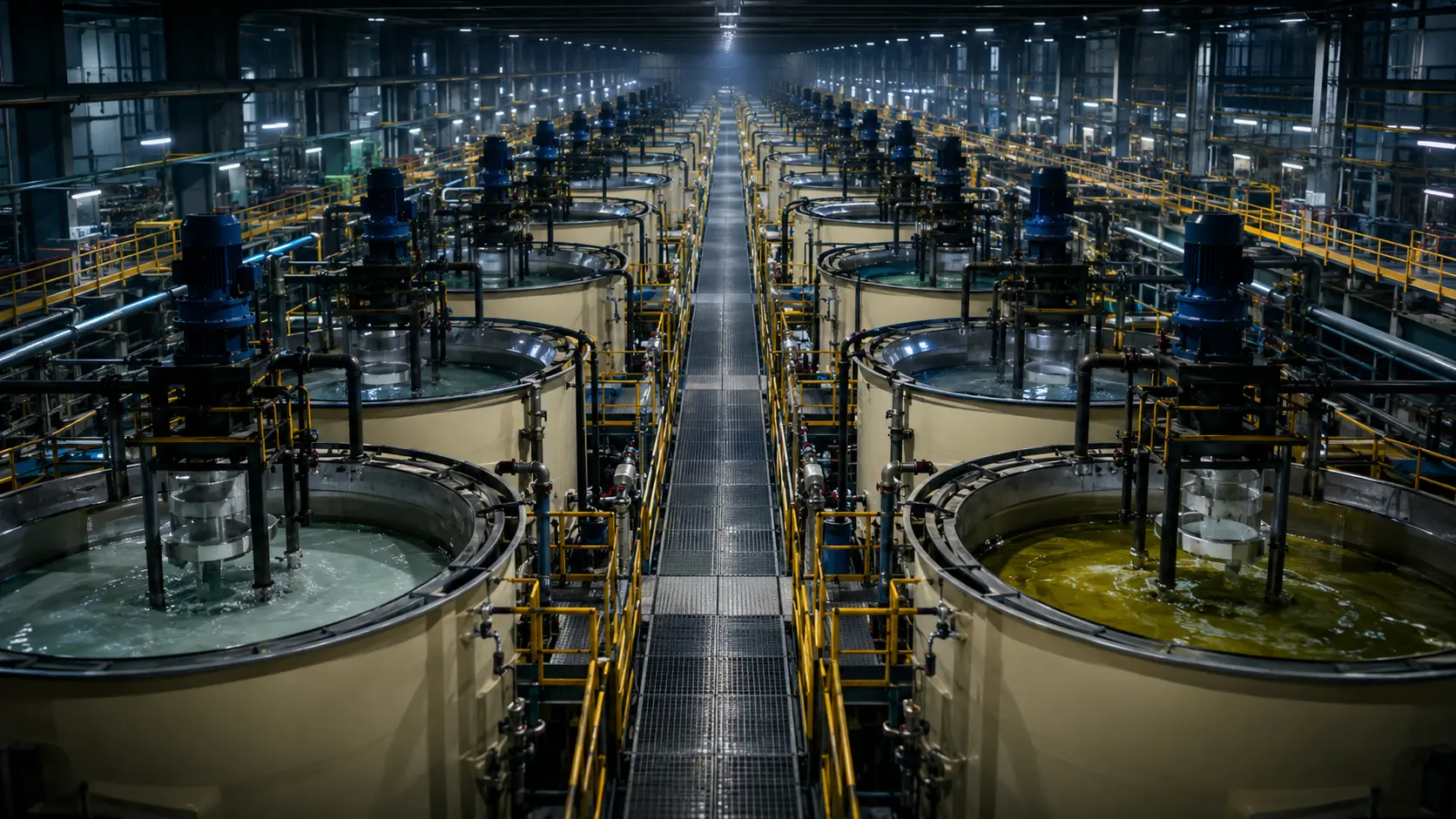
- Concept: Mixer-Settler Tanks: Industrial vats that violently agitate water and oil together before allowing them to naturally separate.
- Concept: Counter-Current Flow: The acidic water moves left while the organic solvent moves right, compounding purification across stages.
- Concept: Separation Factor: The tiny mathematical preference an organic solvent shows for one specific element over its neighbor.
HOW A SOLVENT EXTRACTION CASCADE WORKS
Rare earth elements do not exist in isolation. When mining companies pull ore from the ground, they extract a fused block of seventeen elements that share nearly identical chemical properties.
Separating Neodymium from Dysprosium is mathematically akin to separating salt from sugar using only water. Because their outer electron shells are identical, standard metallurgical smelting simply melts them into a useless, unrefined alloy.
Hydrometallurgy solves this through solvent extraction. Engineers dissolve the raw rare earth rock into a highly acidic aqueous solution. They then introduce a specialized organic solvent, typically an organophosphorus compound, into the liquid mix.
The separation relies entirely on the lanthanide contraction—the physical reality that heavier rare earths possess slightly smaller atomic radii. The organic solvent chemically prefers to bind with the smaller radius of Dysprosium over the slightly larger Neodymium.
This chemical preference, known as the separation factor β, is extraordinarily weak, often hovering near beta = 1.5 (or β = 1.5) A single mixing event only purifies the solution by a fraction of a percent.
To achieve the 99.99 percent purity required for military and aerospace magnets, engineers string together hundreds of mixer-settler tanks. The acidic water flows in one direction, while the organic solvent flows in the exact opposite direction in a continuous counter-current cascade, violently mixing and settling until the specific elements isolate completely at opposite ends of the factory.
WHY IT MATTERS NOW
The global energy transition runs entirely on high-performance permanent magnets. Electric vehicle motors, offshore wind turbines, and guided missile actuators require precise alloys of Neodymium, Praseodymium, and Dysprosium to function at extreme temperatures without losing their magnetic fields.
Western nations dominate the design and deployment of these final products, but they completely lack the mid-stream chemical infrastructure required to build them. Mining rare earth ore in California or Australia is strategically useless if the raw dirt must be shipped across the Pacific for chemical separation.
China currently commands over eighty-five percent of global solvent extraction capacity. This monopoly is not based on access to raw minerals, but entirely on the mastery of hydrometallurgical processing at an industrial scale.
Replicating a heavy lanthanide cascade requires massive capital expenditure and a willingness to handle millions of gallons of highly toxic, radioactive wastewater. A standard facility requires up to 1,500 distinct mixer-settler stages calibrated to perfect chemical equilibrium.
Western governments are currently subsidizing heavy rare earth separation facilities in Texas and Western Australia. These geopolitical investments explicitly aim to break the solvent extraction monopoly, establishing localized, closed-loop supply chains for critical defense assets before a geopolitical embargo cuts off access to refined powders.
WHAT MOST PEOPLE MISS
Policymakers frequently assume that a rare earth refinery is a standard chemical plant that can be turned on and off based on market demand. They entirely miss the brutal kinetic reality of the extraction cascade.
A multi-stage cascade operates in a state of continuous dynamic equilibrium. If a technician improperly adjusts the pH level in tank 40, it triggers a cascading chemical distortion that impacts the purity of tank 400 several days later. Shutting the system down forces the organic and aqueous layers to mix incorrectly, requiring months of continuous, unprofitable operation to re-establish the precise purity gradient across the entire factory line.
THE TRAJECTORY
Next 12–36 Months: Western defense contractors will aggressively finance boutique solvent extraction facilities dedicated exclusively to Dysprosium and Terbium. These micro-refineries will guarantee a secure, albeit highly expensive, supply of heavy lanthanides strictly for military aerospace applications.
Next Five Years: The commercialization of continuous ion exchange chromatography. Chemical engineering startups will deploy resin-based separation columns that physically replace the massive physical footprint of mixer-settler tanks, drastically reducing the total volume of toxic organic solvents required per ton of output.
Next Ten Years: The integration of biological ligand extraction. Material scientists will engineer synthetic proteins that bind exclusively to specific rare earth atomic radii with a separation factor far exceeding legacy petrochemical solvents. This biological sorting will eliminate the need for hundreds of sequential stages, shrinking the separation process to a single automated vat.
What Could Go Wrong: Catastrophic organic solvent fires. The extraction process requires millions of gallons of highly flammable kerosene to dilute the chemical extractants. A localized spark inside a tightly packed mixer-settler facility can instantly vaporize the entire chemical inventory, destroying the factory and dispersing highly acidic, radioactive heavy metals into the local atmosphere.
Most Likely Outcome: Solvent extraction will remain the absolute dominant industrial method for rare earth separation through the next decade. The sheer capital efficiency of legacy mixer-settler architecture will continue to outcompete advanced alternatives, ensuring that whoever operates the largest chemical cascades controls the global permanent magnet supply chain.
KEY TERMS
- Hydrometallurgy: The specialized field of extractive metallurgy that utilizes highly acidic aqueous chemistry to recover metals from raw ores and concentrates.
- Lanthanide Contraction: The steady decrease in the physical size of atoms and ions across the rare earth series, dictating how chemical solvents interact with adjacent elements.
- Counter-Current Flow: An industrial processing technique where two immiscible liquids travel in opposite directions to maximize the transfer of a specific substance between them.
- Mixer-Settler: A physical tank mechanism that rapidly stirs two incompatible liquids together to exchange ions before letting them rest and separate into distinct layers based on density.
- Separation Factor: A mathematical ratio defining exactly how much a specific chemical solvent prefers to bind with one element over another during a single mixing stage.
SOURCES
- Department of Energy (DOE) — Critical Materials Strategy and Rare Earth Separation Technologies
- Institute of Electrical and Electronics Engineers (IEEE) — The Geopolitics of Permanent Magnets and Heavy Lanthanide Processing
- Journal of Hydrometallurgy — Solvent Extraction Dynamics of Neodymium and Dysprosium in Multi-Stage Cascades
- International Energy Agency (IEA) — The Role of Critical Minerals in Clean Energy Transitions