Advertisement
)

AT A GLANCE
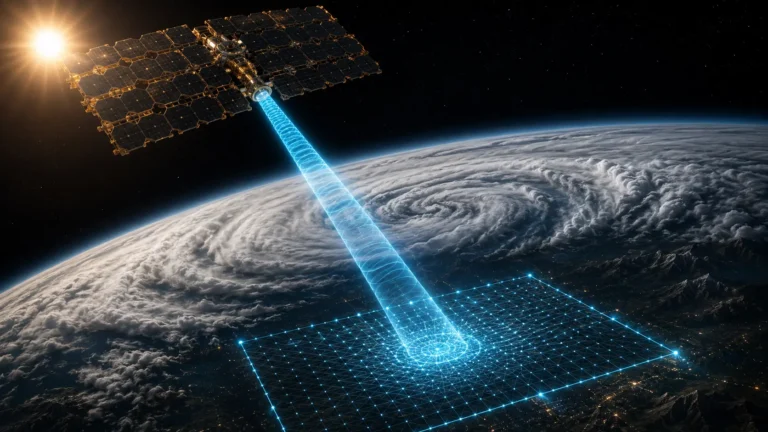
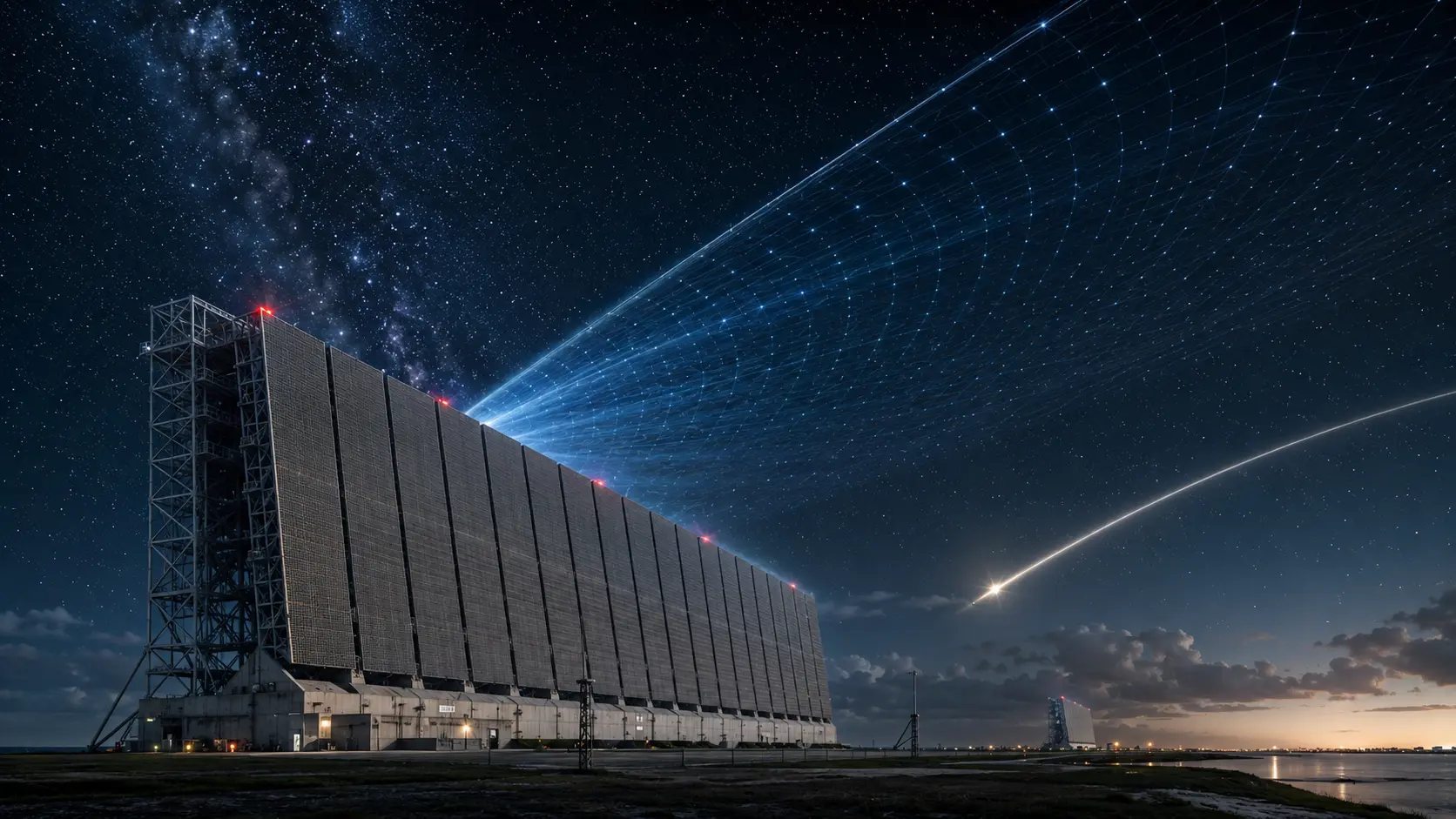
- Concept: The Orbital Net: The system continuously blasts a wide, unbroken fan of radio frequency energy vertically into space; objects are detected the millisecond they fly through it.
- Concept: Digital Beamforming: The radar uses software to mathematically divide its massive energy output into thousands of independent, highly focused tracking beams.
- Concept: Bistatic Architecture: The system physically separates the massive transmitter and the receiver, neutralizing adversarial attempts to home in on a single radar emission point.
- Concept: Un-Cued Discovery: The radar does not need to know where an object is to find it; it automatically detects, categorizes, and tracks completely unknown debris and classified satellites in real-time.
HOW IT WORKS
Tracking objects in orbit using traditional parabolic dish radar is mathematically inefficient. A dish must physically point at a specific coordinate and scan mechanically. If you do not know a satellite is there, the dish will likely never find it. The United States Space Force required a system capable of “un-cued discovery”—finding objects no one knew existed.
The Space Fence, constructed by Lockheed Martin on the Kwajalein Atoll in the Marshall Islands, solves this using an S-band phased array architecture. It abandons moving dishes entirely. The system consists of thousands of fixed, solid-state Transmit/Receive Modules (TRMs) arrayed across massive flat concrete structures.
Instead of scanning, the transmitter fires a continuous, highly energized “fence” of electromagnetic radiation directly upward, spanning from east to west. Any object in low Earth orbit (LEO)—whether a functional Chinese spy satellite or a stray titanium bolt—must eventually fly through this invisible wall. The moment an object crosses the boundary, the radar energy reflects back to the Earth.
The returning energy is captured by a separate, physically distinct receiver array (a bistatic configuration). The magic of the Space Fence lies in its back-end processing. Using digital beamforming, the system’s supercomputers mathematically isolate the exact phase and timing of the returning signals across thousands of individual receiving antennas.
This interferometry allows the software to instantly calculate the precise velocity, altitude, and trajectory of the object. If the system detects a novel object, it immediately spawns a highly focused, localized “micro-beam” to track the object as it exits the primary fence, generating a highly accurate orbital state vector that is instantly uploaded to the master military space catalog.
WHY IT MATTERS NOW
Orbit is transitioning from a pristine scientific sanctuary into an actively contested warfighting domain. The ability to project terrestrial power now relies entirely on the survival of military satellite constellations providing GPS, secure communications, and missile warning telemetry.
The primary threat to these constellations is not just other satellites, but kinetic debris. A fleck of paint traveling at 17,500 miles per hour hits with the kinetic energy of a rifle bullet. A collision with a ten-centimeter piece of aluminum will instantly vaporize a billion-dollar military asset. The Space Fence exponentially increases the resolution of orbital tracking, dropping the detection limit from objects the size of a basketball down to objects the size of a marble.
This resolution upgrade is the foundation of Space Domain Awareness (SDA). The Space Fence allows the military to mathematically predict conjunctions (collisions) days in advance, providing commanders enough time to execute limited Delta-v burns to move their satellites out of the debris path.
More critically, this high-resolution tracking is a prerequisite for counter-space interdiction. Adversaries are actively deploying “inspector” satellites—highly maneuverable orbital vehicles designed to quietly creep up to classified US satellites to intercept communications or physically disable them. Because the Space Fence detects un-cued maneuvers instantly, it strips away the cloak of orbital darkness. If a Russian or Chinese satellite executes a clandestine engine burn over the Southern Hemisphere, the Space Fence will immediately flag the trajectory change the moment it crosses the Kwajalein Atoll, exposing the hostile action in near real-time.
WHAT MOST PEOPLE MISS
Public relations materials frequently frame the Space Fence as an ecological tool for preventing the Kessler Syndrome—the runaway cascade of orbital debris. They completely miss the reality that the bistatic architecture is expressly designed for survivability against electronic warfare and anti-radiation missiles.
In a conventional radar setup, the transmitter and receiver share the same physical location. In a major conflict, an adversary can easily program a missile to follow the massive radio emission directly back to the source, destroying the radar. By physically separating the Space Fence transmitter and receiver by miles, the US Space Force created a bistatic geometric offset. The receiver operates in total electromagnetic silence. Even if an adversary successfully jams or strikes the massive, noisy transmitter building, they are blind to the location of the receiver, and the military retains the capability to track the incoming threat using secondary, distributed transmitters.
THE TRAJECTORY
Next 12–36 Months: The Space Force will activate a second, geographically dispersed Space Fence site in Western Australia. This second node will mathematically close the remaining blind spots in low Earth orbit, ensuring that no satellite can execute a clandestine maneuver without passing through at least one detection net within a 90-minute orbital period.
Next Five Years: The integration of continuous, machine-learning track correlation. Currently, tracking a tumbling, fragmented piece of debris across multiple radar passes requires heavy human analysis. AI algorithms will begin autonomously connecting the dots, maintaining continuous, unbroken custody of hundreds of thousands of erratic objects without human intervention.
Next Ten Years: Space Fence architecture will transition from terrestrial concrete arrays to space-based interferometer nets. The military will deploy constellations of radar-equipped satellites that look down from medium Earth orbit (MEO). This will completely bypass atmospheric distortion and the geographic limitations of island-based radars, providing persistent, spherical surveillance of the entire orbital domain.
What Could Go Wrong: The extreme sensitivity of the S-band receiver array is highly vulnerable to localized electromagnetic interference. If commercial 5G telecommunications networks or high-power commercial satellite uplinks bleed into the specific frequency bands reserved for the Space Fence, the receiver array will suffer severe mathematical noise. This would blind the system to the smallest, most dangerous pieces of micro-debris, severely degrading the integrity of the military’s collision warning algorithms.
Most Likely Outcome: The Space Fence will function as the absolute master ledger of physical reality in orbit. Access to its high-resolution tracking data will become a primary geopolitical currency, traded to allied nations and commercial satellite operators in exchange for strategic alignment and orbital right-of-way.
KEY TERMS
- Phased Array: A radar antenna composed of thousands of individual elements that steer radio beams mathematically by altering the phase of the signal, rather than physically moving a dish.
- Digital Beamforming: The algorithmic processing of raw radar signals to mathematically synthesize multiple, highly focused tracking beams simultaneously from a single physical antenna array.
- Bistatic Radar: A radar architecture where the transmitter and the receiver are physically separated by a significant geographic distance, heavily complicating adversarial electronic warfare.
- Space Domain Awareness (SDA): The continuous, comprehensive tracking and characterization of all physical objects, maneuvers, and environmental threats occurring in Earth’s orbit.
- Un-Cued Discovery: The ability of a radar system to detect, track, and catalog an object without receiving any prior tip-off regarding the object’s location or trajectory.
SOURCES
- United States Space Force (USSF) — Space Domain Awareness Architecture and Orbital Tracking Capabilities
- Lockheed Martin — Space Fence S-Band Phased Array Radar System Specifications
- IEEE Aerospace and Electronic Systems Magazine — Digital Beamforming and Interferometry in Deep Space Radar Tracking
- Department of Defense (DoD) — Space Debris Mitigation and Kinetic Interdiction Strategy