Advertisement
)

AT A GLANCE
- Concept: Closed-Loop Architecture: The computer constantly measures physical outputs to instantly correct its own fuel inputs.
- Concept: Absolute Authority: Pilots cannot manually override the system to push engines past physical thermodynamic limits.
- Concept: Redundant Channels: Dual independent processing lanes ensure catastrophic hardware failures do not cause engine shutdowns.
- Concept: Thrust Specific Fuel Consumption: Micro-optimizing fuel flow drastically reduces the absolute baseline cost of global commercial aviation.
HOW IT WORKS
Jet engine combustion is a chaotic, high-pressure thermodynamic reaction. The exact volume of fuel required changes every millisecond based on outside air temperature, atmospheric density, compressor rotation speed, and pilot thrust demand.
Historically, pilots manipulated complex hydromechanical cables to meter fuel mechanically. Today, they push an electronic throttle lever that sends a simple digital request to the Full Authority Digital Engine Control (FADEC).
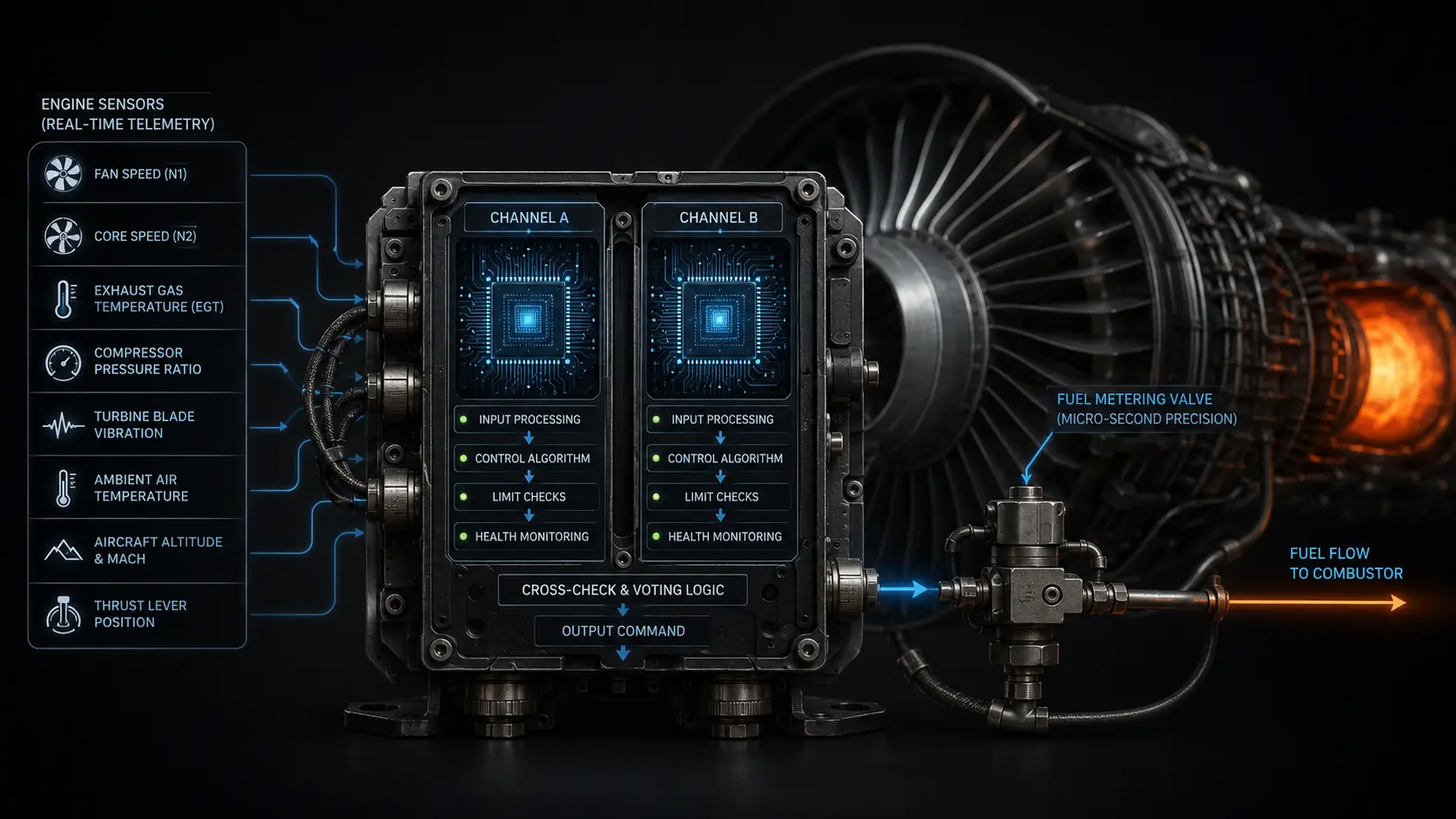
The FADEC is a ruggedized computer bolted directly to the fan casing of the turbofan engine. It receives the pilot’s thrust request and immediately calculates the exact fluid dynamics required to achieve it safely.
The system executes this calculation using a strict closed-loop feedback architecture. It gathers real-time physical data from dozens of sensors measuring exhaust gas temperature, turbine blade vibration, and internal compressor pressure.
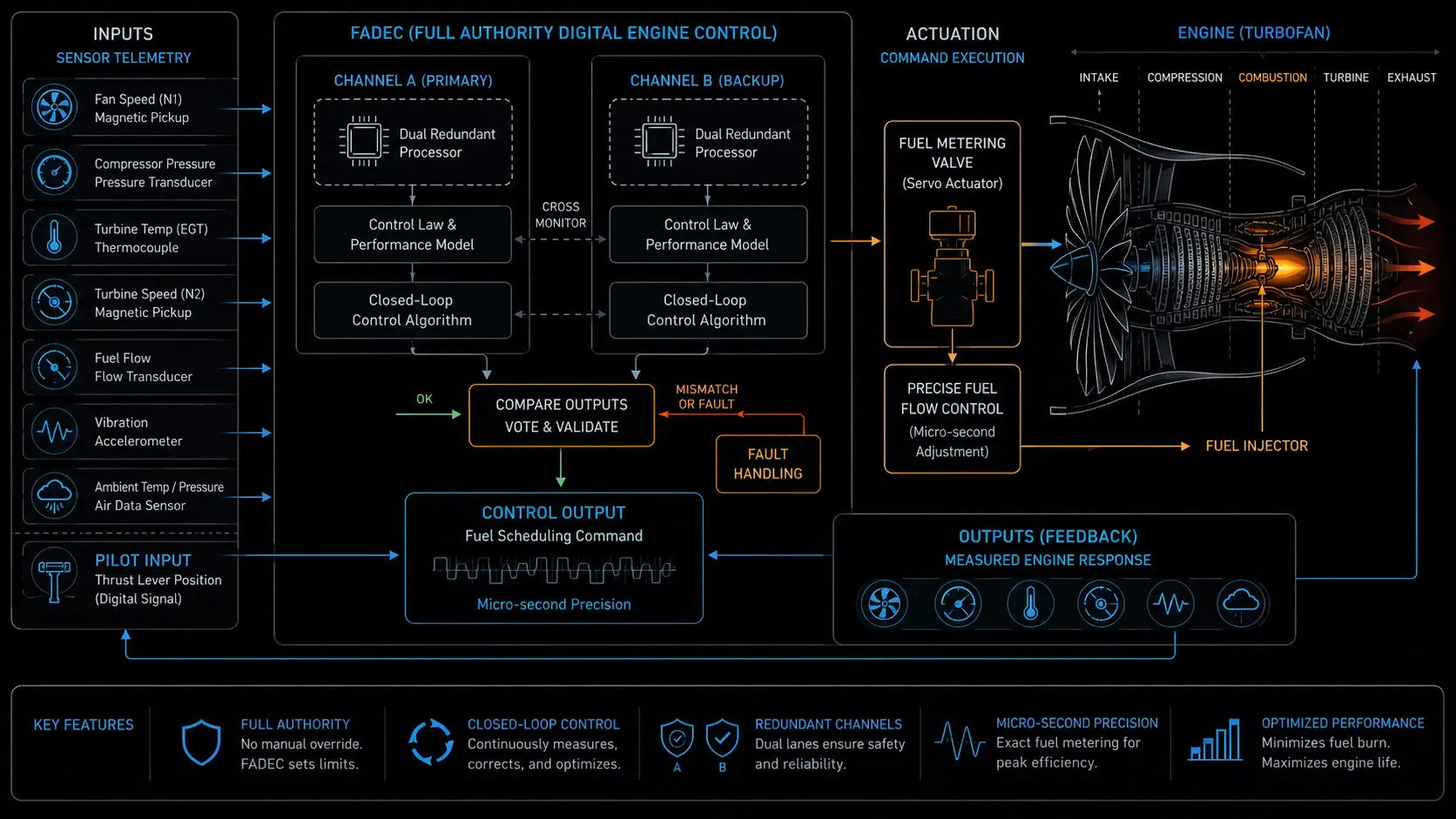
Based on these telemetry inputs, the algorithm operates the fuel metering valve with extreme micro-second precision. It injects the absolute minimum volume of Jet-A kerosene required to maintain the desired thrust, mathematically ensuring the engine operates at peak thermodynamic efficiency.
WHY IT MATTERS NOW
Global airlines operate on exceptionally thin financial margins. Fuel consumption represents the single largest variable operating expense for any commercial aviation carrier.
Reducing Thrust Specific Fuel Consumption (TSFC)—the mathematical ratio of fuel burned to thrust produced—directly dictates an airline’s profitability. A one percent reduction in TSFC across a massive global fleet saves an airline hundreds of millions of dollars annually.
Engine manufacturers like GE Aerospace and Rolls-Royce do not simply sell metal hardware; they sell guaranteed fuel efficiency. The FADEC software acts as the primary mechanism delivering these contractual performance guarantees to the airlines.
By preventing engines from running hotter or faster than strictly necessary, the software extends the physical lifespan of the highly expensive turbine blades. This algorithmic restraint lengthens the time on wing, keeping aircraft generating revenue instead of sitting in maintenance hangars.
As geopolitical conflicts force carriers to fly longer, highly inefficient routes to avoid closed airspace, maximizing the caloric output of every drop of kerosene becomes an absolute financial necessity.
WHAT MOST PEOPLE MISS
Aviation enthusiasts often assume pilots maintain ultimate physical control over the aircraft engines during emergencies. They miss the defining characteristic of “Full Authority” architecture: the software completely removes the human from the physical control loop.
If a panicked pilot shoves the electronic throttle instantly to maximum power during a stall, the FADEC completely ignores the speed of the human input. The algorithm mathematically calculates the maximum safe acceleration rate to prevent a catastrophic compressor stall and meters the fuel accordingly, overriding human panic with strict thermodynamic physics.
THE TRAJECTORY
Next 12–36 Months: Engine manufacturers will integrate continuous 5G telemetry downlinks directly into the FADEC hardware. This constant data stream will allow ground crews to analyze microscopic combustion anomalies and order replacement parts hours before the aircraft lands.
Next Five Years: Advanced control algorithms will dynamically adjust internal compressor geometries in real-time. By actively changing the angle of stator vanes based on atmospheric turbulence, the software will squeeze further efficiency gains out of mature engine architectures.
Next Ten Years: The industry will deploy hybrid-electric FADEC systems. These controllers will autonomously manage complex load-sharing between traditional kerosene combustion and electric rim-driven fans to achieve zero-emission taxiing and optimized climbing profiles.
What Could Go Wrong: The FADEC sits physically bolted to an engine vibrating at thousands of rotations per minute while enduring extreme thermal cycles. If the vibration damping mounts fail, the physical shock could shatter the internal silicon processors, forcing the engine into a default, uncontrolled shutdown mid-flight.
Most Likely Outcome: FADEC optimization will reach the absolute thermodynamic limits of the Brayton cycle. Future efficiency gains will rely less on hardware redesigns and almost entirely on proprietary algorithmic updates beamed directly to the engine controllers.
KEY TERMS
- FADEC (Full Authority Digital Engine Control): A redundant electronic system that autonomously controls all aspects of an aircraft engine’s performance without any manual backup mechanism.
- Thrust Specific Fuel Consumption (TSFC): A mathematical efficiency metric that measures the mass of fuel an engine burns to generate one unit of thrust.
- Closed-Loop Feedback: A control architecture where the system continuously measures its physical output and instantly adjusts its input parameters to correct any deviations.
- Compressor Stall: A dangerous aerodynamic disruption inside a jet engine caused when the internal airflow detaches from the rapidly spinning compressor blades.
- Time on Wing: The operational metric tracking how many continuous flight hours an aircraft engine safely executes before requiring physical removal for heavy maintenance.
SOURCES
- Federal Aviation Administration (FAA) — Propulsion System Control and Electronic Engine Control (EEC) Standards
- GE Aerospace — Advanced Turbofan Control Architectures and Predictive Maintenance Telemetry
- Journal of Engineering for Gas Turbines and Power — Thermodynamic Optimization and FADEC Algorithmic Modeling
- Rolls-Royce — The Trent Engine Family: FADEC Evolution and Fleet Management Analytics