Advertisement
)

AT A GLANCE
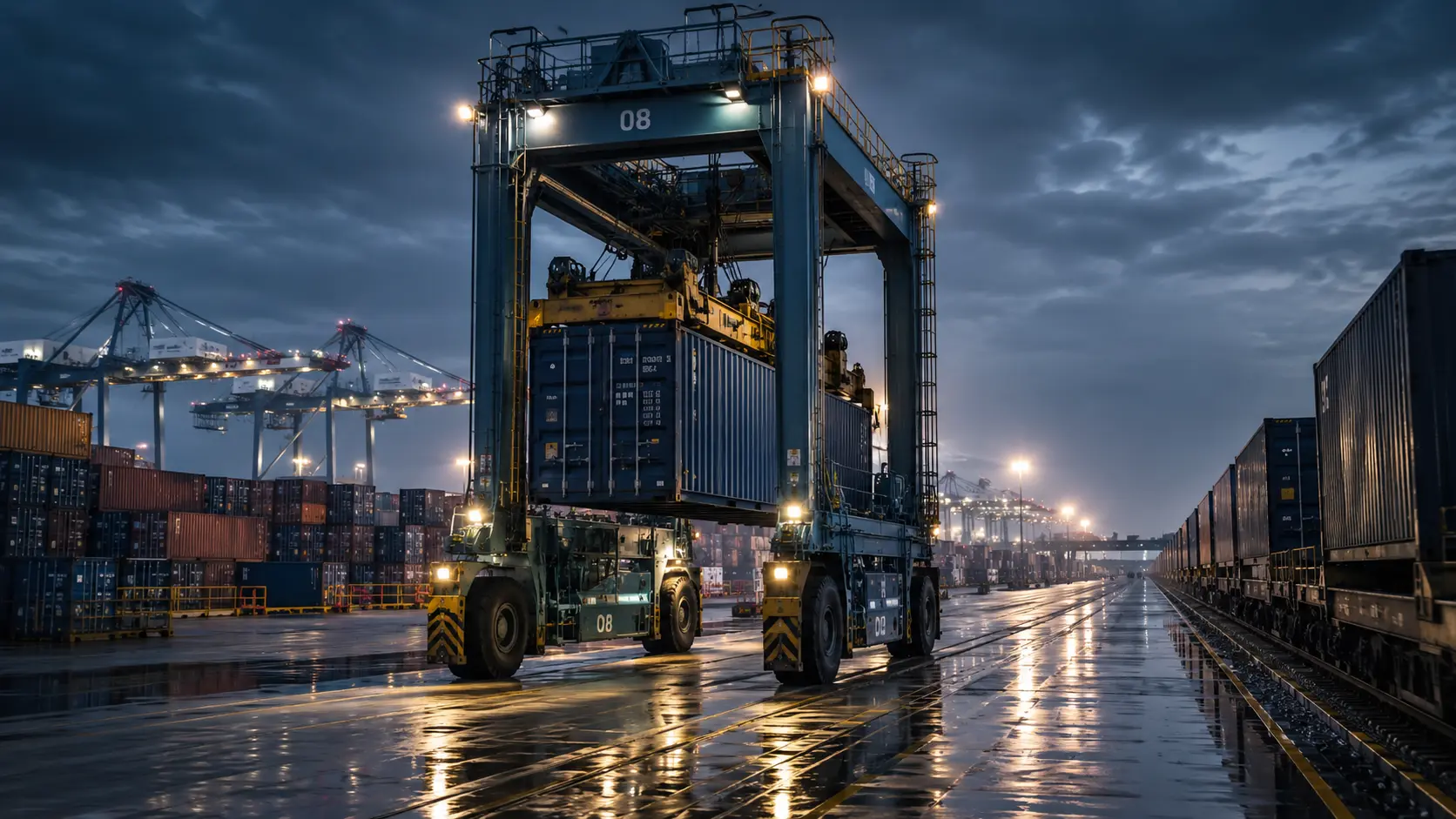
- Concept: The Straddle Carrier: An eight-wheeled, diesel-electric robot that drives directly over a 40-foot container, physically lifting it into its own underbelly to transport it.
- Concept: Terminal Operating System (TOS): The central software brain that mathematically calculates the exact movement and stacking coordinates for tens of thousands of steel boxes simultaneously.
- Concept: Scheduling Heuristics: Algorithms prioritize container movements based on train departure times, container weight distribution, and minimizing empty driving time.
- Concept: Dwell Time Compression: The primary metric of an intermodal hub, measuring exactly how few hours a container sits idle on the asphalt before boarding a train.
HOW A STRADDLE CARRIER ARRAY WORKS
When a 20,000-TEU cargo ship docks, it dumps thousands of identical steel containers onto a concrete pier in a completely random order. The port must immediately sort these boxes and transfer them onto a transcontinental train waiting miles away. If this transfer process bottlenecks, the entire global supply chain physically stops.
Modern intermodal hubs abandon traditional forklifts and chassis trucks to solve this. They rely on fleets of straddle carriers—massive, 50-foot-tall mobile frames. A straddle carrier does not tow a container; it drives directly over it. It drops a hydraulic spreader bar, locks onto the four corner castings of the container, and hoists the box up into its hollow chassis. This allows the carrier to drive freely over other stacked containers, operating in incredibly dense, narrow concrete aisles.
The physical machines are entirely subservient to the Terminal Operating System (TOS). The TOS uses advanced scheduling heuristics to sequence every movement. If a train bound for Chicago departs at 14:00, the TOS algorithm identifies every container manifested for Chicago currently buried in the yard.
The algorithm executes a “kinematic optimization loop.” It dispatches specific straddle carriers to dig out the Chicago boxes, calculating the exact routes that prevent the carriers from blocking each other in the aisles. The TOS ensures the carriers arrive at the rail siding in the precise order required by the train’s load plan, matching heavy containers to specific reinforced rail cars while balancing the overall weight distribution of the two-mile-long train.
WHY IT MATTERS NOW
Continental freight velocity is no longer determined by the speed of a train; it is determined entirely by the intralogistics of the intermodal transfer hub. E-commerce conglomerates demand absolute predictability in their supply chains. If a container misses its scheduled rail connection because it was buried under ten other boxes in a port yard, the delivery timeline fails.
The automation of the straddle carrier array represents the industrial weaponization of software. Ports in Northern Europe and the American West Coast are spending billions of dollars to upgrade legacy diesel carriers to fully automated, electric Auto-Strads. These unmanned machines operate 24 hours a day in total darkness, guided by millimeter-accurate differential GPS and magnetic transponder grids.
This automation fundamentally alters the economics of rail freight. A fully optimized TOS utilizing an automated straddle array can compress container “dwell time” from five days down to less than twelve hours. This hyper-efficiency mathematically increases the total throughput capacity of the physical port by 40 percent without pouring a single yard of new concrete.
By achieving this velocity, rail networks can actively strip market share away from long-haul diesel trucking. Transferring a container directly from a ship to a train bypasses the severe structural shortages in commercial truck drivers, drastically lowering the total carbon intensity and unit cost of moving physical goods across a continent.
WHAT MOST PEOPLE MISS
Logistics commentators frequently praise the precision of the Terminal Operating System. They completely ignore the physical “reshuffling penalty” that constantly degrades the algorithm’s efficiency.
Because space is limited, ports stack containers up to four high. The TOS cannot see into the future perfectly; it does not always know exactly when a specific truck or train will arrive. If the TOS stacked a high-priority container at the bottom of a stack, a straddle carrier must physically pick up and move three other heavy containers just to reach the target.
This process, known as unproductive shuffling, consumes massive amounts of diesel fuel, battery power, and mechanical maintenance. The true genius of a tier-one TOS is not how fast it moves containers to the train, but its ability to run predictive, background algorithms during the quiet hours of the night, preemptively un-burying and restacking containers so they are sitting perfectly at the top of the stack the moment the sun rises.
THE TRAJECTORY
Next 12–36 Months: The mass deployment of 5G ultra-reliable low-latency communication (URLLC) networks across terminal yards. This wireless architecture will allow the TOS to process LIDAR and optical telemetry from the straddle carriers in real-time, drastically reducing the physical safety buffer required between active robots and accelerating total yard velocity.
Next Five Years: The integration of reinforcement learning into TOS scheduling heuristics. Instead of following rigid mathematical rules programmed by human engineers, the TOS will act as an autonomous AI agent. It will learn the unique, unpredictable daily flow of a specific port through trial and error, developing completely novel stacking architectures that mathematically minimize the reshuffling penalty.
Next Ten Years: The physical elimination of the straddle carrier in mega-hubs. As cargo volumes exceed the kinematic limits of mobile robots, next-generation ports will transition entirely to massive, fixed Automated Stacking Cranes (ASCs) suspended over the yard, utilizing the straddle carriers only as localized shuttles rather than primary stacking assets.
What Could Go Wrong: A severe algorithmic deadlock caused by a data corruption event. If a cyberattack or a simple sensor failure causes the TOS to believe a container is located in Slot A, when it is physically located in Slot B, the algorithm will dispatch a straddle carrier into a physical collision. The resulting mechanical crash instantly paralyzes that section of the yard, requiring dangerous human intervention to manually reset the massive robotic grid.
Most Likely Outcome: The automated straddle carrier array will remain the critical physical bridge in the global supply chain. The software algorithms controlling these machines will dictate the ultimate ceiling on how quickly human civilization can move physical matter from the ocean to the interior of a continent.
KEY TERMS
- Straddle Carrier: A specialized freight-carrying vehicle designed to drive over its load, lift it from above, and transport it within the narrow aisles of a terminal.
- Terminal Operating System (TOS): The complex enterprise software architecture that controls the movement, storage, and logistical tracking of all cargo within a port facility.
- Intermodal: The movement of freight in an identical container using multiple modes of transportation (ship, rail, and truck) without physically handling the freight itself.
- Dwell Time: The total physical time a shipping container sits idle in a terminal yard waiting to be loaded onto its next mode of transport.
- Heuristic: An algorithmic shortcut or mathematical rule-of-thumb used by software to find an approximate, highly efficient solution to a scheduling problem when a perfect calculation would take too long.
SOURCES
- Institute of Electrical and Electronics Engineers (IEEE) — Scheduling Heuristics and Kinematic Optimization in Automated Container Terminals
- Kalmar Global — Auto-Strad Technical Specifications and Terminal Automation Architecture
- Navis — Terminal Operating System (TOS) N4 Algorithmic Optimization and Yard Planning
- World Maritime University — The Economic Impact of Port Automation on Global Supply Chain Velocity