Advertisement
)

At a Glance
- Concept: A heavily congested, naturally occurring oceanic bottleneck required for the most efficient East-West maritime trade.
- Why it matters: It accommodates roughly 25% of all global maritime trade and approximately 80% of China’s imported crude oil.
- Who uses it: Global shipping conglomerates, Middle Eastern oil exporters, and East Asian manufacturing economies.
- Biggest takeaway: The geographic limitations of this single channel dictate the maximum size of global cargo ships and drive the naval strategies of modern superpowers.
In Simple Words
Imagine a massive, multilane highway connecting two of the busiest economic zones on Earth. Now imagine that highway suddenly funnels down into a single, narrow dirt road.
This is the exact geographic reality of the Strait of Malacca. It is a body of water connecting the Indian Ocean to the South China Sea. To move manufactured goods from China to Europe, or to move crude oil from the Middle East to Japan, ships must pass through this specific corridor.
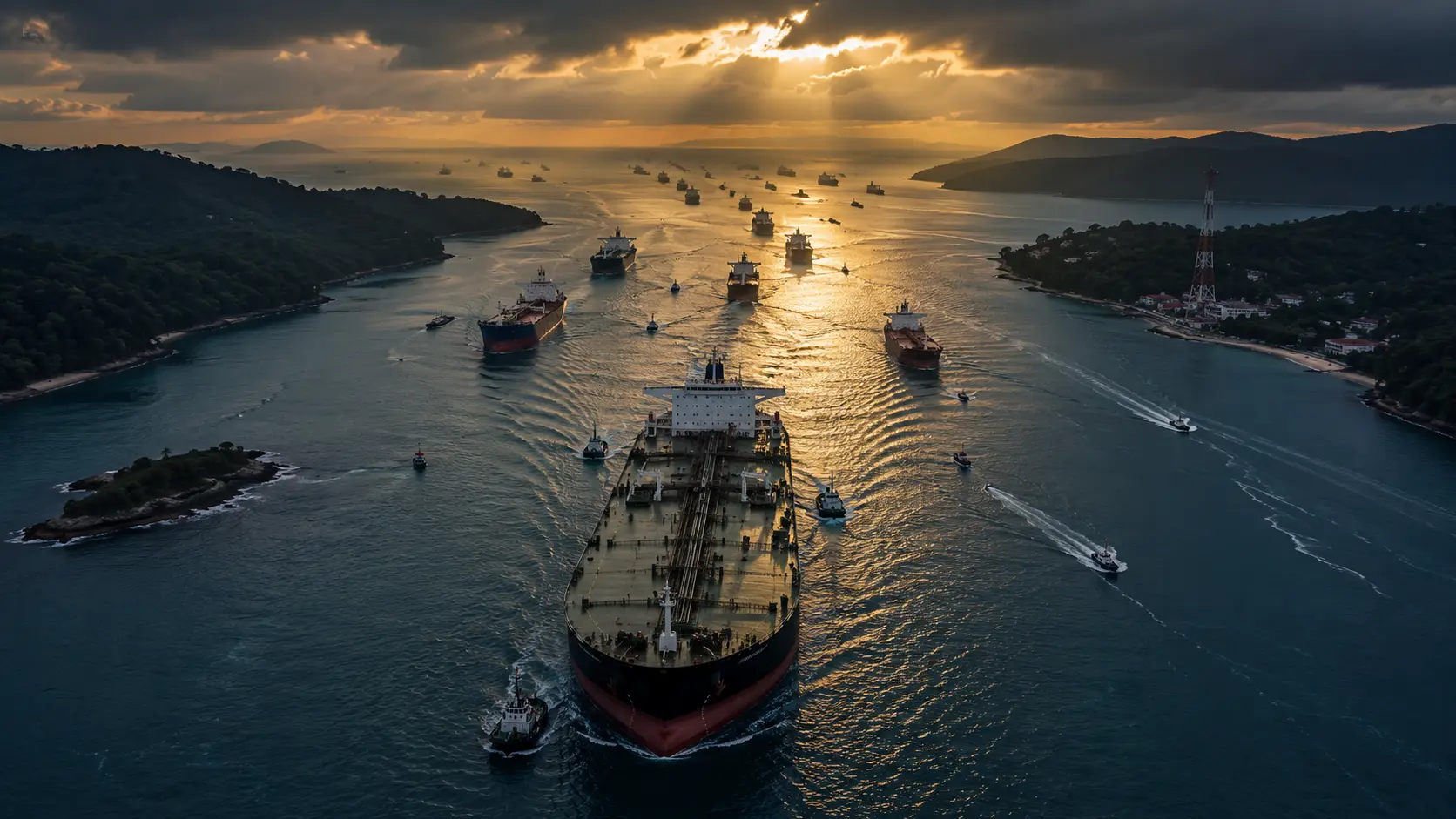
At its narrowest point, near Singapore, the shipping lane shrinks to just 1.5 nautical miles wide. Over 60,000 vessels crowd into this tiny space every single year.
Because so much of the global economy relies on this one specific shortcut, it has become one of the most critical and vulnerable points on the world map. If the strait were blocked by a military conflict, a sunken ship, or extreme piracy, the global supply chain would immediately fracture, and the price of energy and consumer goods would skyrocket worldwide.
Why This Matters
The global economy is entirely dependent on maritime efficiency. Ships carry about 80% of global trade by volume. The route through the Strait of Malacca is the shortest, cheapest, and fastest way to connect the manufacturing powerhouses of East Asia with the consumer markets of Europe and the energy reserves of the Middle East.
This geographic reliance creates a severe strategic vulnerability.
The strait handles roughly 23 million barrels of oil every single day. For nations like Japan, South Korea, and China, uninterrupted access to this oil is a matter of national survival. China, for instance, relies on this single channel for about 80% of its imported crude oil.
This extreme dependency is heavily monitored by global militaries. A hostile naval force could easily blockade the 1.5-mile-wide Phillips Channel, effectively cutting off the energy supply to the world’s second-largest economy.
As geopolitical tensions rise in the Indo-Pacific, the Strait of Malacca is no longer just a commercial shipping lane. It is the geographic center of gravity for global trade warfare, forcing superpowers to spend billions of dollars building alternative pipelines and expanding their naval fleets to secure it.
The Big Picture
Before discussing the physical mechanics of navigating the strait, it is essential to understand where this chokepoint fits into the broader global system.
The Strait of Malacca sits at the intersection of energy security, global logistics, and maritime law. It borders Indonesia, Malaysia, and Singapore. Because it passes through the territorial waters of sovereign nations, navigating it requires strict adherence to international maritime law.
However, unlike the Suez Canal or the Panama Canal, the Strait of Malacca is a naturally occurring waterway. There are no toll gates and no single corporate authority managing the flow of traffic. This makes it a highly complex, decentralized environment where giant oil tankers, local fishing boats, and international military vessels must all operate simultaneously in incredibly tight quarters.
HOW THE STRAIT OF MALACCA WORKS
To understand the mechanics of the Strait of Malacca, we must start with the fundamental problem of oceanic logistics: moving massive volume efficiently.
1. The Fundamental Problem
Transporting millions of barrels of oil from the Persian Gulf to Shanghai requires massive ships. To keep the cost of fuel per barrel low, shipping companies build the largest vessels physically possible. However, the shortest route between these two points passes directly through the shallow archipelago of Southeast Asia.
2. The Insufficiency of Alternatives
If a ship cannot fit through the Strait of Malacca, it must divert south. The alternatives are the Sunda Strait or the Lombok Strait in Indonesia. Taking these alternative routes adds thousands of nautical miles to the journey. This drastically increases fuel consumption, labor costs, and delayed delivery times, destroying the economic efficiency of the voyage.
3. The Core Mechanism: Draft Limits
The Strait of Malacca is relatively shallow, with a minimum depth of about 25 meters (82 feet). This creates a hard physical limit on the size of ships that can pass through.
A ship’s draft is the vertical distance between the waterline and the bottom of the ship’s hull. International navigation guidelines mandate that ships must maintain at least 3.5 meters of under-keel clearance to ensure they do not scrape the ocean floor.
4. Technical Depth: The Malaccamax Standard
To maximize profits without running aground, naval architects created a specific ship classification called Malaccamax.
A Malaccamax Very Large Crude Carrier (VLCC) is engineered to the absolute mathematical limit of the strait. These ships are built up to 333 meters long and 60 meters wide. Most importantly, when fully loaded with oil, they possess a maximum draft of exactly 20.5 meters. This leaves exactly the required clearance to scrape safely over the shallowest points of the strait.
5. Real-World Consequences
Because ships cannot be built any deeper than 20.5 meters to use this route, shipping companies are forced to make ships longer and wider to increase cargo capacity. This results in ultra-large container ships and oil tankers that are incredibly difficult to maneuver, squeezing through a congested 1.5-mile-wide channel while dodging local traffic and avoiding collision.
Real-World Applications
The physical limitations of the strait ripple outward, affecting multiple global industries.
Maritime Insurance and Piracy: The strait is a notorious hotspot for modern piracy. Because giant cargo ships must drastically reduce their speed to navigate the shallow, narrow waters safely, they become easy targets for armed boarding parties using small, fast speedboats. As a result, maritime insurance providers carefully calculate “piracy risk premiums” for vessels utilizing this route, directly increasing the cost of global shipping.
Singapore’s Economic Engine: The geography of the strait created the modern state of Singapore. Situated at the very exit of the chokepoint, Singapore established itself as the ultimate maritime service station. It provides deep-water ports, refueling (bunkering) services, and financial clearinghouses for the 60,000 vessels passing through annually, turning a tiny island into a global financial superpower.
The Belt and Road Initiative: To reduce reliance on this single waterway, China is spending billions on alternative infrastructure. Through the Belt and Road Initiative, Beijing has financed overland oil and gas pipelines through Myanmar and Pakistan. These pipelines allow energy from the Middle East to be unloaded in the Indian Ocean and pumped directly into China, entirely bypassing the Strait of Malacca.
Economic & Strategic Impact
The Strait of Malacca dictates the strategic posture of the world’s largest militaries.
For global supply chains, the strait acts as a permanent cap on economies of scale. Because ships cannot be built deeper than the Malaccamax limit to serve the Asia-Europe route, shipping companies cannot infinitely lower freight costs by building larger and larger vessels. The geography permanently fixes the baseline cost of global trade.
For China, the strait represents an existential threat known as the “Malacca Dilemma.” Coined in 2003 by former Chinese President Hu Jintao, this term describes China’s fear that hostile naval forces (particularly the United States Navy) could blockade the strait during a conflict. Because roughly 80% of China’s oil imports travel through this bottleneck, a successful blockade would instantly paralyze the Chinese military and economy.
Strategically, this dilemma has triggered a massive naval arms race. China is rapidly expanding its deep-water navy to project power into the Indian Ocean to protect its shipping lanes. Simultaneously, nations like India have expanded their own naval presence near the entrance of the strait to counter Chinese expansion and maintain strategic leverage.
Advantages
- Unmatched Efficiency: It remains the shortest and most cost-effective maritime route connecting the Indian and Pacific Oceans.
- Geographic Sheltering: Unlike the open ocean, the strait is protected by the landmasses of Sumatra and Malaysia, sheltering ships from severe deep-sea storms.
- Economic Hub Access: The route provides direct access to major financial and logistics hubs, particularly the Port of Singapore, facilitating immediate refueling and cargo transfers.
Limitations
- Severe Congestion: Accommodating over 60,000 vessels a year creates a high risk of catastrophic ship-to-ship collisions.
- Draft Constraints: The 25-meter minimum depth prevents Ultra Large Crude Carriers (ULCCs) and newer, deeper container ships from utilizing the route.
- Piracy and Smuggling: The narrow geography forces ships to slow down near coastlines with complex jurisdictions, making them vulnerable to localized criminal networks.
- Environmental Fragility: An oil spill from a grounded Malaccamax tanker would instantly devastate the coastal ecosystems and local fishing economies of Malaysia and Indonesia.
Common Misconceptions
Misconception: The Strait of Malacca is a man-made canal controlled by a single government.
Reality: It is a naturally occurring waterway bordered by multiple sovereign nations. Unlike the Suez Canal, no single entity charges a toll for passing through it.
Misconception: Ships can just take a slightly different route if the strait is blocked.
Reality: The alternatives (Sunda and Lombok Straits) are thousands of miles out of the way. A blockade would not just be an inconvenience; it would cause immediate, catastrophic delays in global supply chains.
Misconception: Malaccamax is an official maritime legal classification.
Reality: Malaccamax is a term used by naval architects to describe the absolute physical limit of the strait. It is an engineering target, not an official regulatory class like Panamax.
What Most People Miss
The physical depth of the strait is not constant; it shifts.
The ocean floor is made of sand, silt, and shifting sediment, and the area is subject to significant tidal changes. When naval architects design a Malaccamax ship with a 20.5-meter draft, they are operating on razor-thin margins.
Ship captains must rely heavily on real-time hydrographic surveys and precise tidal data. If a massive oil tanker passes over the shallowest point during an unusually low tide, the calculated 3.5-meter under-keel clearance can vanish. The ship could scrape the seabed, rupture its hull, and cause an environmental and economic disaster that would close the strait entirely.
Comparison Table
| Feature | Strait of Malacca | Sunda Strait | Lombok Strait |
| Location | Between Malaysia and Sumatra. | Between Sumatra and Java (Indonesia). | Between Bali and Lombok (Indonesia). |
| Primary Advantage | Shortest, most direct route for East-West trade. | Alternative route for vessels bypassing Malacca. | Extremely deep water; accommodates massive vessels. |
| Minimum Depth | ~25 meters. | ~20 meters. | ~250 meters. |
| Vessel Constraints | Limited to Malaccamax draft (20.5m). | Too shallow for fully loaded VLCCs. | Safely accommodates Ultra Large Crude Carriers (ULCCs). |
| Economic Drawback | High congestion and piracy risks. | Adds navigation distance and time. | Adds thousands of miles to standard shipping routes. |
Case Study
Situation: In the early 2000s, the Chinese government realized its rapid economic expansion was entirely dependent on foreign oil imported from the Middle East and Africa.
Challenge: Military strategists identified that roughly 80% of this oil had to pass through the Strait of Malacca. Because the United States Navy maintained dominance in the Asia-Pacific region, China recognized it had no way to protect its energy supply if the US chose to blockade the strait during a geopolitical conflict.
Solution: President Hu Jintao formally identified this vulnerability as the “Malacca Dilemma” in 2003. In response, China launched a multi-decade, multi-billion-dollar strategy to bypass the strait entirely. They financed a deep-water port in Gwadar, Pakistan, and built the China-Myanmar pipeline.
Outcome: Today, oil can be unloaded in the Indian Ocean and pumped directly across land into western China. Furthermore, China aggressively modernized its navy to protect its remaining maritime supply lines.
Lessons Learned: Geographic bottlenecks dictate foreign policy. A tiny, 1.5-mile stretch of water near Singapore successfully forced a global superpower to spend hundreds of billions of dollars re-engineering the logistics architecture of the Asian continent.
Future Outlook
Next 12–24 Months
Piracy and maritime security incidents will likely fluctuate, increasing insurance premiums for vessels utilizing the strait. Shipping conglomerates will rely heavily on advanced AI routing systems to calculate real-time tidal depths, maximizing the cargo capacity of Malaccamax vessels down to the centimeter to combat rising fuel costs.
Next 3–5 Years
Regional powers, particularly India and Indonesia, will expand their naval patrols near the western and southern approaches of the strait. China will accelerate the completion of its “String of Pearls” strategy—a network of allied commercial and military ports across the Indian Ocean designed to secure the approach to Malacca.
Next 10 Years
Global shipping will face a hard mathematical ceiling. As global trade volume continues to increase, the physical width and depth of the Strait of Malacca cannot expand. Congestion will eventually reach a critical threshold, forcing shipping companies to fundamentally restructure global trade routes and permanently shift traffic toward the deeper Lombok Strait.
Most Likely Scenario
The Strait of Malacca will remain the single most important maritime chokepoint on Earth. However, the economic reliance on this specific channel will be slowly diluted as China and other Asian powers continue to build overland pipelines and rail networks to actively mitigate their geographic vulnerability.
Key Takeaways
- The Strait of Malacca handles 25% of global maritime trade and is the world’s busiest oil transit chokepoint.
- The strait is exceptionally shallow, with a minimum depth of only 25 meters.
- Malaccamax vessels are engineered specifically for this strait, limited to a maximum draft of 20.5 meters.
- The “Malacca Dilemma” describes China’s extreme vulnerability to a naval blockade in this 1.5-mile-wide channel.
- To bypass the strait, superpowers are investing billions in overland pipelines through Pakistan and Myanmar.
- The physical limitations of the strait permanently cap the size and efficiency of East-West maritime cargo ships.
- Navigating the strait requires precise tidal calculations to maintain a minimum of 3.5 meters of under-keel clearance.
Glossary
Bunkering: The process of supplying fuel to ships for their own use, a major industry in ports like Singapore.
Chokepoint: A narrow geographic feature, such as a strait or canal, that causes traffic to bottleneck and creates strategic vulnerability.
Draft: The vertical distance between the waterline and the lowest point of a ship’s hull; dictates how deep water must be for safe passage.
Malacca Dilemma: The strategic vulnerability of China’s economy due to its heavy reliance on the Strait of Malacca for energy imports.
Malaccamax: A naval architecture term describing the maximum possible dimensions for a ship to safely navigate the Strait of Malacca.
Under-Keel Clearance: The exact distance between the lowest point of a ship’s hull and the ocean floor.
Very Large Crude Carrier (VLCC): A massive class of oil tankers, commonly engineered to Malaccamax standards to carry oil from the Middle East to Asia.
Frequently Asked Questions
Why don’t ships just sail around the Strait of Malacca?
They can, but it adds thousands of nautical miles and days of travel time to the journey. The massive increase in fuel and operational costs makes alternate routes economically devastating for shipping companies.
Who legally controls the Strait of Malacca?
No single country controls it. The strait passes through the territorial waters of Indonesia, Malaysia, and Singapore, and is governed by the United Nations Convention on the Law of the Sea (UNCLOS), allowing “transit passage” for international vessels.
What is the narrowest point of the strait?
The Phillips Channel in the Singapore Strait is the narrowest point, funneling traffic down to a width of roughly 1.5 nautical miles.
How deep is the Strait of Malacca?
The minimum navigational depth is approximately 25 meters (82 feet). This creates a severe limitation for ultra-large cargo vessels.
What happens if a ship gets stuck in the strait?
Because the channel is heavily congested, a grounded ship could cause massive traffic jams, forcing other ships to idle or take long detours. A severe incident could cause global oil prices to spike instantly.
Is piracy still a problem in the Strait of Malacca?
Yes. While regional navies have improved patrols, the narrow, shallow waters force ships to slow down, making them vulnerable to armed robbery from fast-moving speedboats operating near the coastlines.
What is a Malaccamax ship?
It is a vessel specifically designed to be as large as mathematically possible while still safely fitting through the strait. It is limited to a draft of 20.5 meters.
Why is China trying to bypass the strait?
Roughly 80% of China’s oil imports travel through the strait. If the United States or another adversary blocked the strait during a war, China’s economy and military would quickly run out of fuel.
Sources
- Malacca Dilemma – Wikipedia
- The World’s Most Strategic Straits and Channels – Al Jazeera
- Strait of Malacca – Wikipedia
- Malaccamax Architectural Constraints – Grokipedia