Advertisement
)

At a Glance
- Concept: A macroeconomic framework mapping the value of the US dollar against global economic conditions, resulting in a U-shaped “smile” curve.
- Why it matters: The US dollar dictates the price of global commodities, the cost of emerging market debt, and the profitability of multinational corporations. Understanding when the dollar will spike or plunge is the absolute bedrock of global trade strategy.
- Who uses it: Central banks, foreign exchange (FX) hedge funds, institutional asset allocators, and corporate treasurers managing cross-border currency risk.
- Biggest takeaway: The US dollar has two distinct superpowers. It attracts capital when interest rates are high (greed), and it attracts capital when the world is panicking (fear). It only loses value when the world is boring and stable.
In Simple Words
Imagine you have a large pile of cash to invest, and you have to choose between keeping it in the United States or sending it to other countries.
If the US economy is booming and American banks are paying high interest rates, you keep your money in the US to get rich. Because everyone around the world wants to do the same thing, they have to buy US dollars to invest there. This massive demand makes the dollar highly valuable.
Now, imagine the opposite: a global pandemic or a massive war breaks out. The global economy is crashing. You are terrified of losing your money in risky foreign countries. What do you do? You panic and pull all your money out of the rest of the world, hiding it in the safest asset on Earth: US Treasury bonds. To buy those bonds, you have to buy US dollars. Once again, massive demand makes the dollar highly valuable.
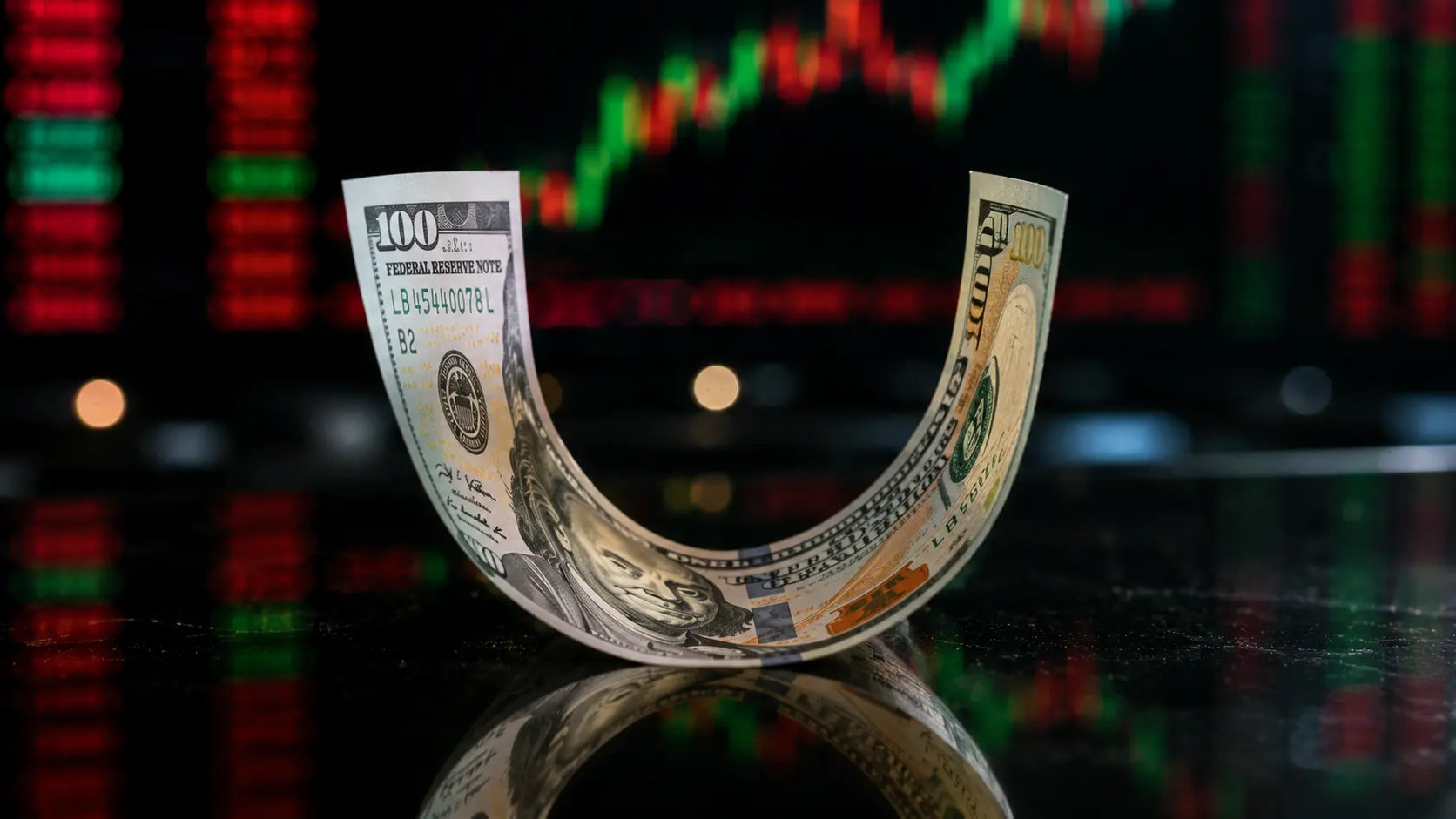
The dollar only gets weak in the middle scenario: when the US is growing slowly, but the rest of the world is doing great. In this scenario, you feel safe enough to send your money overseas to find better profits. Economist Stephen Jen plotted these three scenarios on a graph in 2001, and it formed the shape of a smile. The dollar wins on the left side (fear), wins on the right side (greed), and only dips in the middle (calm).
Why This Matters
The framework matters in 2026 because the dollar sits between two powerful, opposing forces.
For the past decade (2014 to 2024), the US dollar crushed foreign currencies, riding the right side of the smile fueled by US technological exceptionalism and high Federal Reserve interest rates. However, holding the world’s reserve currency at artificially elevated levels creates severe geopolitical friction. Emerging markets that borrowed money in US dollars are being financially suffocated because it costs them more of their local currency to pay back their dollar-denominated debts.
As we navigate through 2026, economists note that the dollar is transitioning. With the US economy slowing to a more moderate pace and global capital seeking diversification, the currency is sliding into the “bottom” of the smile. Understanding this shift is critical. If the dollar systematically weakens, it will ignite a massive rally in emerging market equities, drive commodity prices higher, and provide profound relief to foreign central banks fighting imported inflation.
The Big Picture
The Dollar Smile Theory is ultimately a reflection of American financial hegemony.
No other currency possesses this dual-sided advantage. If the Eurozone economy collapses, the Euro crashes. If the Japanese economy stagnates, the Yen depreciates. But because the US dollar accounts for nearly 60% of disclosed global foreign exchange reserves and dominates global trade invoicing, it acts as the primary plumbing of the international financial system.
When global liquidity dries up and fear spikes, corporations, banks, and sovereign nations do not scramble for Euros or Yuan; they scramble for dollars to pay their dollar-denominated liabilities. This structural dependency guarantees that the dollar will always catch a bid during a crisis, cementing the left side of the smile into the architecture of modern capitalism.
How the Dollar Smile Theory Works
Understanding currency valuation requires bridging the gap between domestic monetary policy and international capital flows. Here is the first-principles breakdown.
1. The Fundamental Problem: The Hunt for Yield vs. Safety
In a globally integrated financial system, capital is nomadic. Trillions of dollars move across borders daily, searching for either maximum profit (yield) or maximum capital preservation (safety). However, moving this capital requires exchanging currencies, which directly alters their supply and demand valuations.
2. The Insufficiency of Traditional Valuation Models
Historically, economists tried to value currencies purely on trade balances or purchasing power parity (PPP). These models suggested that if a country imported more than it exported, its currency should weaken. The US runs massive trade deficits, yet the dollar remains dominant. Traditional models failed to account for the sheer gravitational pull of US capital markets and safe-haven dynamics.
3. The Core Mechanism: The Three Phases of the Smile
Stephen Jen’s framework solved this by dividing the dollar’s behavior into three distinct macroeconomic phases:
- The Left Side (Fear): Global economic distress or geopolitical shock. Investors dump risky international assets and rush into US dollars for safety, driving the currency up.
- The Bottom (Calm): Moderate US growth coupled with global economic expansion. Capital flows out of the US seeking higher-yielding assets in emerging and developed markets, driving the dollar down.
- The Right Side (US Exceptionalism): Robust US economic performance characterized by strong GDP growth and high Federal Reserve interest rates. Foreign capital floods into US assets to capture the high yield, driving the dollar up.
4. Technical Depth: The Eurodollar Squeeze
The left side of the smile (fear) is mechanically driven by the Eurodollar market—US dollars held in banks outside the United States. Trillions of dollars of global debt are owed in USD. In a crisis, the revenue of foreign corporations plummets, but their dollar-denominated debt obligations remain fixed. They must aggressively buy dollars on the open market to service their debt, creating a violent short squeeze that rockets the dollar’s value higher, regardless of what the US domestic economy is doing.
5. Real-World Consequences: The Wrecking Ball Effect
When the dollar spikes on either end of the smile, it acts as a wrecking ball for the rest of the world. A strong dollar mathematically suppresses global commodity prices (since oil and gold are priced in dollars). Furthermore, foreign central banks are forced to hike their own interest rates—even if their domestic economies are weak—just to defend their currencies from collapsing against the surging greenback.
Real-World Applications
The Dollar Smile framework is actively used to dictate trillion-dollar asset allocation strategies.
Emerging Market Debt Trading: Sovereign debt investors monitor the smile obsessively. When macroeconomic indicators suggest the US is entering the “bottom” of the smile (weakening dollar), institutional capital rotates aggressively into emerging market bonds (like Brazil or Indonesia). A weakening dollar effectively acts as a tax cut for these nations, easing their debt burden and allowing their domestic assets to soar.
Corporate FX Hedging: Multinational corporations (like Apple or Toyota) use the theory to time their currency hedging. If a US company sells iPhones in Europe during the right side of the smile (strong dollar), the Euros they earn are worth less when converted back to dollars, crushing their quarterly earnings. Corporate treasurers use the smile framework to purchase forward contracts and options, locking in exchange rates before the dollar hits extreme highs.
Reserve Currency Management: Foreign central banks use the framework to manage their FX reserves. In early 2025, noting that the dollar remained historically overvalued and perhaps structurally transitioning, many central banks accelerated their diversification away from US Treasuries, actively accumulating gold to protect their sovereign wealth from the inevitable slide down into the bottom of the smile.
Economic & Strategic Impact
The traditional reliability of the Dollar Smile is facing profound structural friction in the mid-2020s.
For decades, foreign investors assumed that holding US dollars offered a natural hedge against global risk-off events. However, the weaponization of the dollar via sanctions, coupled with aggressive US fiscal deficits, has subtly shifted global capital flows.
In early 2025, market observers noted a highly unusual divergence: during episodes of global risk aversion, the dollar exhibited uncharacteristic weakness, failing to act as the ultimate safe haven. While the dollar remains structurally dominant—accounting for roughly 56% of global FX reserves—this anomaly suggests that institutional investors are beginning to alter their currency hedge ratios. If international allocators structurally lower their unhedged US exposure, the left side of the smile (the safe-haven spike) will become materially less pronounced in future global crises.
Advantages
- Predictive Accuracy: The framework accurately explains why the dollar behaves counter-intuitively, reconciling the paradox of a currency strengthening during both economic booms and domestic recessions.
- Asset Allocation Blueprint: It provides a clear, actionable roadmap for multi-asset portfolio managers, dictating when to overweight US equities versus international or emerging market equities based on the current phase of the smile.
- Risk Management: Helps corporate treasurers anticipate “whipsaw” currency movements, allowing them to optimize their supply chain pricing and protect profit margins from sudden FX volatility.
Limitations
- Timing the Trough: While the theory explains the “why,” it is notoriously terrible at predicting the “when.” Determining exactly when the dollar transitions from the bottom of the smile back to the right side is incredibly difficult and heavily reliant on unpredictable Federal Reserve policy errors.
- The “Smirk” Mutation: Some strategists argue the theory is outdated due to the deteriorating US net international investment position. They argue the smile has morphed into a “smirk,” where the right-side appreciation effect is permanently muted by shifting global investment patterns.
- Alternative Safe Havens: If global central banks successfully elevate gold or engineer a commodity-backed alternative currency for bilateral trade, the structural foundation of the left side of the smile (forced dollar buying during crises) could erode.
Common Misconceptions
Misconception: A booming US economy is the only thing that makes the dollar strong.
Reality: The dollar frequently hits its highest valuations during global panics when the US economy is actually in a recession (the left side of the smile). It strengthens out of defensive necessity, not economic optimism.
Misconception: De-dollarization means the dollar smile is dead.
Reality: While de-dollarization headlines are prevalent, the dollar’s share of global reserves remains far above any single alternative. The smile theory remains entirely relevant; the amplitude of the curves may simply flatten as the world slowly diversifies.
Misconception: A weak dollar is bad for the United States.
Reality: A moderately weak dollar (the bottom of the smile) is highly beneficial for US multinational corporations, as it makes their exports cheaper and more competitive abroad, while inflating the value of their overseas earnings when repatriated back to the US.
What Most People Miss
The role of the Japanese Yen as the Counter-Weight.
While analysts focus intensely on the US dollar, they often ignore the other side of the currency pair. The Japanese Yen has historically served as the alternative safe haven. For years, the Bank of Japan (BOJ) held interest rates at zero (or negative), nullifying the Yen’s safe-haven appeal and making the dollar smile wider than ever.
However, as the BOJ began increasing interest rates, the interest-rate gap between Japan and the rest of the world started to close. The Yen is aggressively reclaiming its safe-haven status. When a global crisis hits in the future, terrified capital will no longer flow exclusively into the US dollar; a massive portion will flow into the Japanese Yen. This dynamic actively suppresses the left side of the Dollar Smile, fundamentally rewriting global risk models.
Comparison Table
| Phase of the Smile | Economic Environment | Driver of USD Demand | Impact on Emerging Markets |
| Left Side (Fear) | Global crisis / Geopolitical shock | Safe-haven capital flight (Defensive) | Severe stress (Capital flight, debt crises) |
| Bottom (Calm) | Moderate US growth / Global expansion | Capital exits US seeking foreign yield | Highly Positive (Strong local currencies) |
| Right Side (Greed) | US Exceptionalism / High Fed Rates | High relative US interest rates (Offensive) | Negative (Capital drained to the US) |
Case Study
Situation: Following a decade of structural outperformance (2014–2024), the US dollar remained highly elevated, trading approximately 20% above its long-term real-trade-weighted basis.
Challenge: Institutional asset allocators had to determine if this outperformance was a permanent “new normal” or if the currency was simply stuck on the right side of the Dollar Smile, poised for a painful reversion to the mean.
Solution (The 2025/2026 Assessment): Utilizing the Dollar Smile framework, global strategists recognized that the macroeconomic environment was shifting. The US economy exhibited resilience but not dominance, with real GDP growth moderating (e.g., the Atlanta Fed’s GDPNow model estimating 1.2% growth in Q1 2026). Simultaneously, the Federal Reserve maintained restrictive rates while global peers stabilized.
Outcome: By applying the theory, strategists identified that the dollar was hovering dangerously between the edges of the smile, transitioning toward the middle phase. Acknowledging this overvaluation, institutional investors initiated a strategic shift in global capital flows, incrementally reallocating capital away from US assets and heavily unhedged positions toward international equities and alternative reserves like gold.
Lessons Learned: The case study reaffirmed that trees do not grow to the sky. Even amid “US Exceptionalism,” the gravitational pull of the Dollar Smile dictates that prolonged periods of extreme valuation eventually resolve into multi-year structural adjustments, rewarding investors who preemptively diversify during the peak.
Future Outlook
Next 12–24 Months
The immediate horizon will be defined by the “Smirk” debate. With US Federal Reserve policy remaining tight but global growth stabilizing, the dollar will likely slide into the bottom of the smile, shedding some of its 20% overvaluation. Corporate treasurers will aggressively adjust their currency hedges, while emerging market equities are poised for a tactical renaissance as the pressure of a hyper-strong greenback is finally lifted.
Next 3–5 Years
The normalization of foreign safe havens. As the Bank of Japan continues to normalize its monetary policy, the Japanese Yen will firmly re-establish itself as the premier alternative safe-haven currency. During the next major geopolitical shock, the capital flight that traditionally fueled the left side of the Dollar Smile will be split between US Treasuries and Japanese assets. This will structurally flatten the left side of the smile, permanently altering how global macro funds model tail-risk events.
Next 10 Years
The structural erosion of the Eurodollar monopoly. By the mid-2030s, the ongoing efforts by BRICS+ nations to bypass the SWIFT system and settle bilateral trade in local currencies (or digital CBDCs) will reach critical mass. While the US dollar will not lose its reserve currency status, the absolute volume of offshore dollar-denominated debt will shrink. Because the left side of the smile is driven by foreign corporations desperately buying dollars to pay their dollar-debts during a crisis, shrinking this debt pile fundamentally weakens the dollar’s crisis-era superpower.
Most Likely Scenario
The Dollar Smile Theory will remain the most accurate conceptual framework for currency markets, but its geometry is changing. The sharp, steep U-shape of the 2000s and 2010s will slowly widen and flatten into a shallow bowl. The dollar will remain the apex predator of global finance, but its ability to violently swing global markets on either side of the smile will be heavily dampened by a more multipolar, financially diversified global economy.
Key Takeaways
- The US Dollar Smile Theory explains that the dollar strengthens in two opposing scenarios: severe global economic distress (fear) and strong US economic outperformance (greed).
- The dollar typically depreciates in the “bottom” of the smile, which occurs when US growth is moderate and the global economy is stable, encouraging capital to seek higher yields abroad.
- The left side of the smile (safe-haven demand) is mechanically driven by the global necessity to acquire dollars to service massive offshore dollar-denominated debts during a crisis.
- In the 2025/2026 cycle, economists estimate the dollar became roughly 20% overvalued, signaling a multi-year transition toward the weaker middle phase of the smile.
- The theory is actively used by institutional investors to time their asset allocations, rotating into emerging markets when the dollar weakens, and fleeing to US Treasuries when it spikes.
- Shifting global capital flows, changing investor hedging behavior, and a resurgent Japanese Yen threaten to mutate the traditional smile into a muted “smirk” in the coming decade.
Glossary
Capital Flight: The rapid exit of money or assets from a specific country due to an economic crisis, geopolitical event, or loss of investor confidence.
DPI (Distributed to Paid-In Capital): (Note: Retained in financial lexicons, but in macro FX, DPI refers to different private market metrics; contextually here, focus on LTV and FX).
Eurodollar: US dollars held in time deposit accounts at banks outside the United States. This massive offshore market is the primary driver of global dollar liquidity.
Flight to Quality (or Safety): A financial market phenomenon where investors sell riskier assets (like stocks or emerging market bonds) and buy the safest possible assets (like US Treasury bonds) during a crisis.
Purchasing Power Parity (PPP): An economic theory that compares different countries’ currencies through a “basket of goods” approach, suggesting exchange rates should eventually equalize the price of identical goods in different countries.
Real Effective Exchange Rate (REER): The weighted average of a country’s currency in relation to an index or basket of other major currencies, adjusted for the effects of inflation.
Frequently Asked Questions
Why does the dollar go up when the US economy is doing badly?
If the US economy is doing badly, it usually means the entire global economy is in a panic. During a global panic, investors care more about keeping their money safe than making a profit. They buy US Treasury bonds because they are the safest assets on Earth, and you need dollars to buy them. This massive demand pushes the dollar’s value up.
Who invented the Dollar Smile Theory?
The theory was popularized in 2001 by Stephen Jen, an economist who was working at Morgan Stanley and the International Monetary Fund (IMF) at the time.
Is the Dollar Smile breaking?
It is not breaking, but it is evolving. With the rise of the Japanese Yen returning as a safe-haven asset and emerging markets building local-currency resilience, some analysts believe the extreme spikes on the right and left sides of the smile will become slightly less severe in the future, forming a “smirk”.
How does the dollar smile affect normal people?
If you live outside the US, a strong dollar makes importing American goods, technology, and oil (which is priced in dollars) much more expensive, driving up local inflation. If you live inside the US, a strong dollar makes traveling internationally and buying imported goods much cheaper.
What causes the dollar to finally weaken?
The dollar weakens when the world is calm and stable, and the US economy is just growing at a normal, boring pace. Investors take their money out of the “safe” US and invest it in riskier foreign countries to get higher returns, selling their dollars to buy foreign currencies.
Sources
[1] EBC Financial Group: Dollar Smile Theory: Why the Greenback Wins Twice (April 2026)
[2] Goldman Sachs Asset Management: US Dollar’s Shifting Landscape: From Dominance to Diversification (June 2025)
[3] Fair Observer: The US Dollar and the Evolving Dollar Smile: A Structural Reassessment (March 2025)
[4] Wellington Management: The yen smile: New economic era upends traditional safe-haven currency relationships (2025)
[5] Joh. Berenberg, Gossler & Co. KG: Berenberg Focus: USD Regime Change (May 2025)