Advertisement
)

AT A GLANCE
- Concept: Below-Deck Ignition: The missile rocket motor fires while still physically trapped inside a sealed steel canister deep within the ship’s hull.
- Concept: Plenum Venting: A shared structural exhaust duct actively reroutes the violent rocket blast safely upward and away from neighboring munitions.
- Concept: Deluge Activation: If an accidental ignition occurs, the system floods the specific cell with pressurized water to cool the warhead.
- Concept: Reloading Limits: The strict dimensional tolerances of these gas-sealed cells physically prevent ships from reloading missiles while at sea.
HOW IT WORKS
Before the 1980s, naval warships loaded missiles individually onto mechanical rail launchers located on the deck. This exposed the munitions to the weather and created a severe mechanical bottleneck; if the mechanical arm jammed, the ship lost its primary offensive capability. The Mk 41 Vertical Launch System (VLS) internalized this process, turning the ship’s hull into a massive, multi-chambered gun barrel.
The defining engineering constraint of a VLS is not the missile itself, but the thermodynamics of the launch. When an SM-6 interceptor or a Tomahawk cruise missile ignites, its solid-rocket motor generates thrust by expelling highly corrosive, toxic gas at temperatures exceeding 3,000 degrees Fahrenheit. Because the missile fires while still trapped inside a sealed steel box deep within the ship, this gas must be instantly evacuated to prevent it from melting the adjacent, live missiles.
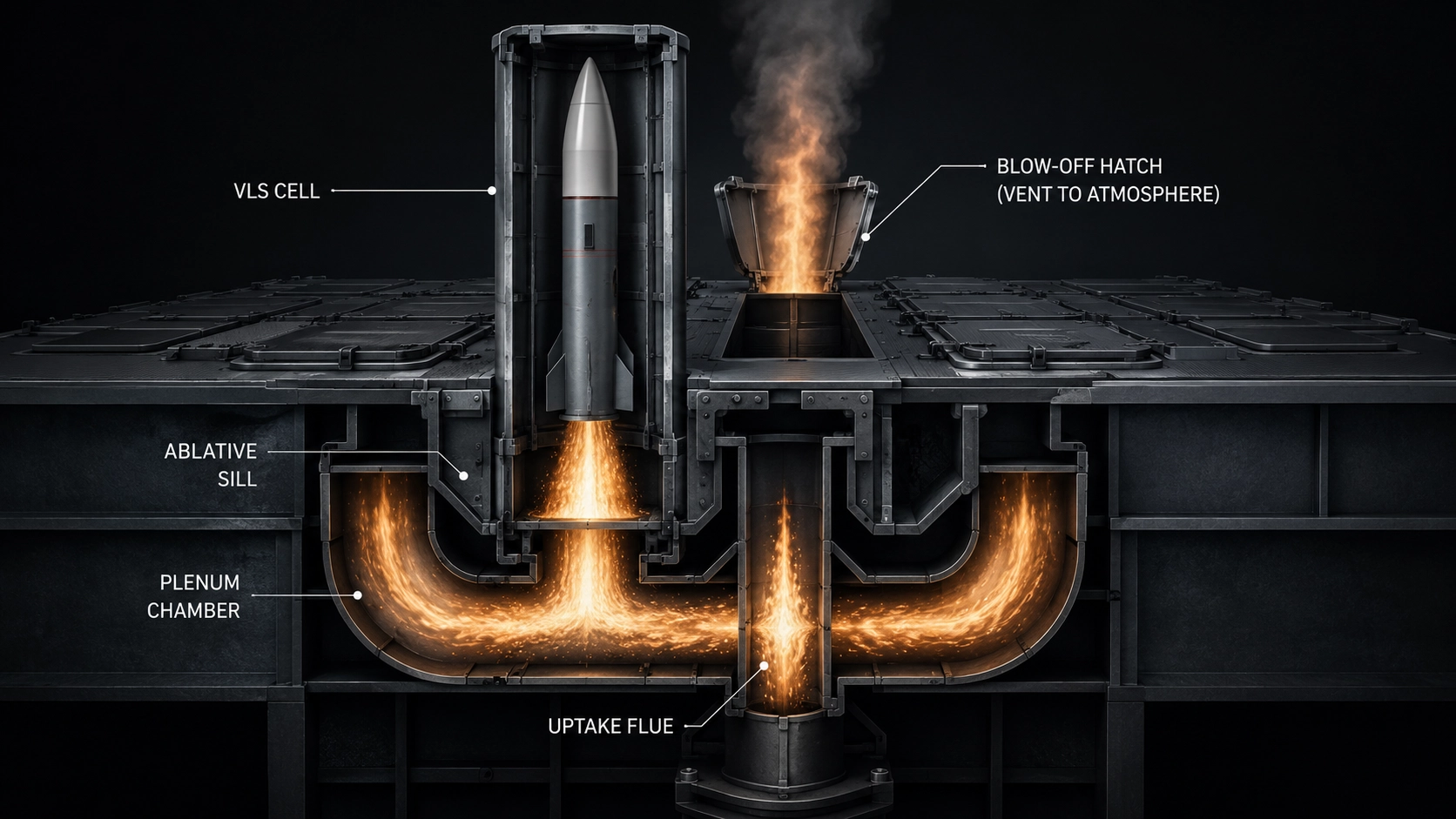
Engineers solve this through the Concentric Gas Management System. The VLS array is not just a row of empty boxes; it is a complex, structural plumbing network. When a missile fires, the exhaust blasts downward through the bottom of the individual canister and impacts a heavy ablative sill.
This sill deflects the gas horizontally into a shared structural channel called the plenum. The plenum acts as a massive exhaust pipe, routing the high-pressure gas laterally to a central uptake flue, which forces the fire back upward and safely vents it out through a blow-off hatch on the ship’s main deck.
The fluid dynamics required to push this gas through a U-turn without causing a back-pressure wave that crushes the firing missile dictate the precise physical dimensions of the entire VLS architecture. Every canister must seal perfectly against this plenum to ensure the toxic blast does not leak into the ship’s internal living quarters.
WHY IT MATTERS NOW
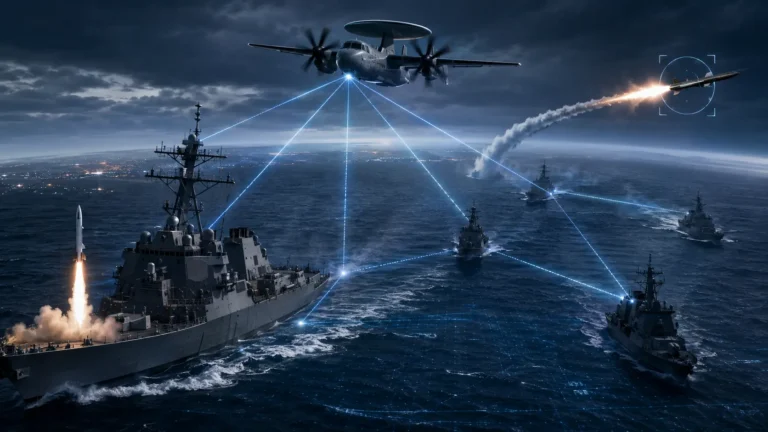
Modern naval warfare is fundamentally a mathematics problem of magazine depth. A single Arleigh Burke-class destroyer carries up to 96 VLS cells. During high-intensity combat, such as defending commercial shipping against drone swarms in the Red Sea, a destroyer can rapidly exhaust this entire inventory in a matter of weeks or even days.
The engineering complexity of the gas management system completely dictates the strategic logistics of global naval conflict. A VLS canister must be loaded into the ship’s deck structure with millimeter-level precision. The canister must securely mate with the exhaust plenum and the high-voltage electronic firing umbilicals.
Because of these extreme physical tolerances, a warship physically cannot reload its VLS cells while bobbing in the open ocean. A heavy crane attempting to lower a two-ton Tomahawk canister into a tight steel cell during three-foot ocean swells would instantly crush the delicate gas seals or sever the electronic connectors.
Consequently, when a multi-billion-dollar warship empties its VLS magazine, it is effectively neutralized. It must abandon its combat station and sail for days or weeks back to a specialized, calm-water naval facility—like Yokosuka, Japan, or Pearl Harbor—simply to use a stabilized pier-side crane to reload. This logistical tether means an adversary does not necessarily need to sink a US Navy destroyer; they simply need to force it to empty its cells.
WHAT MOST PEOPLE MISS
Military commentators frequently judge a ship’s power solely by counting the number of visible VLS hatches on the deck. They entirely miss the thermal constraints limiting rapid-fire capabilities.
A standard 8-cell VLS module shares a single central exhaust uptake. If a ship’s combat system attempts to ripple-fire all eight missiles simultaneously to intercept an incoming hypersonic swarm, the massive volume of combined exhaust gas will instantly over-pressurize the shared plenum. This back-pressure causes a “choked flow” condition, where the exhaust violently rebounds upward, structurally destroying the unfired missiles still sitting in their canisters. To prevent this catastrophic failure, the VLS software physically enforces a micro-second delay between launches, artificially capping the ship’s absolute maximum rate of fire regardless of the incoming threat density.
THE TRAJECTORY
Next 12–36 Months: The US Navy will accelerate the testing of the Transferrable Rearming Mechanism (TRAM). This specialized, heavy-duty articulating crane system is designed to attach directly to the ship’s deck, mathematically compensating for wave motion to safely lower VLS canisters while operating in calm, forward-deployed anchorages, reducing the reliance on fixed ports.
Next Five Years: Defense contractors will field cold-launch VLS architectures for larger munitions. Instead of igniting the rocket motor inside the ship, a high-pressure gas generator will literally blow the missile out of the cell like a mortar round. The rocket motor will only ignite once the weapon is safely fifty feet in the air, completely eliminating the need for heavy, space-consuming exhaust plenums inside the hull.
Next Ten Years: The physical constraints of the VLS will force a transition toward directed-energy weapons. As physical magazine depth remains an unsolvable logistical constraint, surface combatants will rely increasingly on megawatt-class solid-state lasers to intercept cheap drones, reserving the finite VLS cells exclusively for heavy, long-range anti-ship ballistic missiles.
What Could Go Wrong: The VLS relies on an automated deluge system that floods a cell with fresh water if a missile rocket motor accidentally ignites while the top hatch remains locked. If localized battle damage severs the ship’s internal water mains, an accidental ignition will rapidly burn through the steel canister, triggering a sympathetic detonation of the entire 96-cell magazine and instantly destroying the ship.
Most Likely Outcome: The Mk 41 Vertical Launch System will remain the undisputed architectural standard for Western naval power. However, the physical inability to easily reload these complex gas-sealed chambers at sea will remain the primary logistical vulnerability limiting the endurance of surface fleets in any prolonged, high-intensity conflict.
KEY TERMS
- Vertical Launch System (VLS): A standardized, modular grid of silos installed in a ship’s hull that stores, manages, and fires multiple types of guided missiles.
- Plenum: A reinforced structural chamber located beneath the VLS cells that captures rocket exhaust and redirects it safely out of the ship.
- Hot Launch: A firing method where the missile’s primary rocket motor ignites while still physically secured inside the launch canister.
- Cold Launch: A firing method that uses compressed gas to eject the missile from the ship before the primary rocket motor ignites in the air.
- Deluge System: An emergency safety mechanism that floods a VLS cell with pressurized water to cool the warhead if the rocket motor inadvertently ignites.
SOURCES
- United States Navy — Mk 41 Vertical Launching System (VLS) Operations and Maintenance Manual
- Lockheed Martin — VLS Gas Management and Structural Engineering Topography
- Naval Sea Systems Command (NAVSEA) — Surface Warfare Logistics and At-Sea Rearming Constraints
- Journal of Naval Engineering — Thermodynamic Modeling of Constrained Solid-Rocket Exhaust Plumes