Advertisement
)

AT A GLANCE
- Concept: Distributed Storing: Content delivery networks hold copies of website data in hundreds of cities simultaneously to reduce physical transit time.
- Concept: Cache Stale State: When a central database updates, the distant edge copies instantly become outdated and incorrect.
- Concept: Cryptographic Hashing: Every file receives a unique mathematical signature; if the file changes, the signature changes completely.
- Concept: Invalidation Routing: Algorithms instantly push new mathematical signatures to all edge nodes to force them to delete stale data.
HOW IT WORKS
The speed of light mathematically limits internet performance. A user in Tokyo requesting data from a database in New York will always experience physical delay. To solve this, Content Delivery Networks (CDNs) like Cloudflare or Akamai place massive racks of edge servers physically close to users around the world, storing localized copies of high-demand data.
This physical distribution creates an immediate computational problem: cache coherence. If a global news organization updates a breaking headline on their main origin server in New York, the localized edge server in Tokyo still holds the old version in its memory cache. If Tokyo continues serving the old version, the global internet fractures into thousands of conflicting realities.
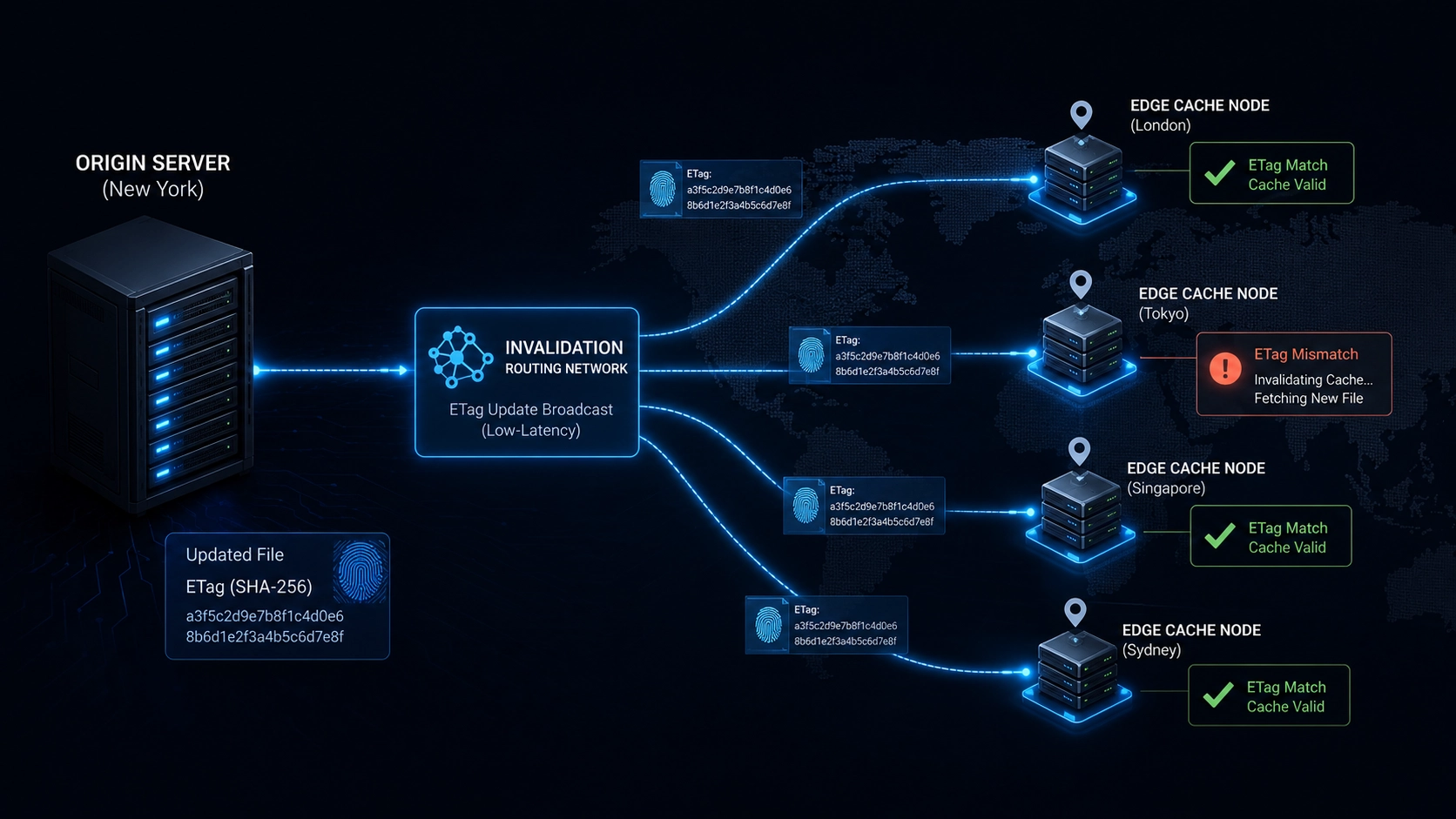
To maintain perfect synchronization without creating massive network gridlock, CDNs utilize edge cache consistency protocols relying heavily on cryptographic hashing. When the origin server updates the news article, it runs the new text through a hash function (like SHA-256) to generate a unique digital fingerprint, known as an Entity Tag (ETag).
The origin server does not immediately blast the heavy, updated file to thousands of edge servers. Instead, it instantly broadcasts only the new ETag fingerprint through a specialized, low-latency invalidation routing network.
When the Tokyo edge server receives the new ETag, it compares it against the ETag of the article currently sitting in its memory. If the tags mismatch, the Tokyo server mathematically recognizes its own data is stale. It immediately deletes the old file and executes a targeted pull request back to the origin server to fetch the exact, updated bytes required to reconcile its state.
WHY IT MATTERS NOW
Modern websites are no longer static digital brochures; they are complex, dynamic applications executing financial transactions, live streaming video, and processing real-time inventory for global e-commerce platforms.
If a multinational retailer drops a limited-edition sneaker, millions of users simultaneously hit thousands of different edge servers worldwide to check inventory. If those edge servers do not maintain perfect, sub-millisecond cache consistency, the system might accidentally sell the same pair of shoes to a buyer in London and a buyer in Seoul.
Maintaining this synchronization requires extreme computational overhead. Centralized databases cannot handle millions of simultaneous verification queries from edge nodes; the sheer volume of “is this data still fresh?” requests would execute a self-inflicted Denial of Service (DoS) attack, melting the origin server’s processors.
By distributing the validation logic outward—allowing the edge nodes to verify freshness autonomously using mathematical hashes rather than full-file downloads—CDNs prevent central database collapse. This specific algorithmic architecture enables the existence of hyperscale digital economies.
The companies controlling these global coherence networks functionally dictate the speed and reliability of modern civilization’s digital infrastructure. A localized failure in Cloudflare’s cache invalidation logic does not just break one website; it instantly disrupts global banking portals, airline ticketing systems, and massive government databases simultaneously.
WHAT MOST PEOPLE MISS
System architects often view caching purely as a storage capacity issue, adding more terabytes of RAM to edge servers to hold more data. They miss the reality that massive storage actually compounds the consistency problem.
The larger the cache, the harder it is to invalidate. If an edge node holds terabytes of localized video and dynamic code, scanning that entire memory bank to find and delete one specific stale file takes significant computational time.
To bypass this, advanced CDNs use structured tag-based invalidation. Instead of searching for the exact file URL, developers attach logical metadata tags (e.g., user-profile-update or inventory-batch-7) to thousands of disparate files. When the origin server broadcasts the invalidation command for a specific tag, the edge node instantly dumps all associated files simultaneously, completing a massive database purge in a single microscopic clock cycle.
THE TRAJECTORY
Next 12–36 Months: Global CDNs will integrate WebAssembly (Wasm) runtimes directly into the edge caching layer. This will allow edge servers to execute custom, application-specific consistency logic locally, dynamically generating fresh content based on user location without ever contacting the origin database.
Next Five Years: Distributed state synchronization will shift from reactive invalidation to predictive pre-fetching using machine learning. Edge networks will analyze global traffic patterns to predict exactly which files will change next, actively pulling the updated cryptographic hashes into local memory milliseconds before the user even clicks the refresh button.
Next Ten Years: The strict boundary between the origin database and the edge cache will dissolve entirely. Distributed ledger architectures and conflict-free replicated data types (CRDTs) will turn every edge node into a fully functioning, write-capable master database, allowing users to execute global financial transactions entirely at the physical edge of the network.
What Could Go Wrong: If a malicious actor successfully intercepts and poisons the invalidation routing network, they could broadcast millions of fake ETag updates simultaneously. This would force every global edge node to delete its entire cache and hammer the main origin server with replacement requests, causing a catastrophic, cascading infrastructure collapse.
Most Likely Outcome: Edge cache consistency protocols will become entirely abstracted away from human developers, managed exclusively by autonomous AI routing engines. The physical location of the master database will become irrelevant, as the synchronization algorithms will maintain a perfect, real-time illusion of localized data for every user on the planet.
KEY TERMS
- Cache Coherence: The computer science requirement ensuring that multiple distributed copies of a single dataset remain perfectly synchronized and identical across a network.
- Content Delivery Network (CDN): A globally distributed network of proxy servers deployed in multiple data centers to serve content spatially closer to end users.
- Cryptographic Hashing: A mathematical algorithm that maps digital data of any size to a fixed-size string of characters, creating a unique, verifiable digital fingerprint.
- Entity Tag (ETag): An HTTP response header utilized by web servers to validate cache freshness, typically containing the cryptographic hash of the requested file.
- Cache Invalidation: The programmatic process of explicitly declaring stored data as stale or outdated, forcing the system to retrieve a fresh copy from the primary database.
SOURCES
- Institute of Electrical and Electronics Engineers (IEEE) — Consistency Mechanisms for Distributed Web Caching
- Cloudflare — CDN Cache Invalidation Architecture and Tag-Based Purging
- Akamai Technologies — Edge Computing State Synchronization and Data Consistency Models
- Internet Engineering Task Force (IETF) — HTTP Caching and Conditional Requests Specifications