Advertisement
)
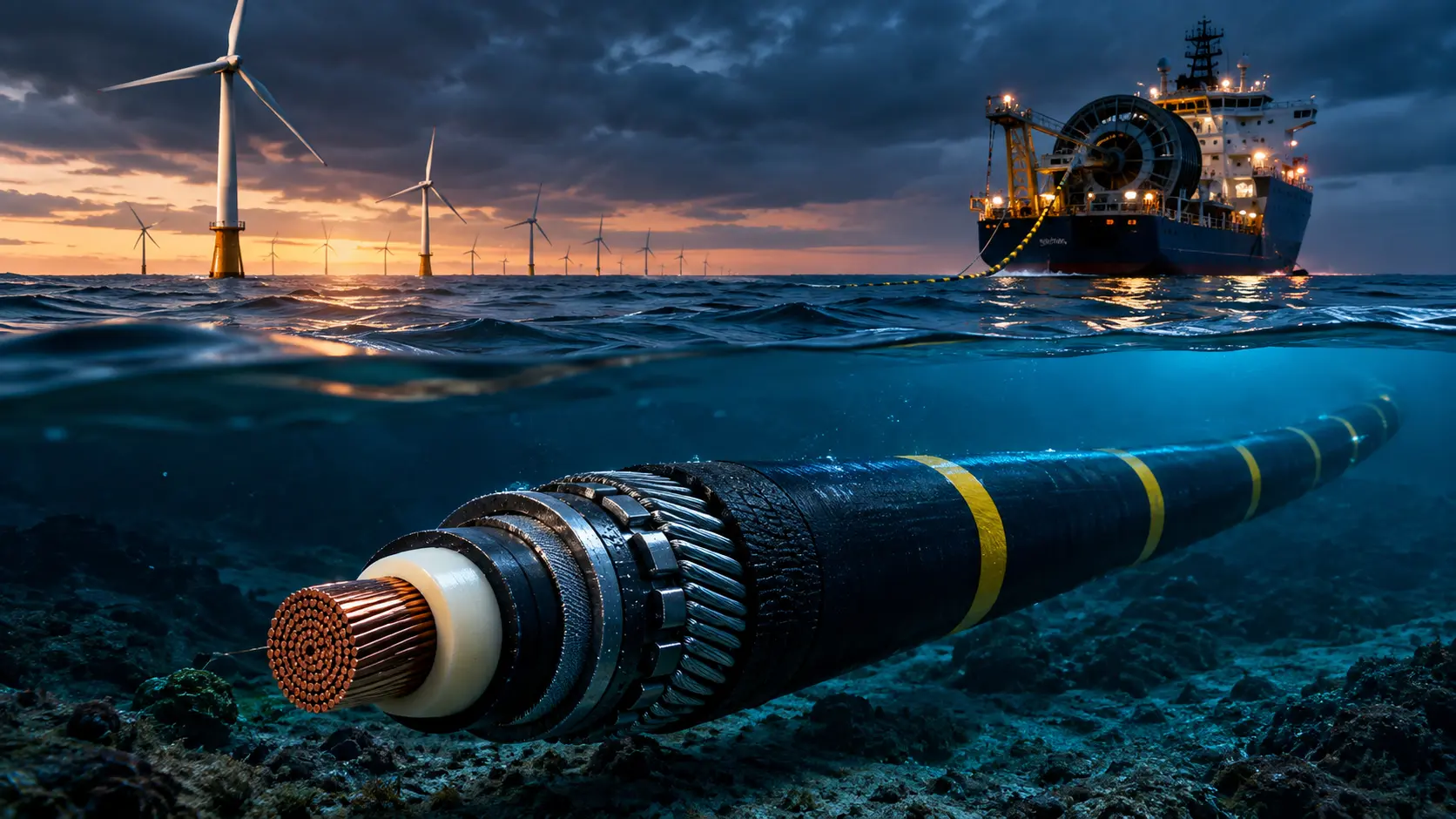

A nation can build a thousand towering wind turbines in the middle of the ocean, but without a physical copper artery connecting them to the mainland grid, they are nothing more than multi-billion-dollar kinetic sculptures. For the past decade, policymakers have obsessed over turbine size, blade aerodynamics, and megawatt capacities. They entirely ignored the seafloor. Now, as the world attempts to plug gigawatts of remote offshore wind into the grid, a brutal physical reality has emerged: the cables required to carry that much power over that much distance are incredibly difficult to make, and even harder to sink.
Why should you care right now? Because the entire global renewable energy transition is currently waiting in line at the cash register of a European oligopoly. Three companies—Prysmian, Nexans, and NKT—effectively control the manufacturing of 525kV High Voltage Direct Current (HVDC) subsea cables and the specialized billion-dollar ships required to lay them. As offshore wind farms move deeper into the ocean to catch stronger winds, utility executives are slamming into a supply chain wall. Order books are full until 2030, project costs are skyrocketing, and securing a cable-laying vessel is now a matter of national energy security.
What are 525kV HVDC Subsea Cables?
525kV HVDC subsea cables are ultra-high-capacity underwater transmission lines designed to carry up to 2.5 gigawatts of electricity over vast distances with near-zero power loss. They utilize cross-linked polyethylene (XLPE) insulation and direct current physics to efficiently connect remote offshore wind farms to mainland power grids.
At a Glance
- Concept: Piping massive amounts of electricity from deep-ocean wind farms to cities using highly insulated, ultra-thick copper cables.
- Why it matters: Standard AC cables lose their power to the ocean over long distances. 525kV HVDC is the only technology that can move gigawatts of power over 100 kilometers underwater without losing the electricity along the way.
- Who uses it: Mega-utilities and transmission system operators (TSOs) like TenneT, National Grid, and Orsted.
- Biggest takeaway: Producing the cable is only half the battle. Laying a continuous 525kV cable requires a highly specialized ship with a 10,000-ton rotating carousel that takes years to build. There is a massive global shortage of these ships.
In Simple Words
Think of an electrical cable like a water pipe. If you want to push more water (electricity) through the pipe, you can either make the pipe wider (Amps), or you can push the water much harder (Volts).
If you just make the pipe wider, it gets too heavy to sink to the bottom of the ocean. So, engineers push the electricity incredibly hard—at 525,000 Volts (525kV).
But there is a catch. If you push standard household electricity (Alternating Current, or AC) through a long underwater pipe, the electricity naturally tries to leak out into the surrounding ocean. After about 60 miles, the cable is using all of its capacity just fighting the ocean, and no actual power reaches the city.
To fix this, engineers use Direct Current (HVDC). Direct current flows in a straight, unstoppable line. A 525kV HVDC cable is essentially an armored, insulated superhighway that allows raw electricity to travel hundreds of miles underwater at the speed of light, arriving at the city with almost zero loss.
Why This Matters
For Utility Planners, Energy Investors, and Supply Chain Execs, 525kV HVDC represents the Ultimate Infrastructure Bottleneck.
The financial models for offshore wind assume that once a turbine is built, it generates revenue. But if a utility cannot secure a 525kV export cable, the wind farm sits idle. Right now, European Transmission System Operators (TSOs) like TenneT are executing $30 billion framework agreements, sweeping up all the available manufacturing capacity at Prysmian, Nexans, and NKT for the next decade.
If you are an offshore wind developer in the United States or Asia, you are effectively locked out. Lead times for 525kV cables have stretched from 24 months to over 72 months. For investors, this supply/demand imbalance dictates that the most lucrative position in the offshore wind market isn’t owning the turbines—it’s owning the cable manufacturers and the vessels that lay them.
Micro-Insight: In the modern energy transition, the company that controls the copper artery wields more geopolitical power than the company that harvests the wind.
The Shift to HVDC Continental Supergrids
We are witnessing the Shift from Local Grids to Continental Supergrids.
The deployment of 525kV HVDC is not just about connecting a single wind farm to a beach. It is the foundational technology for the “Interconnector Era.” Because HVDC can travel thousands of kilometers without loss, nations are using these cables to tie entire countries together. A 525kV cable allows excess solar power in Spain to instantly flow under the sea to power factories in the UK, or offshore wind in the North Sea to heat homes in Germany. It turns isolated national grids into a massive, load-balancing continental machine.
How 525kV HVDC Subsea Cables Work
Shooting 525,000 volts of electricity through a copper wire resting in freezing, highly conductive salt water is an exercise in extreme physics. Here is the first-principles breakdown of the architecture.
1. The Fundamental Problem: Capacitive Charging Current
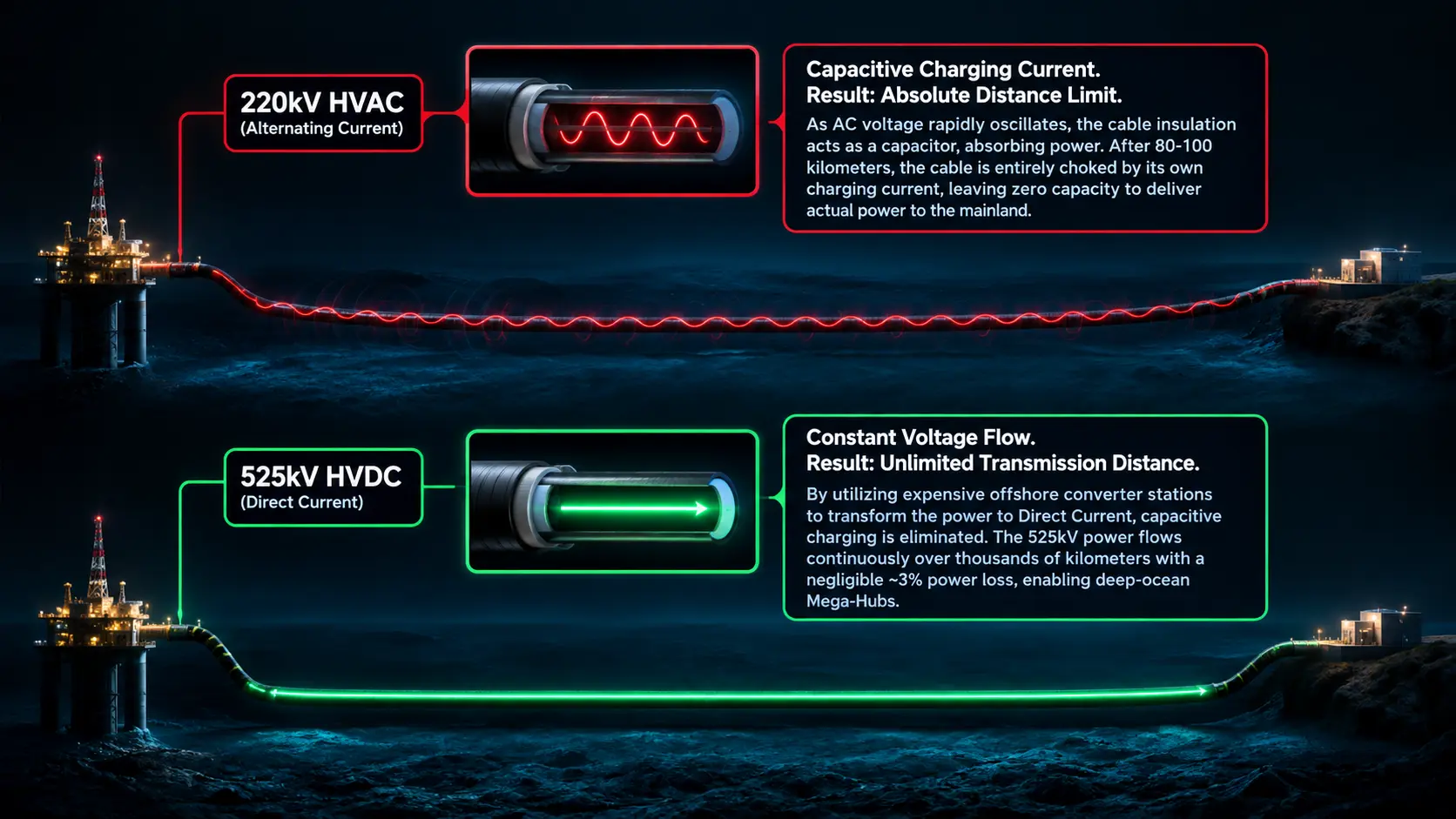
Standard power grids use Alternating Current (AC). When AC travels through a subsea cable, the copper wire inside and the seawater outside act like the two plates of a capacitor, with the cable’s insulation acting as the barrier. As the AC voltage alternates 60 times a second, it constantly “charges and discharges” this capacitor. Over long distances (past 80 km), this “charging current” takes up the entire capacity of the cable. The cable gets full of useless, bouncing energy, leaving zero room for real, usable electricity.
2. The Core Mechanism: High Voltage Direct Current (HVDC)
To defeat capacitive loss, engineers convert the electricity to Direct Current (DC) before it goes underwater. Because DC voltage is constant—it does not alternate—it charges the cable’s capacitance exactly once when it is turned on, and then never again. This allows the electricity to flow indefinitely with roughly a 3% power loss per 1,000 kilometers, making it the only viable method for deep-sea transmission.
3. Technical Depth: XLPE Insulation and Thermal Limits
When you push 2.5 GW of power through copper, it generates massive amounts of heat. Older cables used paper soaked in thick oil (Mass-Impregnated insulation), which melted at around 55°C. Modern 525kV cables use Cross-Linked Polyethylene (XLPE). XLPE is a highly engineered plastic that can operate continuously at 90°C. If the utility pushes too much power and the copper exceeds 90°C, the XLPE melts, the 525,000 volts arc into the seawater, and the multi-million-dollar cable violently shorts out at the bottom of the ocean.
Plain-English Takeaway: You can only push as much electricity through a cable as the plastic wrapping can handle before it melts. XLPE plastic raised that melting point, allowing us to pump gigawatts of power.
4. Technical Depth: The Cable Laying Vessel (CLV) Bottleneck
Manufacturing the cable is difficult; transporting it is harder. 525kV cable weighs roughly 50 kilograms per meter. You cannot splice (connect) short pieces of cable together easily in the middle of the ocean—splices are weak points. Therefore, the cable must be manufactured in one continuous, massive length.
To move it, you need a highly specialized Cable Laying Vessel (CLV). These ships possess massive internal carousels that hold up to 10,000 tons of continuous cable. They use advanced Dynamic Positioning (DP3) thrusters to fight ocean currents and remain perfectly stationary while lowering the cable thousands of meters to the sea floor.
5. Real-World Consequences: The Oligopoly Queue
Because a state-of-the-art CLV costs over $200 million and takes four years to build, there are only about a dozen capable of handling 525kV HVDC in the world. Prysmian, Nexans, and NKT own them. If your offshore wind project does not secure a timeslot on one of these vessels years in advance, your project simply does not happen.
Subsea Power Transmission: 220kV HVAC vs. 525kV HVDC
Simulating Capacitive Line Loss, Dielectric Thermal Limits, and Long-Distance Grid Throughput
Subsea Cable Length
80 km
Transmission Architecture
220kV HVAC (Alternating)
525kV HVDC (Direct Current)
Delivered Active Power
0.45 GW
Capacitive / Reactive Loss
58.4% (Severe)
Cable Core Temperature
54.2°C (XLPE Safe)
Deep-Water Subsea Profile & Waveform Propagation
CAPACITIVE LOSS DETECTED
Transmission Throughput: Active Power (GW) & Line Efficiency (%)
Real-World Applications
525kV technology is no longer theoretical; it is actively being deployed in the world’s most aggressive infrastructure mega-projects.
The Eastern Green Link (EGL) Projects: The UK is currently executing a massive grid overhaul to bring wind power from Scotland down to demand centers in England. EGL 4, awarded to Prysmian, represents a multi-billion-euro contract to deploy 525kV HVDC cables stretching hundreds of kilometers down the coast. This bypasses the onshore bottleneck of building ugly overhead pylons through the British countryside, utilizing the sea as a high-capacity energy highway.
The North Sea Wind Power Hub: TenneT, the Dutch-German transmission operator, is leading the “2GW Program.” They have standardized 525kV HVDC as the absolute baseline for all future North Sea wind connections. Instead of each wind farm running its own small cable to shore, multiple wind farms connect to a centralized artificial island or massive offshore converter platform. The platform converts the power to 525kV DC and shoots 2.0 to 2.5 GW through a single, massive trunk line to the mainland, drastically reducing the amount of copper required and limiting disruption to the seabed.
Nexans Aurora in Deep Water: France’s Nexans has continually pushed the boundaries of installation depth. Using their flagship vessel, the Nexans Aurora, they are proving that 525kV cables can be laid in waters approaching 3,000 meters deep. This is critical for floating offshore wind farms, which are deployed over deep-ocean trenches (like the Mediterranean or the US West Coast) where traditional fixed-bottom turbines cannot be built.
Economic & Strategic Impact
The core strategic consequence of the 525kV era is Absolute Vendor Pricing Power.
Because the technical specifications of 525kV HVDC XLPE cable are so exacting, and the risk of failure is a multi-million-dollar disaster, utilities refuse to buy from unproven, low-cost manufacturers. They will only buy from Prysmian, Nexans, and NKT.
This has resulted in an absolute seller’s market. These three European giants are securing capacity reservation fees—utilities are literally paying them millions of dollars just to hold a spot in the manufacturing queue, before a single inch of copper is even drawn. Their order backlogs now exceed $15 to $20 billion each. They dictate the timelines, they dictate the margins, and they ultimately dictate the pace of the global energy transition.
Advantages
- Zero Capacitive Loss: HVDC allows power to travel hundreds of kilometers underwater without the severe charging current losses that cripple AC cables.
- Massive Throughput: Operating at 525,000 volts allows a single cable trench to move up to 2.5 GW of power, minimizing the environmental impact on the seabed.
- Grid Load Balancing: Connects asynchronous national grids (e.g., UK and France), allowing them to share power and balance out the intermittency of wind and solar.
- High Thermal Limits: XLPE insulation allows the cable to run safely at 90°C, increasing the maximum amperage and overall power density.
Limitations
- The Converter Station CapEx: HVDC requires massive offshore platforms to convert the AC power from the turbines into DC power for the cable. These HVDC converter stations cost hundreds of millions of dollars and are the size of an office building.
- The Vessel Shortage: You cannot lay these cables with a standard ship. The severe lack of 10,000-ton capacity Cable Laying Vessels (CLVs) is delaying projects globally.
- Jones Act Friction: In the US, maritime law requires ships operating between domestic ports to be American-built. There is a critical lack of US-flagged CLVs capable of laying 525kV cables, threatening the entire US East Coast offshore wind timeline.
Takeaway: 525kV HVDC makes the impossible possible, but it shifts the economic burden from the cable itself to the massive, expensive converter stations and specialized installation ships required to make it work.
Common Misconceptions
Misconception: We can just build more cable factories to solve the backlog.
Reality: The bottleneck is not just the factory; it is the testing and the ships. 525kV cable must undergo year-long pre-qualification testing before it is allowed on the grid. Even if you build a factory tomorrow, it takes 3-4 years to build the specialized CLV required to lay the cable.
Misconception: Subsea cables are just thick wires.
Reality: They are highly complex, multi-layered engineered systems. A single 525kV cable contains a massive copper core, semi-conducting screens, ultra-pure XLPE insulation, a lead or aluminum water-blocking sheath, and heavy-duty galvanized steel armor wire.
Misconception: HVDC is always better than HVAC.
Reality: HVDC is only better for long distances. Because the offshore AC/DC converter stations are so astronomically expensive, if a wind farm is less than 60 kilometers from the shore, it is still cheaper to use standard High Voltage AC (HVAC) cables.
What Most People Miss
The disruptive capability of Dynamic Cable Ratings.
Historically, operators gave a subsea cable a strict, static maximum power rating based on worst-case summer temperatures. If they pumped more power, they assumed the XLPE insulation would melt at 90°C.
What utility planners are realizing is that the bottom of the North Sea in winter is freezing cold. Advanced operators are now wrapping their subsea cables with Distributed Temperature Sensing (DTS) fiber optics. These fiber lasers monitor the exact temperature of the cable in real-time, every meter along the route. If the ocean is cold, the operator knows the cable is being aggressively cooled by the water, allowing them to safely push 15% to 20% more power through the 525kV line than its static rating allows. This “dynamic rating” unlocks gigawatts of free capacity from infrastructure that is already buried.
Comparison Table
| Metric | 220kV HVAC (Alternating Current) | 320kV HVDC (Direct Current) | 525kV HVDC (Direct Current) |
| Max Transmission Distance | ~80 km (Capacitive limit) | 1,000+ km | 1,000+ km |
| Max Power Capacity | ~400 MW per circuit | ~1.0 to 1.2 GW | ~2.0 to 2.5 GW |
| Insulation Type | XLPE (Standard) | XLPE or Mass-Impregnated | Advanced High-Temp XLPE |
| Converter Station Required | No (Cheaper offshore CapEx) | Yes (Expensive) | Yes (Most Expensive) |
| Primary Use Case | Near-shore Wind Farms | Legacy Interconnectors | Deep-Ocean Mega-Hubs & Supergrids |
Future Outlook
Next 12–24 Months
The era of Capacity Reservations and Strategic M&A. Through 2027, the focus will not be on technological innovation, but on supply chain warfare. Utilities will continue to lock up Prysmian and Nexans capacity through the early 2030s. We will likely see offshore wind developers vertically integrate by acquiring stakes in marine logistics companies just to guarantee access to Cable Laying Vessels, treating maritime transit as a core strategic asset.
Next 3–5 Years
The scaling of US Domestic Manufacturing. By 2030, the United States will be forced to solve its Jones Act bottleneck. We will see the completion of new, US-flagged CLVs funded by massive federal subsidies. Concurrently, European cable manufacturers will complete their first high-voltage subsea manufacturing plants on US soil (such as Nexans in South Carolina), localizing the supply chain to serve the massive East Coast wind boom.
Next 10 Years
The 525kV Multi-Terminal DC Grid. By the mid-2030s, the current point-to-point architecture (one wind farm to one city) will be obsolete. The North Sea will operate as a true “Multi-Terminal” HVDC grid. Massive 525kV cables will connect multiple wind farms to multiple countries simultaneously via offshore circuit breakers. This oceanic supergrid will autonomously route power to whichever nation needs it most in milliseconds, creating a unified, hyper-resilient European energy market.
Most Likely Scenario
525kV HVDC is the absolute physical prerequisite for a decarbonized global economy. The technology works flawlessly; the physics of XLPE insulation and direct current transmission have been conquered. However, the multi-billion-dollar backlog caused by a narrow European oligopoly and a severe lack of specialized vessels ensures that offshore wind targets for 2030 will likely be missed. The transition will happen, but it will be governed entirely by the speed at which we can build the ships required to sink the copper.
Key Takeaways
- Standard AC cables lose massive amounts of power over long underwater distances. High Voltage Direct Current (HVDC) is mandatory for connecting remote offshore wind farms to the mainland.
- 525kV is the current technological pinnacle, allowing a single cable trench to deliver up to 2.5 Gigawatts of power with near-zero transmission loss.
- The cables utilize advanced XLPE plastic insulation, which allows the internal copper core to run as hot as 90°C without melting or shorting out in the ocean.
- The entire global market is constrained by an oligopoly (Prysmian, Nexans, NKT) and a severe shortage of specialized Cable Laying Vessels (CLVs) capable of handling the 10,000-ton cable weight.
- Operators are now using fiber-optic temperature sensors (DTS) to monitor the cable in real-time, allowing them to pump more power through the line when the ocean water is cold enough to cool it.
Glossary
Cable Laying Vessel (CLV): A highly specialized, expensive ship equipped with massive internal carousels and dynamic positioning thrusters, designed specifically to carry and lay thousands of tons of continuous subsea cable.
Capacitive Charging Current: The phenomenon in AC cables where the alternating current charges the cable’s insulation like a battery, wasting massive amounts of capacity over long distances.
Distributed Temperature Sensing (DTS): A technology that uses fiber-optic cables wrapped around the power line to measure the exact temperature of the cable in real-time using laser backscatter.
High Voltage Direct Current (HVDC): A transmission method that pushes electrical power in a single, constant direction. It prevents power loss over extreme distances but requires highly expensive converter stations.
Jones Act: A US maritime law requiring goods transported between US ports (or offshore US installations) to be carried on ships that are built, owned, and operated by US citizens.
XLPE (Cross-Linked Polyethylene): An advanced, highly durable plastic insulation used in high-voltage cables. It replaced older oil-soaked paper, allowing cables to safely operate at 90°C.
Sources
S&P Global Commodity Insights: The HVDC Subsea Cable Supply Chain Crunch
TenneT: 2GW Program and 525kV HVDC Standardization
Nexans: Offshore Wind and Deep Water Installation Records
Prysmian Group: Eastern Green Link 4 and Multi-Billion Euro Backlogs
IEEE Power and Energy Technology Systems Journal: Thermal Limitations and Dynamic Rating of XLPE Subsea Cables