Advertisement
)
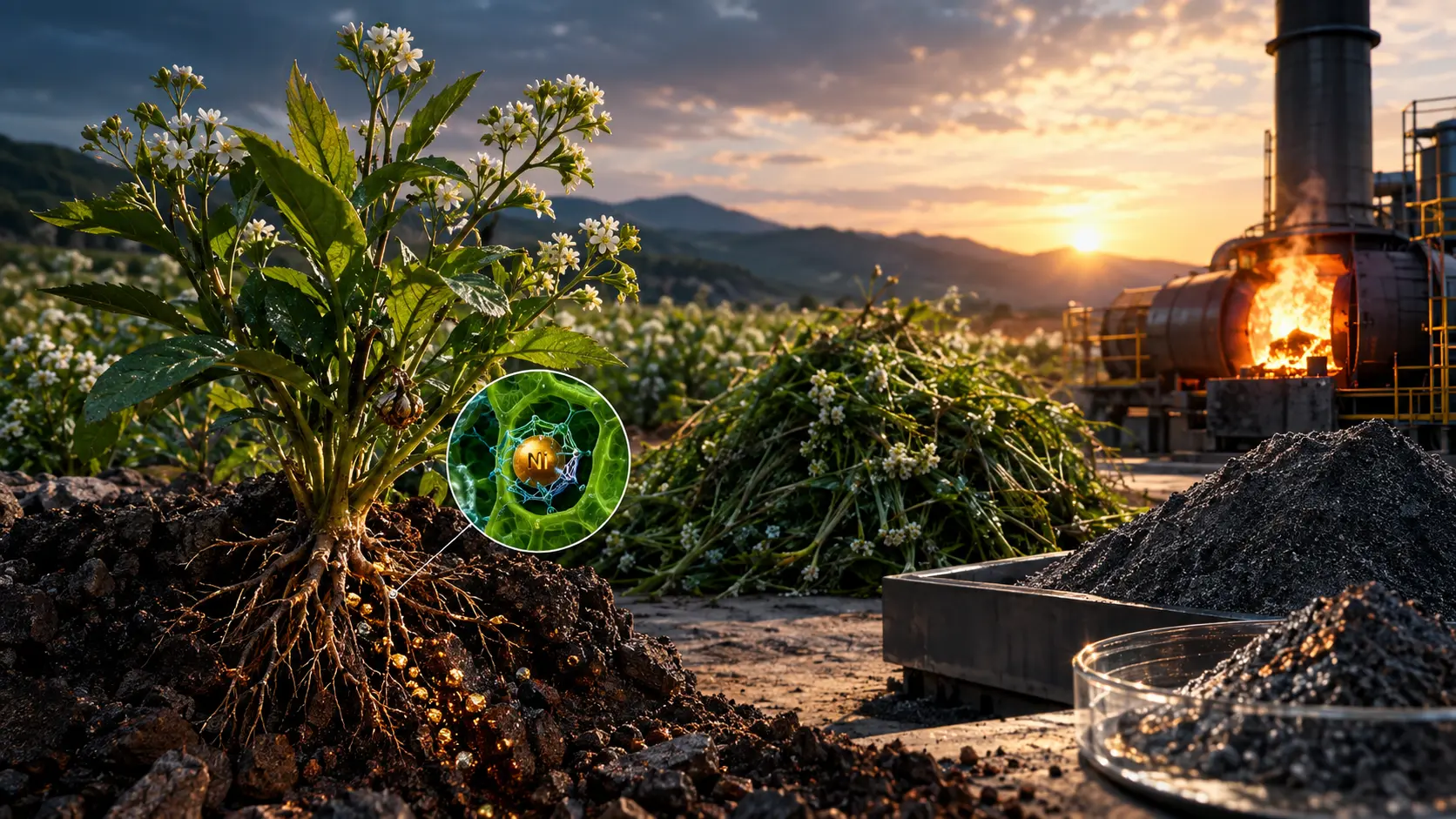

The global transition to electric vehicles has a dirty, open secret: the nickel required to build the batteries is actively destroying the ecosystems it was meant to save. Traditional nickel mining in regions like Indonesia relies on High-Pressure Acid Leaching (HPAL), a brutally toxic industrial process that clear-cuts vast rainforests and generates millions of tons of acidic, radioactive sludge. If an automaker wants to build a “green” EV today, their supply chain forces them to finance immense ecological destruction.
Why should you care right now? Because the mining industry has discovered a biological loophole that bypasses the bulldozer entirely: farming for metal. Using specialized, sap-bleeding “hyperaccumulator” plants, engineers can literally grow nickel. These exotic botanical species act as biological vacuums, drinking heavy metals out of toxic, depleted soils like water. By harvesting and burning the crop, mining executives are producing ultra-high-grade “bio-ore” that legally circumvents global ESG restrictions. This is not just environmental cleanup; it is the birth of an entirely new asset class that fuses agriculture with heavy industrial metallurgy.
What is Agromining?
Agromining (or phytomining) is an industrial process that uses specialized hyperaccumulator plants to extract critical metals from the soil. The plants absorb heavy metals like nickel or cobalt through their roots. They are then harvested and incinerated to create a high-grade “bio-ore,” providing a sustainable alternative to traditional, destructive mining.
At a Glance
- Concept: Growing crops on toxic, metal-rich dirt, harvesting the plants, and burning them to collect the metal hidden inside their leaves.
- Why it matters: The traditional way to get nickel involves strip-mining rainforests and bathing the dirt in boiling sulfuric acid. Agromining extracts the exact same metal using sunlight and seeds.
- Who uses it: Vanguard ESG mining startups, researchers in Australia and France, and EV automakers desperate for clean supply chains.
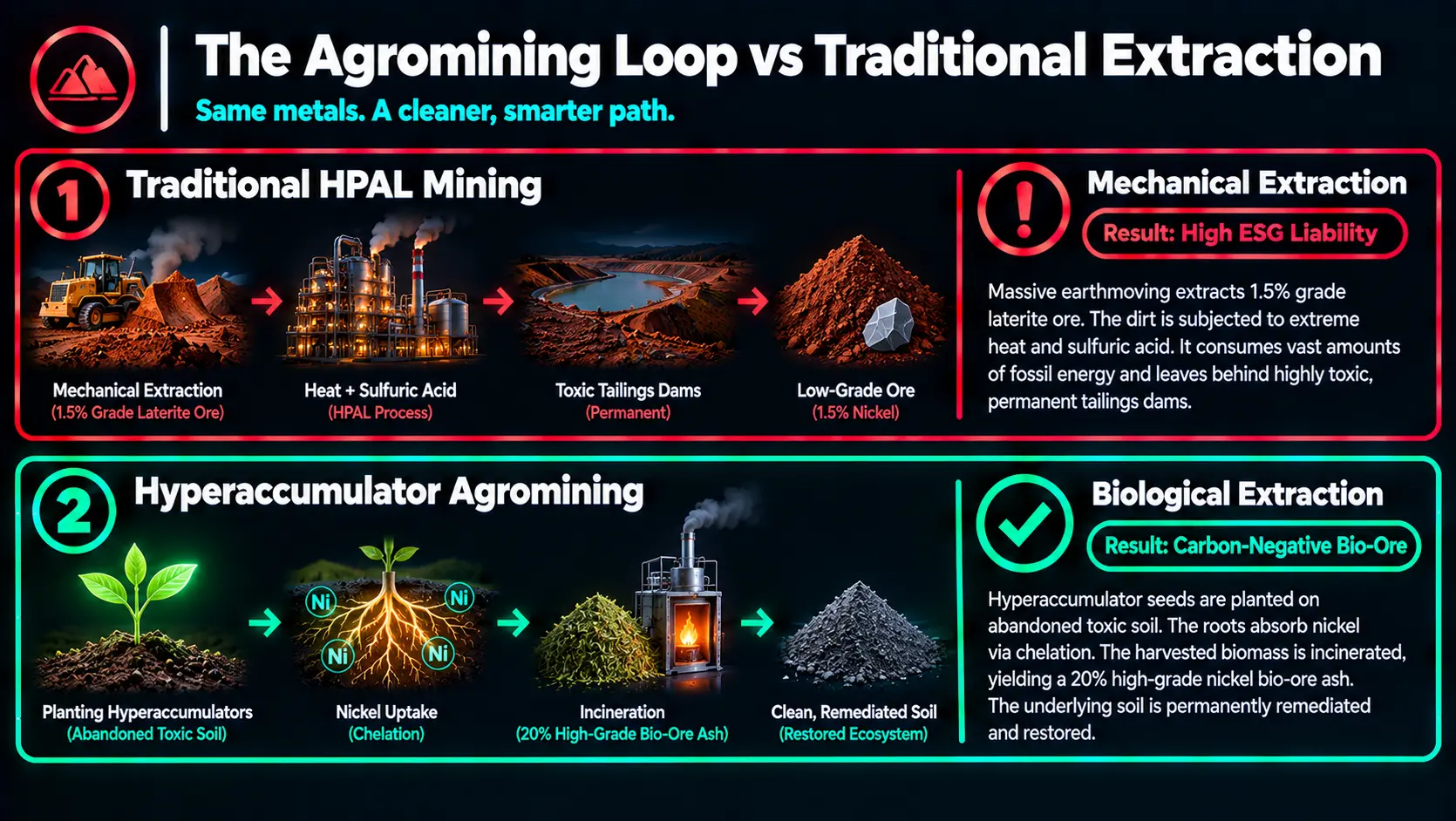
- Biggest takeaway: The ash produced from burning a hyperaccumulator plant is roughly 20% pure nickel. Traditional dirt mined out of a standard nickel mine is only 1.5% nickel. The plant does the hardest part of the refining process for free.
In Simple Words
If you plant a normal tomato in soil heavily contaminated with heavy metals, it will quickly die. The metal destroys the plant’s cells.
But over millions of years, a few rare plants evolved a superpower. To stop bugs from eating them, they learned to intentionally absorb toxic metals from the ground and store them in their leaves. When a bug takes a bite, it gets poisoned, but the plant survives. These are called hyperaccumulators.
Agromining turns this biological quirk into a business. Mining companies take land that is so toxic or naturally rich in metal that nothing else can grow there. They plant a massive field of hyperaccumulators. Over the summer, the plants drink up the metal. In the fall, tractors harvest the plants, bale them like hay, and burn them. The fire burns away the carbon, leaving behind an ash that is packed with pure, highly valuable nickel.
Why This Matters
For Commodity Traders, ESG Investors, and Mining Execs, agromining solves the Green Premium Sourcing Trap.
The electric vehicle (EV) industry is currently trapped in a paradox. Consumers and Western governments are demanding zero-emission vehicles, but they are also enforcing strict ESG (Environmental, Social, and Governance) compliance on how the materials are sourced. Automakers like Tesla and Ford are facing severe regulatory threats in Europe if their batteries are linked to deforestation or toxic tailings dams in the developing world.
This has created a massive market demand for “Green Nickel”—nickel extracted without ecological devastation.
Agromining is the ultimate ESG arbitrage. It does not destroy the environment; it actually cleans it. By planting hyperaccumulators on abandoned, toxic mine tailings, companies can extract millions of dollars of residual nickel while simultaneously remediating the soil (phytoremediation). This allows commodity traders to sell the resulting bio-ore at a massive “green premium” to Western automakers desperate to sanitize their supply chains.
Micro-Insight: Agromining is currently the only metal extraction process on Earth that is fundamentally carbon-negative and net-positive for local biodiversity.
The Shift to Biomimetic Metal Extraction
We are witnessing the pivot from Mechanical Extraction to Biomimetics.
Since the Bronze Age, humanity has extracted metal through brute force: digging massive holes, crushing rocks, and melting them with extreme heat. Agromining shifts this paradigm from physics to biology.
By outsourcing the initial, energy-intensive phase of chemical separation to a plant’s root system, we are turning photosynthesis into a metallurgical tool. We are no longer fighting the Earth to extract its resources; we are programming its flora to hand them to us.
How Hyperaccumulators Chelate Heavy Metals
Forcing a plant to absorb toxic concentrations of metal without dying requires a masterpiece of evolutionary chemistry. Here is the first-principles breakdown of the architecture.
1. The Fundamental Problem: Low-Grade Ore Energy
Most of the unmined nickel left on Earth is trapped in “laterite” soil at incredibly low concentrations (around 1%). To extract it, you must scoop up 100 tons of dirt, heat it to immense temperatures, and bathe it in high-pressure acid just to get 1 ton of nickel. The energy required to process the 99 tons of useless dirt is astronomical.
2. The Core Mechanism: Citrate Chelation
Hyperaccumulators solve this concentration problem through a process called chelation. When a plant like Alyssum murale absorbs nickel through its roots, the metal should technically poison it. To survive, the plant’s cells produce a special organic molecule (often citrate or histidine). This molecule acts like a biological straightjacket. It wraps around the nickel atom, neutralizing its toxicity. The plant then safely pumps this wrapped nickel up into its stems and leaves for storage.
3. Technical Depth: Ultramafic Cropping
Farmers deploy these plants on “ultramafic” soils. These are naturally occurring soils that are loaded with heavy metals like nickel and magnesium, but completely devoid of standard agricultural nutrients like potassium. Because regular crops (like corn or wheat) cannot survive in ultramafic soil, agromining does not compete with global food production. The land is otherwise economically useless.
Plain-English Takeaway: The plant acts like a microscopic chemical refinery, sifting through the dirt to find the nickel, wrapping it in a protective bubble, and storing it safely in its leaves.
4. Technical Depth: Bio-Ore Smelting Thermodynamics
Once the plants reach maturity, they are mechanically harvested and dried. The dried biomass is then burned in a controlled incinerator. The carbon and organic matter burn away as energy (which can be captured to generate electricity). What is left behind is the “bio-ore” ash.
Because the plant already isolated the metal, this ash contains between 15% and 25% pure nickel. The bio-ore is then shipped to a standard smelter. Because the grade is so high, the smelter uses a fraction of the energy it normally would to refine it into battery-grade nickel sulfate.
5. Real-World Consequences: Closed-Loop Remediation
As the hyperaccumulators are harvested year after year, the toxic metal concentration in the soil slowly drops. Eventually, the heavy metals are entirely stripped from the topsoil. At this point, the land is “cured.” The mining company can sell the newly detoxified, remediated land back to local communities for standard agricultural farming, closing the industrial loop perfectly.
Agromining Remediation Simulator
Hyperaccumulator Metal Chelation & Bio-Ore Harvesting Cycle
Initial Soil Toxicity
High (100%)
Plant Species
Standard Crop
Alyssum (Hyperaccumulator)
Soil Toxicity Remaining
100.0%
Current Bio-Ore Grade
0.0% Ni
Total Nickel Extracted
0.0 kg
Biological Chelation & Root Extraction
AWAITING PLANTING
Phytoremediation Economics Over Multiple Seasons
Commercial Phytomining and Bio-Ore Production
Agromining is transitioning from academic botany experiments into commercial, revenue-generating agriculture.
The Sabah Bio-Ore Farm (Malaysia): In the Malaysian state of Sabah, large tracts of land are covered in naturally occurring ultramafic soil. Researchers and commercial partners established a pilot farm using Phyllanthus rufuschaneyi, a locally discovered hyperaccumulator. The farm successfully harvests continuous crops, proving that tropical agromining can yield up to 250 kilograms of pure nickel per hectare annually. This bio-ore is then processed into high-purity nickel chemicals for the battery supply chain.
European Mine Tailing Recovery (Albania & Greece): Across the Balkans, decades of legacy mining have left massive, toxic “tailings” dumps. These dumps are environmental hazards that constantly leach heavy metals into the local water table. Agromining startups are planting Alyssum murale directly on top of these waste dumps. The plants stabilize the soil to prevent toxic runoff while slowly extracting the residual nickel that the legacy miners missed, turning a major environmental liability into a recurring revenue stream.
The “Green Premium” Offtake Agreements: Western automakers are quietly engaging in advanced talks to secure “offtake agreements” directly with agromining startups. By purchasing bio-ore nickel, an automaker can mathematically offset the carbon and ESG penalties associated with the rest of their supply chain. The nickel extracted from these plants commands a strict “green premium” on the commodities market, often selling for a higher price per ton than standard Indonesian HPAL nickel.
Economic & Strategic Impact
The core strategic consequence of agromining is Distributed Commodity Security.
Traditional mining requires a highly concentrated geographical anomaly—you have to find a massive, deep deposit of metal. This centralizes geopolitical power in a few specific countries (e.g., Indonesia for nickel, the DRC for cobalt).
Agromining decentralizes this power. There are millions of hectares of low-grade ultramafic soil and degraded industrial land scattered across North America and Europe. While the concentration in any one spot is too low to justify digging a traditional mine, it is perfect for hyperaccumulators. By deploying agromining across distributed, abandoned lands, Western nations can establish a sovereign, localized supply of critical battery metals without opening a single new open-pit mine.
Advantages
- Ultra-High Grade Output: Transforms 1% laterite dirt into 20% high-grade bio-ore ash, drastically cutting the energy required at the smelting phase.
- Carbon Negative: The plants pull massive amounts of CO2 out of the atmosphere as they grow. Even when incinerated, the process can be paired with carbon capture, making the resulting nickel net-negative in carbon emissions.
- Non-Competitive Land Use: Flourishes on toxic soils where standard food crops will instantly die, avoiding the “food vs. fuel” land-use conflicts seen in biofuel agriculture.
- Phytoremediation: Systematically cleans toxic land over time, eventually restoring dead industrial zones back to healthy, arable ecosystems.
Limitations
- Massive Spatial Footprint: Agromining is farming. It requires vast amounts of surface area. To match the output of a single massive industrial mine, an agromining operation would require tens of thousands of hectares of active farmland.
- Time Velocity: You cannot extract the metal faster than the plant grows. A traditional mine operates 24/7. Agromining is bound by agricultural seasons, weather, and harvest cycles, making output slower and less predictable.
- Incineration Logistics: The plants must be burned to create the bio-ore. Doing this improperly can release heavy metals directly into the atmosphere as toxic smoke. It requires highly specialized, closed-loop industrial incinerators equipped with advanced scrubbers to capture the metal safely.
Takeaway: Agromining replaces capital-intensive engineering with time-intensive biology. It is cheap and clean, but it demands patience and vast acreage, making it a powerful supplemental source of nickel, but not a total replacement for traditional mining.
Common Misconceptions
Misconception: The plants synthesize the metal themselves.
Reality: Plants cannot create matter. They only act as sponges. If there is no nickel in the soil to begin with, the hyperaccumulator will not produce any nickel. It can only extract what is physically present in the dirt.
Misconception: Any plant can be used for agromining.
Reality: Only about 0.2% of all known plant species are hyperaccumulators. Standard crops will quickly die of metal toxicity. The industry relies on highly specific, rare species discovered in extreme environments.
Misconception: We are genetically modifying plants to do this.
Reality: While genetic engineering may be used in the future to increase yields, current commercial agromining relies on naturally occurring, wild-type plants that evolved these traits over millions of years to deter herbivores.
What Most People Miss
The disruptive capability of Strategic Urban Metal Harvesting.
When analysts look at phytomining, they picture rural landscapes. What they miss is urban waste.
Modern cities produce massive amounts of municipal sludge and wastewater biosolid waste, which are often heavily contaminated with a mix of heavy metals. Instead of burying this toxic sludge in expensive landfills, utilities can spread it across secured, dedicated fields and plant hyperaccumulators. The plants suck the heavy metals out of the human waste, detoxifying the sludge while simultaneously harvesting commercial-grade metals, turning city sewage treatment plants into low-grade urban mines.
Comparison Table
| Metric | Traditional Laterite Mining (HPAL) | Agromining (Phytomining) |
| Initial Extraction Cost | Massive (Heavy machinery, acid) | Low (Seeds, water, tractors) |
| Ore Grade Delivered | 1% to 2% | 15% to 25% (Bio-ore ash) |
| Environmental Impact | Severe (Deforestation, toxic tailings) | Net-Positive (Phytoremediation) |
| Extraction Velocity | High (24/7 Operations) | Low (Seasonal harvests) |
| Land Reclamation | Decades / Often abandoned | Built-in to the process |
Future Outlook
Next 12–24 Months
The era of Automaker Offtake Validation. Through 2027, the focus will shift from academia to high finance. Vanguard agromining startups will announce their first major, multi-year offtake agreements with European and American EV manufacturers. The success of these pilot contracts will prove to Wall Street that “bio-ore” commands a legitimate ESG price premium, validating the business model and unlocking institutional capital for land acquisition.
Next 3–5 Years
The scaling of Genetically Optimized Cultivars. By 2030, biotech companies will apply modern CRISPR gene-editing to naturally occurring hyperaccumulators. By editing the plant’s genome, scientists will create “super-crops” that grow twice as fast, possess deeper root systems, and feature enhanced citrate chelation pathways, effectively doubling the nickel yield per hectare without increasing fertilizer use.
Next 10 Years
The Global Tailings Reclamation Mandate. By the mid-2030s, governments will fundamentally alter mining regulations. It will become legally mandatory for legacy mining corporations to deploy agromining operations over their abandoned tailings dams. Phytomining will become a massive, secondary industry attached to all global mining operations, permanently closing the loop on mineral extraction and turning centuries of industrial waste into a sovereign, renewable asset class.
Most Likely Scenario
Agromining represents one of the most elegant solutions in modern industrial history. While its massive land requirements and slow biological clock prevent it from completely replacing traditional high-volume mining, its ability to bypass the ESG toxicity of the HPAL process is too valuable to ignore. By transforming environmental remediation from a sunk cost into a highly profitable commodity venture, agromining will become a mandatory, rapidly scaling component of the clean energy transition.
Key Takeaways
- Traditional nickel mining destroys rainforests and produces toxic waste, creating a severe ESG nightmare for electric vehicle manufacturers.
- Agromining solves this by planting rare “hyperaccumulator” crops on toxic land. These plants naturally suck heavy metals out of the dirt without dying.
- When the plants are harvested and burned, the remaining ash (bio-ore) is composed of up to 25% pure nickel, dramatically reducing the energy required for final smelting.
- This process cleans up polluted industrial sites (phytoremediation) while producing “Green Nickel” that automakers can buy to sanitize their supply chains.
- While agromining is cheap and ecologically perfect, it is a slow farming process that requires massive amounts of land, making it a supplement to—rather than a total replacement for—traditional mining.
Glossary
Agromining (Phytomining): The industrial process of growing plants on metal-rich soils, harvesting them, and burning the biomass to extract commercially viable quantities of metal.
Bio-Ore: The ash produced after burning a hyperaccumulator plant, which contains an exceptionally high grade of targeted metal (e.g., 20% nickel).
Chelation: A biological process where a plant produces organic molecules that wrap around toxic heavy metal atoms, neutralizing their toxicity so the plant can safely store them.
High-Pressure Acid Leaching (HPAL): The harsh, traditional industrial process used to extract nickel from low-grade dirt using extreme heat, pressure, and sulfuric acid.
Hyperaccumulator: A rare species of plant that has evolved the ability to survive in toxic soil by actively absorbing and storing massive amounts of heavy metals in its shoots and leaves.
Phytoremediation: The use of living plants to clean up contaminated soil, groundwater, or sludge by absorbing the pollutants.
Ultramafic Soil: Naturally occurring soil that is very low in essential plant nutrients (like calcium and potassium) but extremely high in heavy metals like iron, magnesium, and nickel.
Sources
Nature: Agromining: farming for metals in the future
The University of Queensland (Centre for Mined Land Rehabilitation): Phytomining and Hyperaccumulator Species Discovery
Environmental Science & Technology: Life Cycle Assessment of Nickel Phytomining
World Economic Forum (WEF): How plants that mine metal could clean up the EV supply chain
Frontiers in Plant Science: The Physiology of Nickel Hyperaccumulation in Alyssum