Advertisement
)

AT A GLANCE
- Concept: Stimulated Emission: Pump diodes excite rare-earth elements to trigger a cascading release of identical photons.
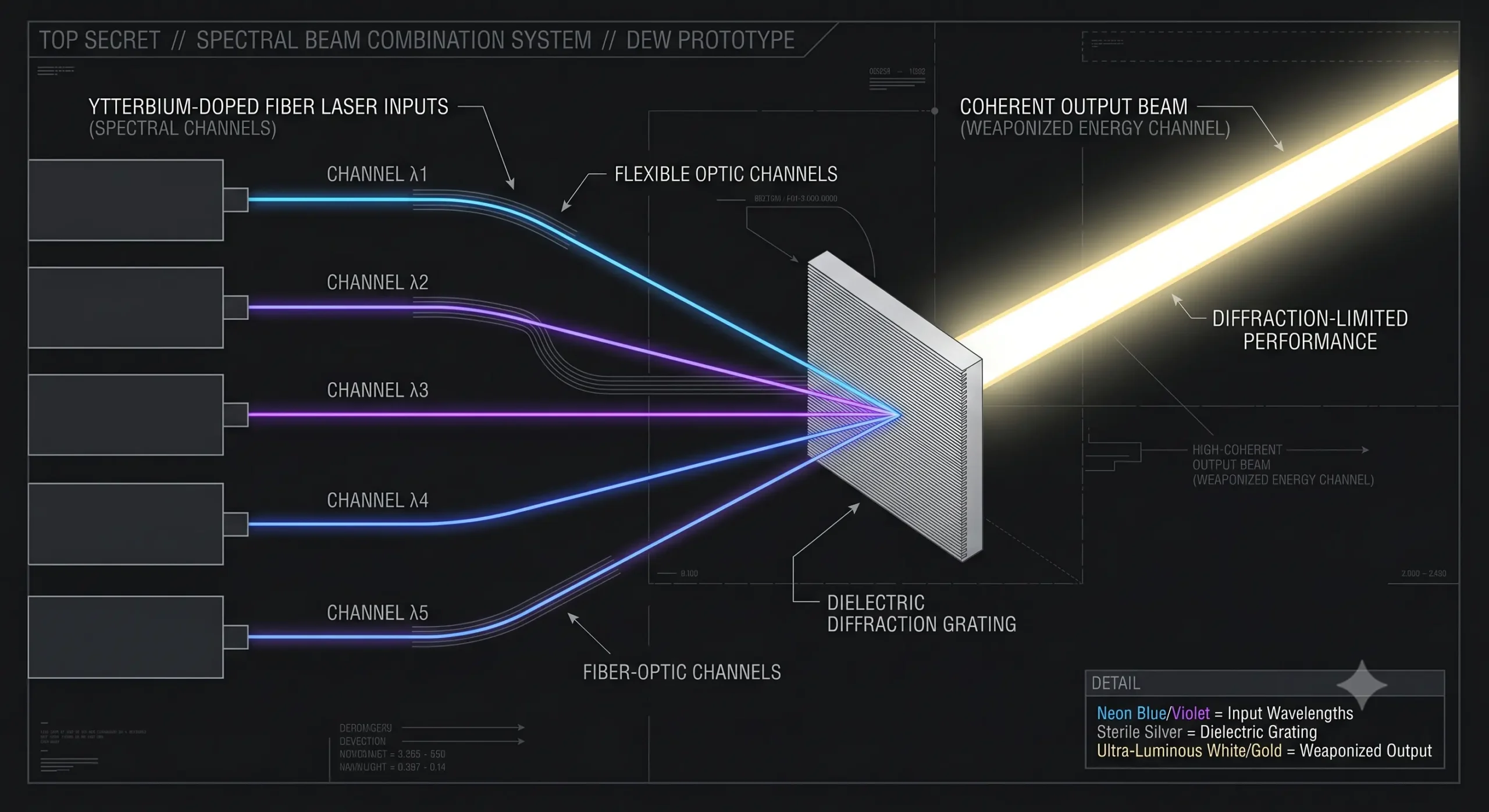
- Concept: Spectral Combining: Gratings merge multiple distinct laser frequencies into one continuous, high-energy output beam.
- Concept: Thermal Blooming: Superheated atmospheric air acts as a diverging lens, instantly scattering uncorrected optical energy.
- Concept: Adaptive Optics: Deformable mechanical mirrors physically warp the outgoing light to perfectly cancel atmospheric distortion.
HOW IT WORKS
Defense lasers do not fire physical mass. They fire concentrated kinetic heat. This physical process begins inside a gain medium, typically a flexible optical fiber doped with a rare-earth element like ytterbium. Electrical power drives industrial pump diodes, which inject base-level light into the fiber to excite the ytterbium electrons into a higher, unstable energy state.
When these excited electrons drop back to their natural state, they release a photon. This newly created photon strikes other excited electrons, triggering a mathematical cascade of identical photons traveling in perfect phase alignment. This alignment creates absolute optical coherence, transforming scattered light into a highly structured, weaponized beam.
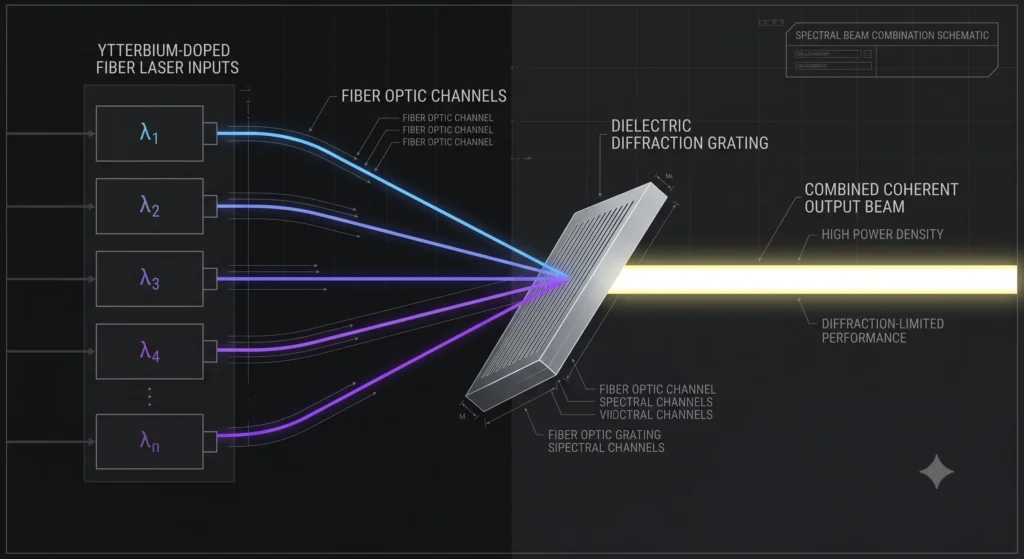
A single optical fiber melts if engineers push too much raw energy through its core. To achieve the 300-kilowatt thresholds required to destroy military hardware, defense contractors utilize spectral beam combining. They run dozens of individual fiber lasers at slightly different optical wavelengths and bounce them off a dielectric diffraction grating.
The physical destruction capacity of this combined beam depends entirely on maintaining a tight focal point, governed by the diffraction limit equation:
$$d = \frac{4 M^2 \lambda f}{\pi D}$$
Where d is the focal spot diameter, M^2 is the beam quality factor, λ (lambda) is the optical wavelength, f is the focal length, and D is the beam diameter at the focusing optic. Minimizing the spot diameter maximizes the thermal energy deposited onto the target.
Pushing hundreds of kilowatts of light through the atmosphere creates immediate physical resistance. The beam superheats the air molecules in its direct path, changing the refractive index of the atmosphere. This expanding hot air creates an invisible, diverging lens that scatters the laser before it hits the target—a phenomenon called thermal blooming.
To counteract this physics problem, the system bounces the outgoing beam off a deformable mirror backed by hundreds of tiny mechanical pistons. These pistons physically warp the surface of the mirror thousands of times per second to pre-distort the light wave. This active correction ensures the wavefront collapses back into a perfect, destructive point exactly when it strikes the incoming missile.
WHY IT MATTERS NOW
The economics of naval and ground-based air defense are currently failing. Firing a two-million-dollar kinetic interceptor to destroy a twenty-thousand-dollar disposable suicide drone guarantees financial exhaustion. Directed energy weapons alter this attrition calculus entirely. A 300-kilowatt laser costs less than ten dollars per shot, requiring only heavy diesel fuel to run the generators.
This reliance on diesel fuel creates an infinitely deep defensive magazine. Traditional naval destroyers carry a strict physical limit of vertical launch cells. Once a ship fires its physical missiles, it must return to a friendly port to reload, removing a billion-dollar asset from the combat theater. A laser-equipped ship fights continuously as long as the engine room maintains electrical output.
The United States Navy recently deployed the High Energy Laser with Integrated Optical-dazzler and Surveillance (HELIOS) system on active Arleigh Burke-class destroyers. This deployment provides the fleet with an immediate, cost-effective layer of defense against small boat swarms and low-flying surveillance drones in highly contested maritime chokepoints.
Moving at 300,000 kilometers per second, a laser bypasses the complex lead-angle calculations required by kinetic artillery. When the tracking radar establishes a lock, the thermal destruction arrives instantly. This zero-time-of-flight physics neutralizes the evasive maneuvers of highly agile drones, securing the absolute inner perimeter of carrier strike groups.
WHAT MOST PEOPLE MISS
Mainstream media evaluates directed energy strictly by its output capability, assuming a 300-kilowatt laser requires exactly 300 kilowatts of electricity from the ship. They miss the severe physical limitation of wall-plug efficiency. Modern solid-state lasers convert at best thirty-five percent of incoming electrical power into weaponized light.
The remaining sixty-five percent of that energy instantly turns into waste heat inside the firing platform. Firing a megawatt-class laser requires dissipating nearly two megawatts of internal thermal blowback. Without massive, heavy liquid cooling loops, the laser will physically melt its own optical cavity before it ever damages an incoming target. Thermal management, not photon generation, dictates the absolute speed limit of directed energy deployment.
THE TRAJECTORY
Next 12–36 Months: Ground forces will deploy mobile 50-kilowatt laser variants mounted directly on armored infantry vehicles. These short-range systems will specialize strictly in burning through the plastic rotors of commercial quadcopters to protect moving forward operating bases.
Next Five Years: Aerospace engineers will integrate highly compact fiber lasers into the tail sections of sixth-generation fighter aircraft. These defensive pods will act as active optical countermeasures, blinding the infrared seekers of incoming air-to-air missiles instantly.
Next Ten Years: Naval vessels will commercialize megawatt-class systems capable of physically burning through the hardened titanium nose cones of hypersonic glide vehicles. This energy scaling will require dedicated onboard nuclear micro-reactors strictly to power the optical capacitors.
What Could Go Wrong: Heavy cloud cover, dense fog, or maritime sea spray physically absorb optical photons. A coordinated adversary waiting for severe weather conditions could completely neutralize a multibillion-dollar laser defense grid, forcing operators to fall back on finite kinetic missiles.
Most Likely Outcome: Directed energy will not completely replace traditional missiles. It will settle into a highly specific, permanent role as the inner-most layer of layered defense architectures, managing cheap, high-volume drone swarms while reserving expensive kinetic interceptors for heavy, weather-obscured threats.
KEY TERMS
- Thermal Blooming: An atmospheric phenomenon where a high-energy laser heats the air in its path, creating a diverging thermal lens that scatters the beam.
- Adaptive Optics: A technology utilizing mechanically deformable mirrors to measure and correct optical wave distortion in real-time.
- Gain Medium: The physical material inside a laser cavity, often a rare-earth-doped fiber, where electron excitation produces a cascade of coherent photons.
- Spectral Beam Combining: An optical technique that merges multiple lasers of slightly different wavelengths into a single high-energy output beam using a diffraction grating.
- Wall-Plug Efficiency: The percentage metric that measures how much raw electrical power a system successfully converts into outgoing optical laser energy.
SOURCES
- Department of Defense (DoD) — Directed Energy Strategy and Architecture Reports
- High Energy Laser Joint Technology Office (HEL-JTO) — Atmospheric Propagation and Thermal Blooming Mitigation
- Northrop Grumman — Spectral Beam Combining and Solid-State Laser Engineering
- Journal of Directed Energy — Adaptive Optics for Tactical High-Energy Laser Weapon Systems