Advertisement
)
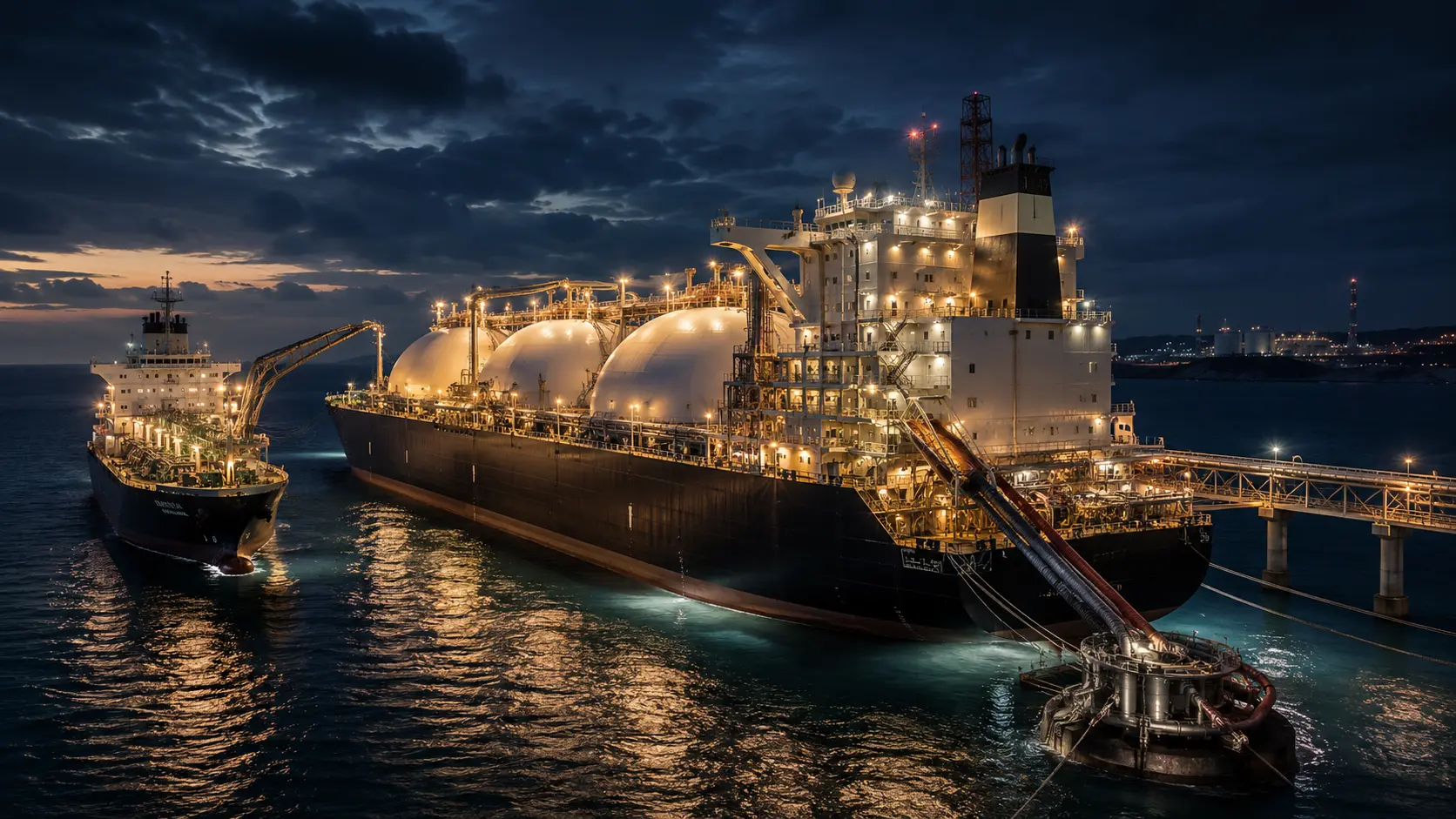

In 2022, the geopolitical foundation of the European economy collapsed. When the Nord Stream pipelines were severed, Germany realized that its industrial base and civilian heating grid were entirely dependent on Russian gas that was never coming back. The obvious solution was to import Liquefied Natural Gas (LNG) from the United States or Qatar via ships. There was just one devastating logistical problem: Germany did not have a single LNG import terminal. Building an onshore concrete-and-steel regasification terminal requires a multi-billion dollar capital expenditure, endless environmental permitting, and up to seven years of construction. Europe did not have seven years; it had seven months before winter arrived.
Why should you care right now? Because maritime engineers provided an instant, plug-and-play solution. Instead of building a terminal on land, Europe simply rented them on the ocean. Enter the Floating Storage Regasification Unit (FSRU). These colossal, 300-meter-long ships function as mobile refineries. They anchor off the coast, accept super-cooled liquid gas from transport tankers, boil it back into a vapor onboard, and blast it directly into the nation’s terrestrial pipeline grid. By deploying FSRUs in a matter of months, Europe successfully executed the fastest and most aggressive supply chain pivot in modern energy history, permanently establishing the FSRU as the ultimate geopolitical hedge against energy weaponization.
What is a Floating Storage Regasification Unit (FSRU)?
A Floating Storage Regasification Unit (FSRU) is a specialized marine vessel designed to act as a mobile Liquefied Natural Gas (LNG) import terminal. It receives super-cooled liquid gas from transport ships, stores it in massive cryogenic tanks, and uses onboard vaporization systems to heat the liquid back into natural gas for immediate injection into an onshore pipeline network.
At a Glance
- Concept: A massive ship that works as an offshore gas terminal. It takes liquid gas from other ships, warms it up until it turns back into a gas, and pumps it directly into a country’s power grid.
- Why it matters: Building a gas terminal on land takes seven years. Parking an FSRU off the coast takes less than a year, allowing countries to instantly import energy during a war or natural disaster.
- Who uses it: European nations (Germany, Italy), emerging economies bypassing pipeline infrastructure (Brazil, Philippines), and major maritime leasing firms like Excelerate Energy and Höegh LNG.
- Biggest takeaway: These ships are the ultimate flexible asset. If a country builds enough solar panels and no longer needs imported gas, the FSRU simply unplugs from the port and sails to a different country, entirely eliminating the risk of building useless, abandoned factories on land.
In Simple Words
Normally, moving natural gas across the ocean requires three steps:
- You freeze the gas until it turns into a liquid (LNG) so it shrinks in size.
- A transport ship carries the liquid across the ocean.
- The ship arrives at a massive, billion-dollar factory on the coast, which slowly warms the liquid back up into gas and pumps it into the city.
An FSRU skips the third step entirely.
Instead of building a factory on the coast, the factory is built directly into the ship. The transport ship pulls up next to the FSRU in the middle of the ocean. The FSRU sucks out the liquid gas, uses its own internal engines and seawater to boil the liquid back into a vapor, and shoots the gas straight into an underwater pipe connected to the city. It is a fully functional, floating factory that can be moved anywhere in the world at a moment’s notice.
Why This Matters
For Commodity Traders, Energy Investors, and Geopolitical Analysts, FSRUs represent Infrastructure Agility and Arbitrage.
Historically, natural gas was a highly regional, rigid commodity. If you were connected to a pipeline, you had gas; if the pipeline was shut off, your economy died. The capital required to build an onshore LNG terminal meant only the wealthiest nations could participate in the global LNG trade.
FSRUs commoditize infrastructure. A developing nation can lease an FSRU for $100,000 to $150,000 a day, instantly opening its domestic energy grid to the global spot market. For commodity traders, this creates massive new demand nodes that can open or close based on lease contracts. Geopolitically, it permanently strips hostile nations of their “pipeline leverage,” because targeted nations can now instantly procure mobile import terminals to access American or Middle Eastern LNG within months.
The Engineering of FSRU Ship-to-Ship Transfers
The deployment of an FSRU is an exercise in extreme thermodynamics. Natural gas is liquefied at -162°C (-260°F). Storing massive volumes of cryogenic liquid on a steel ship requires specialized containment systems (like the GTT Mark III membrane), where the tank walls expand and contract violently based on temperature.
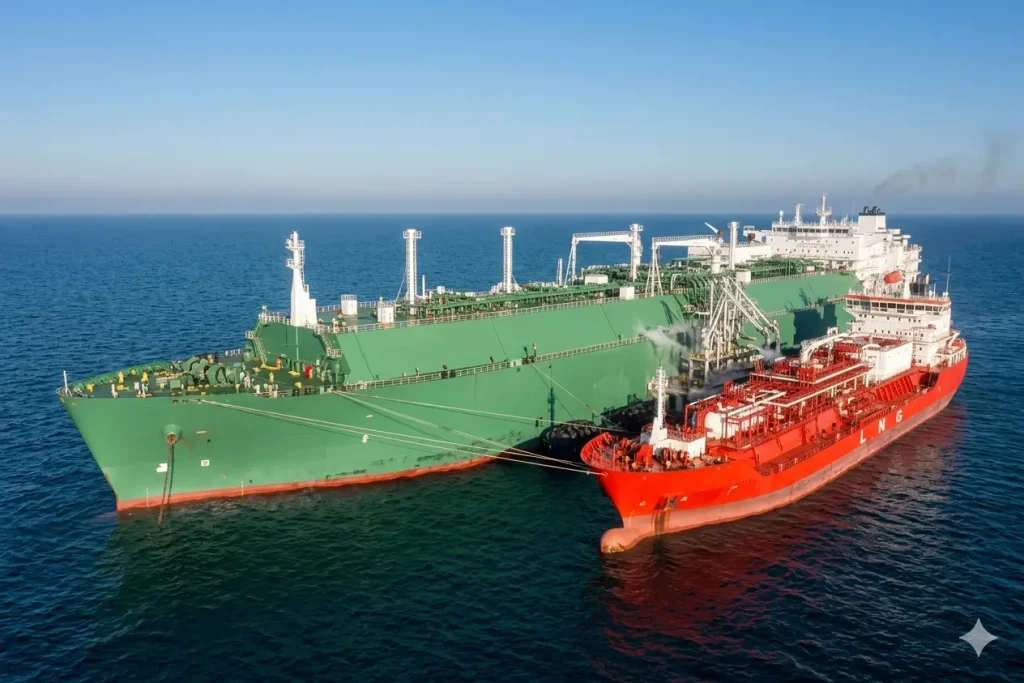
Simultaneously, the ship must continuously execute “ship-to-ship” (STS) transfers. Two massive, 100,000-ton vessels must physically tie themselves together in the open ocean, braving heavy waves and ocean swells, while pumping highly volatile, super-cooled liquid through flexible cryogenic hoses. It is a masterpiece of dynamic maritime engineering that onshore terminals never have to contend with.
How FSRUs Work: Open-Loop vs Closed-Loop Vaporization
Converting -162°C liquid into high-pressure pipeline gas while floating on the ocean requires complex, redundant vaporization architectures. Here is the first-principles breakdown of the mechanics.
1. The Fundamental Problem: The State Change
To inject LNG into a national power grid, it must be converted from a cryogenic liquid into a high-pressure gas. Doing this requires an immense amount of thermal energy (heat). On land, terminals have unlimited space to build massive heaters. On a ship, space and power generation are strictly limited, and the equipment must survive corrosive saltwater environments.
2. The Core Mechanism: Open-Loop Vaporization
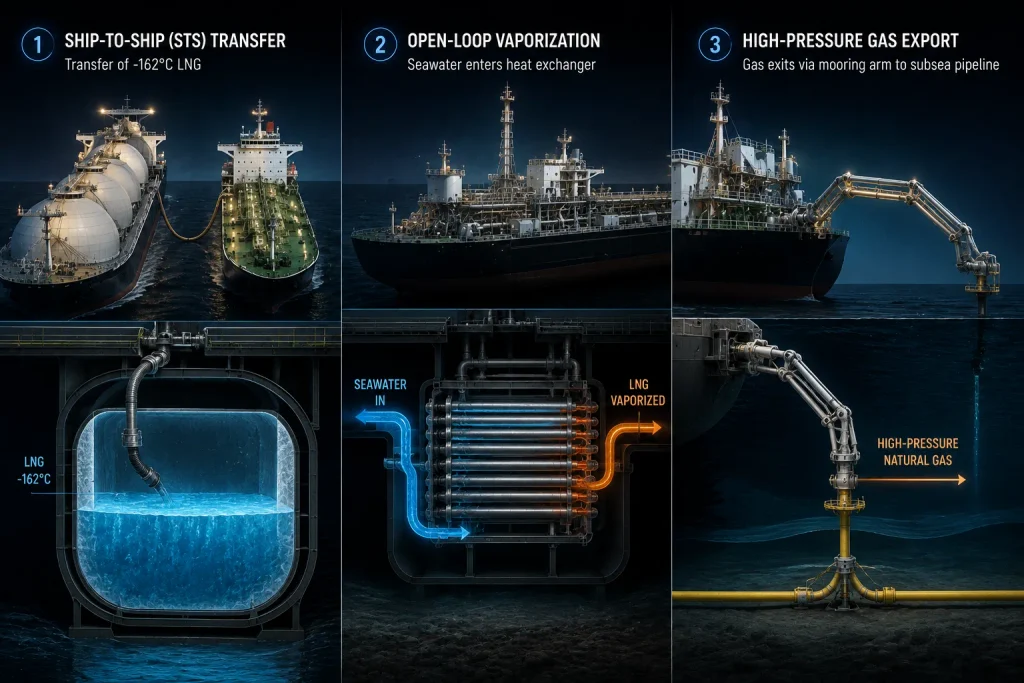
The most efficient way to heat the LNG on a ship is to use the ocean. In an Open-Loop System, the FSRU sucks in massive amounts of ambient seawater. The relatively warm seawater is pumped through a heat exchanger (a series of metal tubes). The -162°C LNG is pumped through adjacent tubes. The heat from the ocean transfers to the LNG, boiling it instantly into a gas. The now-freezing seawater is discharged back into the ocean.
3. Technical Depth: Closed-Loop Vaporization
If the ocean is too cold (like in Northern Europe during the winter), or if local environmental laws forbid dumping freezing chlorinated water back into the sea, the ship uses a Closed-Loop System. The FSRU fires up its own onboard steam boilers, burning a small fraction of the natural gas it carries to generate intense heat. The steam heats a freshwater/glycol mixture, which then acts as the heating fluid to boil the LNG. This requires burning valuable cargo, making it much more expensive, but environmentally and thermally predictable.
4. Technical Depth: Managing Boil-Off Gas (BOG)
No cryogenic tank is perfectly insulated. Heat inevitably leaks into the tank from the sun and the ocean, causing a tiny percentage of the LNG to continuously boil into a vapor known as Boil-Off Gas (BOG). If left unmanaged, the pressure would build until the ship exploded.
FSRUs manage BOG flawlessly: they route the stray gas directly into the ship’s own engines to generate electricity, or they use massive onboard compressors to smash the BOG into a high-pressure state and inject it directly into the onshore pipeline alongside the newly vaporized gas.
5. Real-World Consequences: High-Pressure Unloading
Once the LNG is converted back into a gas, it must be physically moved from the floating ship to the terrestrial landmass. The FSRU connects to the shore via a specialized offshore mooring system (like a submerged turret or a jetty). Massive, articulated high-pressure loading arms physically lock onto the ship, allowing the gas to flow at pressures exceeding 100 bar directly into the national grid, powering millions of homes instantly.
FSRU Regasification Thermodynamics
Open-Loop (Seawater) vs. Closed-Loop (Steam Boiler) Simulation
20°C
2°C (Arctic)
28°C (Tropical)
Regasification Output Volume
100%
Energy Cost ($/MMBtu)
LOW
Global FSRU Deployment: The Germany Wilhelmshaven Terminal
The flexibility of FSRUs has driven rapid deployment across wildly different economic and geographic environments.
The German Energy Crisis (Wilhelmshaven): In early 2022, Germany faced an industrial collapse following the loss of Russian pipeline gas. In a record-breaking pivot, the German government chartered several FSRUs. By December 2022, the Höegh Esperanza arrived at the port of Wilhelmshaven. The necessary port infrastructure and pipeline connections were built in less than 200 days—a process that normally takes years. The ship instantly began feeding the German grid, effectively saving the nation from winter blackouts and proving the unparalleled crisis-response capability of marine assets.
Archipelagos and Emerging Markets (Philippines & Indonesia): Building terrestrial pipelines across thousands of scattered islands is geographically impossible and economically unviable. FSRUs offer a modular solution. A single FSRU can be moored off the coast of an island, serving as a localized hub to power a specific regional power plant. Companies like Excelerate Energy provide these turnkey floating terminals, allowing emerging economies to instantly switch from burning dirty, imported coal to cleaner natural gas without committing to a massive national pipeline project.
Seasonal Peak Shaving (Italy & South America): Many countries only experience severe energy deficits during specific seasons (e.g., winter heating in Italy, or summer droughts in Brazil that cripple hydroelectric dams). Building a permanent onshore terminal for a problem that only exists three months a year is a waste of capital. A nation can simply lease an FSRU during its peak demand season, plug it into the grid, and send the ship away when the season ends, perfectly executing an “Infrastructure-as-a-Service” model.
Economic & Strategic Impact
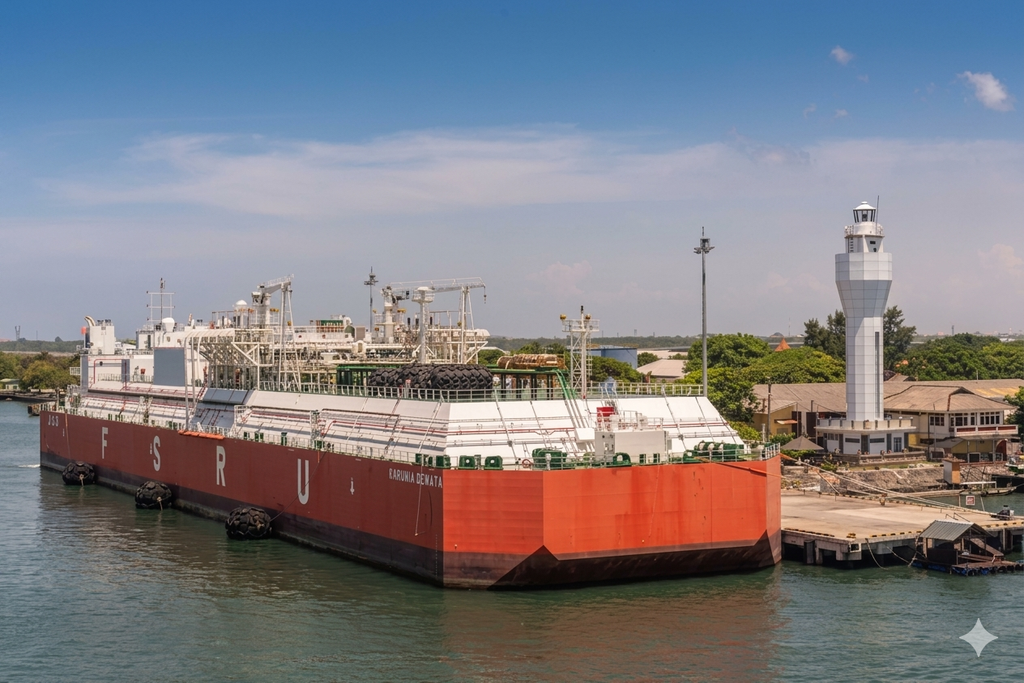
The core strategic consequence of the FSRU is the Eradication of the Stranded Asset Risk.
In the global push toward decarbonization and Net-Zero 2050, building a $3 billion onshore LNG terminal is a massive financial gamble. An onshore terminal has a lifespan of 40 to 50 years. If a country successfully transitions to 100% wind, solar, and nuclear power in 15 years, that onshore terminal becomes a useless, abandoned “stranded asset,” permanently destroying billions of dollars of investor capital.
The FSRU entirely solves the stranded asset problem. An FSRU is a leased ship. If European gas demand plummets by 2035 due to renewable adoption, the European country simply does not renew the lease. The ship detaches from the dock, sails through the Suez Canal, and begins a new, highly profitable lease contract providing energy to a developing grid in India or Vietnam. The capital is perfectly protected because the infrastructure literally drives itself to the next customer.
Advantages
- Extreme Deployment Speed: Can be procured, moored, and operational in 6 to 12 months, bypassing the 5 to 7-year construction delays of onshore concrete terminals.
- Zero Stranded Asset Risk: The asset is fully mobile. It can be relocated globally to match shifting macroeconomic energy demands or bypass strict regional climate legislation.
- Lower Capital Expenditure (CapEx): Leasing an FSRU drastically shifts the financial burden from massive upfront capital investment to predictable, operational expenditure (OpEx) leasing models.
- Dual Functionality: If not needed as a regasification terminal, an FSRU can operate as a standard LNG transport carrier, ensuring the asset constantly generates revenue for its owner.
Limitations
- Vulnerability to Bad Weather: Unlike a concrete facility bolted to the bedrock, an FSRU is a ship bobbing on the ocean. During severe typhoons or hurricanes, ship-to-ship LNG transfers are too dangerous to execute, potentially causing temporary disruptions in the gas supply.
- Higher Operating Costs (OpEx): Leasing the ship, paying the highly specialized maritime crew, and potentially burning cargo to run a Closed-Loop vaporization system makes the daily operating cost of an FSRU significantly higher than a fully amortized onshore terminal.
- Volume Bottlenecks: While massive, the storage capacity of an FSRU is physically constrained by the size of the hull (typically around 170,000 cubic meters). Massive onshore terminals can build dozens of storage tanks, vastly outperforming a single FSRU in total throughput capacity.
Common Misconceptions
Misconception: An FSRU extracts the gas from the ocean floor.
Reality: An FSRU is not a drilling rig (like an FPSO). It only stores and processes gas that was already drilled, liquefied, and brought to it by another transport ship.
Misconception: They are more dangerous than land terminals.
Reality: FSRUs are subject to some of the strictest maritime and structural safety regulations on Earth. Placing the volatile cryogenic liquid offshore, away from densely populated coastal cities, often inherently reduces the risk to civilian populations compared to onshore mega-facilities.
Misconception: Any ship can plug into any port.
Reality: While the ship is mobile, the docking infrastructure is highly bespoke. The high-pressure gas arms, the submerged turrets, and the specific underwater pipelines connecting the ship to the mainland must be custom-built to match the exact specifications of the FSRU.
What Most People Miss
The disruptive capability of FSU Conversion Strategy.
When analysts look at the FSRU market, they assume every ship was built from scratch. What they miss is the lucrative economics of retrofitting.
There are hundreds of aging, standard LNG transport carriers sailing the oceans today. As new environmental regulations (like the IMO’s CII ratings) make these older, less efficient ships obsolete for global transport, maritime companies do not scrap them. They send them to a drydock, weld a massive regasification unit onto the deck, and convert them into Floating Storage Units (FSUs) or FSRUs. This effectively recycles a dying, 20-year-old ship into a highly lucrative, stationary infrastructure asset, extending the lifetime revenue generation of maritime hardware by decades.
Comparison Table
| Feature | Standard LNG Carrier | Onshore LNG Terminal | FSRU (Floating Terminal) |
| Primary Function | Transport liquid gas | Store & regasify | Transport, store, & regasify |
| Deployment Speed | N/A (Moving asset) | 5 to 7 Years | 6 to 12 Months |
| Capital Cost (CapEx) | High (~$250M) | Extremely High (>$1B) | Leased (OpEx heavy model) |
| Stranded Asset Risk | Zero | High | Zero (Relocatable) |
| Capacity Constraints | Limited by hull size | Practically Infinite | Limited by hull size |
Case Study
Situation: Following the geopolitical severing of Russian pipeline gas in 2022, Germany was structurally exposed. The nation’s heavy industry and civilian heating infrastructure relied on a massive baseload of natural gas, and the country possessed exactly zero domestic LNG import infrastructure. Traditional engineering assessments concluded that constructing a permanent onshore terminal at Wilhelmshaven would take until 2026 at the earliest, guaranteeing catastrophic winter shortages.
Challenge: Procure, permit, and construct an operational LNG import gateway connected directly to the German high-pressure gas grid within a 10-month window before the onset of the European winter.
Solution (The Wilhelmshaven FSRU Deployment): The German government chartered the Höegh Esperanza, a state-of-the-art FSRU. Simultaneously, engineering firm Uniper aggressively expedited the construction of the offshore mooring jetty and the 26-kilometer high-pressure connecting pipeline to the terrestrial grid, bypassing standard bureaucratic permitting delays via emergency legislation.
Outcome: By December 2022, the Höegh Esperanza arrived fully loaded with LNG. Within weeks, it successfully initiated ship-to-ship transfers and commenced regasification, injecting up to 5 billion cubic meters (bcm) of natural gas annually into the German grid. The project was completed in 194 days.
Lessons Learned: The Wilhelmshaven deployment shattered the paradigm of sluggish infrastructure development. It proved that by combining the geographic agility of maritime FSRU assets with emergency regulatory streamlining, a nation can entirely rewrite its geopolitical energy dependency within a single fiscal year.
Future Outlook
Next 12–24 Months
The era of European Contract Fulfillment and Optimization. In the immediate term, the dozen FSRUs hastily chartered by European nations during the 2022 crisis will reach operational maturity. The focus will shift from panic-deployment to thermodynamic optimization. Operators will heavily invest in transitioning from expensive Closed-Loop vaporization to highly efficient Open-Loop systems wherever environmental regulations permit, drastically reducing the daily fuel-burn penalties and lowering the overall cost of imported LNG for European consumers.
Next 3–5 Years
The scaling of The Southeast Asian Pivot. As Europe structurally reduces its gas consumption through massive offshore wind and grid-scale battery deployments, the current glut of FSRUs anchored in the North Sea will inevitably seek new markets. By the late 2020s, these ships will unplug and sail toward Southeast Asia (Vietnam, Philippines, Indonesia). These rapidly industrializing archipelagos desperately need to transition off coal but lack the capital to build onshore mega-terminals. The influx of redeployed European FSRUs will trigger a massive, localized LNG boom in the Pacific Rim.
Next 10 Years
The Ammonia and Hydrogen Conversion Threat. By the mid-2030s, the natural gas market will face immense regulatory pressure. FSRU owners will be forced to adapt their fleets to handle the next generation of zero-carbon fuels. We will see the aggressive engineering of “Floating Ammonia Cracking Units.” Instead of boiling LNG into methane gas, these heavily modified ships will accept liquid ammonia (NH₃) from green-energy super-producers (like Australia or Chile), chemically crack the ammonia onboard, and inject pure, zero-carbon Hydrogen (H₂) directly into the terrestrial pipeline grids of heavily industrialized nations.
Most Likely Scenario
The FSRU is the ultimate manifestation of infrastructure-as-a-service. It solves the central paradox of the modern energy transition: nations need reliable gas today, but cannot commit to 50-year fossil fuel investments without angering ESG investors. By offering an instant, mobile, and mathematically finite infrastructure solution, FSRUs will dominate global energy logistics until the physical transition to global electrification is absolute.
Key Takeaways
- Building a massive concrete facility on the coast to import liquid gas takes billions of dollars and up to seven years. FSRUs bypass this by placing the entire facility onto a massive, movable ship.
- Europe used FSRUs to survive the loss of Russian pipeline gas in 2022, renting the ships and plugging them into their power grids in just months instead of years.
- The ship works by taking super-cooled liquid gas (-162°C) from transport tankers, boiling it back into a gas using either warm ocean water or onboard steam heaters, and blasting it into underwater pipelines.
- FSRUs solve the “Stranded Asset” problem. If a country switches entirely to solar power and no longer needs gas, the ship simply unties from the dock and sails away to find a new customer, protecting investor capital.
- While incredibly flexible, they are vulnerable to extreme weather (hurricanes prevent ships from safely docking next to them) and have less total storage capacity than massive land-based terminals.
Glossary
Boil-Off Gas (BOG): The small amount of LNG that naturally warms up and turns into a gas inside the ship’s tanks because perfect insulation is physically impossible. The ship uses this gas to run its own engines.
Closed-Loop Vaporization: A method of heating the LNG back into a gas using the ship’s own internal steam boilers. It is expensive because it requires burning some of the cargo, but necessary if the ocean is too cold.
Floating Storage Regasification Unit (FSRU): A massive, specialized ship that acts as a mobile import terminal, receiving liquid gas, storing it, warming it up, and pumping it into a country’s pipeline grid.
Infrastructure-as-a-Service (IaaS): The economic model of renting critical infrastructure (like an FSRU) for a specific time period rather than paying the massive upfront cost to build it permanently on land.
Open-Loop Vaporization: A highly efficient method of heating the LNG by sucking in massive amounts of warm ambient ocean water, passing it near the freezing gas to boil it, and returning the chilled water to the sea.
Ship-to-Ship (STS) Transfer: The highly complex maritime maneuver where two massive ships tie together in the ocean to pump super-cooled liquid gas from the transport carrier directly into the FSRU.
Sources
S&P Global Commodity Insights: The Role of FSRUs in the European Energy Crisis
Excelerate Energy: FSRU Technology and Global Deployment Operations
Oxford Institute for Energy Studies: Floating LNG Regasification: Market Dynamics and Geopolitics
Höegh LNG: Wilhelmshaven FSRU Terminal Technical Overview
International Gas Union (IGU): The Economics of Floating Storage and Regasification Units