Advertisement
)

AT A GLANCE
- Concept: Fission Heating: A uranium reactor replaces the chemical combustion chamber to generate extreme, sustained thermal energy.
- Concept: Low Molecular Mass: Heating pure, lightweight hydrogen gas produces significantly higher exhaust velocities than heavy combustion byproducts.
- Concept: Specific Impulse: Nuclear thermal engines deliver twice the fuel efficiency of the best chemical rockets in existence.
- Concept: Martian Logistics: Doubling propulsion efficiency cuts transit times in half, minimizing astronaut radiation exposure during interplanetary flight.
HOW IT WORKS
Traditional chemical rockets rely on combustion. They mix a liquid fuel, like methane, with an oxidizer to create a violent chemical explosion. This explosion generates hot, expanding exhaust gases that push the rocket forward.
This chemical process carries a strict physical limitation. The resulting exhaust contains heavy molecules, like water vapor and carbon dioxide, which move relatively slowly when forced out of a nozzle.
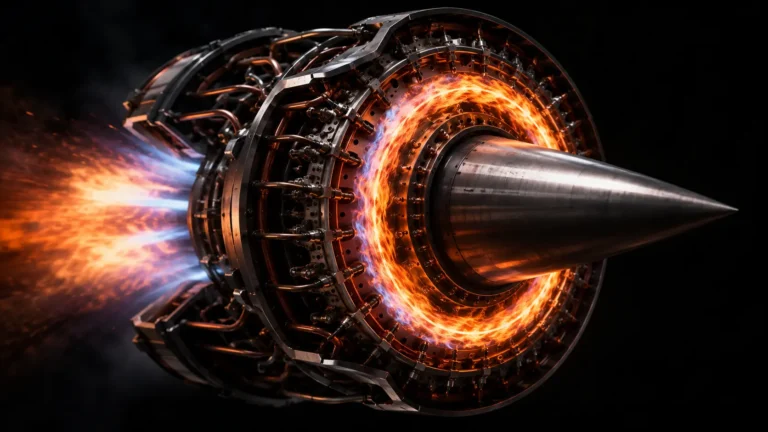
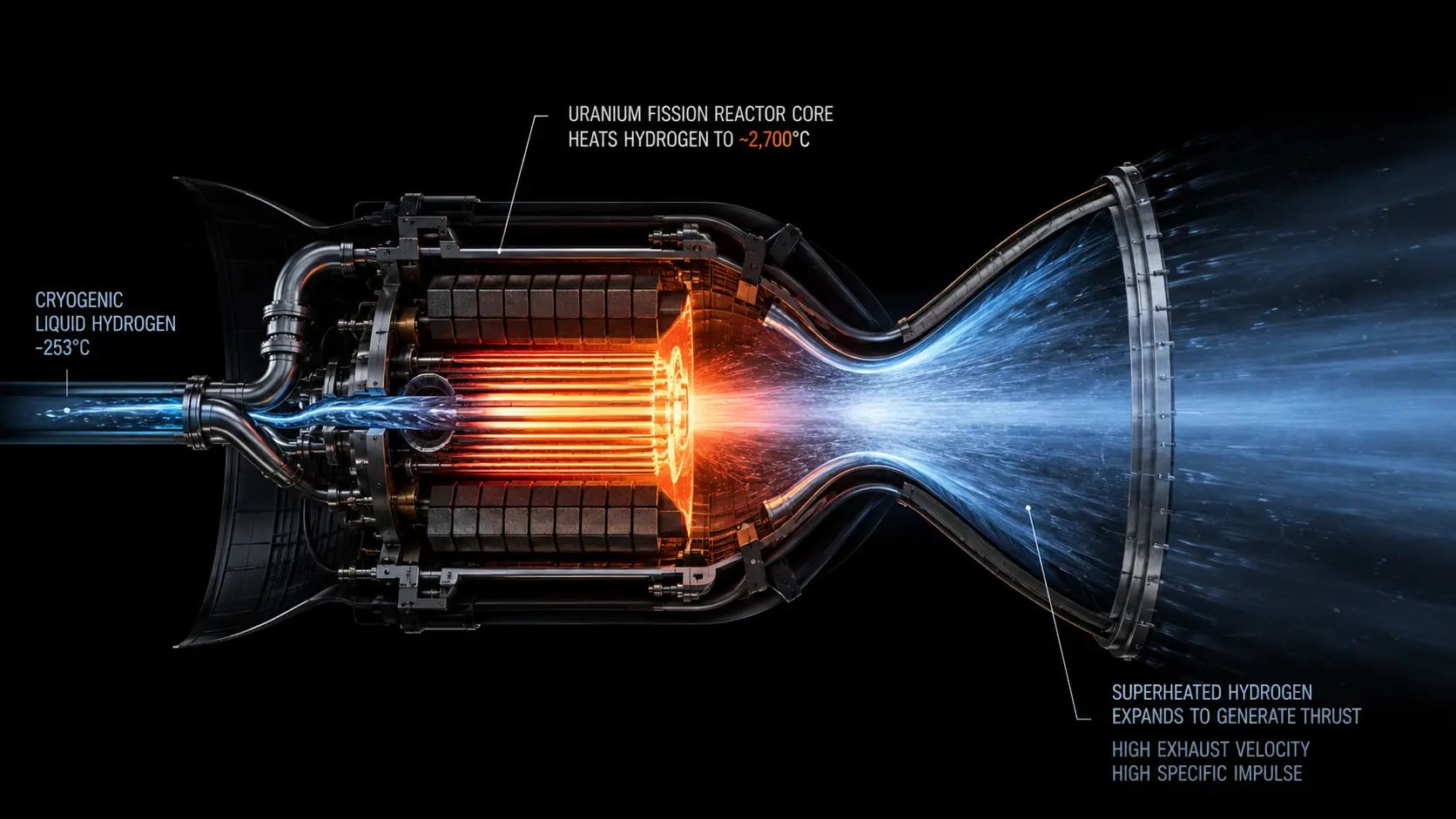
A Nuclear Thermal Propulsion (NTP) system removes the oxidizer and the explosion entirely. Instead, engineers pump cryogenic liquid hydrogen directly into the core of a compact uranium-235 fission reactor.
The nuclear reactor heats the hydrogen gas to nearly 2,700 Kelvin in a fraction of a second. The superheated gas expands violently and accelerates out of the rocket nozzle to produce continuous thrust.
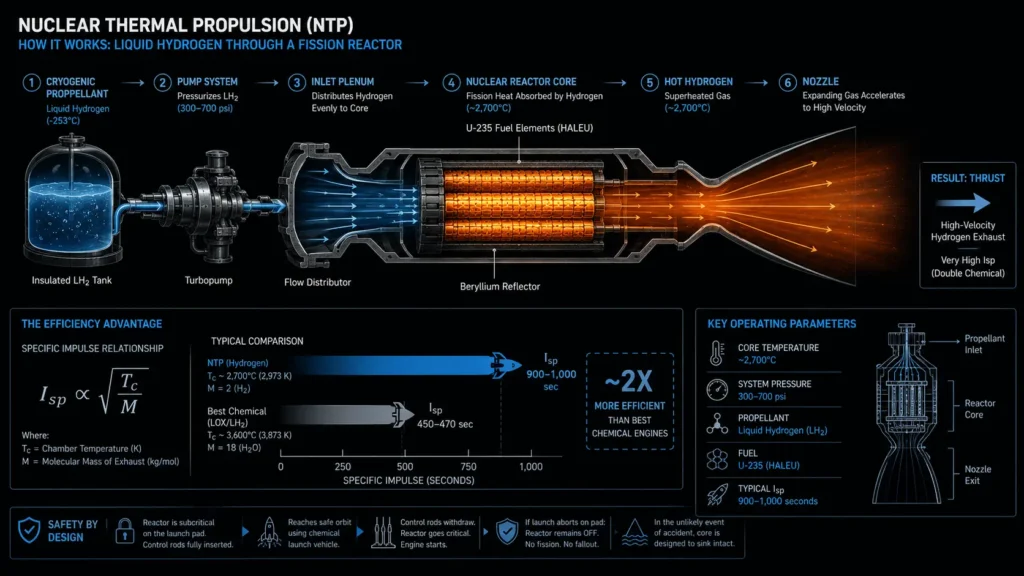
Because pure hydrogen is the lightest element in the universe, it accelerates to vastly higher speeds than heavy combustion byproducts when exposed to extreme heat. This physical reality governs the specific impulse ($I_{sp}$) equation, which dictates rocket efficiency:
$$I_{sp} \propto \sqrt{\frac{T_c}{M}}$$
Where T_c represents the core chamber temperature and M represents the molecular mass of the exhaust gas. By maximizing temperature through nuclear fission and minimizing mass by using pure hydrogen, the engine mathematically doubles the top speed capability of the spacecraft.
WHY IT MATTERS NOW
The modern space economy currently obsesses over the economics of launch reusability. Companies optimize massive chemical rockets to lift heavy cargo into low Earth orbit cheaply. However, chemical propulsion lacks the thermodynamic efficiency to build a sustainable logistical bridge to Mars.
Flying a chemical rocket to Mars requires coasting along a Hohmann transfer orbit, a slow trajectory that takes roughly seven to nine months. During this transit, astronauts face severe exposure to deep space cosmic radiation and solar flares.
Nuclear thermal propulsion fundamentally alters this orbital mechanics equation. By doubling the specific impulse, an NTP-equipped spacecraft can execute high-energy continuous burns. This extra velocity cuts the Earth-to-Mars transit time down to just three or four months.
NASA and DARPA recently recognized this hard mathematical limit and partnered with Lockheed Martin to build the Demonstration Rocket for Agile Cislunar Operations (DRACO). This operational prototype aims to test a live nuclear thermal engine in space by 2027.
Whichever nation controls high-efficiency nuclear transit dictates the geopolitical reality of deep space. A spacecraft equipped with an NTP engine can rapidly alter its orbit around the Moon, easily outmaneuvering traditional chemical satellites that must hoard their highly limited fuel supplies.
WHAT MOST PEOPLE MISS
Public discourse assumes nuclear rockets act like flying atomic bombs, fearing a catastrophic radiation event during launch. They miss the strict mechanical safety protocols governing the fission core. The reactor remains completely dormant, physically locked by neutron-absorbing control rods, and completely non-radioactive while the rocket sits on the Earth’s surface.
The system only achieves nuclear criticality once the spacecraft reaches a safe, high-altitude orbit using traditional chemical boosters. If the rocket explodes on the launchpad, the uranium core simply falls into the ocean as heavy metal, creating zero nuclear fallout because the fission chain reaction never started.
THE TRAJECTORY
Next 12–36 Months: Aerospace contractors will finalize ground-based thermal testing of High-Assay Low-Enriched Uranium (HALEU) fuel elements. These tests will prove the composite materials can survive 2,700 Kelvin without melting the internal reactor block.
Next Five Years: The DRACO mission will execute the first successful orbital demonstration of a nuclear thermal rocket. This test will officially validate the complex fluid dynamics of pumping cryogenic liquid hydrogen through a live fission core in absolute zero gravity.
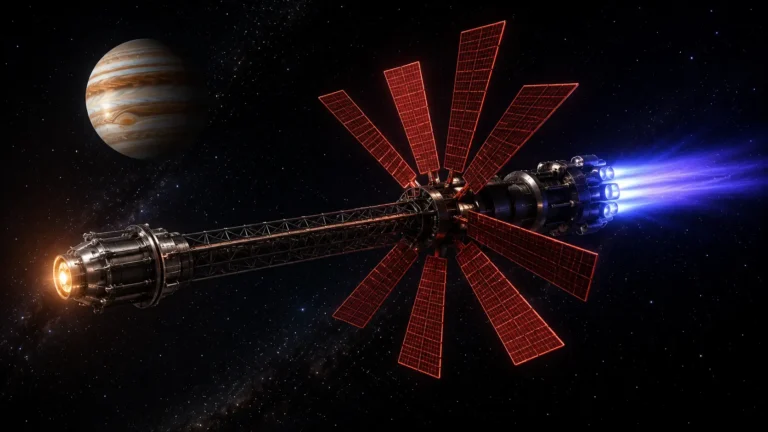
Next Ten Years: NASA will assemble modular nuclear transfer vehicles in lunar orbit. These reusable orbital tugs will continuously ferry heavy cargo between the Earth and the Moon, entirely replacing chemical upper stages for deep space logistics.
What Could Go Wrong: Extreme thermal cycling induces severe mechanical stress on the reactor internals. If the sudden injection of negative-250-degree liquid hydrogen physically cracks the 2,700-Kelvin ceramic uranium fuel rods, radioactive debris will blast directly out the engine nozzle, permanently contaminating the spacecraft structure.
Most Likely Outcome: Nuclear thermal propulsion will become the mandatory architectural standard for all human interplanetary flight. Chemical rockets will remain strictly relegated to the role of atmospheric heavy lifters, acting solely as the freight elevators to low Earth orbit.
KEY TERMS
- Nuclear Thermal Propulsion (NTP): A spacecraft engine that generates thrust by pumping a liquid propellant through a nuclear fission reactor to rapidly heat and expand the gas.
- Specific Impulse (I_sp): A metric of rocket efficiency measuring how effectively an engine converts propellant mass into forward thrust, typically measured in seconds.
- High-Assay Low-Enriched Uranium (HALEU): A specialized nuclear fuel enriched between 5 and 20 percent, providing high energy density without the security risks of weapons-grade material.
- Propellant Mass Fraction: The mathematical ratio of a rocket’s fuel mass to its total mass, dictating how much actual cargo the vehicle can carry to its destination.
- Hohmann Transfer Orbit: An elliptical orbital trajectory used to transfer between two planets utilizing the absolute minimum amount of chemical rocket propellant.
SOURCES
- National Aeronautics and Space Administration (NASA) — Demonstration Rocket for Agile Cislunar Operations (DRACO) Architecture
- Defense Advanced Research Projects Agency (DARPA) — Nuclear Thermal Propulsion Fluid Dynamics and Core Design
- American Institute of Aeronautics and Astronautics (AIAA) — Thermofluid Modeling of Hydrogen Expansion in NTP Systems
- Lockheed Martin — Space Nuclear Power and Propulsion Technologies