Advertisement
)

AT A GLANCE
- Concept: Solid-Phase Synthesis: The growing DNA chain remains tethered to a physical support resin during chemical washes.
- Concept: Deblocking Kinetics: An acid wash removes a protective chemical cap to expose the next reactive attachment point.
- Concept: Coupling Efficiency: Specialized activator reagents force the incoming nucleotide to bond with the existing molecular chain.
- Concept: Capping and Oxidation: Secondary washes permanently stabilize the new bond and terminate any unreacted chains.
HOW IT WORKS
Biological organisms construct DNA using complex polymerase enzymes. Artificial manufacturing abandons biological enzymes entirely in favor of brute-force physical chemistry.
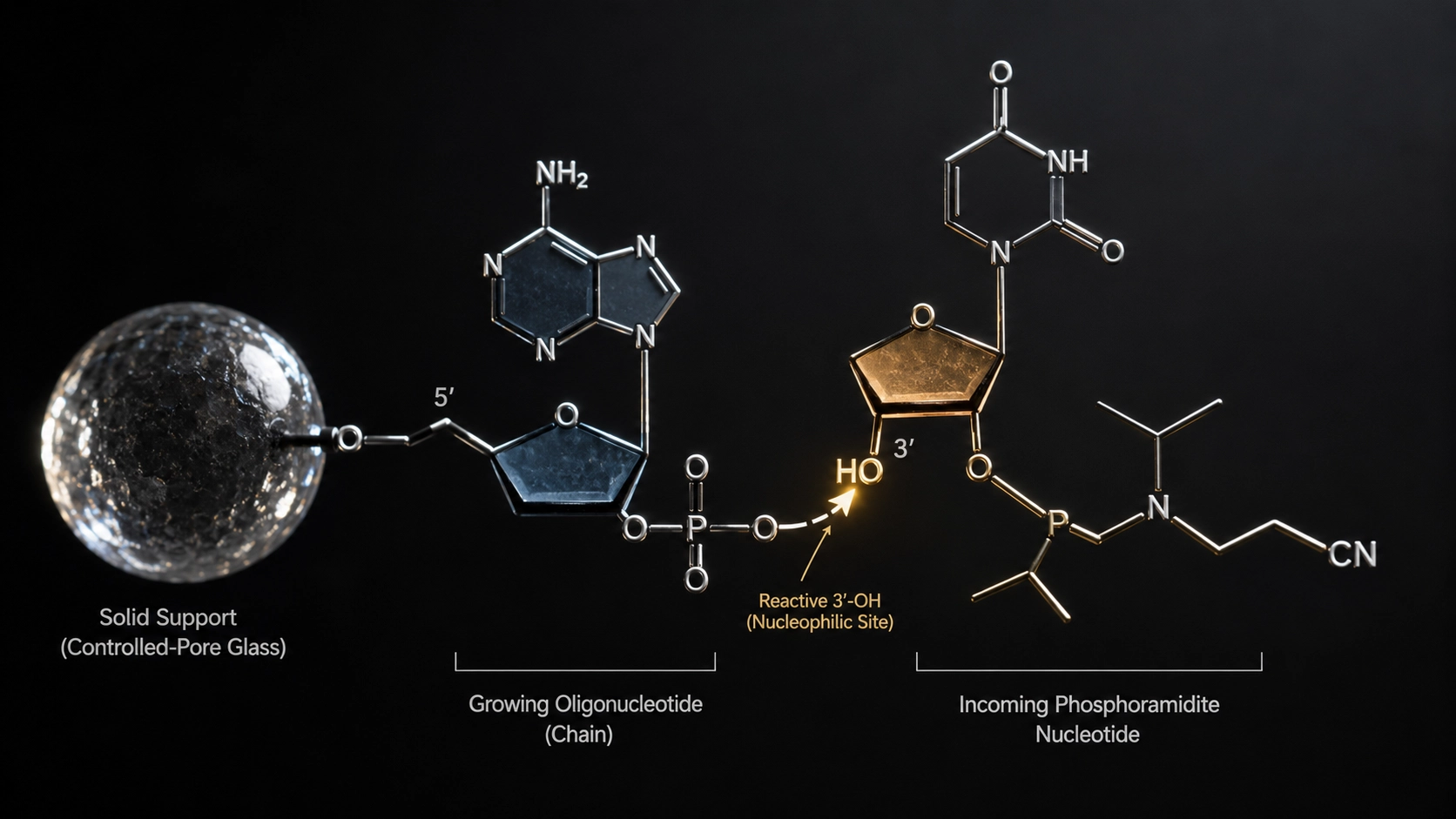
Engineers execute this process through solid-phase synthesis. They attach the first nucleotide of the desired genetic sequence to a microscopic bead of controlled-pore glass. This physical anchor holds the molecule in place while automated fluidic pumps flush liquid chemical reagents across the substrate.
Building the molecule requires a repeating four-step chemical cycle: deblocking, coupling, capping, and oxidation. The cycle begins with deblocking. A trichloroacetic acid solution washes over the glass bead, removing a dimethoxytrityl protective group from the anchored nucleotide and exposing a highly reactive hydroxyl site.
Once the site is exposed, pumps inject the next nucleotide—a synthetic phosphoramidite—alongside an acidic activator chemical like tetrazole. The activator strips a protective ring from the incoming nucleotide, forcing it to physically bind to the exposed hydroxyl site on the anchored chain. This coupling reaction forms an unstable phosphite triester linkage.
The synthesis cycle mathematically relies on coupling efficiency. If the coupling reaction fails on a single molecule, that molecule will permanently misprint the remainder of the genetic code. To prevent this, the capping step floods the chamber with acetic anhydride, chemically neutralizing any unreacted chains to prevent them from growing further.
Finally, an iodine-based oxidation wash converts the unstable phosphite triester linkage into a permanent, biologically stable phosphate diester bond. The system then flushes the chamber with anhydrous acetonitrile solvent and repeats the entire four-step cycle for the next letter in the programmed sequence.
WHY IT MATTERS NOW
The modern biotechnology industry operates entirely on customized genetic instruction sets. Developing advanced mRNA therapeutics or CRISPR therapies requires inserting synthetic genetic code directly into human cells.
Every single one of these medical interventions begins as a digital text file on a computer. Translating that digital code into a physical biological molecule requires industrial-scale phosphoramidite synthesis.
This mechanical process dictates the absolute speed limit of global biological research. When a novel viral pathogen emerges, pharmaceutical companies cannot wait months to harvest natural viral DNA. They type the genome sequence into a synthesizer and print the physical molecules overnight to immediately begin vaccine prototyping.
This reliance creates a severe macroeconomic dependency on highly specialized chemical reagents. Companies like Thermo Fisher Scientific and Agilent Technologies monopolize the supply chains for the extremely pure phosphoramidites and tetrazole activators required to run these machines.
If a geopolitical conflict disrupts the supply of industrial acetonitrile solvent, the entire global synthetic biology pipeline immediately halts. Pharmaceutical manufacturers physically cannot print mRNA vaccine production pipelines without a continuous, uninterrupted flow of these specific highly refined chemicals.
WHAT MOST PEOPLE MISS
Financial analysts track the total volume of DNA bases printed, assuming synthetic biology scales linearly like digital software. They completely miss the mathematical decay inherent in step-wise chemical coupling efficiency.
The overall yield of a synthesized DNA strand follows a strict geometric progression dictated by the formula:
$$Y = \eta^{n-1}$$
Where Y is the final yield, η (eta) is the coupling efficiency of a single cycle, and n is the total number of nucleotides in the sequence.
If an industrial synthesizer operates at an exceptional 99 percent coupling efficiency, printing a 100-base sequence yields only a 37 percent final usable product. The remaining 63 percent consists of truncated, highly toxic chemical junk. Printing genes longer than 200 base pairs becomes physically and financially impossible, forcing manufacturers to manually stitch shorter fragments together in expensive post-processing laboratories.
THE TRAJECTORY
Next 12–36 Months: Reagent manufacturers will commercialize advanced microfluidic synthesizers that drastically reduce the physical volume of chemical washes required per cycle, cutting the baseline cost of oligonucleotide production by fifty percent.
Next Five Years: The industry will aggressively shift toward enzymatic DNA synthesis. By engineering mutant terminal deoxynucleotidyl transferase (TdT) enzymes to print DNA in aqueous solutions, manufacturers will bypass the highly toxic acid washes of the phosphoramidite cycle completely.
Next Ten Years: Hyperscale bio-foundries will deploy massively parallel enzymatic arrays capable of printing entire million-base synthetic chromosomes in a single continuous run. This capability will enable the complete synthetic construction of custom agricultural organisms directly from digital code.
What Could Go Wrong: An accidental contamination event in a primary chemical refinement facility could introduce microscopic water vapor into the global supply of anhydrous acetonitrile. Moisture instantly destroys phosphoramidite reagents, which would cause simultaneous, catastrophic synthesis failures across all global biopharmaceutical manufacturing floors.
Most Likely Outcome: The phosphoramidite method will remain the undisputed, high-fidelity standard for short-chain medical oligonucleotides over the next decade. Enzymatic synthesis will capture the long-chain genetic assembly market, but the legacy toxic chemical cycle will continue to dominate strict therapeutic applications due to established regulatory approval pathways.
KEY TERMS
- Phosphoramidite: A synthetic, chemically modified nucleotide designed specifically to remain stable in storage and react aggressively during solid-phase DNA synthesis.
- Solid-Phase Synthesis: A chemical manufacturing technique where the primary molecular chain remains covalently bonded to a physical substrate while reagents wash over it.
- Coupling Efficiency: The mathematical probability that a single incoming nucleotide successfully bonds with the existing genetic chain during a synthesis cycle.
- Deblocking: The chemical process of removing a protective dimethoxytrityl group from a nucleotide to expose a reactive site for the next chain addition.
- Oligonucleotide: A short, synthetic strand of DNA or RNA molecules utilized extensively in genetic testing, forensic research, and therapeutic drug development.
SOURCES
- National Institutes of Health (NIH) — Solid-Phase Oligonucleotide Synthesis and Phosphoramidite Chemistry
- Thermo Fisher Scientific — Reagent Optimization for High-Throughput DNA Synthesis
- Journal of the American Chemical Society — Stepwise Coupling Efficiency and Truncation Kinetics in Synthetic DNA
- Agilent Technologies — Phosphoramidite Manufacturing and Anhydrous Solvent Specifications