Advertisement
)

AT A GLANCE
- Concept: Membrane Permeabilization: High-voltage electricity temporarily destabilizes the lipid bilayer to open microscopic entry pores.
- Concept: Square Wave Pulses: Generators deliver mathematically precise electrical spikes to prevent fatal cellular thermal damage.
- Concept: Non-Viral Transfection: Electrical delivery bypasses the severe biological toxicity and manufacturing bottlenecks of viral vectors.
- Concept: Cell Viability: Perfecting the voltage duration dictates the survival rate of the modified human tissue.
HOW IT WORKS
The human cellular membrane acts as a strict physical barricade. It consists of a lipid bilayer designed specifically to keep large, charged molecules—like synthetic DNA and RNA—out of the cytoplasm. To rewrite a cell’s genetic code, bioengineers must forcefully bypass this biological barrier.
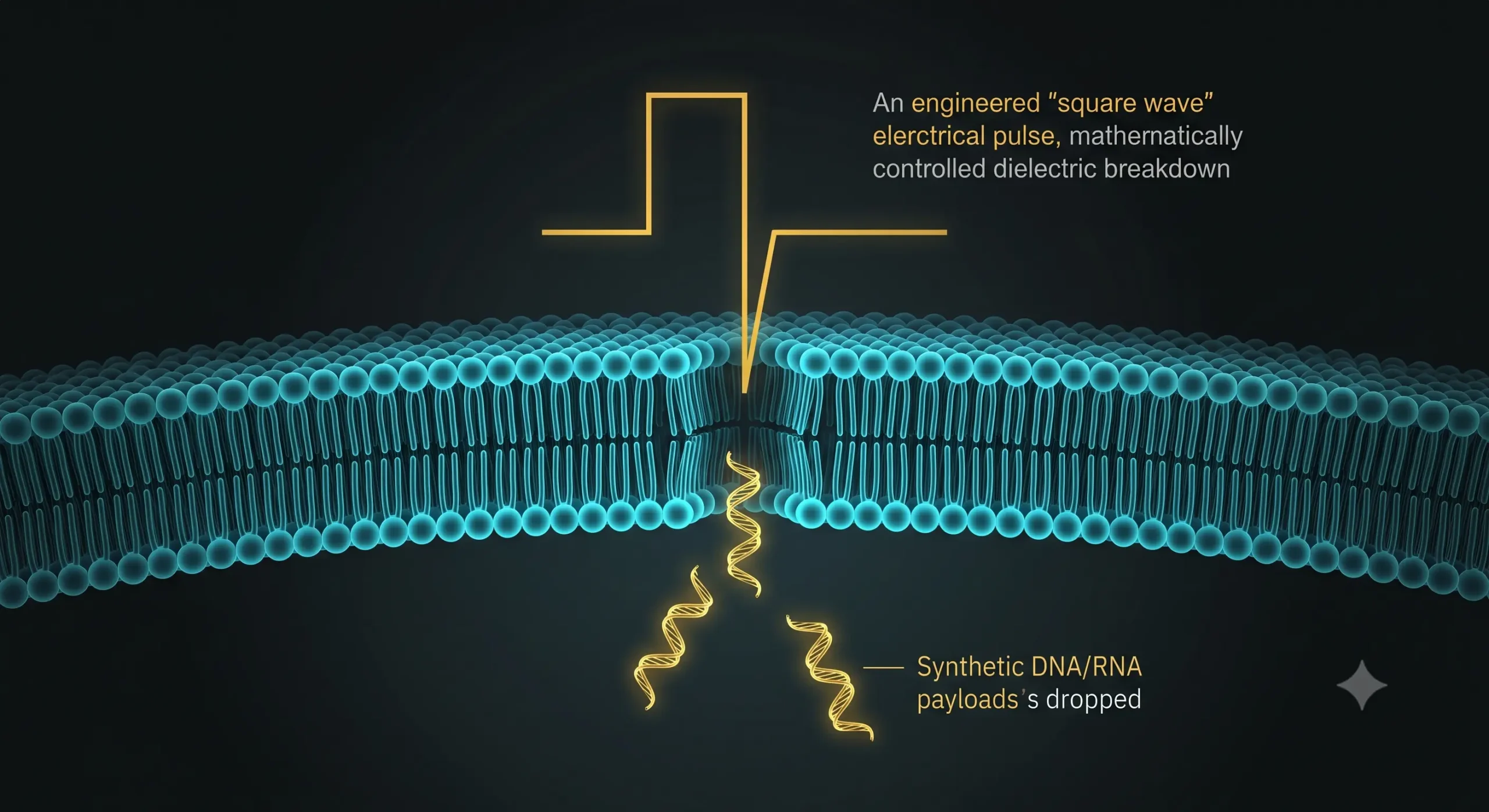
Electroporation accomplishes this through physical dielectric breakdown. A specialized waveform generator applies a high-voltage electrical field across a suspended cell culture. This external field alters the induced transmembrane voltage across the cell, governed by the Schwan equation:
$$\Delta V_m = 1.5 E r \cos \theta$$
Where ΔV_m is the induced transmembrane voltage, E is the applied electric field strength, r is the cell radius, and θ (theta) is the polar angle relative to the field.
When this induced voltage exceeds a strict biological threshold—typically around one volt—the lipid bilayer physically tears. These temporary microscopic pores remain open just long enough for surrounding genetic payloads to diffuse into the cell.
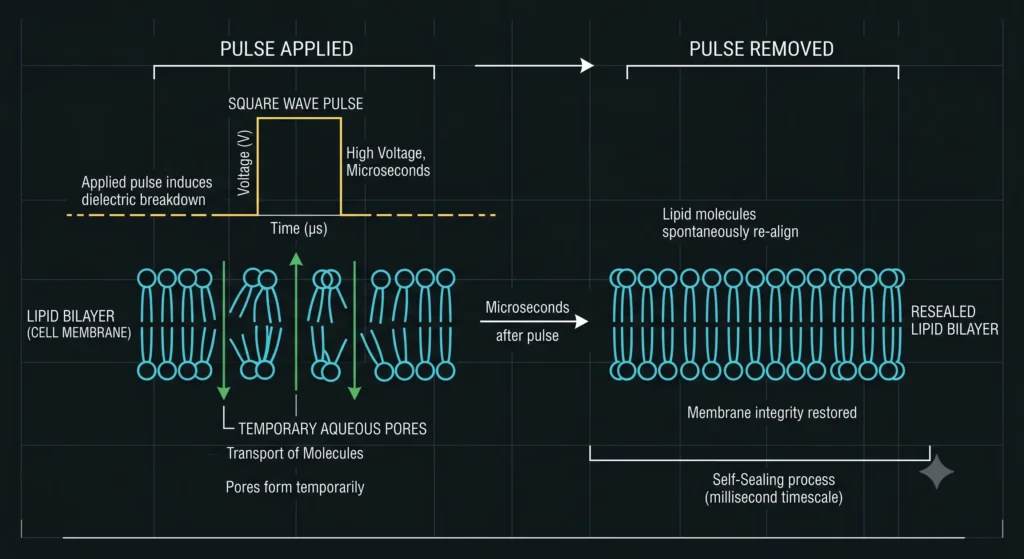
The generator must execute this violence with extreme mathematical precision. If the electrical pulse lasts too long, the energy converts into Joule heating, physically boiling the cell from the inside out. To prevent this, advanced systems use solid-state capacitors to deliver square wave pulses. These pulses instantly ramp to maximum voltage, hold for exact microseconds, and drop to zero, optimizing target entry while ensuring the cellular membrane can naturally heal itself.
WHY IT MATTERS NOW
The pharmaceutical industry is aggressively scaling personalized cell therapies, such as CAR-T treatments for oncology. Manufacturing these living drugs requires extracting a patient’s immune cells, genetically altering them to hunt cancer, and multiplying them in a bioreactor.
Historically, manufacturers relied on lentiviral vectors to insert this new genetic code. Viruses are highly effective at penetrating cells, but breeding them requires massive, dedicated biomanufacturing facilities. This viral bottleneck delays patient treatments by months and drives the production cost of a single therapy dose past half a million dollars.
Clinical-grade electroporation severs this reliance on viral manufacturing. Waveform generators manufactured by companies like MaxCyte and Thermo Fisher allow laboratories to process billions of cells in minutes using pure electricity. This mechanical approach reduces genetic engineering from a massive facility-level operation down to a highly concentrated benchtop physics problem.
The United States Food and Drug Administration heavily scrutinizes these manufacturing workflows. Every time an electrical pulse kills a percentage of the patient’s harvested cells, the total yield drops. If the viability rate falls too low, the manufacturer mathematically fails to produce enough altered cells to constitute a legal, clinical-grade therapeutic dose.
WHAT MOST PEOPLE MISS
Scientific literature frequently treats electroporation as a simple commodity tool, focusing entirely on the downstream clinical success of the edited cells. Analysts assume that pushing a hardware button automatically yields a perfectly edited cellular batch.
They miss the severe biophysical trade-off between transfection efficiency and cellular survival. An aggressive high-voltage pulse guarantees the synthetic DNA enters the cell, but it often shreds the internal organelles, leaving the cell genetically modified but biologically dead. The true industrial moat belongs to the hardware companies that own the proprietary waveform algorithms capable of pushing massive DNA payloads through the membrane while keeping ninety percent of the cells alive.
THE TRAJECTORY
Next 12–36 Months: Clinical manufacturers will transition entirely from exponential decay pulses to microsecond-controlled square waves, utilizing real-time impedance sensors to dynamically adjust the voltage mid-pulse based on individual cellular resistance.
Next Five Years: Continuous flow electroporation will replace static batch processing entirely. High-throughput microfluidic channels will pass billions of cells individually through localized electrical fields, guaranteeing identical voltage exposure across the entire patient sample.
Next Ten Years: Hardware engineers will commercialize nano-electroporation arrays. These physical substrates will apply tiny electrical currents directly to targeted regions of the cell membrane, bypassing the cytoplasm entirely to deliver synthetic genes straight into the nucleus.
What Could Go Wrong: A sudden electrostatic discharge or hardware grounding failure during continuous processing could arc the electrical current. This physical spark would instantly incinerate the entire patient sample, forcing the hospital to completely restart the dangerous cellular extraction process.
Most Likely Outcome: Proprietary electroporation platforms will establish a permanent hardware monopoly over the personalized medicine supply chain. The exact electrical parameters required to transfect primary human cells safely will remain tightly guarded corporate trade secrets, forcing pharmaceutical companies into long-term hardware licensing agreements.
KEY TERMS
- Transfection: The artificial introduction of foreign nucleic acids into a eukaryotic cell to modify its genetic function.
- Lipid Bilayer: The double layer of specialized fat molecules that forms the primary physical boundary of all living human cells.
- Square Wave Pulse: An electrical signal that transitions instantaneously between a steady high voltage and zero, preventing residual heat buildup.
- Viral Vector: A genetically engineered virus used historically to carry synthetic genetic payloads into target cells.
- Joule Heating: The physical process where the passage of an electric current through a conductor produces internal thermal energy.
SOURCES
- U.S. Food and Drug Administration (FDA) — Chemistry, Manufacturing, and Control Information for Human Gene Therapy Investigational New Drug Applications
- Biophysical Journal — Kinetics of Pore Formation and Disappearance in the Cell Membrane During Electroporation
- MaxCyte Inc. — Scalable Electroporation Architecture and Clinical Transfection Yields
- Nature Biomedical Engineering — Microfluidic Electroporation for High-Throughput Intracellular Delivery