Advertisement
)

AT A GLANCE
- Concept: Single-Strand Nicking: The system slices only one side of the DNA ladder to prevent chaotic cellular repair mechanisms.
- Concept: Primer Binding Site: A specific sequence physically docks with the severed DNA to initiate the writing process.
- Concept: Reverse Transcription: An attached enzyme reads the engineered RNA template and synthesizes new DNA directly into the genome.
- Concept: Structural Optimization: The exact length of the RNA template dictates the thermodynamic success rate of the edit.
HOW IT WORKS
Traditional CRISPR-Cas9 operates as molecular scissors. It physically severs both strands of the DNA double helix. This violent double-strand break triggers a state of panic within the cell, forcing it to glue the severed ends back together rapidly. This chaotic repair process frequently inserts or deletes random base pairs, effectively destroying the gene rather than fixing it.
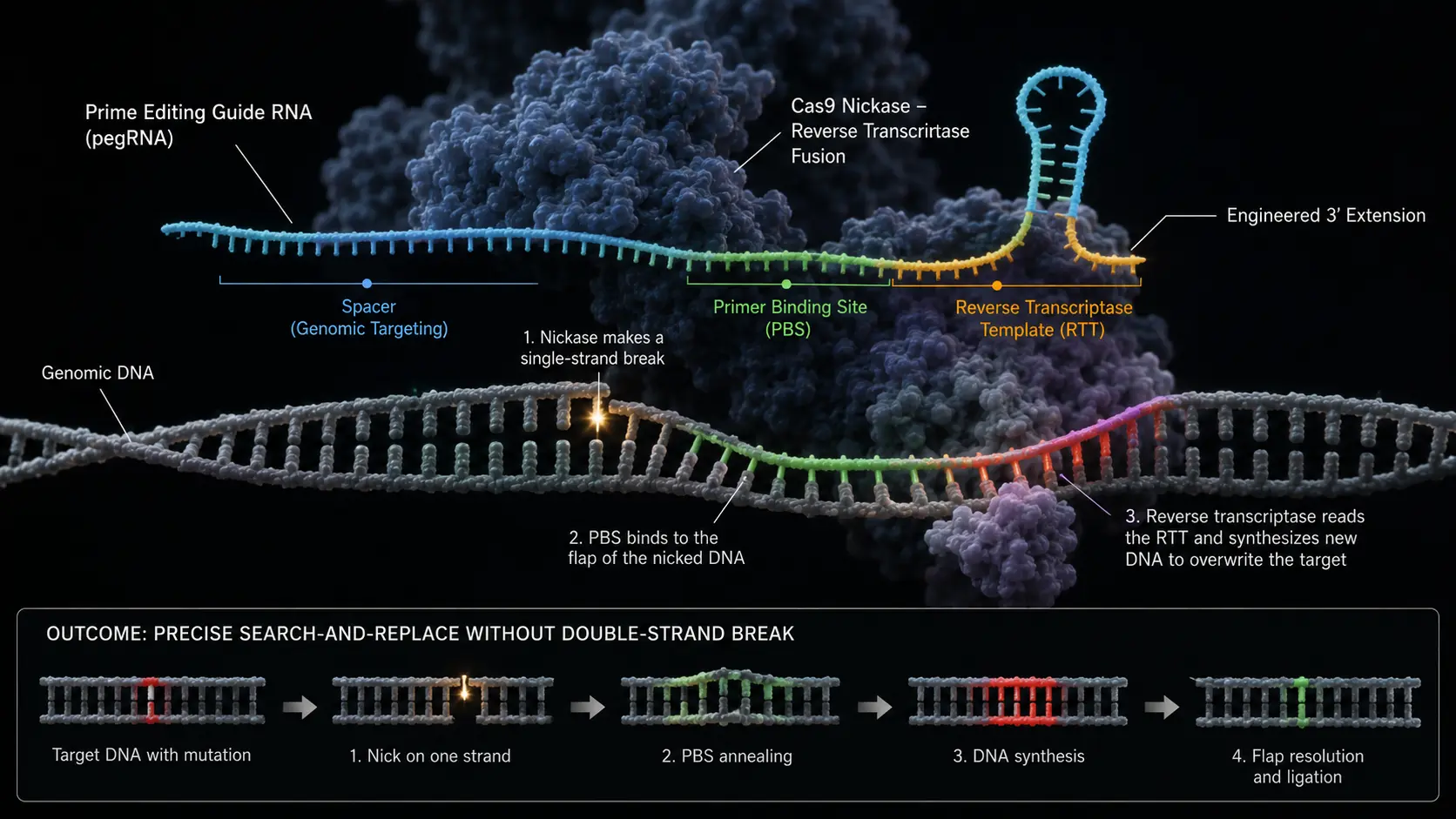
Prime editing avoids this destruction entirely. The system utilizes a modified fusion protein combining a Cas9 nickase and a reverse transcriptase enzyme. Instead of cutting the entire helix, the nickase carefully slices exactly one strand of the DNA.
The precision of this operation relies entirely on the prime editing guide RNA (pegRNA). This highly complex molecule contains a standard targeting sequence to locate the mutation, but it also features a highly engineered physical extension at its 3′ end. This extension houses two distinct components: the primer binding site (PBS) and the reverse transcriptase template (RTT).
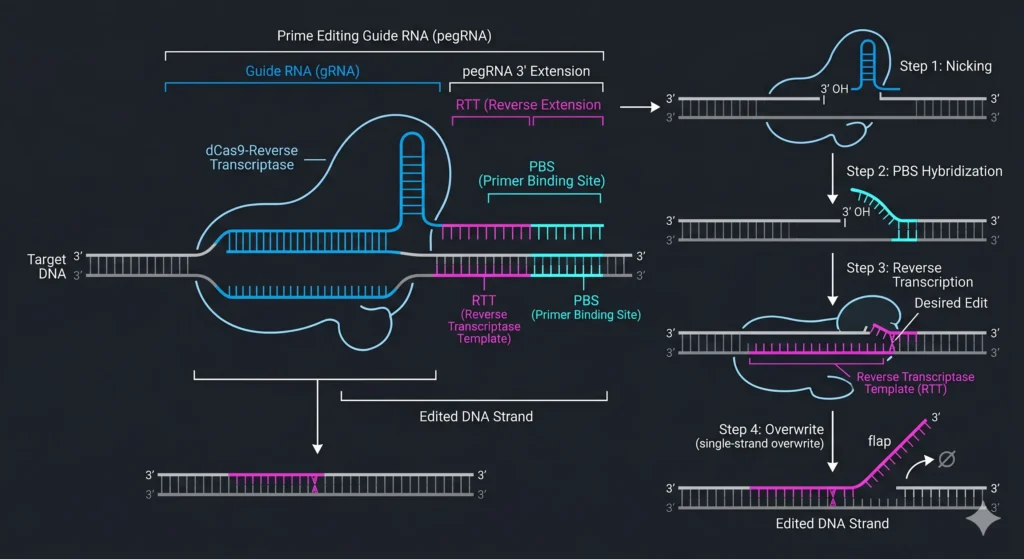
When the nickase slices the target DNA strand, the severed edge physically flips outward. The primer binding site on the pegRNA chemically docks with this exposed DNA flap. Once docked, the reverse transcriptase enzyme activates. It reads the adjacent RTT sequence on the guide RNA and synthesizes the corresponding new DNA sequence directly onto the severed genomic strand.
The stability of this temporary docking phase is strictly governed by the thermodynamics of RNA-DNA hybridization. The physical success of the edit depends entirely on the Gibbs free energy (ΔG) of the structure. If the ΔG of the secondary folding state is too negative, the pegRNA binds to itself rather than the target DNA, instantly terminating the synthetic editing process.
WHY IT MATTERS NOW
The regulatory approval of initial CRISPR therapies proved that editing human DNA is clinically viable. However, those legacy therapies rely on gene disruption. They break dysfunctional genes to treat diseases like sickle cell anemia. They cannot safely repair precise point mutations without causing dangerous chromosomal translocations.
Prime editing transitions biotechnology from a blunt instrument into a molecular word processor. It executes exact search-and-replace mechanics. Over eighty-five percent of known pathogenic human genetic variants exist as simple point mutations or minor insertions and deletions. Prime editing possesses the theoretical physical architecture to correct all of them.
Corporations like Prime Medicine are aggressively building industrial pipelines to commercialize this technology. The financial implications rewrite pharmaceutical economics. A single, error-free genetic correction can cure a lifelong chronic metabolic disorder with one intravenous infusion. This permanent correction bypasses the traditional business model of lifetime pharmaceutical management.
The primary limitation blocking this future is no longer theoretical biology; it is structural synthetic manufacturing. Synthesizing these highly complex pegRNAs requires absolute chemical precision. The intellectual property surrounding the exact length, modification, and structural stabilization of these guide molecules dictates the financial hierarchy of the global genomic medicine market.
WHAT MOST PEOPLE MISS
Biomedical reporting frequently assumes that inserting a longer RNA sequence automatically yields a larger DNA correction. They view the pegRNA as a simple digital text file containing unlimited code. They entirely ignore the severe physical geometry of the molecule.
The process suffers from a strict structural paradox involving the primer binding site and the reverse transcriptase template. If engineers extend the RTT to insert a larger gene correction, the extended RNA strand physically folds back on itself due to natural base-pairing affinity. This localized folding creates an impenetrable structural loop that physically blocks the reverse transcriptase enzyme. The molecular engine stalls, the edit fails, and the cell deletes the target sequence completely. Optimizing this exact nucleotide length balance remains the primary barrier preventing rapid clinical scale-up.
THE TRAJECTORY
Next 12–36 Months: Bioengineers will aggressively deploy dual-pegRNA systems in preclinical trials. By firing two opposing guide RNAs simultaneously at the same genomic locus, researchers will successfully insert entire massive gene cassettes, advancing beyond simple single base-pair edits.
Next Five Years: Deep learning algorithms will completely automate pegRNA design. Neural networks will accurately predict RNA folding thermodynamics across billions of variations, generating the exact optimal PBS and RTT lengths instantly and bypassing expensive laboratory trial and error.
Next Ten Years: In vivo prime editing will become the default clinical standard for monogenic diseases. Hospitals will inject localized lipid nanoparticles carrying optimized pegRNA directly into the patient’s bloodstream to execute permanent, non-destructive genomic corrections within specific targeted organ tissues.
What Could Go Wrong: If the reverse transcriptase enzyme chemically stutters and reads past the engineered template, it will synthesize random molecular noise directly into the patient’s genome. This unprogrammed genetic insertion could inadvertently activate an adjacent oncogene, triggering aggressive, untreatable cellular malignancy.
Most Likely Outcome: Prime editing will permanently replace traditional CRISPR-Cas9 for all therapeutic correction applications. The absolute physical necessity of executing precision genomic insertions without severing the DNA double helix will force the entire biopharmaceutical industry to rebuild its genetic engineering architectures.
KEY TERMS
- Prime Editing Guide RNA (pegRNA): An engineered synthetic RNA molecule containing both the genomic targeting sequence and the desired genetic edit instructions.
- Reverse Transcriptase: A specialized biological enzyme that reads an RNA template and synthesizes a corresponding physical strand of DNA.
- Nickase: A modified CRISPR enzyme designed to cut exactly one strand of the DNA double helix, actively preventing destructive cellular panic responses.
- Primer Binding Site (PBS): The specific sequence on the pegRNA that physically docks with the severed DNA strand to initiate the synthetic writing process.
- Reverse Transcriptase Template (RTT): The exact engineered RNA sequence that dictates the new genetic code to be written into the target genome.
SOURCES
- Nature — Search-and-Replace Genome Editing Without Double-Strand Breaks or Donor DNA
- Cell — Optimization of Prime Editing Guide RNAs for Mammalian Cells
- U.S. Food and Drug Administration (FDA) — Human Gene Therapy for Rare Diseases Guidelines
- Prime Medicine — Prime Editing Platform Architecture and Preclinical Transduction Metrics