Advertisement
)

AT A GLANCE
- Concept: Change in Velocity (Delta-v): Spacecraft do not use fuel to maintain speed; they only burn fuel to accelerate or decelerate to change orbits.
- Concept: The Tsiolkovsky Equation: The fundamental physics formula proving that adding more fuel makes a rocket exponentially heavier and harder to move.
- Concept: Hohmann Transfer: An elliptical trajectory that uses the absolute minimum amount of propellant to travel between two circular orbits.
- Concept: Payload Penalty: Every kilogram of fuel required to reach a higher orbit directly subtracts from the allowable weight of the satellite’s sensors.
HOW IT WORKS
Reaching orbit is not a matter of flying upward; it is a matter of flying sideways fast enough that the curvature of the Earth falls away before the spacecraft hits the ground. Once in the vacuum of space, aerodynamic drag disappears. According to Newtonian physics, a satellite will maintain its velocity forever without burning a single drop of fuel. Propellant is only required when the satellite needs to change its orbit.
This requirement is measured in Delta-v (Δv), meaning “change in velocity.” Placing a surveillance satellite into Geostationary Earth Orbit (GEO)—an altitude of 35,786 kilometers where the satellite matches the Earth’s rotation and stares constantly at one geographic region—requires a massive Delta-v budget.
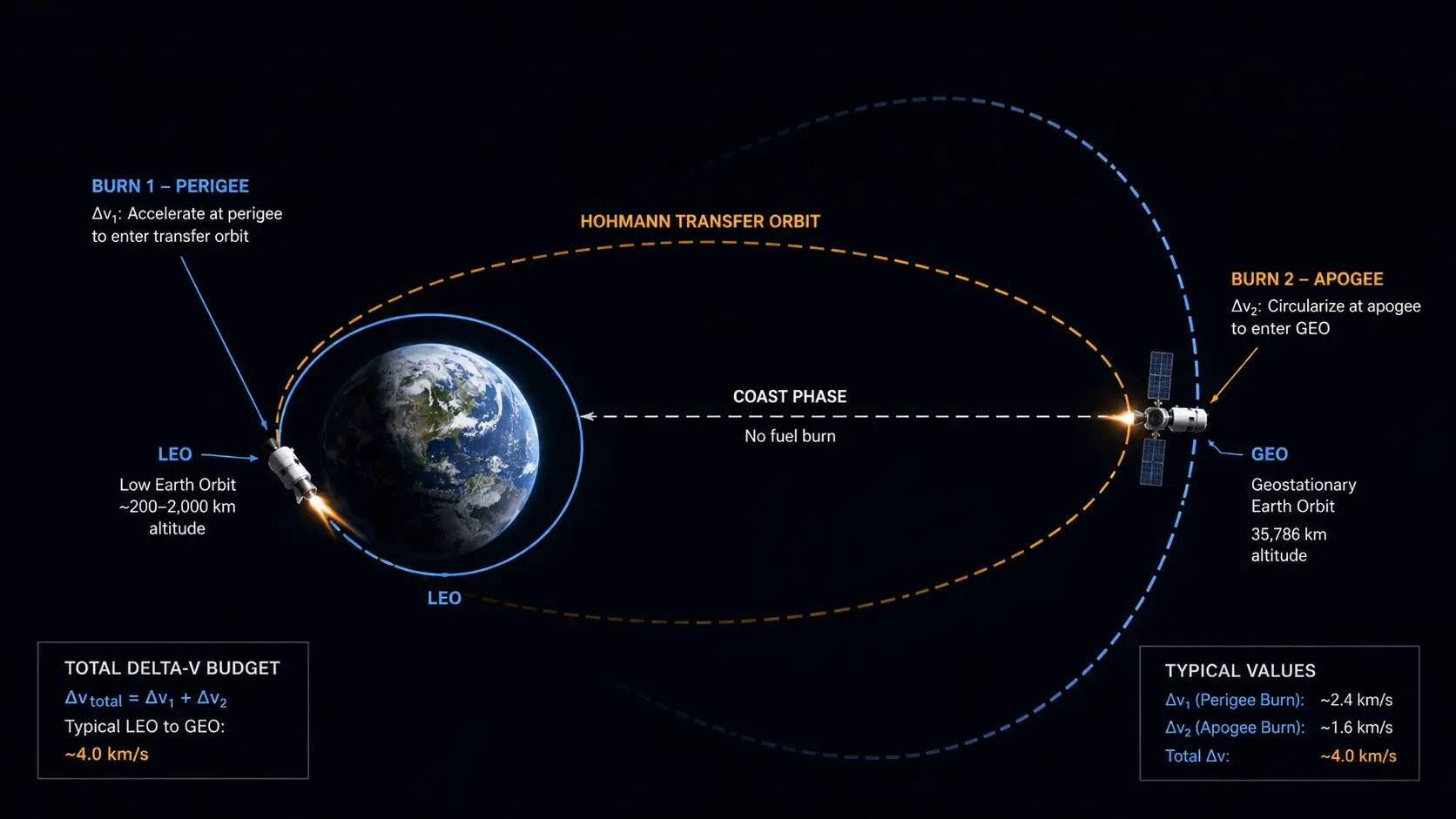
A rocket first launches into a low parking orbit (LEO). To reach GEO, the upper stage executes a Hohmann Transfer. This is a two-burn maneuver. The first burn (Δv₁) occurs at the lowest point (perigee), accelerating the spacecraft into an elliptical transfer orbit that reaches out to the target altitude. The spacecraft coasts for several hours without burning fuel. Once it reaches the highest point (apogee), it executes a second burn (Δv₂) to circularize the orbit.
The total required Delta-v is the sum of these two burns. The physics governing how much fuel is required to achieve this Δv is dictated by the Tsiolkovsky rocket equation:
$$\Delta v = v_e \ln \frac{m_0}{m_f}$$
Where v_e is the exhaust velocity of the engine (Specific Impulse), m₀ is the initial mass of the fully fueled rocket, and m_f is the final dry mass. The natural logarithm (ln) is the brutal tyrant of aerospace engineering. It dictates that to double the Delta-v, a rocket requires exponentially more propellant. Because the rocket must carry the fuel it intends to burn later, the vehicle spends the vast majority of its energy simply lifting its own unburnt fuel.
WHY IT MATTERS NOW
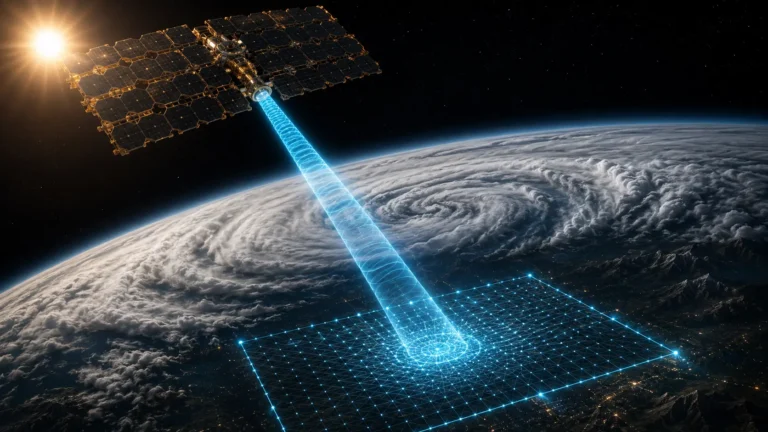
Space is the ultimate high ground for modern geopolitical competition. A military satellite in LEO circles the Earth every 90 minutes, providing only brief, intermittent snapshots of a target. A satellite in GEO stares at the exact same continent continuously, providing persistent, uninterrupted early warning of ballistic missile launches and continuous encrypted communications for deployed troops.
The Delta-v budget strictly limits who can access this high ground. Reaching LEO requires roughly 9.5 km/s of Delta-v. Pushing a heavy payload from LEO all the way to GEO requires an additional 4.0 km/s.
Because of the exponential tyranny of the rocket equation, finding that extra 4.0 km/s requires massive upper-stage launch vehicles with extremely high Specific Impulse (efficiency), such as the liquid hydrogen-fueled Centaur upper stage used by United Launch Alliance (ULA). A nation might possess the engineering capability to build a brilliant spy satellite and a basic rocket to reach LEO, but if they cannot mathematically balance the Delta-v budget for a Hohmann transfer, their satellite cannot physically reach GEO.
This mathematical constraint dictates payload economics. If an intelligence agency wants to add a heavier, higher-resolution optical lens to a satellite, they increase the final dry mass (m_f). To maintain the required Delta-v to reach GEO, they must exponentially increase the fuel (m₀). If the fuel required exceeds the physical volume of the rocket fairing, the mission is physically impossible. Therefore, aerospace engineers spend billions of dollars shaving mere ounces off satellite chassis to buy back Delta-v margin for critical surveillance sensors.
WHAT MOST PEOPLE MISS
Launch broadcasts focus heavily on the fiery liftoff and the booster returning to land. They completely miss the reality that the most complex orbital mechanics occur in absolute silence, hours later, thousands of miles away from Earth.
Furthermore, the public assumes that once a satellite reaches GEO, it stays there forever without effort. They miss the requirement for “station-keeping.” The gravitational pull of the Moon and the Sun constantly tugs the satellite out of its perfect geostationary slot. To counteract this, the satellite must carry onboard thrusters and a dedicated reserve Delta-v budget (roughly 50 meters per second, per year). The physical lifespan of a billion-dollar military asset is not dictated by the degradation of its electronics; it dies the exact moment its onboard propellant tanks run dry, rendering it unable to execute the Delta-v required to maintain its orbit.
THE TRAJECTORY
Next 12–36 Months: The United States Space Force will rapidly expand the deployment of maneuverable satellite constellations. Traditional satellites are sitting ducks. Next-generation military payloads will allocate massive portions of their internal mass strictly for emergency Delta-v budgets, allowing them to rapidly alter their orbits to dodge physical anti-satellite (ASAT) weapons or interceptors.
Next Five Years: In-space refueling will fundamentally alter the rocket equation. Companies will launch massive propellant depots into low Earth orbit. A satellite will launch completely dry, maximizing its sensor payload, dock with the depot in LEO to fill its tanks, and then execute the Delta-v burn to GEO. This architecture effectively bypasses the exponential launch penalty.
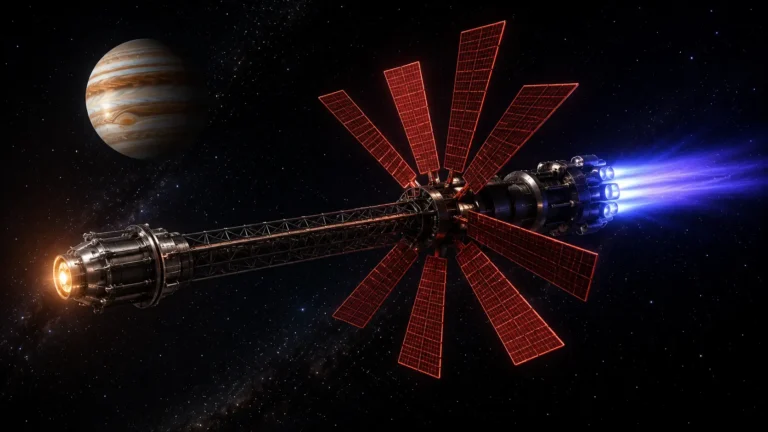
Next Ten Years: The integration of continuous-thrust Hall-effect ion thrusters. Instead of executing short, violent chemical burns (a standard Hohmann transfer), satellites will use solar power to accelerate charged xenon gas for months at a time. This low-thrust spiral trajectory takes significantly longer to reach GEO but requires a fraction of the propellant mass, freeing up thousands of kilograms for heavier, more advanced intelligence payloads.
What Could Go Wrong: The commercialization of LEO is creating a severe debris environment (Kessler Syndrome). To safely navigate through dense clouds of space junk, a satellite must constantly execute avoidance maneuvers. Each maneuver consumes a fraction of its finite Delta-v budget. A highly congested orbit could force a satellite to burn through its ten-year station-keeping budget in a matter of months, ending its operational life prematurely.
Most Likely Outcome: The Delta-v budget will remain the absolute currency of orbital geopolitics. However, the transition from expendable chemical upper stages to highly efficient, refuelable electric propulsion will permanently decouple the size of a military payload from the physical lifting capacity of terrestrial rockets.
KEY TERMS
- Delta-v (Δv): A measure of the impulse required to perform a maneuver that changes a spacecraft’s trajectory, literally “change in velocity.”
- Tsiolkovsky Rocket Equation: The fundamental mathematical principle describing vehicle motion that relies on expelling part of its mass as exhaust to generate thrust.
- Hohmann Transfer: An orbital maneuver that moves a spacecraft between two circular orbits of different altitudes using two engine burns and the lowest possible amount of energy.
- Specific Impulse (I_sp): A measure of how efficiently a rocket engine generates thrust, directly determining how much Delta-v a specific mass of propellant can provide.
- Geostationary Earth Orbit (GEO): A circular orbit 35,786 kilometers above the Earth’s equator where a satellite’s orbital period matches the Earth’s rotation, keeping it stationary over a single point on the ground.
SOURCES
- National Aeronautics and Space Administration (NASA) — Basics of Space Flight: Orbital Mechanics and Delta-v Budgets
- United States Space Force (USSF) — Space Domain Awareness and Geostationary Orbit Operations
- Journal of Guidance, Control, and Dynamics — Optimization of Low-Thrust Orbital Transfers vs Impulsive Hohmann Trajectories
- United Launch Alliance (ULA) — Centaur Upper Stage Capabilities and Geosynchronous Insertion Profiles