Advertisement
)

AT A GLANCE
- Concept: The Radar Horizon: A ship’s radar cannot see targets flying low over the ocean beyond the physical curvature of the Earth.
- Concept: Sensor Fusion: CEC does not share verbal reports or map coordinates; it streams the raw, microsecond radar returns from every ship into a single computational pool.
- Concept: Engage On Remote: A destroyer can physically launch a missile at an incoming threat using only the radar targeting data provided by a completely different ship.
- Concept: Electronic Warfare Resilience: By combining data from multiple radars operating on different frequencies, the network mathematically filters out enemy jamming attempts.
HOW THE COOPERATIVE ENGAGEMENT CAPABILITY WORKS
The physical geometry of the Earth strictly dictates naval combat. Because radar waves travel in straight lines, the curvature of the planet creates a blind spot. A destroyer’s radar cannot detect a sea-skimming anti-ship cruise missile until it crosses this physical horizon, usually at a distance of about twenty miles. At supersonic speeds, twenty miles gives the ship less than a minute to detect, track, and intercept the threat.
Historically, naval fleets managed this geometry through voice communication and basic data links (like Link 16). An airborne radar plane (AWACS) would detect a target over the horizon, calculate its coordinates, and transmit a digital icon to the destroyer’s map. However, this icon is simply a report; it is not mathematically precise enough to guide a physical interceptor missile.
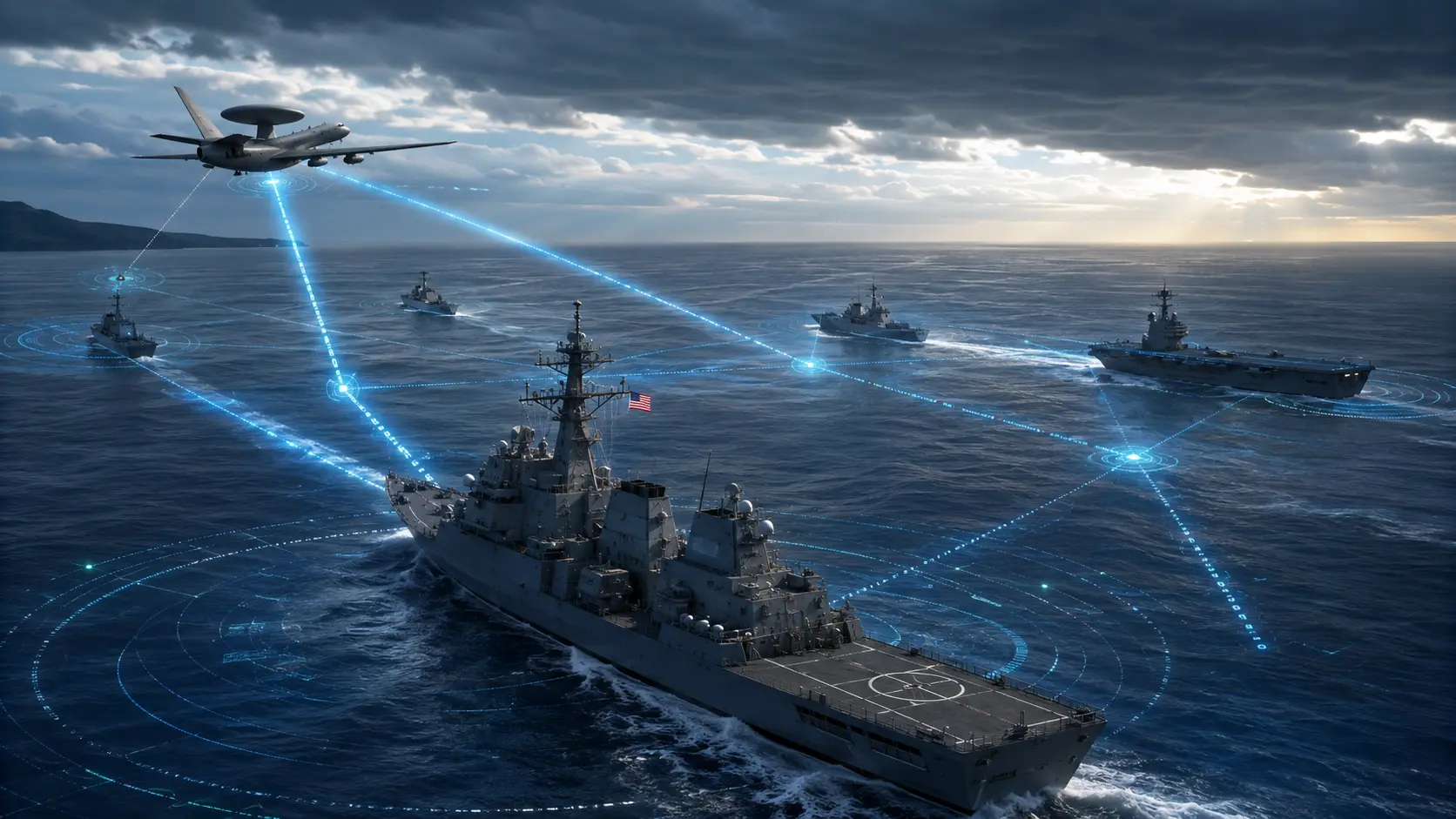
The Cooperative Engagement Capability (CEC) fundamentally alters this architecture. It replaces the transmission of processed tracks with the transmission of raw measurement data. The CEC hardware extracts the unfiltered radar echoes directly from the antennas of every ship and aircraft in the strike group. It transmits this massive volume of raw data across a highly encrypted, directional microwave mesh network.
Each ship’s onboard CEC processor executes a highly complex algorithmic fusion. It takes the raw radar echo from a cruiser, the radar echo from an E-2D Hawkeye aircraft, and its own radar echo, and mathematically welds them together in real time.
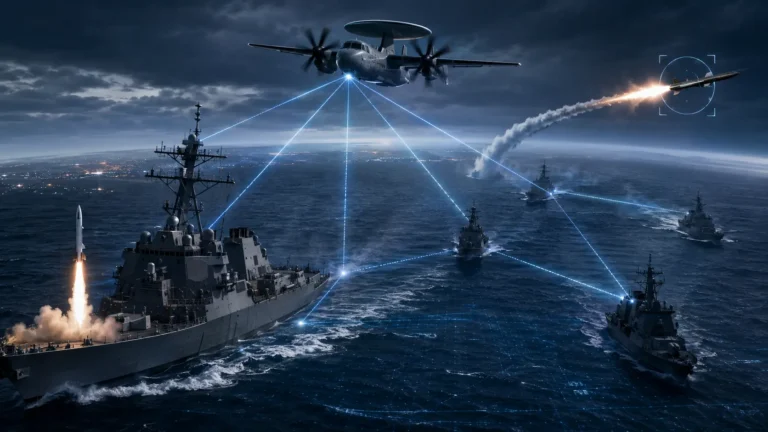
The resulting “composite track” possesses the combined geometric accuracy of all sensors in the network. This composite track is so precise that the Aegis Combat System recognizes it as a native, fire-control quality target. This enables the ultimate mechanic of fleet defense: Engage On Remote. A destroyer can launch a Standard Missile-6 (SM-6) at a target it physically cannot see, entirely guided by the fused radar telemetry provided by other nodes in the network.
WHY IT MATTERS NOW
The proliferation of advanced anti-ship missiles mathematically threatens the survival of the Carrier Strike Group. Nations like China have deployed vast arsenals of supersonic cruise missiles and maneuvering anti-ship ballistic missiles (ASBMs). These weapons compress the timeline of a naval engagement from minutes down to seconds.
If a US Navy destroyer relies solely on its own organic radar to fight, it will be overwhelmed by a synchronized, multi-axis saturation attack. The defensive limit of a single ship is bounded by how quickly its own radar can rotate and process targets. CEC physically breaks this boundary by expanding the sensor aperture of the ship to encompass hundreds of square miles of ocean.
This capability dictates modern naval deployment strategy. By networking sensors, a strike group can disperse its ships over a much wider geographic area. Instead of clustering tightly around an aircraft carrier for mutual defense, destroyers can operate independently, projecting localized air defense umbrellas that overlap via the CEC mesh.
This architecture serves as the operational prerequisite for the Navy’s transition to Distributed Maritime Operations (DMO). The Pentagon is aggressively funding unmanned surface vessels (USVs) designed to act as remote sensor nodes. These robotic ships will sail hundreds of miles ahead of the main fleet, extending the CEC radar network deep into contested territory, completely blinding adversarial anti-access/area denial (A2/AD) strategies without risking human sailors.
WHAT MOST PEOPLE MISS
Defense commentators frequently view CEC purely as an offensive targeting upgrade. They entirely miss its structural role as the ultimate countermeasure against advanced electronic warfare.
Adversarial jamming works by overwhelming a specific ship’s radar receiver with massive amounts of electromagnetic noise on a targeted frequency. In a pre-CEC environment, the blinded ship becomes defenseless.
Within a CEC network, jamming a single ship is tactically useless. The targeted ship’s Aegis system simply ignores its own jammed radar and continues fighting using the pristine targeting data provided by a sister ship positioned thirty miles away operating on a different frequency. Furthermore, the CEC algorithms can mathematically triangulate the exact location of the jammer by analyzing the geometric differences in the noise received across multiple fleet sensors, instantly turning the adversary’s electronic attack into a lethal targeting beacon.
THE TRAJECTORY
Next 12–36 Months: Full integration of the F-35 Lightning II into the CEC architecture via the Naval Integrated Fire Control-Counter Air (NIFC-CA) protocol. The stealth fighter will act as an invisible, high-altitude sensor node, penetrating deep into hostile airspace to stream targeting data back to the surface fleet without revealing its own position.
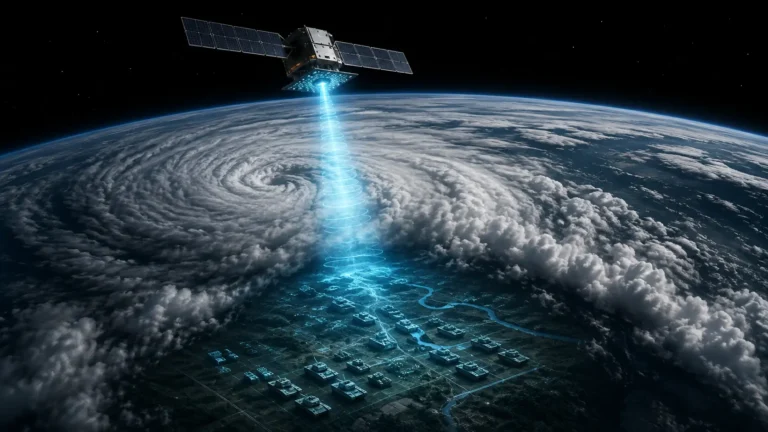
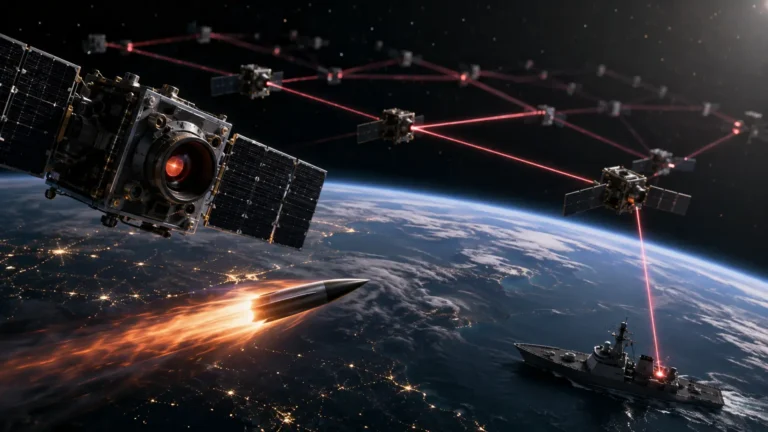
Next Five Years: The transition from line-of-sight microwave networks to low-latency satellite mesh networks. Currently, CEC nodes must be relatively close to each other to maintain the microwave data link. By routing the raw sensor data through proliferated Low Earth Orbit (LEO) satellite constellations, the Navy will connect strike groups operating in completely different oceans into a single, global fire-control network.
Next Ten Years: Algorithmic autonomous engagement. As the volume of incoming supersonic targets exceeds human cognitive limits, the CEC network will utilize onboard machine learning to not only fuse the radar data but to autonomously assign targets and launch interceptors from the optimal ship in the fleet, executing fleet-wide defense in milliseconds without human authorization.
What Could Go Wrong: The CEC microwave network requires a massive, continuous exchange of high-bandwidth data. If a sophisticated adversary executes a synchronized, multi-spectral electromagnetic pulse (EMP) or deploys advanced broadband jamming drones specifically designed to sever the inter-ship data links, the fleet will instantly fracture back into isolated, highly vulnerable individual ships.
Most Likely Outcome: Cooperative Engagement Capability will become the absolute baseline architecture for all Western allied naval forces. The strategic value of a warship will no longer be determined by the size of its missiles, but entirely by its ability to seamlessly ingest and contribute to the distributed, multi-domain sensor mesh.
KEY TERMS
- Cooperative Engagement Capability (CEC): A real-time sensor fusion network that allows multiple naval vessels and aircraft to share raw radar data and fight as a single distributed system.
- Sensor Fusion: The mathematical integration of data from multiple independent sensors to create a single, highly accurate situational picture that reduces uncertainty.
- Aegis Combat System: The centralized, automated command and control weapons system used by the US Navy to track and destroy incoming aerial threats.
- Engage On Remote (EoR): A tactical capability where a ship launches a weapon at a target using strictly the fire-control data provided by a remote sensor on another platform.
- Radar Horizon: The geographic limit of a ship’s radar detection capability, caused by the physical curvature of the Earth blocking straight-line radio waves.
SOURCES
- Department of the Navy (DoN) — Naval Integrated Fire Control-Counter Air (NIFC-CA) Architecture
- Congressional Research Service (CRS) — Navy Aegis Ballistic Missile Defense (BMD) Program: Background and Issues
- Johns Hopkins University Applied Physics Laboratory (JHU/APL) — The Evolution of the Cooperative Engagement Capability
- Lockheed Martin — Aegis Combat System Baseline Upgrades and Distributed Maritime Operations