Advertisement
)

AT A GLANCE
- Concept: API Telemetry: Software continuously pings thousands of home inverters to monitor real-time battery capacity and voltage.
- Concept: Algorithmic Pooling: The aggregator mathematically binds scattered kilowatts into a single dispatchable, megawatt-class virtual generator.
- Concept: Frequency Response: The system automatically injects or absorbs power within milliseconds to stabilize alternating current sine waves.
- Concept: Degradation Arbitrage: High-frequency market participation violently accelerates the chemical wear on physical lithium-ion cells.
HOW A VIRTUAL POWER PLANT WORKS
Grid operators balance electricity supply and demand at an exact frequency of 60 hertz. A sudden drop in supply, like a failing transmission line or a collapsing cloud cover over a solar farm, causes this frequency to dip, physically threatening systemic blackouts.
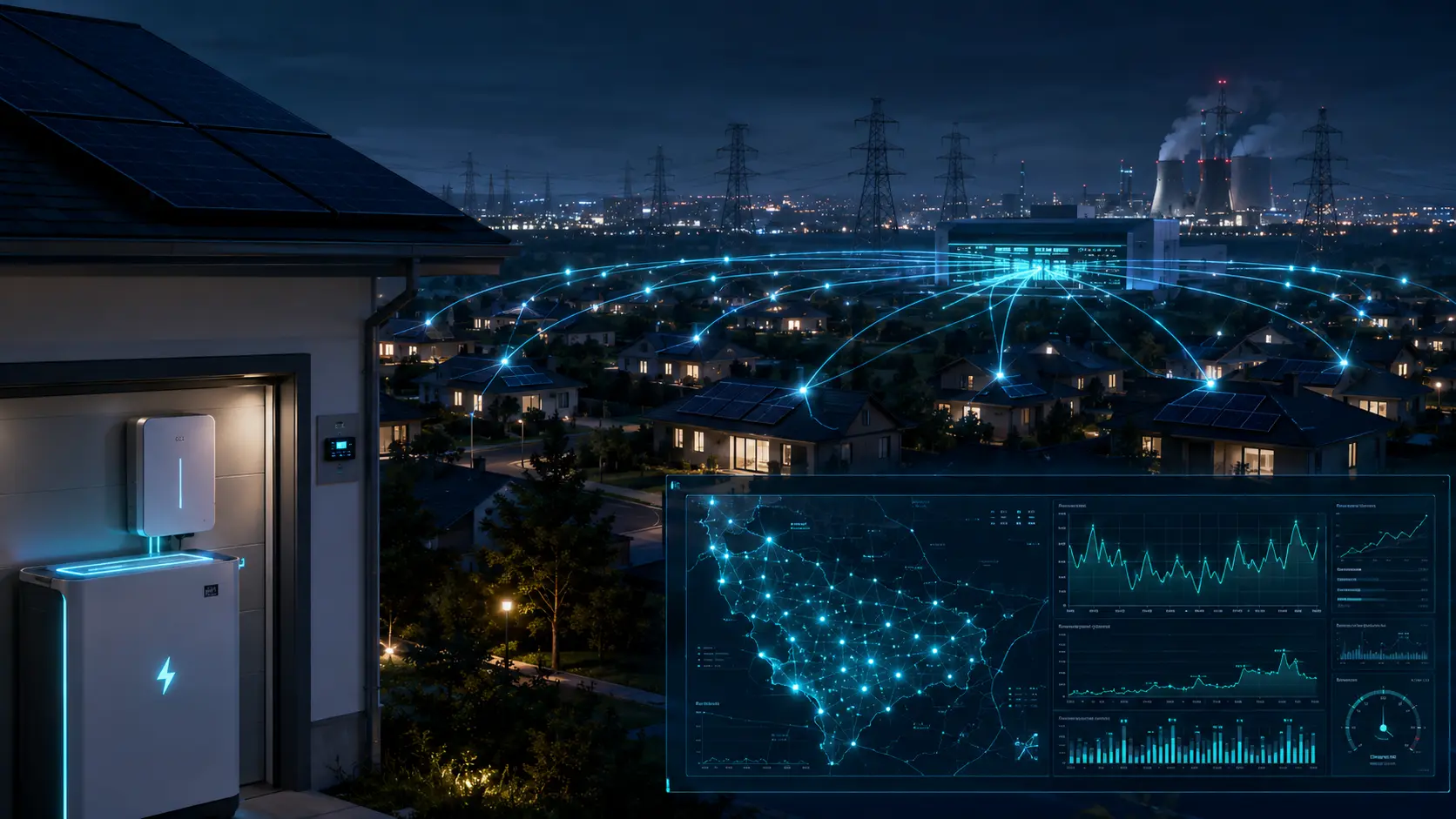
Virtual Power Plants (VPPs) solve this mechanical vulnerability by mathematically pooling distributed energy resources (DERs). A central Distributed Energy Resource Management System (DERMS) establishes persistent, encrypted API connections with thousands of residential and commercial solar batteries across a specific geographic footprint.
The software executes a continuous telemetry ingestion loop. Every few milliseconds, the DERMS polls the exact State of Charge (SoC), thermal operating limits, and network latency of every connected physical battery.
When the grid operator signals a frequency deviation, the VPP algorithm calculates the optimal response geometry. It instantly commands specific individual inverters to discharge exact kilowatt micro-bursts, aggregating these fragmented, tiny outputs into a massive, unified frequency correction that stabilizes the regional grid instantly.
WHY IT MATTERS NOW
Wholesale electricity markets previously excluded residential assets entirely. The Federal Energy Regulatory Commission (FERC) Order 2222 legally dismantled this barrier, mandating regional grid operators to allow aggregated distributed resources to compete directly against massive thermal power plants.
This policy shift instantly monetized the latent capacity sitting idle inside residential garages. Aggregators capture this financial margin by selling highly lucrative ancillary services, such as spinning reserve and frequency regulation, directly into the wholesale market.
The financial model relies entirely on software-defined latency. To qualify for premium frequency regulation payouts, a VPP must prove it can react to a dispatch signal and inject physical electricity into the grid in under one second.
Companies like Tesla and Sunrun exploit this extreme operational velocity. They command thousands of disparate home batteries to inject power during peak demand price spikes, capturing massive arbitrage spreads while permanently retiring the need to turn on expensive, centralized natural gas peaker plants.
WHAT MOST PEOPLE MISS
Clean-tech marketing frames VPP participation as passive, risk-free income for homeowners. They completely omit the physical chemistry of lithium-ion degradation caused by aggressive frequency response profiles.
Participating in high-frequency wholesale markets requires a battery to execute hundreds of micro-charge and micro-discharge cycles per hour. This violent, continuous thermal cycling heavily degrades the solid-electrolyte interphase (SEI) layer inside the cell, mechanically destroying the multi-year lifespan of a $10,000 residential asset to generate a fraction of that value in grid service payouts for the software aggregator.
THE TRAJECTORY
Next 12–36 Months: Utility commissions will mandate specific degradation compensation structures in VPP contracts. Homeowners will refuse to surrender API control of their hardware without guaranteed warranties explicitly covering the electrochemical wear of high-frequency arbitrage.
Next Five Years: The integration of electric vehicles into bidirectional VPP loops (V2G). The software will target the massive battery packs sitting idle in corporate parking lots, drawing multi-megawatt reserves from automotive fleets without paying to install stationary hardware.
Next Ten Years: Autonomous hardware-level market bidding. Individual home inverters will embed localized machine learning models to bid their own capacity directly onto localized cryptographic ledgers, rendering the centralized third-party software aggregator entirely obsolete.
What Could Go Wrong: API latency collapse. If a regional internet outage or a localized cyberattack delays the VPP’s telemetry polling by just two seconds, the aggregator will fail its strict grid dispatch commitment, incurring massive financial penalties and actively destabilizing the local power grid.
Most Likely Outcome: Virtual power plants will become the absolute dominant mechanism for grid balancing. Software platforms coordinating decentralized chemical storage will permanently outcompete the physical response time of heavy rotating mechanical turbines.
KEY TERMS
- Virtual Power Plant (VPP): A cloud-based network that aggregates the capacities of heterogeneous distributed energy resources to trade on the electricity market.
- State of Charge (SoC): The exact, real-time measurement of the remaining electrical energy stored inside a specific chemical battery cell.
- Frequency Response: An automatic mechanism that rapidly adjusts grid power injection or withdrawal to correct deviations from the standard electrical frequency.
- FERC Order 2222: A federal mandate that forces regional wholesale electricity markets to accommodate aggregations of distributed energy resources.
- Telemetry: The automated, continuous transmission of operational data from remote physical hardware to a centralized receiving system.
SOURCES
- Federal Energy Regulatory Commission (FERC) — Order No. 2222: Participation of Distributed Energy Resource Aggregations in Markets Operated by Regional Transmission Organizations
- Lawrence Berkeley National Laboratory — Telemetry and Control Requirements for Virtual Power Plants in Frequency Regulation
- Department of Energy (DOE) — Pathways to Commercial Liftoff: Virtual Power Plants
- IEEE Transactions on Smart Grid — Degradation-Aware Control of Distributed Battery Energy Storage Systems