Advertisement
)

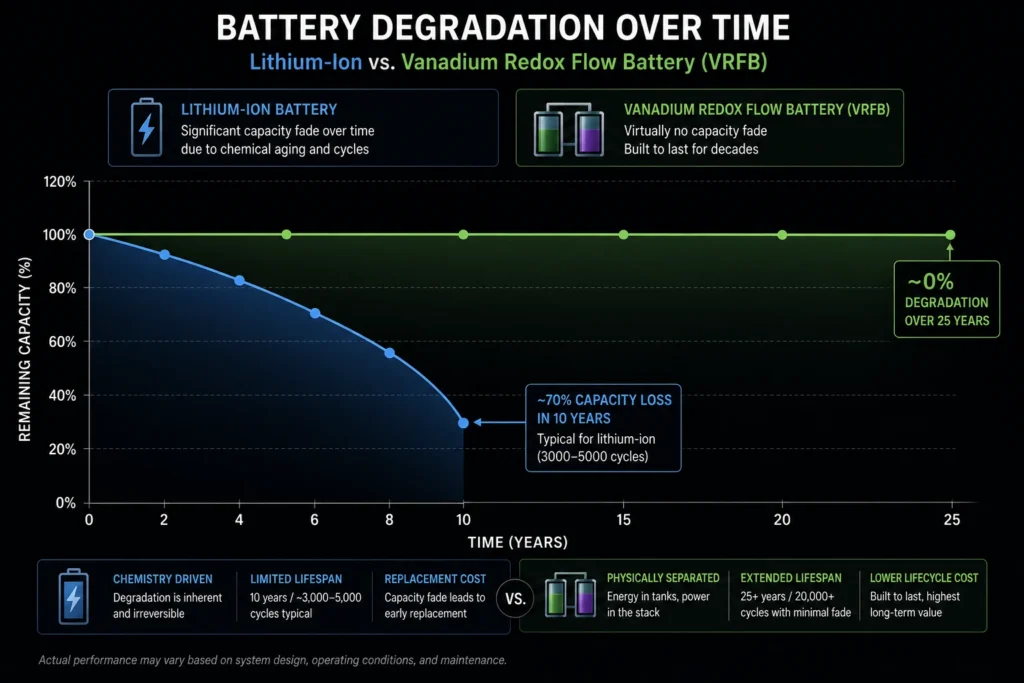
Lithium-ion batteries are the undisputed champions of the smartphone and the electric vehicle, but they harbor a fatal flaw when applied to the global power grid: they die. A standard utility-scale lithium battery degrades slightly every single time it is charged and discharged, typically reaching the end of its useful economic life after 5,000 to 7,000 cycles. When a lithium battery dies, replacing it is a massive capital expense. Furthermore, if you want a lithium battery to store power for 12 hours instead of 4 hours, you have to buy entirely new, highly expensive battery cells.
To solve the intermittency of solar and wind power, utility planners desperately need a battery that never degrades and can store massive amounts of energy cheaply. The solution is the Vanadium Redox Flow Battery (VRFB). Instead of storing energy inside solid metal cells, VRFBs store energy in giant tanks of liquid. Why should you care right now? Because VRFBs fundamentally change the economics of the power grid. They allow utilities to completely separate the power of the battery from its storage capacity, creating a system that can charge and discharge 20,000 times with zero degradation, effectively serving as an infinite, liquid hard drive for renewable energy.
What is a Vanadium Redox Flow Battery (VRFB)?
A Vanadium Redox Flow Battery (VRFB) is a rechargeable flow battery that employs vanadium ions in different oxidation states to store chemical potential energy. It pumps liquid electrolyte from external tanks through a central ion-exchange membrane stack, where the chemical energy is converted into electrical energy without degrading the system’s components.
At a Glance
- Concept: Storing electrical energy in large tanks of liquid chemicals rather than inside solid battery cells. The liquid is pumped through a central chamber to release the power.
- Why it matters: Unlike lithium, the liquid vanadium never degrades. The battery can be drained to zero percent and charged back to 100 percent tens of thousands of times over 25 years with no loss of capacity.
- Who uses it: Utility companies stabilizing solar and wind farms, commercial microgrids, and remote mining operations requiring long-duration (8-to-12-hour) energy storage.
- Biggest takeaway: It perfectly decouples power and energy. If you want more power (Megawatts), you build a bigger central membrane stack. If you want more energy capacity (Megawatt-hours), you don’t buy more batteries—you simply build bigger, cheap plastic tanks and fill them with more liquid.
In Simple Words
A normal battery (like a AA battery or the lithium-ion battery in your phone) stores its energy and delivers its power from the exact same physical place—inside the solid metal casing. Because everything is crammed together, the solid materials slowly break down and degrade every time you use them.
A Vanadium Redox Flow Battery (VRFB) separates the storage from the engine.
Think of it like a car. The engine determines how fast the car can go (Power), and the gas tank determines how far it can go (Energy). If you want to drive further, you don’t buy a second engine; you just install a bigger gas tank.
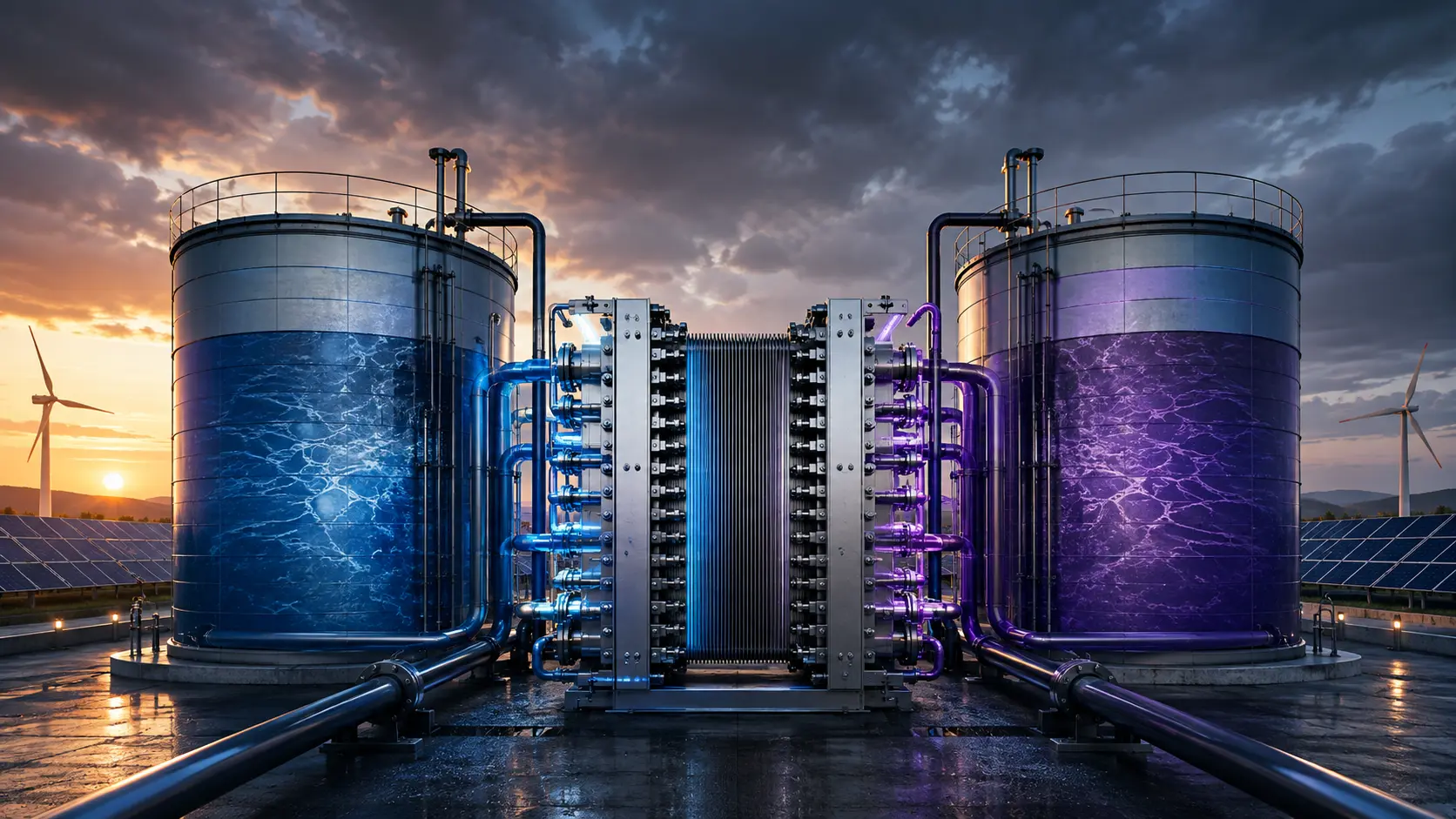
A VRFB works the exact same way. It has a central “engine” (called a cell stack) and two giant exterior tanks filled with a liquid called vanadium electrolyte. To get electricity, pumps push the liquid from the tanks into the central engine, where the two liquids meet across a special membrane to create an electrical charge. Because the energy is stored in the liquid tanks and not inside the engine, the battery never degrades. If the power grid needs the battery to last 24 hours instead of 4 hours, engineers simply build larger tanks.
Why This Matters
The global transition to renewable energy is completely bottlenecked by Long-Duration Energy Storage (LDES).
Solar panels only produce power during the day, but peak power demand occurs in the evening when people return home from work. Lithium-ion batteries are excellent at shifting power for 2 to 4 hours. However, building a lithium-ion facility to store power for 10 or 12 hours is astronomically expensive because you have to buy billions of individual battery cells.
VRFBs solve the 10-hour problem. Because adding capacity only requires adding more liquid vanadium and larger plastic tanks, the marginal cost of adding an extra hour of storage plummets. For utility planners and energy investors, VRFBs represent the missing link for 24/7 renewable baseload power. They offer a highly predictable, 25-year operational lifespan (matching the lifespan of a solar farm itself) without the need for the multi-million-dollar battery replacement cycles required by lithium-ion systems.
The Resurgence of Flow Battery Technology
The flow battery concept was invented by NASA in the 1970s and refined by the University of New South Wales in the 1980s. However, it languished for decades because lithium-ion batteries—driven by massive consumer electronics and EV manufacturing scale—became too cheap to compete against.
Today, the geopolitical and technical limits of lithium have triggered a massive commercial resurgence for VRFBs. Nations are realizing that packing thousands of lithium-ion cells into shipping containers creates severe fire risks (thermal runaway). VRFBs, which are mostly made of water, are physically incapable of catching fire. This safety profile, combined with the strategic imperative to deploy massive amounts of heavy, grid-scale storage, has initiated a surge of commercial VRFB mega-projects across China, Australia, and the United States in the mid-2020s.
How a Vanadium Redox Flow Battery Works
Extracting electricity from a flowing liquid requires a delicate balance of electrochemistry and fluid dynamics. Here is the first-principles breakdown.
1. The Fundamental Problem: Cross-Contamination
Early flow batteries used two completely different chemicals (e.g., iron and chromium) for the positive and negative tanks. Over time, these chemicals would accidentally leak across the central membrane and mix. Once mixed, the battery was permanently poisoned and destroyed.
2. The Insufficiency of Solid Electrodes
Solid batteries use rigid crystal structures to store ions. Expanding and contracting these structures during charge and discharge causes physical micro-fractures, eventually destroying the battery’s ability to hold a charge (degradation).
3. The Core Mechanism: The Four States of Vanadium
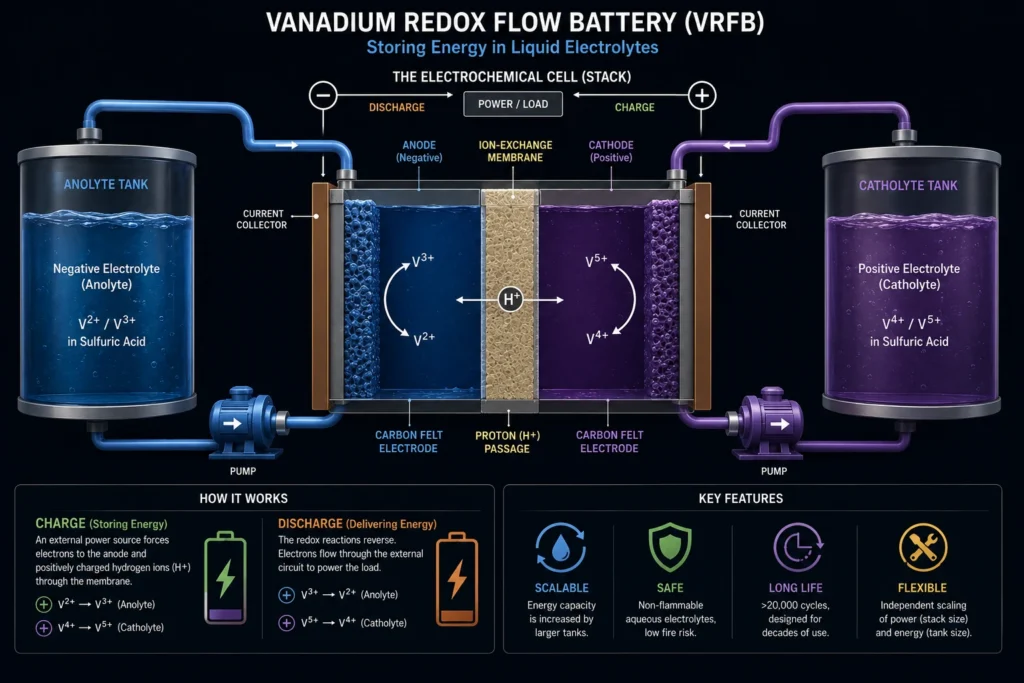
The VRFB solves both problems by using only one element: Vanadium. Vanadium is a unique transition metal because it can exist in four different stable oxidation states in a liquid solution: V²⁺, V³⁺, V⁴⁺, and V⁵⁺.
Because both tanks use the exact same base element, if the liquids accidentally mix across the membrane, the battery is not destroyed. The operator simply applies an electrical current to automatically re-balance the fluids and restore the battery to 100% health.
4. Technical Depth: The Ion-Exchange Membrane Stack
The VRFB system consists of a positive tank (Catholyte: V⁴⁺ and V⁵⁺) and a negative tank (Anolyte: V²⁺ and V³⁺). The liquids are dissolved in a mild sulfuric acid and water solution. Pumps push both liquids into a central chamber, but they are separated by a porous plastic sheet called an ion-exchange membrane. The liquids never physically mix. Instead, as they flow past each other, hydrogen ions ($H^+$) pass through the microscopic pores of the membrane, creating an electrical current that flows out through carbon electrodes to the power grid.
5. Real-World Consequences: Independent Scaling
This architecture completely decouples power and energy.
- Power (Megawatts): If you want to output more electricity at once, you add more surface area to the central membrane stack.
- Energy (Megawatt-hours): If you want the battery to run longer, you don’t touch the stack; you simply build bigger exterior tanks and fill them with more vanadium fluid.
Grid-Scale Battery Storage Applications
The heavy, unmovable nature of VRFBs restricts them to stationary applications, but they excel at the massive scale required by the grid.
The Dalian Mega-Battery (China): The ultimate proof-of-concept for VRFB scalability is the massive Dalian flow battery station in Liaoning Province, China. Connected to the grid in 2022 and scaling up through the mid-2020s, the facility is designed to output 200 MW of power with 800 MWh of capacity. It acts as a massive shock absorber for the regional grid, absorbing excess wind power during off-peak hours and discharging it during peak demand, proving that flow batteries can be engineered to stabilize entire cities.
Microgrids and Island Power: Remote mining operations and island nations heavily rely on expensive, highly polluting diesel generators. Because these locations are remote, replacing degraded lithium-ion batteries every 7 years is logistically crippling. VRFBs are being deployed as the permanent backbone of these microgrids. Once the tanks and stacks are installed, they provide 25 years of uninterrupted solar-shifting without needing heavy maintenance or replacement cells shipped across the ocean.
Commercial and Industrial Peak Shaving: Large factories and data centers are penalized by utilities for high “demand charges”—spikes in electricity usage during the day. By installing a VRFB outside the facility, companies can charge the liquid tanks slowly overnight when power is cheap, and discharge the battery during the day to perfectly flatten their grid pull, saving millions in commercial utility penalties over the battery’s multi-decade lifespan.
Economic & Strategic Impact
The financial model of a VRFB is fundamentally different from a traditional battery due to the concept of Residual Value.
When a lithium-ion battery reaches the end of its 10-year lifespan, it is a liability. The operator must pay specialized recycling firms to safely dispose of the degraded, highly flammable cells.
When a VRFB reaches the end of its 25-year lifespan, the pumps and plastic membranes may need replacing, but the liquid vanadium electrolyte inside the tanks is exactly the same as the day it was poured in. It has not degraded by a single atom.
Because vanadium is a highly valuable, globally traded commodity (primarily used to strengthen steel), the liquid inside a VRFB retains immense residual value. At the end of the project, the utility can literally pump the liquid out of the tanks and sell it back to the commodity market, or lease it to a new battery project. This transforms the vanadium electrolyte from a depreciating capital expense (CapEx) into an appreciating, leasable financial asset, radically altering the Levelized Cost of Storage (LCOS) calculation for institutional investors.
Advantages
- Zero Degradation: Capable of 15,000 to 20,000+ charge cycles. The capacity does not fade over time, ensuring 100% performance on day one and year twenty.
- Decoupled Scaling: To add more hours of storage, you only buy more liquid and plastic tanks, making Long-Duration Energy Storage (LDES) economically viable.
- Absolute Safety: The electrolyte is mostly water and non-flammable. VRFBs cannot catch fire or suffer thermal runaway, making them safe to install in dense urban areas or indoor commercial facilities.
- 100% Depth of Discharge (DoD): Lithium batteries shouldn’t be drained below 10% or charged above 90% without causing damage. A VRFB can be safely drained to absolute zero and held there indefinitely without any damage to the chemistry.
Limitations
- Low Energy Density: Vanadium electrolyte takes up a massive amount of physical space and is incredibly heavy. A VRFB requires a large concrete foundation and a massive physical footprint, making it entirely useless for electric vehicles or mobile applications.
- Lower Round-Trip Efficiency: Lithium-ion batteries boast an excellent round-trip efficiency of ~90-95% (you get out almost all the power you put in). VRFBs suffer from lower efficiency (~70-75%) because physical energy must be spent constantly running the mechanical pumps to push the heavy liquid through the membrane stack.
- High Upfront CapEx: Because the global supply chain for vanadium electrolyte and specialized ion-exchange membranes is not as mature as lithium, the initial upfront cost to build a 4-hour VRFB is significantly higher than a 4-hour lithium system (though it wins heavily on a 25-year timeline).
- Commodity Price Volatility: The cost of the battery is heavily tied to the spot price of Vanadium Pentoxide (V_2O_5). Spikes in global steel demand can drastically inflate the cost of the raw electrolyte.
Common Misconceptions
Misconception: Flow batteries are a new, untested technology.
Reality: The core chemistry was patented in 1986 by Maria Skyllas-Kazacos at the University of New South Wales. It is a highly proven, mature technology. The only reason it isn’t ubiquitous is that it historically lacked the venture capital and manufacturing scale that cell phones and EVs provided to lithium-ion.
Misconception: The acid inside the tanks is highly dangerous.
Reality: The vanadium is dissolved in a sulfuric acid solution, but it is relatively mild (roughly the same concentration as the acid found in a standard lead-acid car battery). While it is a hazardous chemical requiring industrial containment, it does not pose a catastrophic explosive threat.
Misconception: Lithium will eventually beat VRFBs for long-duration storage.
Reality: They serve completely different physics. Lithium-ion is unbeatably light and fast, perfect for cars and 2-hour grid bursts. But buying 12 hours of lithium storage means buying 12 hours worth of expensive metal casings and redundant electronics. VRFBs win mathematically past the 8-hour mark because water and plastic tanks are cheaper than solid metal cells.
What Most People Miss
The emergence of the Electrolyte-as-a-Service (EaaS) leasing model.
The biggest hurdle for VRFB adoption is the massive upfront cost of buying the thousands of gallons of vanadium liquid. To solve this, the financial industry has created an entirely new leasing structure.
What most utility planners miss is that they no longer have to buy the liquid. Because the vanadium never degrades, specialized mining companies and commodity funds will lease the liquid electrolyte to the battery operator. The operator pays a small monthly rental fee to use the liquid. This instantly slashes the upfront Capital Expenditure (CapEx) of building the battery by up to 40 percent, shifting the cost of the liquid to an operating expense (OpEx) and making VRFBs highly competitive against lithium-ion from day one.
Comparison Table
| Feature | Lithium-Ion Battery (LFP) | Vanadium Redox Flow Battery (VRFB) |
| Energy Storage Medium | Solid metal electrodes/cells | Liquid Vanadium Electrolyte in tanks |
| Cycle Life / Degradation | ~5,000 to 7,000 cycles (Degrades) | 15,000+ cycles (Zero degradation) |
| Power/Energy Coupling | Coupled (Buy more cells for both) | Decoupled (Buy tanks for energy, stack for power) |
| Round-Trip Efficiency | High (~90-95%) | Moderate (~70-75% due to pump energy) |
| Safety / Fire Risk | Moderate (Thermal runaway risk) | Zero (Non-flammable liquid) |
| Best Application | EVs, Smartphones, 2-4hr grid storage | Stationary 8-12+ hour massive grid storage |
Case Study
Situation: A massive commercial solar farm in California needed to store energy generated during the sunny midday hours to sell it back to the grid during the highly lucrative 6:00 PM to 10:00 PM evening peak.
Challenge: The utility initially priced out a 100-Megawatt, 10-hour Lithium-ion battery system. However, the financial models collapsed. Running a lithium-ion battery through a full deep-discharge cycle every single day would degrade the cells so aggressively that the entire multi-million dollar battery facility would need to be physically replaced in 8 years, destroying the 20-year ROI of the solar farm.
Solution (The VRFB Pivot): The developers pivoted to a Vanadium Redox Flow Battery. They installed a 100 MW membrane stack and paired it with massive external tanks capable of holding 1,000 MWh of liquid electrolyte. To overcome the high upfront cost of the vanadium, they utilized an Electrolyte-as-a-Service (EaaS) contract, leasing the liquid from a commodity firm.
Outcome: The VRFB allowed the solar farm to deep-cycle the battery to 100% depth of discharge every single day without a fraction of a percent of degradation. By year 10, when the lithium system would have required a catastrophic replacement CapEx, the VRFB continued operating at peak efficiency.
Lessons Learned: The case study proved that for heavy, daily, long-duration cycling, Levelized Cost of Storage (LCOS) is the only metric that matters. While lithium wins on upfront cost, the flow battery’s infinite cycle life and decoupled energy storage make it the undisputed economic winner for true baseload renewable shifting over a multi-decade timeline.
Future Outlook
Next 12–24 Months
The era of Megawatt Commercialization. In 2026 and 2027, the Western supply chain for VRFBs will formalize. Dozens of pilot programs funded by the U.S. Department of Energy and European equivalents will transition into active, commercial 50 MW to 100 MW grid-connected deployments. Utilities will heavily favor VRFBs for specific zoning approvals where local fire departments have aggressively banned massive lithium-ion installations near residential neighborhoods due to thermal runaway fears.
Next 3–5 Years
The optimization of High-Density Electrolytes. While vanadium is brilliant, researchers are aggressively trying to solve its low energy density. By 2028-2030, commercial chemistry tweaks—such as introducing hydrochloric-sulfuric mixed-acid electrolytes—will allow the vanadium liquid to hold significantly more charge and operate at wider temperature ranges without precipitating. This will physically shrink the size of the required tanks by 20 to 30 percent, drastically lowering the concrete and real estate footprint required to build the facilities.
Next 10 Years
The Commoditization of the Flow Stack. By the 2030s, VRFBs will transition from bespoke engineering projects into standard, commoditized infrastructure. The ion-exchange membranes (currently an expensive, specialized material) will be mass-produced at scale, collapsing the cost of the central power stack. VRFBs will become the default “substation in a box” for global utilities, completely replacing natural gas “peaker plants” by providing 12 to 24 hours of dispatchable, zero-carbon power at a fraction of the cost of legacy fossil fuels.
Most Likely Scenario
Lithium-ion will maintain its absolute monopoly over anything that moves (cars, drones, phones) and short-duration 2-hour grid shifting. However, VRFBs will permanently capture the heavy, industrial Long-Duration Energy Storage (LDES) market. As global grids become increasingly saturated with volatile solar and wind, the 25-year, non-degrading reliability of liquid vanadium will become the foundational bedrock of the clean energy transition.
Key Takeaways
- Vanadium Redox Flow Batteries (VRFBs) store energy in large tanks of liquid electrolyte rather than inside solid metal cells, making them immune to physical degradation.
- Because they use the exact same element (Vanadium) in four different oxidation states, the liquids can cross-contaminate without permanently destroying the battery.
- VRFBs decouple power and energy: to get more power, you build a bigger central membrane stack; to get more energy capacity (hours of storage), you simply build bigger liquid tanks.
- While Lithium-ion batteries die after 5,000 to 7,000 cycles and pose severe fire risks, VRFBs can cycle over 15,000 times (lasting 25+ years) and are physically non-flammable.
- At the end of the battery’s 25-year life, the liquid vanadium is still 100% pure and can be sold back to the commodity market, completely changing the financial lifecycle of the asset.
- The primary drawback is a large physical footprint and a lower round-trip efficiency (~75%) compared to lithium, as energy is spent running mechanical pumps to move the heavy liquid.
Glossary
Anolyte and Catholyte: The specific liquid electrolyte solutions stored in the negative (anolyte) and positive (catholyte) tanks of a flow battery.
Depth of Discharge (DoD): The percentage of a battery’s total capacity that has been used. VRFBs can be discharged to 100% DoD safely, whereas doing so damages lithium-ion batteries.
Electrolyte-as-a-Service (EaaS): A financial leasing model where the battery operator rents the expensive vanadium liquid from a commodity firm, drastically lowering the upfront cost of building the battery.
Ion-Exchange Membrane: The critical, semi-permeable plastic sheet inside the central stack that prevents the two liquids from mixing while allowing specific ions (like protons) to pass through to create electricity.
Levelized Cost of Storage (LCOS): The total lifetime cost of building, maintaining, and running a battery storage system divided by the total amount of energy it will discharge over its life. VRFBs excel at LCOS due to their 25-year lifespans.
Oxidation State: The degree of oxidation (loss of electrons) of an atom. Vanadium is unique because it can smoothly transition between V²⁺, V³⁺, V⁴⁺, and V⁵⁺ states to store and release electrical energy.
Frequently Asked Questions
Why don’t we put flow batteries in electric cars?
Flow batteries are incredibly heavy and have very low “energy density” (they require massive amounts of liquid to hold a charge). If you put a flow battery in an EV, the car would be the size of a semi-truck just to travel 300 miles. They are strictly designed for heavy, stationary use on the power grid.
If the liquids mix, is the battery ruined?
No, and this is the magic of using only Vanadium. In older flow batteries that used two different metals, mixing destroyed the chemistry. Because both tanks in a VRFB use vanadium, if they accidentally mix, the operator just applies an electrical current to re-separate the oxidation states, and the battery is perfectly fixed.
Why are they safer than lithium-ion?
Lithium-ion batteries contain highly volatile liquid solvents. If they overheat, they suffer “thermal runaway” and generate their own oxygen, making the fire almost impossible to put out. The electrolyte in a VRFB is mostly water and non-flammable vanadium salts; it physically cannot catch fire.
How much does the liquid cost?
Vanadium is an expensive commodity, typically used to strengthen steel. The cost of the electrolyte makes up roughly 30% to 50% of the upfront cost of the entire battery system, which is why operators are increasingly choosing to lease the liquid rather than buy it outright.
Does a flow battery make noise?
Unlike solid-state lithium batteries which are mostly silent (save for cooling fans), a VRFB has mechanical moving parts. It uses industrial plumbing pumps to constantly push the liquid from the tanks into the central stack, meaning it generates a low, constant mechanical hum while operating.
Sources
[1] U.S. Department of Energy (DOE): Vanadium Redox Flow Batteries: Reliability and Grid Scale Deployment (2025/2026 Analysis)
[2] Pacific Northwest National Laboratory (PNNL): Cost and Performance Metrics of Flow Batteries for Long-Duration Storage
[3] Invinity Energy Systems: The Economics of Vanadium Flow Batteries vs. Lithium-Ion (Whitepaper 2026)
[4] IEEE Power & Energy Magazine: Decoupling Power and Energy: The Role of VRFBs in Microgrids
[5] Clean Energy States Alliance (CESA): Electrolyte-as-a-Service and the Financial Modeling of Flow Batteries